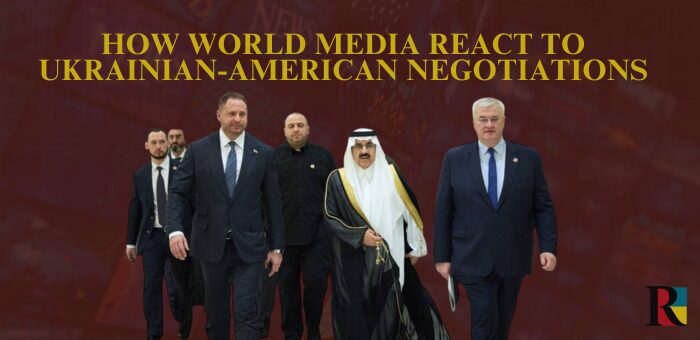


According to Ukraine news, on March 11, 2025, a meeting of delegations of Ukraine and the United States took place in Jeddah, Saudi Arabia. Following the negotiations, the Office of the President published a joint statement that Ukraine was ready to immediately implement a temporary 30-day ceasefire in this war in Ukraine today. It can be extended by mutual consent of Russia and stop the war in Ukraine.
After the meeting, the United States was supposed to convey to the Russian authorities that “reciprocity from Russia is the key to achieving peace” in Ukraine war now. Also after these negotiations, Washington “immediately canceled” the pause in the exchange of intelligence and resumed security assistance to Kyiv.
How the world media reacted to these negotiations between Ukraine and the United States and the possibility to stop the war in Ukraine – The Ukrainian Review analyzes further.
Briefly: American media
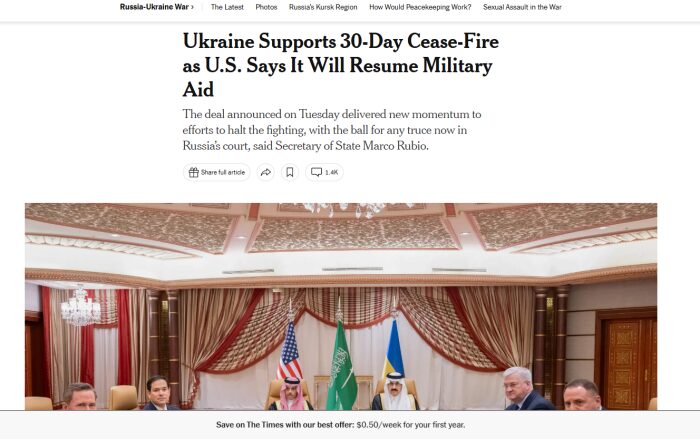
The New York Times wrote only one news item on this topic – “Ukraine supports 30-day ceasefire like the United States. Says it will resume military assistance”.
The news item states that Ukraine supports the 30-day ceasefire proposed by the US, but its implementation depends on Russia’s consent. During the talks in Jeddah, Washington announced the resumption of military aid to Kyiv after its suspension.
US Secretary of State Marco Rubio is quoted as saying that the initiative is now Moscow’s. At the same time, journalists emphasize that Russia did not participate in the talks and has not yet given an official response. And they note that Putin has put forward conditions for ending the war, including excluding Ukraine from NATO membership.
It was possible with the help of Britain: British media
The BBC wrote several publications before and after the meeting.
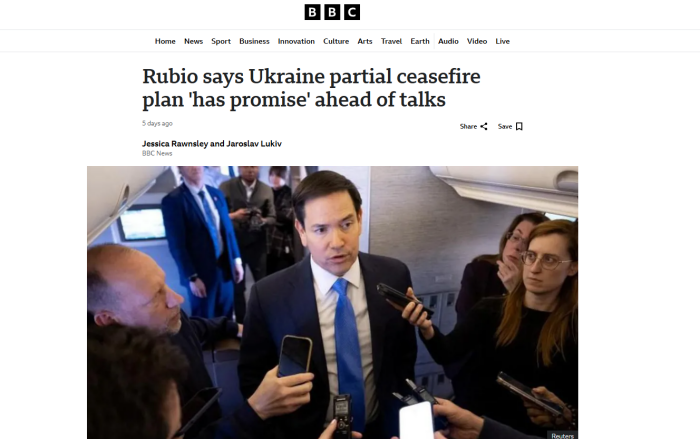
For example, in the news item “Rubio says that the plan for a partial ceasefire in Ukraine was “promised” before the talks,” journalists quote Marco Rubio as saying that Ukraine’s concession in the form of agreeing to a ceasefire would indicate the Ukrainian authorities’ desire to stop the war. At the same time, it is noted that “Russia has previously rejected the idea of a temporary ceasefire, saying it was an attempt to buy time and prevent Ukraine’s military collapse.”
In another publication, “Why Ukraine Hopes Trump’s Minerals Deal Will Return US Support,” the journalists emphasize that “For Kyiv, it is also a chance to improve relations with Washington and join a process in which it has not yet participated.”
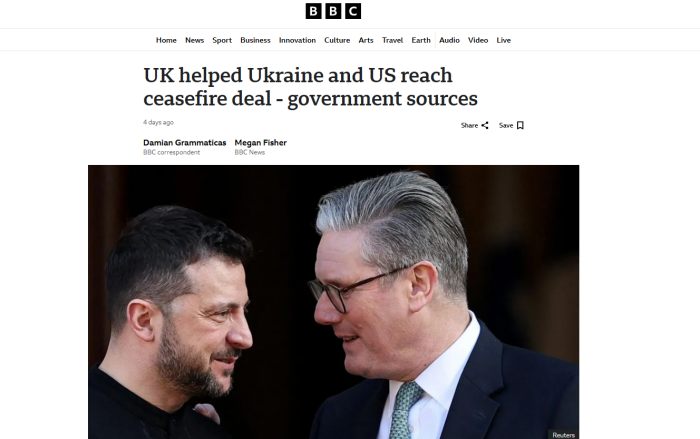
The news item “Great Britain Helped Ukraine and the US Reach Ceasefire Agreement – Government Sources” states that “Great Britain was “closely involved” in helping Ukraine and the US reach an agreement on a proposed ceasefire with Russia”.
In memory of Macron: French media
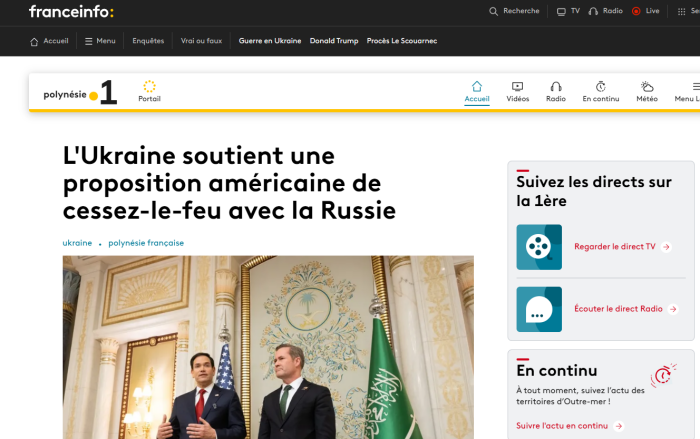
Francetvinfo writes that “Ukraine supported the US proposal for a 30-day ceasefire with Russia, in exchange for which Washington announced an “immediate” lifting of the suspension of aid to Kyiv at a meeting in Saudi Arabia”.
In another publication, “War in Ukraine: What to Remember During Negotiations Between the US and the Ukrainian Delegation in Saudi Arabia,” the journalists write that “One of the challenges for Kyiv was to convince the US to resume military aid and intelligence sharing, interrupted after a quarrel between US President Donald Trump, his Vice President J. D. Vance, and Volodymyr Zelenskyy in the Oval Office, February 28”.
This news also quotes French President Emmanuel Macron, in particular, that he supported US-Ukraine negotiations on a possible 30-day ceasefire and noted that the decision is now up to Russia.
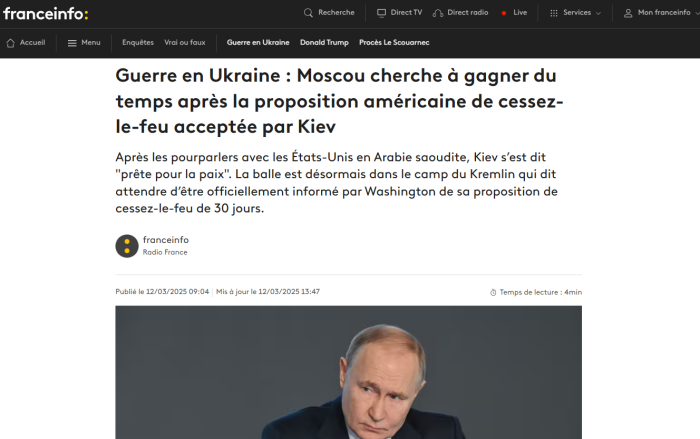
In another news item, “War in Ukraine: Moscow seeks to buy time after US ceasefire proposal accepted by Kyiv,” it is stated that Moscow is not ready for a ceasefire. Journalists note that the Kremlin will not agree to a temporary ceasefire without fulfilling its conditions, such as Ukraine’s withdrawal from NATO, demilitarization, and a change of government in Kyiv. In addition, Russia continues its military offensive in Donbas and other regions, which gives it a certain advantage. The Kremlin believes that a ceasefire will only strengthen Ukraine, allowing it to regroup. Pro-Kremlin media and experts call the US proposal a “trap” and question its sincerity.
Detailed monitoring of negotiations: Chinese media
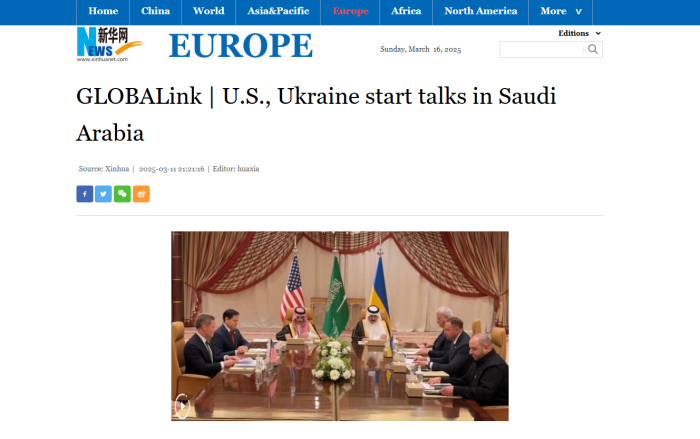
The Chinese media outlet Xinhua has published several publications on the topic of Ukrainian-American talks. In particular, journalists wrote a separate news item about the start of negotiations and a separate one about the start of the second round of negotiations.
Later, journalists published a news item that “Ukraine has declared its readiness to accept the US proposal for an “immediate, temporary 30-day ceasefire” after talks with the US delegation in Jeddah.”
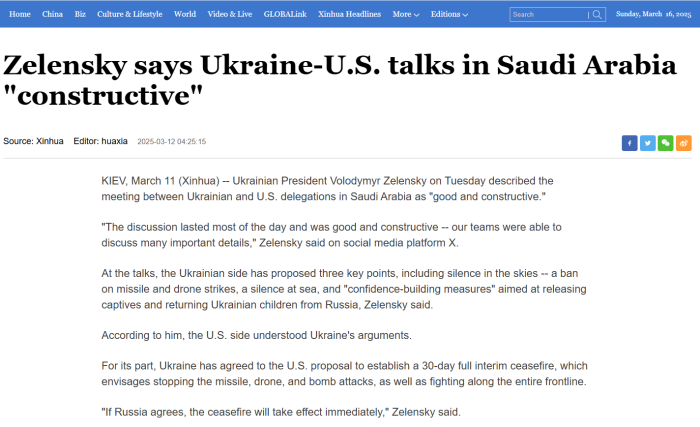
Then the media published a statement by Volodymyr Zelenskyy, who called the meeting of the Ukrainian and American delegations in Saudi Arabia “good and constructive”
They also emphasize that during the negotiations the Ukrainian side proposed three key points, including silence in the sky – a ban on missile and drone strikes, silence at sea and “confidence-building measures” aimed at the release of prisoners and the return of Ukrainian children from Russia.
Russia’s detailed response: Serbian media
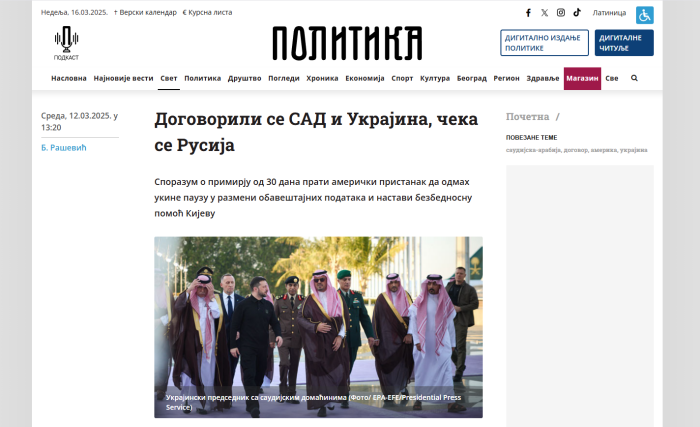
The Serbian media “Politika”, unlike other world media, did not write a news item emphasizing that Ukraine had agreed to a 30-day ceasefire. It published a news item emphasizing that “Ukraine and the US have agreed, now they are waiting for Russia’s decision, and for now the US is resuming intelligence sharing and military assistance”. And they published a statement by US Secretary of State Marco Rubio that he hopes that “a ceasefire between Russia and Ukraine could come within a few days”,
All further news on this topic is Russia’s reaction. For example, that “Russia has presented the US with a list of demands for an agreement to end the war with Ukraine and restore relations with Washington” (however, the demands are still unknown).
In another news item, they write that Russian President Vladimir Putin’s assistant for international affairs Yuri Ushakov said that “the proposed 30-day ceasefire is nothing more than a temporary respite for the Ukrainian army”.
Another high-profile publication is that “the world is waiting for Moscow’s proposal for a thirty-day ceasefire”.
***
The negotiations between Ukraine and the US on a temporary ceasefire have caused a wide resonance in the world media. Most Western publications focused on Ukraine’s support for the 30-day ceasefire and the resumption of military assistance from the United States. At the same time, it was emphasized that the implementation of this initiative depends on the reaction of Russia, which has not yet officially agreed to the terms of the ceasefire.
British media noted the active role of the United Kingdom in reaching agreements, as well as the influence of geopolitical factors, in particular economic agreements between the United States and Ukraine. French and Chinese media focused on the strategic aspects of the negotiations and key proposals from Kyiv, such as a ban on air strikes and the release of prisoners.
Pro-Russian Serbian media mostly perceived the ceasefire as a “respite for Ukraine” or as part of a US diplomatic game.
Anya Ostymchuk