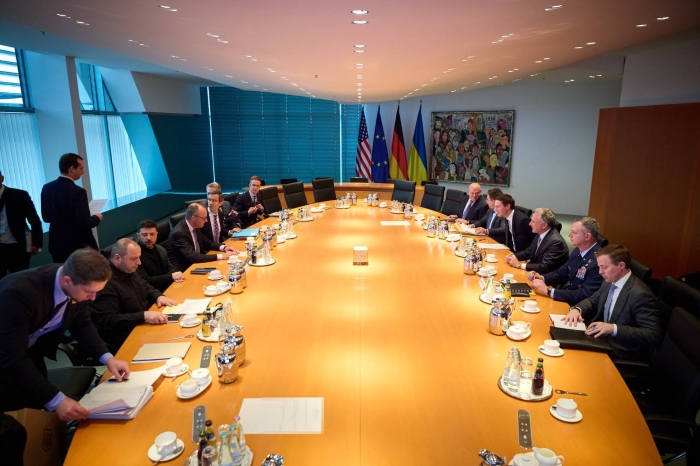


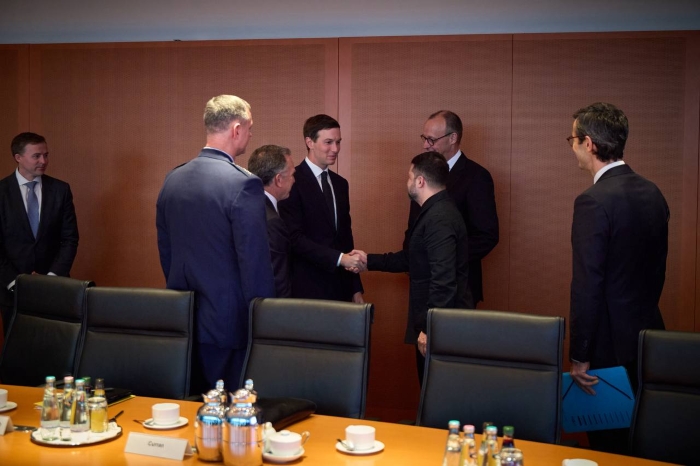
The second round of negotiations between Ukraine and the United States has concluded in Berlin. Noteworthy that yesterday’s first one lasted more than five hours.
The United States is represented by the U.S. Special Representative Steve Witkoff and U.S. Presidential Adviser and son-in-law Jared Kushner, while the Ukrainian delegation was led by President Volodymyr Zelenskyy.
Donald Trump is reportedly pleased with the outcome of the talks between the U.S. and Ukrainian delegations in Berlin, a U.S. official told Sky News. However, media assessments have been far more cautious, as Ukrainian sovereignty remains under pressure.
More European leaders will participate in the next round.
Three Parts of the Agreement
Ukraine and the United States discussed three key documents intended to pave the way toward peace:
-
an economic document on post-war reconstruction;
-
security guarantees to protect Ukraine from renewed Russian aggression;
-
a basic framework document consisting of 20 points.
So far, no clear answers regarding security guarantees have emerged. It is only evident that NATO membership will not be included as such a guarantee.
Stumbling Block
According to AFP, the U.S. side insisted that Ukraine abandon the Luhansk and Donetsk regions — a position Kyiv considers a red line. As a result, the first round of talks was described as difficult.
The United States is proposing that Ukraine relinquish Crimea, Donetsk, and Luhansk entirely, and cede Zaporizhzhia and Kherson regions along the current line of demarcation.
No official statements were issued after the first round. Later, Secretary of the National Security and Defense Council of Ukraine Rustem Umerov stated:
We hope that by the end of the day we will reach an agreement that will bring us closer to peace. There is a lot of anonymous speculation in the media right now, so don’t give in to rumors and provocations.
Subsequently, it was clarified that Umerov did not mean “today” literally, but used the phrase “by (as “at”) the end of the day” as an expression. The confusion stemmed from a mistake in the initial post.
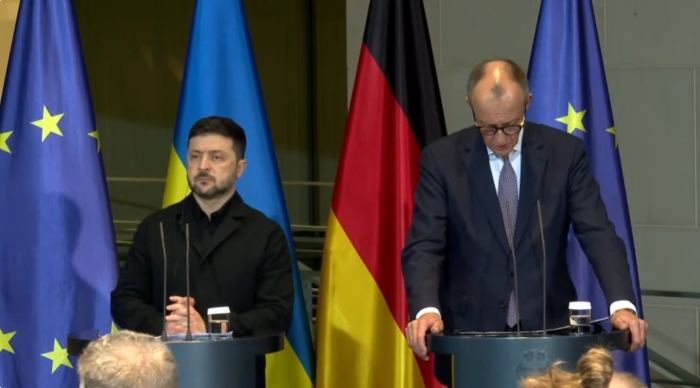
During a press conference with German Chancellor Friedrich Merz, President Zelenskyy openly acknowledged that the U.S. and the Ukrainian–European side currently hold different positions on territorial issues.
A U.S. official told Reuters:
We believe that the Russians will accept guarantees in the final deal. Trump is focused on stopping the Russians from moving west.
This position appears naïve, given that Russian officials consistently demonstrate a lack of interest in any peace settlement. For instance, Russian Ambassador to the UK Andrey Kelin stated:
This definitely should not be an agreement; we should be talking about Ukraine’s surrender. Kyiv should think not about an agreement, but about the situation on the ground.
German Position
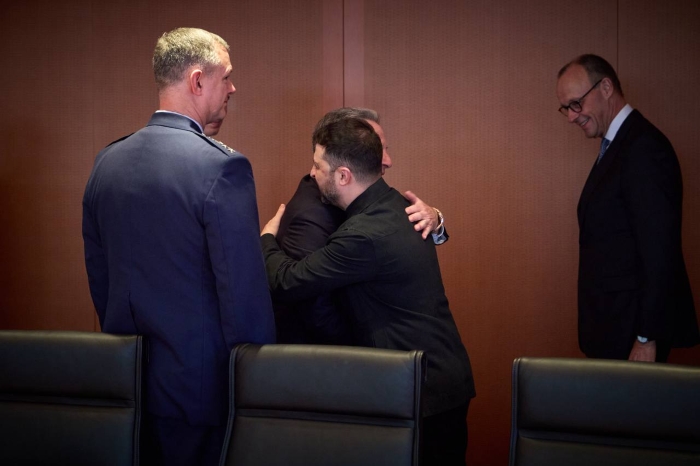
Berlin hosted the U.S.–Ukrainian delegations, making the latest Germany’s rhetoric particularly noteworthy. The possible use of frozen Russian assets appears closer than before. Volodymyr Zelenskyy thanked Germany for pioneering efforts to push this issue onto the agenda during his meeting with Julia Klöckner, President of the Bundestag.
Chancellor Merz once again appealed to historical parallels, recalling 1938 — a policy that only appeased a dictator. Coming from the leader of Germany, this message sounded especially strong.
He also reiterated his opposition to providing Ukraine with loans backed by Russian frozen assets. At the same time, Merz emphasized that the confiscation of those assets would send a clear signal to Moscow to end the war.
EU Signals
Ukraine’s accession to the EU could become part of a broader agreement to end the war. However, officials stress that this remains only a draft idea, as unanimous consent from all member states would be required.
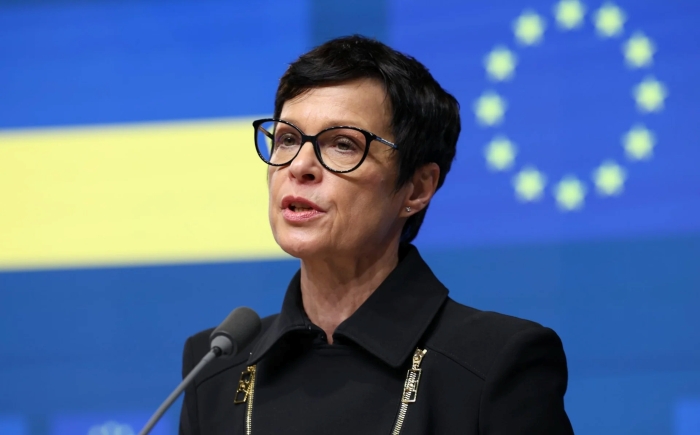
European Commissioner for Enlargement Marta Kos confirmed this in an interview with DW, commenting on reports that the latest version of the peace plan envisions Ukraine’s EU accession no later than early 2027.
Slovak Prime Minister Robert Fico has already voiced opposition, stating he would be among the first to block Ukraine’s EU accession, despite previously assuring support for Ukraine’s European integration. This shift is not surprising: with elections approaching and Hungary acting as an energy partner demanding exemptions to purchase cheap Russian gas, Fico appears keen to align with Viktor Orbán.
Nevertheless, EU membership itself is not a security guarantee, but rather an economic stimulus.
Conclusion
Ukrainian–U.S. consultations are ongoing. However, the sense that a solution is close may be misleading. Russia cannot be forced to accept a document, particularly given its continued irrational behavior.
Finnish President Alexander Stubb and Chancellor Merz have emphasized the current “momentum,” describing peace as “closer than ever.” Yet this remains a one-sided Western perspective. Russia, by contrast, escalates its demands each time a compromise framework is proposed.
For Ukraine, it is evident that any pause would allow Russia to rearm and stabilize its economy. At the same time, Moscow fears a similar outcome for Kyiv — as well as the return home of its own soldiers, many of whom are former prisoners. As a result, Russia is going to continue fighting to the last breath.
The real aim of these negotiations for Russia is to force Ukraine into territorial concessions, destabilize Ukrainian society, and secure a symbolic victory by legitimizing border changes in the 21st century. These are not U.S. talking points, yet Washington increasingly appears as a mediator whose proposals favor the Russian side. Zelenskyy and Merz have articulated this carefully, balancing problematic points with gratitude toward the U.S. partner, as diplomatic realities require.
European leaders are preparing for further rounds of discussion. Still, it remains difficult to rationalize a peace plan when facing an irrational aggressor. For now, the only genuinely positive outcome for Ukraine is the strengthening of ties with its European partners.