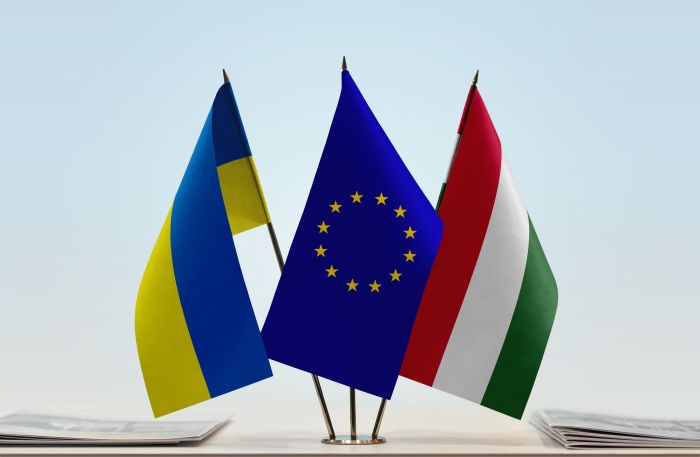


Hungary is predictably and consistently blocking negotiations with Ukraine on EU accession. Recent events exposing corruption in Ukraine’s energy sector have fueled anti-Ukrainian rhetoric from Hungarian site. Its Minister of Foreign Affairs and Trade Péter Szijjártó stated that Hungary would not allow the Ukrainian mafia into the European Union, nor would it allow “low-quality” Ukrainian grain onto the European market.
What are the consequences of impeding the implementation of the EU’s collective intentions regarding Ukraine, which the reasons stay behind for blocking important decisions, and under what circumstances can the situation be changed?
Delay in Ukraine’s European Integration
In March 2025, Volodymyr Zelenskyy noted that the only country blocking Ukraine’s accession to the EU is Hungary. This was confirmed in an interview with Europa Libera Moldova by Marta Kos, the EU Commissioner for Enlargement. This could break the tandem of Ukraine and Moldova on the path to EU accession.
It is noteworthy that these statements do not mention Slovakia, although in his interview with Startitup in early 2025, Robert Fico also threatened that Ukraine would definitely not join NATO, and that there would be problems with joining the EU. Instead, before the gas transit was cut off, Slovak Prime Minister Robert Fico, during a press conference with former Ukrainian Prime Minister Denys Shmyhal, claimed that Slovakia would not only not prevent Ukraine’s accession to the EU, but would also provide advice:
We are not a country that will hinder you on this path, but on the contrary, we want to help, to share with you our experience in accession negotiations.
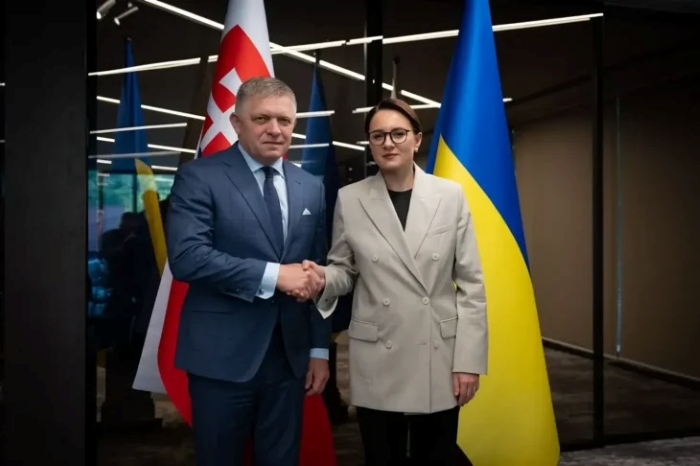
During a meeting with Volodymyr Zelenskyy in Uzhhorod in September 2025, Robert Fico emphasized that Slovakia supports Ukraine’s European integration. At the opening of joint Ukrainian-Slovak intergovernmental consultations in Košice on October 17, Slovak Prime Minister Robert Fico stated that Ukraine’s accession to the European Union would strengthen cooperation between the countries. He then reaffirmed Slovakia’s support for Ukraine’s European integration.
Persuasion or Coercion: Proposals and Risks
In turn, the 18th package of sanctions against Russia, adopted in July 2025, was delayed due to Slovakia’s position. During the spring meeting in Bratislava, Prime Ministers Viktor Oran and Robert Fico, amidst the ongoing discussions on revising the EU’s decision-making mechanism, jointly spoke out against the abolition of unanimity. German Chancellor Friedrich Merz warned in May 2025 during the WDR Europaforum, in the context of a question about Slovakia and Hungary, that countries that do not adhere to European values could be deprived of financial support. Since a significant part of Hungary’s funding has already been frozen, the warning was primarily directed at Slovakia, to which Robert Fico responded in his Facebook post that Slovakia is “not a little student who needs to be taught” and that Merz’s communication style is counterproductive.
As reported in European Pravda, Kaja Kallas, during her visit to Lviv on May 9, 2025, noted that in case Hungary vetoes Ukraine’s accession to the EU, there is a plan B and C that should not be disclosed yet. Similar hints were made by the EU Ambassador to Ukraine, Katarina Mathernova.
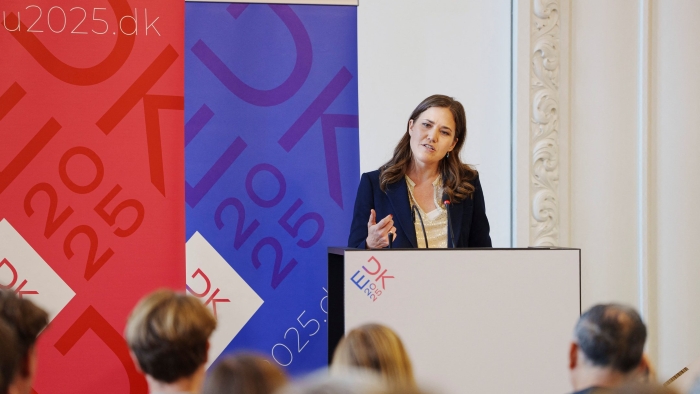
In July 2025, Denmark took over the presidency of the EU Council. Support for Ukraine is among its key priorities. According to Politico, Danish Minister of European Affairs Marie Bjarre cited Article 7 of the EU Treaty, which refers to the provision for temporary restriction of rights in case of non-compliance with the principles of the Union. Marie Bjarre said that Denmark is ready to use all possible instruments of pressure on Hungary to help Ukraine move forward in the accession process.
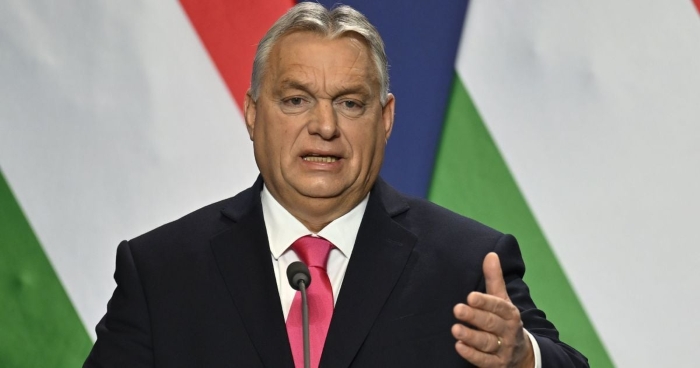
In 2023, Hungary agreed to allow the opening of negotiations for Ukraine’s accession to the EU. This happened against the backdrop of the European Commission unblocking €10 billion frozen due to problems with the rule of law. Hungary is now blocking the opening of the “Fundamentals” cluster of negotiations, which was supposed to begin in April 2025. Viktor Orbán is demanding greater protection for national minorities in Hungary. In his interview for MTI, he called Ukraine’s accession to the EU “the biggest threat,” arguing that Ukrainians will ruin farmers, and the only motivation for Ukraine to join as soon as possible is money for reconstruction, which will allegedly come from Hungary as well. It is noteworthy that according to the European Commission’s Costs and Benefits data, which provides information up to 2023, Hungary is a country that has received more from the EU than it has invested. Orbán accuses Ukraine and the collective “Brussels” of interfering in Hungary’s domestic politics, which is allegedly manifested in strengthening the opposition against the current regime.
After two attacks on the “Druzhba” (“Friendship”) pipeline, a new wave of accusations from Hungary and Slovakia has been hurled at Ukraine. The countries demand that the EU “ensure energy security” in connection with the disruption of Russian oil supplies. Hungary threatens to cut off electricity supplies to Ukraine, and Slovakia threatens to halt diesel supplies.
Hungary and Slovakia secured a one-year delay in their application for imports, after the US imposed sanctions on Russian oil facilities in autunm.
Klara Dobrev, MEP from Socialists and Democrats party, Hungary, shared with The Ukrainian Review the opinion, that Ukraine’s accession to EU is in contrary would positively impact Hungary:
Ukraine’s accession to the EU is beneficial for the whole of Europe, including Hungary and Hungarian citizens. Enlargement is one of the most important instruments of the Union to promote peace and prosperity in Europe. A strong, sovereign and prosperous Ukraine is indispensable in light of the threat by Vladimir Putin’s autocratic regime. Once conditions are fulfilled, Ukraine’s membership will hugely strengthen the European Union, and within it, Hungary — politically as well as economically. Friendship, peace and co-operation with Ukraine, as our neighbour, is a historic necessity, and opportunity for our country’s future.

At the same time, current Hungarian policy vector harms Hungary’s perception within the EU:
Hungary’s reputation in the EU has been disastrous for years now, as Orbán regularly aligned himself with Vladimir Putin. His regular blocking of vital EU decisions to favour the Russian aggressor are against Hungary’s national interest, represent a clear violation of our obligation to co-operate in good faith with fellow EU countries. It also contradicts our NATO responsibilities.
The damage that Orbán, acting as Putin’s puppet, is inflicting on Hungary’s international standing and on Ukrainian-Hungarian relations, cannot be overestimated. Ukrainians, though, need to be aware that Orbán does not speak for Hungarians. He is an autocrat, just like Putin, and he is being seen increasingly as such by other EU and NATO member states as well.
Hungary’s position on Ukraine in the EU Council will not change as long as Viktor Orbán is in power, for all the reasons mentioned above. However, popular support for Viktor Orbán’s government is visibly fading. Elections are due in less than a year’s time. We, as Hungary’s main progressive opposition party, will work to end his reign at the first opportunity. That will enable us to return to constructive, friendly relations with Ukraine as well.
Hungarian propaganda on Ukraine
The coming of the new US administration to power has strengthened Hungary’s confidence in the ultimatum tone of its EU relations policy. The fact that the United States is interested in the current government in Hungary is evidenced by the fact that sanctions imposed under the Biden administration were lifted on Orban’s ally Antal Rogan, who was responsible for propaganda. Elections in Hungary are scheduled for April 2026. However, after the meeting in White house with Volodymyr Zelenskiy and European leaders, Donald Trump called Viktor Orbán to ask what are the reasons to block Ukrainian integration to the EU.
In an interview on Europe Day 2025, Olha Stefanishyna, Deputy Prime Minister for European Integration, said:
Hungary has chosen to communicate with the new US administration through the prism of a negative perception of Ukraine. This is sad, and we believe that this approach really deserves to be rethought.
Regarding Ukraine’s accession to the EU, Viktor Orbán conducted the VOKS2025 poll of Hungarian opinion. It was allegedly attended by 2,284,732 people, 95% of whom were against Ukraine’s accession to the Union. The Ministry of Foreign Affairs of Ukraine responded to this event in a comment:
The official results of the consultations have not yet been published. However, it is hard to doubt the overall manipulative purpose of this action of the Hungarian government, which has nothing to do with the principles of democracy, openness and transparency of the expression of will
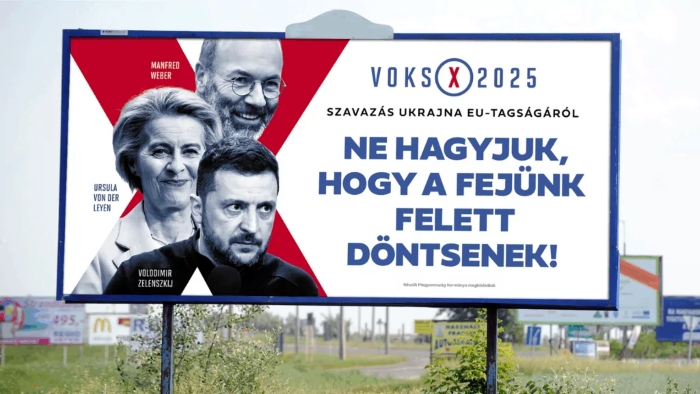
Initially, the head of the Hungarian opposition party Tisa, Peter Magyar, criticized his opponent’s intentions in his post, calling it a waste of time, as he believes that Ukraine will not be able to join the EU for decades, but later he conducted an alternative poll. The results showed that out of more than 1.1 million respondents, 58.18% supported Ukraine’s accession to the EU.
Dorka Takacsy, researcher specializing in disinformation and propaganda across Central-Eastern Europe and Russia, shared the outcomes from the research, exploring Hungarian propaganda regarding Ukraine shares the opinion that Hungary will stick to anti-ukrainian position because it is the huge part of the election narrative:
I do not see the intention from the Hungarian government to change [the opinion on vetoing] simply because it has built up now an entire campaign for scapegoating Ukrainians and warning Ukraine for many things. It has already won an election with almost the same narratives last time. This was in 2022, when Fidesz has brought this to the forefront of political discussion.
So when the talk is about Ukraine now, according to the official Hungarian rhetorics, it frames Ukraine as a clear danger to the Hungarian pockets. So it is scaring Hungarians that they will lose a lot of money, and lists many examples why Ukraine should never join the EU. Almost all of these arguments are absolutely lacking any funding, so there they put random numbers. You cannot prove these numbers anyhow, so you can clearly see that a large extent of it is sheer propaganda and disinformation. The Hungarian government has created this false sense of urgency now with the whole Ukraine in the EU question.
It’s on the one hand scaremongering how much it would cost for Hungarian people to rebuild Ukraine, also how many Ukrainian people would come to Hungary to work and steal Hungarian people’s job. These narratives are not even that sophisticated. It’s just painting up the picture of that you are going to have tremendous economic hardships.

Research, conducted with the participation of Dorka Dorka Takacsy, showed the following tendencies:
Recently, we had a study about what the governmental media told about Ukraine. And we also had focus group discussions to understand what Hungarian people think about it. And what we found in the Hungarian governmental narratives was that in the summer of 2023, so already two years ago, large amounts of, when the funds for Hungary were already frozen, because that happened in the spring. But in that summer, it has been already widely discussed among the EU leaders, when should Ukraine and how should Ukraine receive the next aid package. In the end, Orbán himself voted in favour of this, just for clarification. And in the summer of 2023, the government of propaganda has connected these two messages and started to tell that, well, Ukrainians will receive the money, which we would be entitled to receive, and the Ukrainians who do not deserve it receive our money. And they started to push this message through this large conglomerate and propaganda empire. Unfortunately, this worked magic. We had the focus group discussions eight months later. Almost every single respondent repeated this.
Despite the prevalent negative side, researches found the encouraging points for establishing the common ground between Ukrainians and Hungarians:
But there is also one positive which I can tell about from our study that in this focus group discussions. I wanted to go deeper, so why do respondents have this terrible opinion about Ukraine and what was interesting that it came out that it had nothing to do with the Transcarpathian Hungarians. It absolutely did not stem from personal bad relations It is the sheer result of top-down hate and scaremongering propaganda. In case of a different government and in case of a change in political will most likely this is going to be reversed because it does not it doesn’t stem from personal or historical regrets or pain. So maybe it can be rewritten in the future, but it’s going to be tremendously difficult.
Klara Dobrev also emphasizes the use of narratives about Ukraine to fight the current government against its opponents:Viktor Orbán regularly creates enemies who, according to his narrative, pose a threat to Hungary. Recently, he made Ukraine an enemy the same way, spreading fake news and false narratives, and suppressing any genuine debate. My party, the Democratic Coalition is a strong supporter of Ukraine’s EU membership. Unfortunately, other opposition parties, such as TISZA, member of EPP, have refused to take a stand. Still, Orbán’s campaign against Ukraine also aims at discrediting the whole opposition. Orbán’s propaganda machinery claims that the opposition is colluding with Ukraine against Hungary’s national interests. Furthermore, they insist that Ukraine’s accession would ruin Hungary, deprive it of EU financial assistance, destroy our agriculture, and our standing in Europe in general. At the same time, they are holding a fake “popular vote”, without a democratic debate, to shamelessly misrepresent public opinion. Whatever the outcome: it won’t mean anything.
Threats of an increase in the number of vetoes
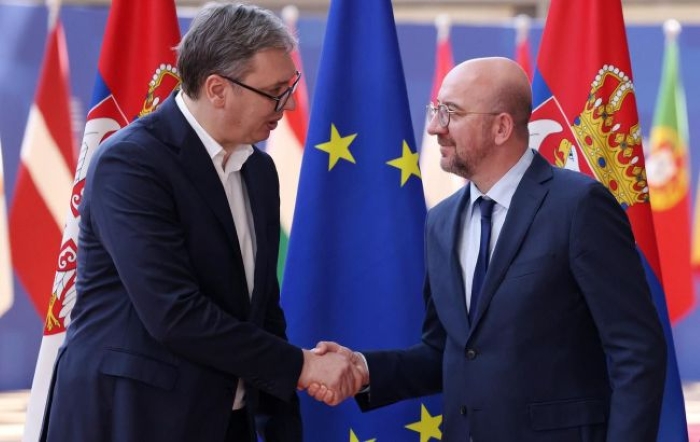
Another poll conducted by Eurobarometer (a survey conducted by EU organizations) in the fall of 2024 showed that in Slovakia, 54 percent of respondents approved of Ukraine’s EU candidate status (sample size: 1,005). In Hungary, 40 percent of 1,023 respondents share this opinion, with the EU average being 60 percent. A similar survey was conducted among 1,008 Serbs, of whom 35 percent answered in the affirmative. If Serbia joins the EU, ideologically, it could become a greater threat in blocking various forms of assistance to Ukraine and slowing down the process of European integration.
From my discussions with Serbian political leadership it is clear that EU membership remains a strategic goal, said Kaja Kallas during a visit to Belgrad.
As of now, however, the integration process is still on hold.
Conclusion
The EU is trying to find a balance between reservations and compromises so that Ukraine advances in European integration. However, the veto system is a well-established rule, so any change in the use of this tool can have negative consequences and risks that must be calculated before the changes are made. The dynamics of the situation may change after the election in Hungary. Despite corruption scandals, Ukrainian society has demonstrated its devotion to EU values through revolution and war.Regardless of temporary setbacks or corruption scandals exploited by opponents, Ukrainian society has consistently demonstrated its commitment to European values through revolution, democratic transformation, and resilience in war—showing that Ukraine’s place in Europe is defined not by the fluctuating positions of individual governments, but by the unwavering choice of its people.