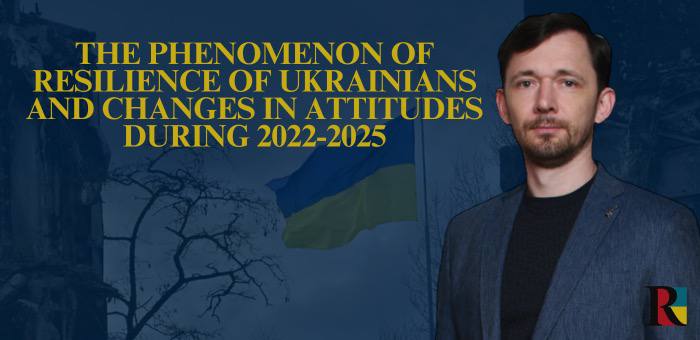


Since the beginning of Russia’s full-scale invasion of Ukraine in 2022, Ukrainian society has demonstrated impressive resilience, solidarity, and the ability to adapt to new challenges. During 2022–2025, significant transformations in the mood of citizens occurred, caused by both events on the front and internal socio-economic changes. This interview with Serhii Dembitskyi, Deputy Director for Scientific Work of the Institute of Sociology of the NAS of Ukraine, is an attempt to analyze the phenomenon of Ukrainian resilience. We will try to investigate the dynamics of public sentiment during the war, revealing the key factors that influenced changes in the consciousness and behavior of citizens.
Stanislav Kinka: Thank you for volunteering to provide a professional assessment of the changes that Ukrainian society underwent during the full-scale russian aggression. Government officials, journalists, and public figures often talk about the resilience of the Ukrainian people, the so-called “resilience formula.” How would you define “the resilience of Ukrainians”? What changes has it undergone in 2022-2025 and what trends can we see in the future? What strengthens or weakens the resilience of Ukrainians?
Serhii Dembitskyi: There are different types of resilience. Our Institute is currently implementing a scientific project dedicated to national resilience. But there is no unanimity on this issue either, there are many interpretations. According to the concept of ensuring a national resilience system, which was approved by the Decree of the President of Ukraine No. 479/2021 on September 27, 2021, national resilience is “the ability of the state and society to effectively resist threats of any origin and nature, adapt to changes in the security environment, maintain sustainable functioning, and quickly restore the desired equilibrium after crisis situations.” At this stage, we are working on a model of national resilience in the space of social configurations. This model is based on two dimensions.
The first dimension concerns the nature of the response to challenges and threats of a national scale. It can be reactive, interactive and proactive. Reactive response consists in anti-crisis activities, interactive – in functioning in an equilibrium environment (relatively speaking, when the situation is familiar and controlled), proactive – in foresight (strategic planning aimed at shaping the future).
The second dimension is determined by the tasks and focus of social action – on oneself and loved ones, on market and public structures, and on structures responsible for observing the rights and obligations of citizens. Social actions aimed at oneself and loved ones form private life, aimed at market and public structures – institutional self-organization, and on structures responsible for observing the rights and obligations of citizens – state institutionalization.
Thus, we can distinguish nine zones of national resilience, determined by the nature of the response to challenges and threats, as well as the direction of corresponding social actions. What is the current situation in each of them, we will investigate within the framework of our project after the finalization of the concept.
S.K. At the beginning of the full-scale invasion, we saw queues at military registration and enlistment offices, the desire of many people to go defend their state, engage in volunteer activities, and be involved in helping the army. Has the situation changed significantly as of today? How does sociology explain these changes? What factors have the greatest influence: fear, disappointment, fatigue, information and psychological operations of the enemy?
S.D. The changes in public opinion in Ukraine after the start of the full-scale invasion of the Russian Federation in 2022 were somewhat paradoxical. Despite the fact that the beginning of the invasion was the most difficult period of this war for the Ukrainian state, the assessments of Ukrainians on socio-political issues changed dramatically for the better. This concerned many aspects – assessments of the state of the economy, attitude towards the state leadership, the importance of the democratic vector of the country’s development, etc.
One popular hypothesis explaining this change is the “rally ‘round the flag effect,” which describes the consolidation of the population around political leaders and central authorities in the face of defining crises, which undoubtedly include full-scale war. If we accept this explanation, then the “rally ‘round the flag” phenomenon manifested itself for the second time in early 2025, when Ukrainian President Volodymyr Zelensky entered into a public dispute with US President Donald Trump in the White House. After that, as in 2022, a number of socio-political assessments of the population went up sharply. At the same time, many other aspects of public life remained significantly different from the social processes that we observed at the beginning of a large-scale invasion.
The Institute of Sociology of the NAS of Ukraine has its own methodological developments suitable for tracking the state of public opinion in general, including the “GSR-5” scale (authored by Doctor of Sociological Sciences Serhiy Dembitsky), one of the purposes of which is to determine the general background of public opinion in the country. Its development began with the need to record the general level of positivity and negativity that characterize public opinion in a specific period of time. From an academic point of view, this need is due to the hypothesis of the existence of a general background of public opinion, in the context of which the remaining more specific issues of general public life will be assessed. The more negative the background of public opinion, the more respondents will gravitate towards negative assessments, and vice versa.
The “GSR-5” scale was developed in 2020, and since 2021 it has been included in the annual sociological monitoring “Ukrainian Society”, which has been conducted by the Institute of Sociology of the NAS of Ukraine since 1994. The results of 2021 demonstrated a pronounced socio-political negativism that characterized public opinion, and the next measurement in May 2022 (the data was collected free of charge for the Institute by the Sociological Group “Rating”) recorded cardinal changes for the better. The latter is fully consistent with the hypothesis of the “rallying around the flag” effect.
In the following, we consider the specific results of the application of the “GSR-5” scale over the past four years, which will allow the reader to form their own idea of changes in public opinion in the conditions of a grueling war.
Indicators for individual questions of the methodology. The “GSR-5” scale consists of five questions and summarizes the answers to them. These questions include an assessment of the activities of central authorities, views on the future of Ukraine, an assessment of living conditions for the majority of the population, a correlation between Ukraine’s achievements and failures since independence, and satisfaction with events in the country. Based on the results of the answers to all questions, a conclusion is made about the attitudes of the respondents – from clearly negative to clearly positive.
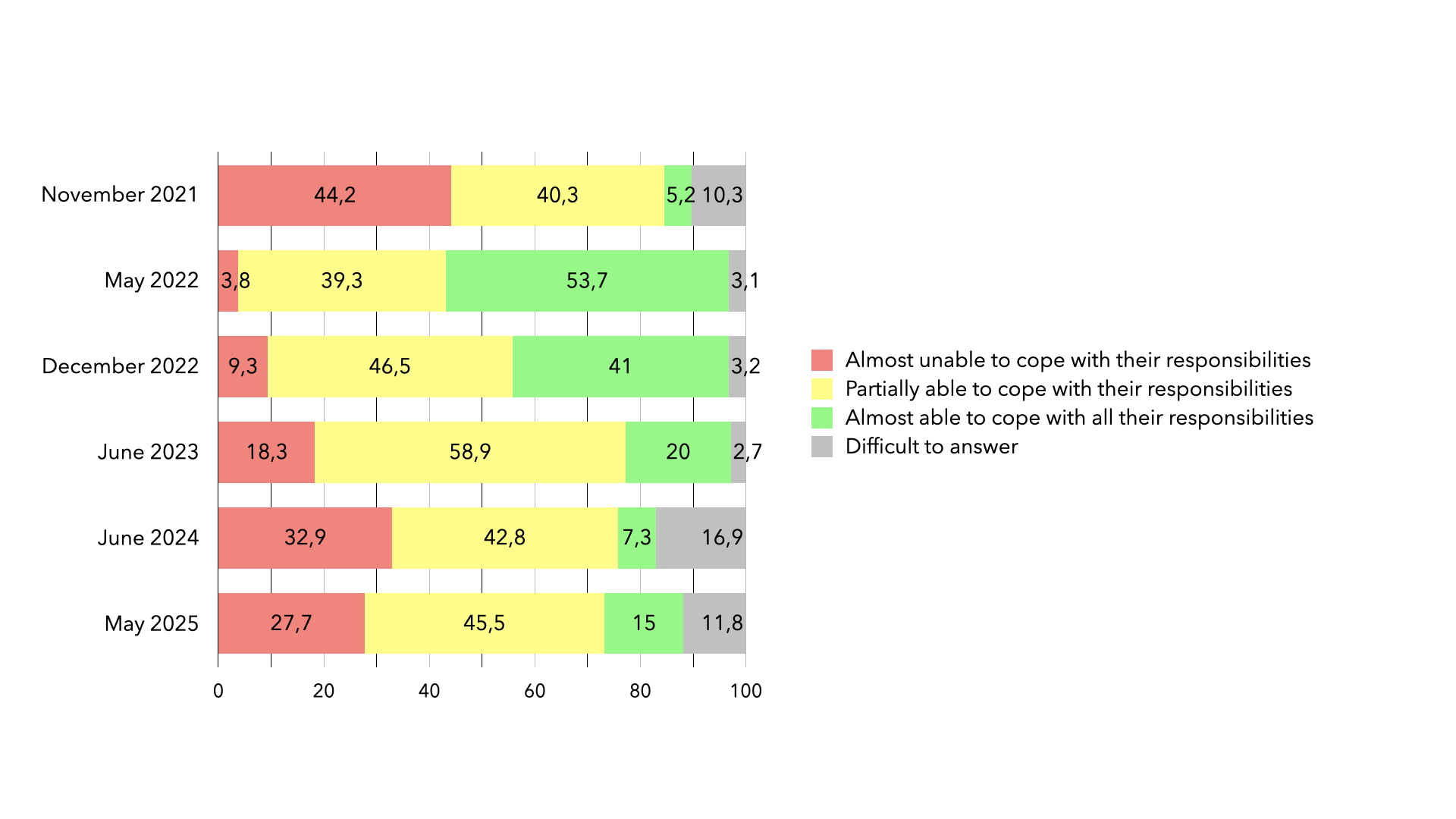
On the eve of the full-scale invasion, negative and intermediate views dominated among the assessments of the effectiveness of central authorities. And already in the first half of 2022, the absolute majority of the population assessed the authorities positively. At the same time, those who gave negative assessments were less than 4%! Subsequently, there was a gradual deterioration in the assessments up to and including 2024. In May 2025, they turned out to be slightly better than the previous year, but no fundamental changes occurred.
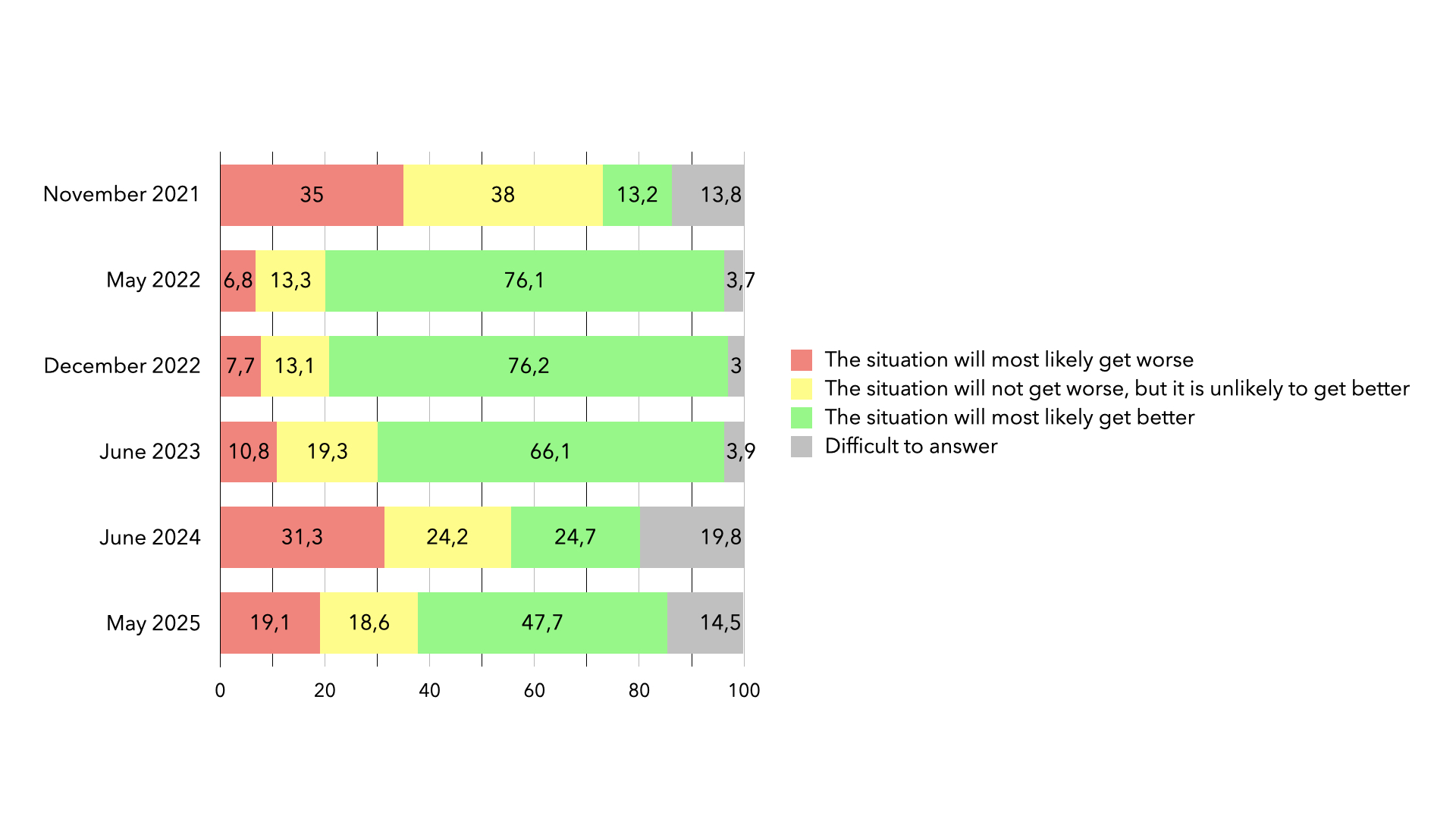
The most significant factor in positive changes was the social optimism of Ukrainians, which in 2021 was characteristic of only 13.2% of the population. Negative and intermediate assessments again occupied a key place. Throughout 2022, optimistic views were characteristic of three quarters of the population. Despite the weakening of optimism in 2023, it was still shared by a significant number of Ukrainians – two thirds. And although in mid-2024 we recorded a significant “dilution” of optimism by negative and intermediate assessments, as of May 2025 it again became decisive for almost half of the population.
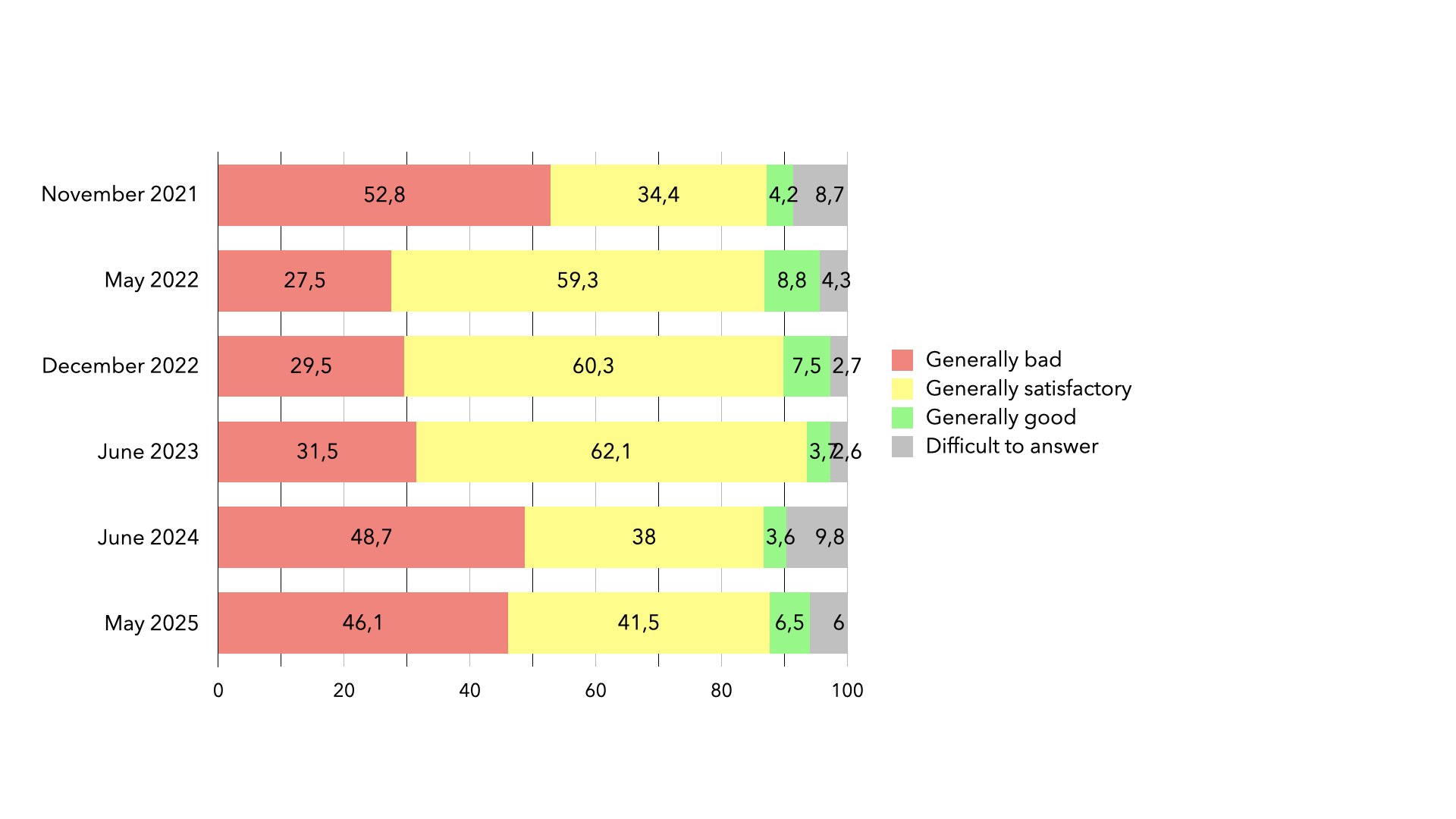
Paradoxically at first glance, during the devastating war, assessments of living conditions for the majority of the country’s population also improved. If in 2021 the absolute majority considered them generally bad, then in 2022 and 2023 they were generally satisfactory. The orientation towards negative assessments in this question returned starting in 2024, although to a slightly lesser extent than in 2021.
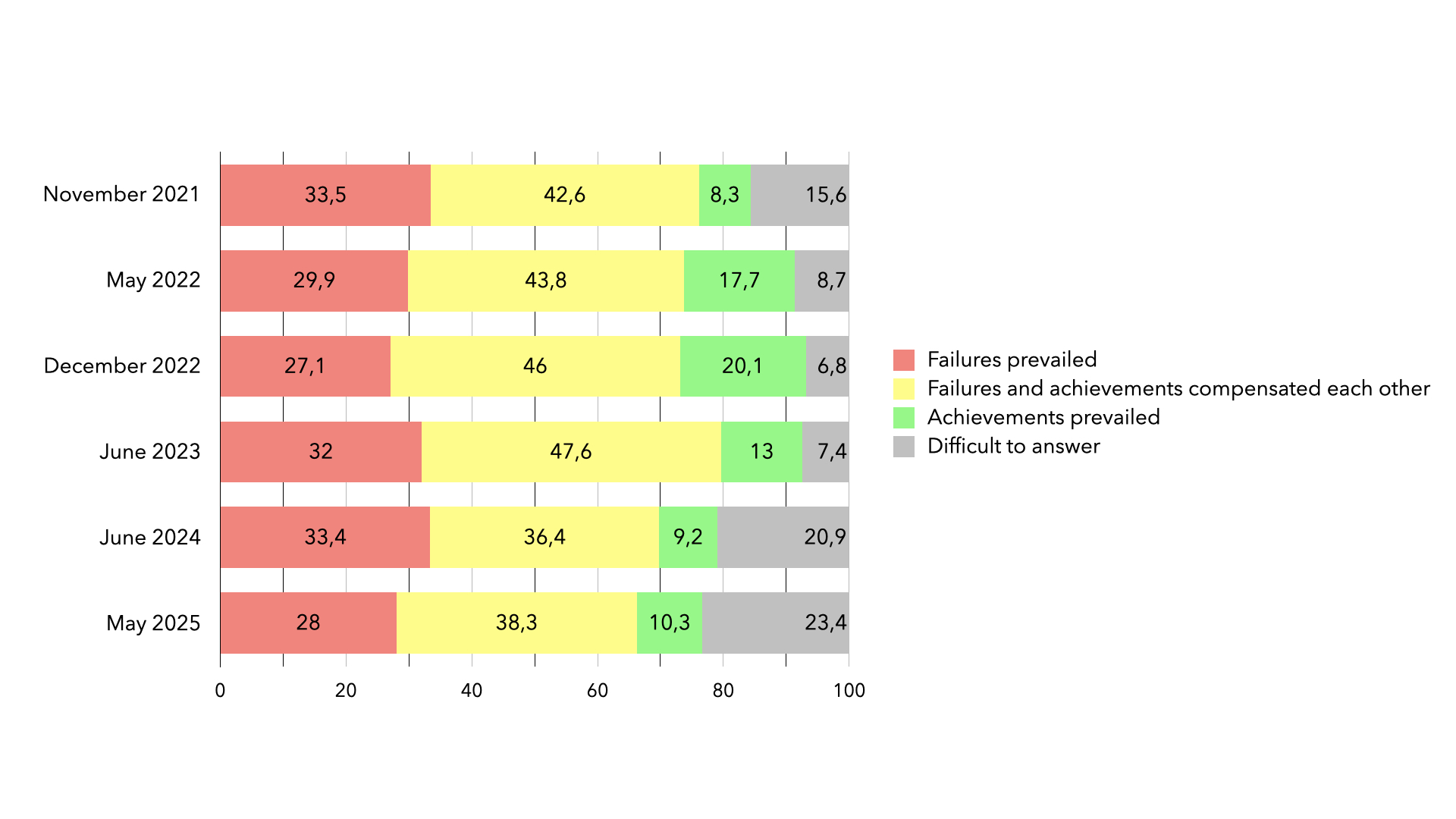
The most stable, given the responses received, was the question about the ratio of achievements and failures of independent Ukraine. The relative majority of responses in all measurements received the answer option according to which failures and achievements compensated for each other. To a somewhat lesser extent, respondents believed that failures prevailed. Positive or uncertain answers were recorded even less. It is significant that the number of uncertain answers increased in 2024 and 2025.
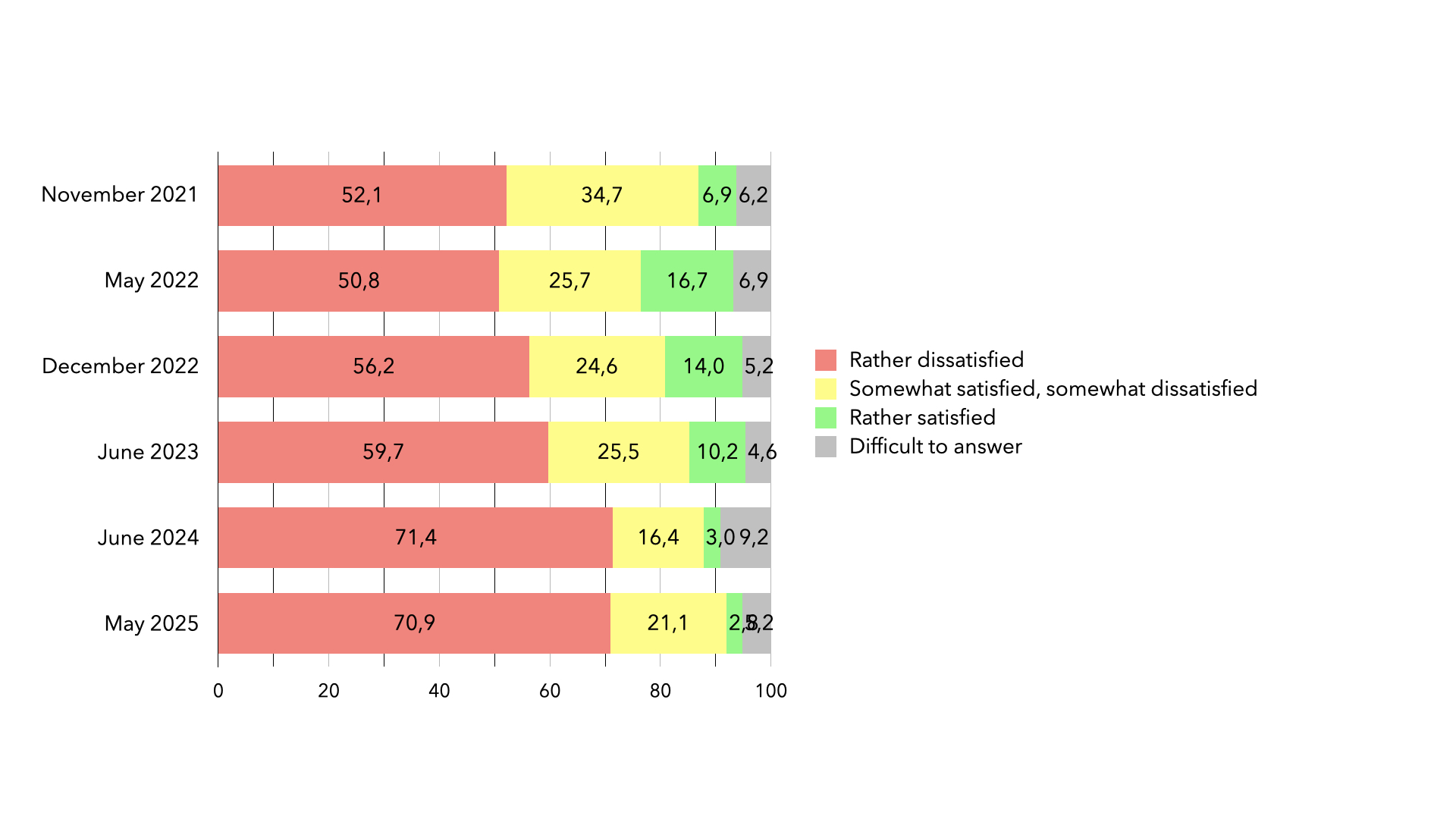
Finally, the most negative assessments in all measurements were recorded for the question of satisfaction with events in the state. But even here in 2022, a certain improvement in the answers can be observed. Just as with the question of the failures and achievements of the Ukrainian state, in this case we see a certain stability in the results. However, this stability is somewhat offset by the increase in negative assessments in 2024.
All the presented changes can be explained by the events, decisions and circumstances that Ukrainian society has encountered over the past 4 years. But I refrain from interpretations and suggest that readers formulate their own explanations. This will be a good exercise for the sociological imagination.
General attitudes. In addition to the presented data, the general attitudes of the population regarding the functioning of the state are given below (these attitudes should not be confused with assessments of the value of one’s own state as such – they differed significantly in 2024). They are determined for each respondent based on the results of answers to individual questions of the scale and demonstrate his contribution to the general background of public opinion – negative, intermediate or positive. As of the end of 2021, a significantly negative background of public opinion was observed. Two-thirds of all respondents demonstrated either clearly negative or moderately negative attitudes. The war destroyed this dominant negativism, demonstrating to Ukrainians that even in such difficult circumstances, the Ukrainian state continues to function and rebuild itself in accordance with new challenges.
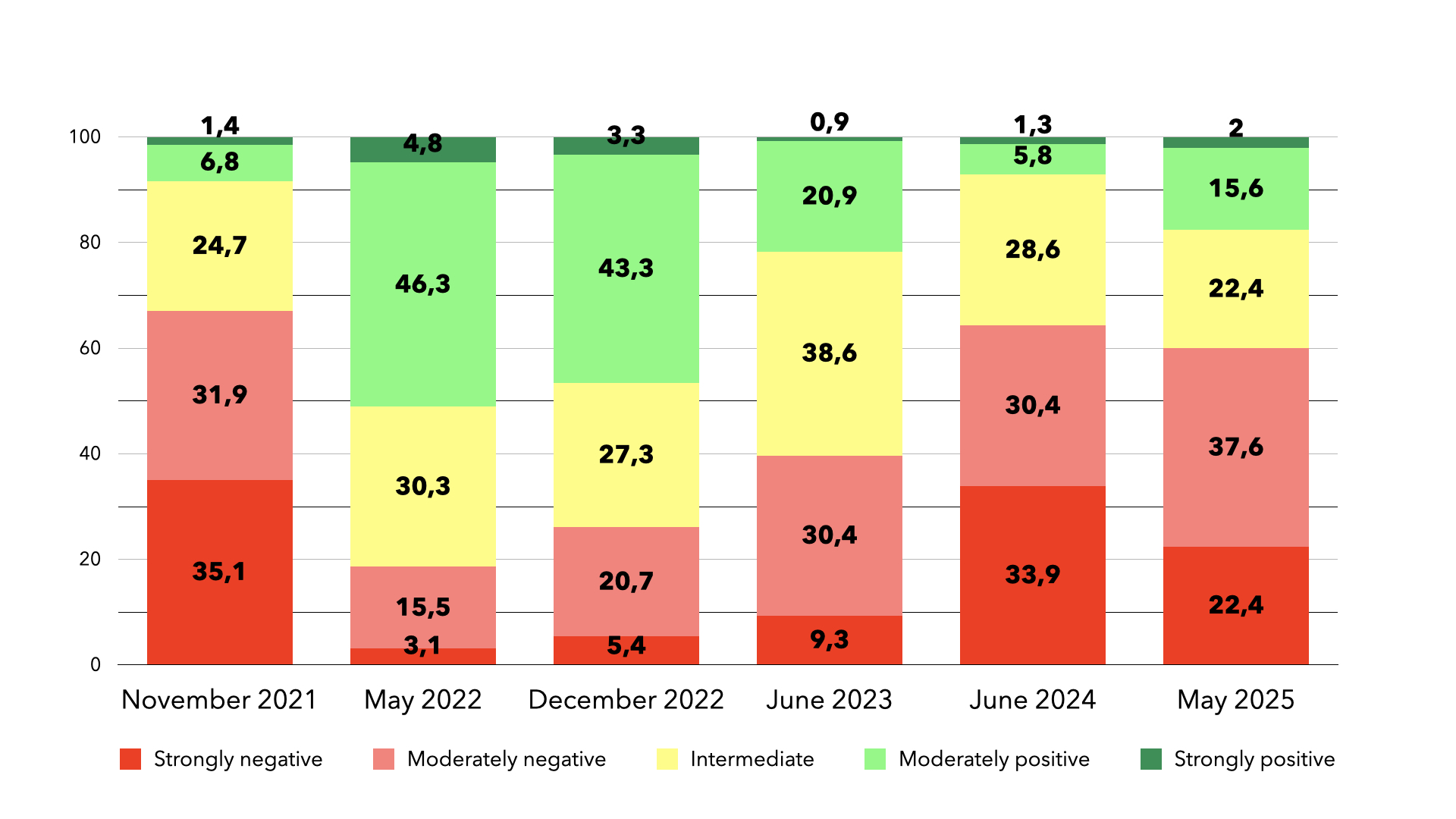
As of May 2022, negative attitudes decreased by more than 3 times, and positive ones increased by 6 times. Thanks to these significant changes, in 2022, positive assessments prevailed, and the number of intermediate ones exceeded the number of negative ones. In 2023, respondents who gave positive assessments were already a minority, and the number of intermediate and negative assessments almost equalized. And already in 2024, respondents with negative assessments were the absolute majority. It is significant that the distribution became almost identical to that at the end of 2021. Thus, in 2024, from the point of view of the general background of public opinion, Ukrainian society returned to its “usual” state less than 3 years after the start of the large-scale invasion.
Finally, it is time to return to the effect of “rallying around the flag”, which was repeated in 2025. As you can see from the last graph, it had a positive, but limited effect. First, the number of positive attitudes has almost tripled compared to 2024. Second, in the negative spectrum of assessments, moderately negative attitudes began to prevail over clearly negative ones. It is obvious that these changes occurred due to a significant increase in the social optimism of Ukrainians. The reason that led to this can be considered the beginning of the diplomatic process, which is designed to end the war. However, you can give alternative explanations for the recent changes.
S.K. Let’s finally talk about the language issue. Sociological studies show that at the beginning of the full-scale war by the Russian Federation against Ukraine, a significant part of people switched to Ukrainian. What is the situation now?
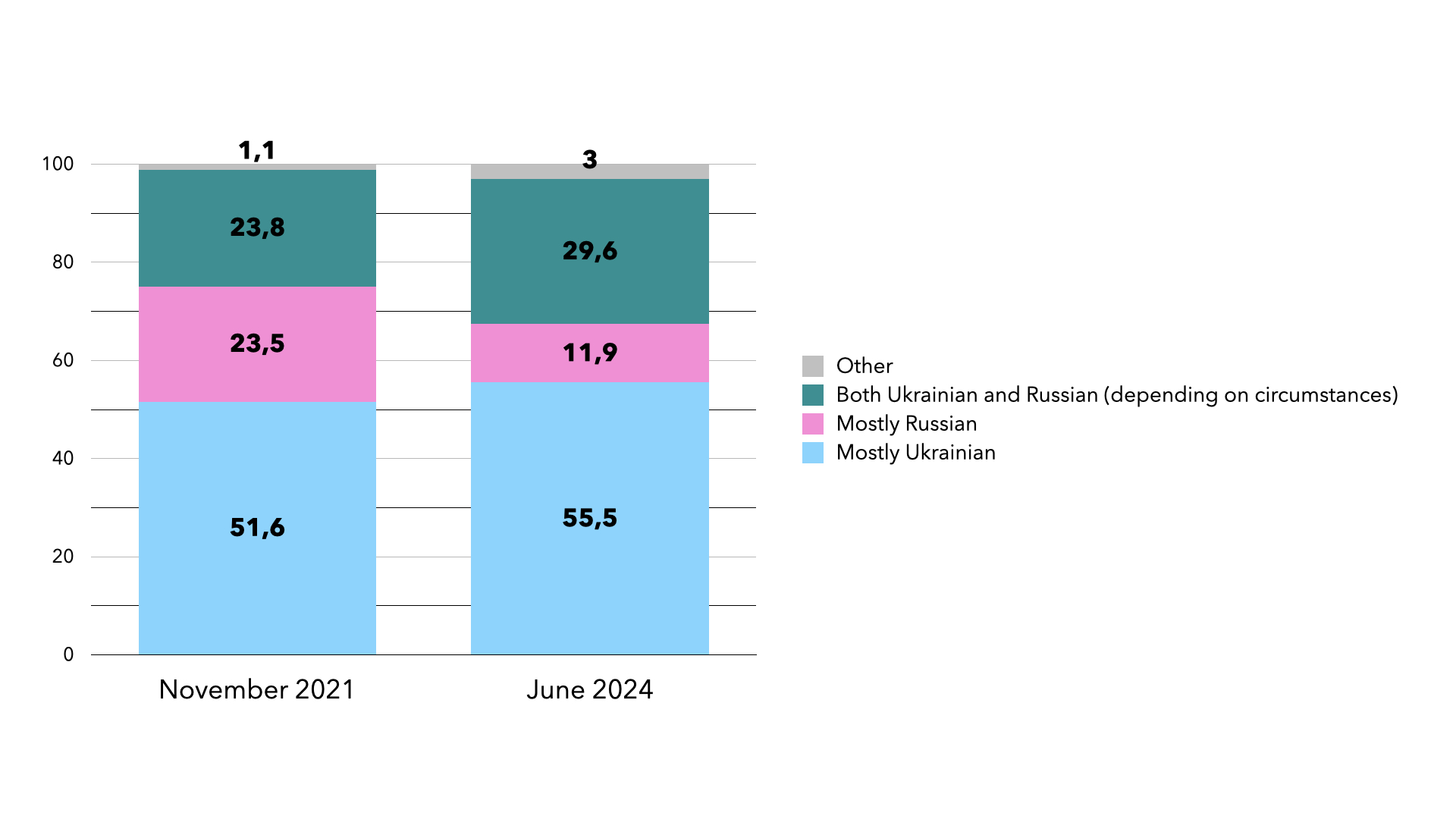
S.D. A good sociological indicator here is the sociological question about the language of communication of respondents at home, which we asked in our monitoring before the large-scale invasion and in the middle of last year. The respondents’ answers show that the pure use of the Russian language has decreased by about 2 times. Accordingly, half of these people began to use Ukrainian on a par with Russian, and half switched to pure Ukrainian. At the same time, the use of the Russian language in one form or another reaches 40%. Not much less than at the end of 2021. We also have data indicating that in May 2025 the distribution of answers to this question was the same as last year. That is, the situation currently looks stable.
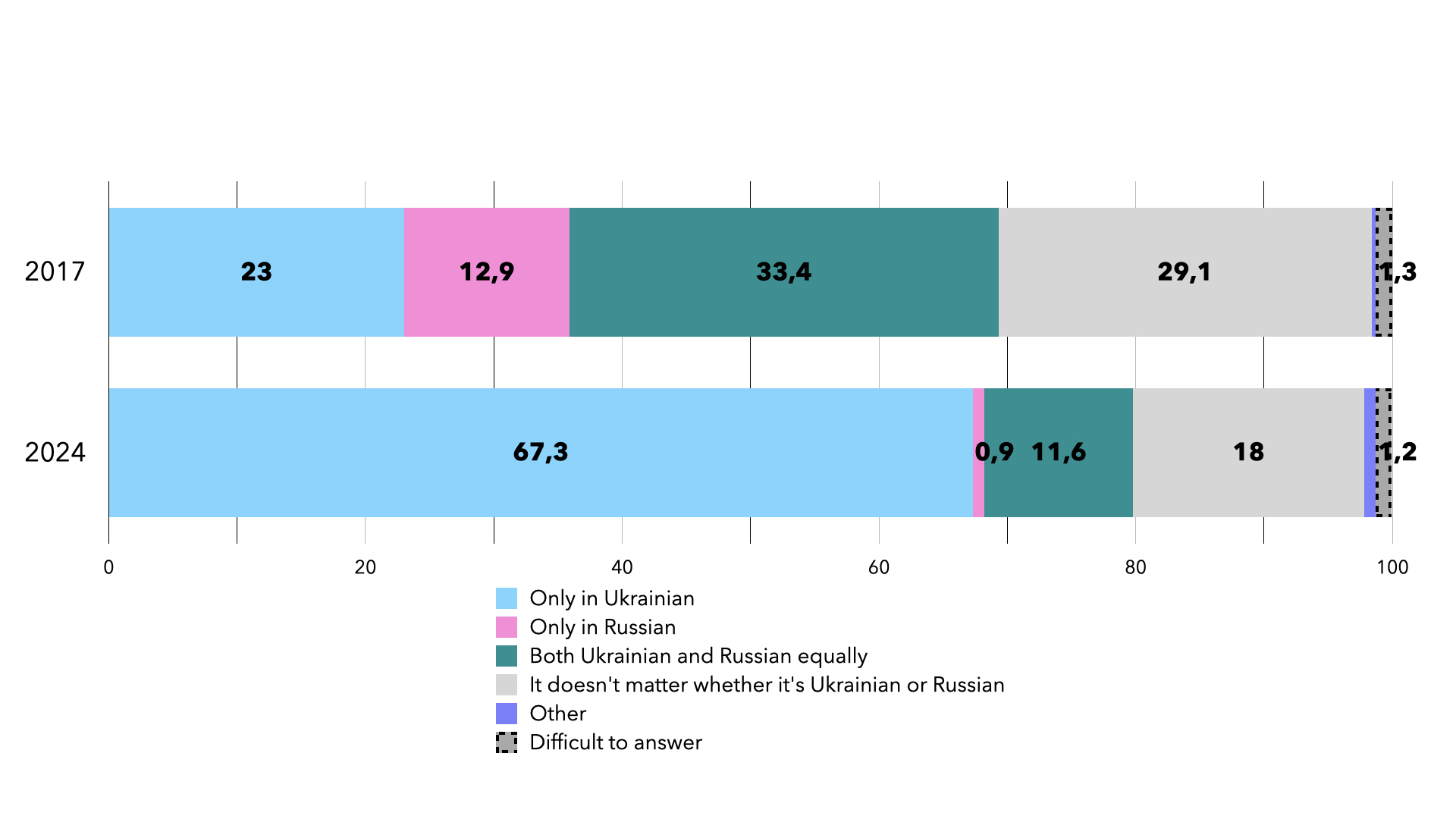
The interesting question here is about the preferred language of television, which we asked in 2017 and 2024. Over the past 7 years, the situation has changed dramatically. There are almost no people left who would like to watch or listen to programs exclusively in Russian. And two-thirds would like to consume relevant information exclusively in Ukrainian (their number has increased almost threefold). We can say that the Ukrainian language has established itself as the standard on television.
Stanislav Kinka