Political or legal Issue: Odesa Mayor’s Resignation
15.10.2025
Share:
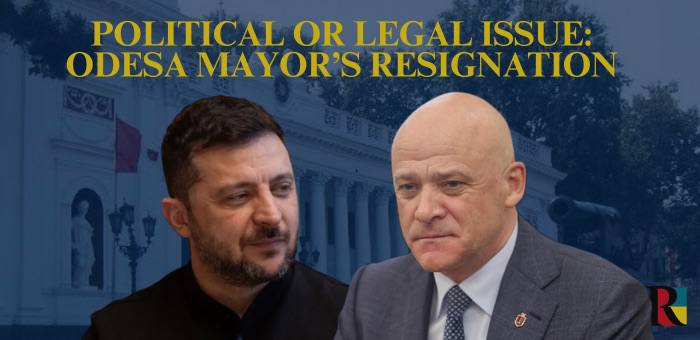
Odesa’s mayor Hennadii Trukhanov can no longer hold his position after his Ukrainian citizenship was annulled. According to the Security Service of Ukraine, he holds a valid Russian passport. Trukhanov denies the accusations and announced he will appeal the decision.
The move has divided public opinion: while many Ukrainians welcomed it as long overdue, others questioned its legal basis, noting that local governance is a particularly sensitive issue for the EU.
Background
Trukhanov’s record has long been controversial. He has faced multiple criminal investigations, including the Krayan plant case, in which he and three Odesa City Council officials were accused of abuse of office and participation in a criminal organization that illegally seized communal assets and later laundered the proceeds. These proceedings have been stalled in the High Anti-Corruption Court for years, allowing him to avoid sentencing so far.
Hennadii Trukhanov is also known for his pro-Russian stance at the beginning of Russia’s aggression, when he refused to acknowledge the annexation of Crimea.
Public dissatisfaction has been mounting in recent months. A petition calling for the establishment of an Odesa City Military Administration gathered the required 25,000 signatures by September 24, 2025. Another petition, demanding that Trukhanov be stripped of Ukrainian citizenship, collected over 28,000 signatures in one day.
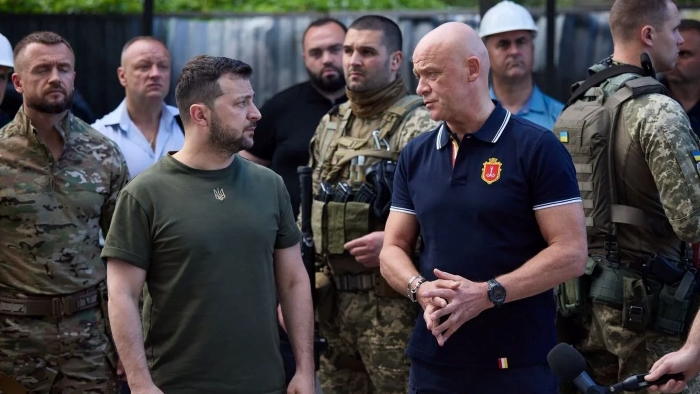
Volodymyr Zelenskyy and Hennadii Trukhanov during President’s visit to Odesa in 2022
The latest wave of outrage followed the deadly flood on September 30, which left ten people dead. Citizens blamed the tragedy on years of municipal neglect and the failure of Odesa’s drainage system.
In the context of the decision to deprive mayor from Ukrainian citizenship, activists have organized demonstration to remind that not only the deprivation of citizenship but also criminal prosecution for the mayor is necessary.
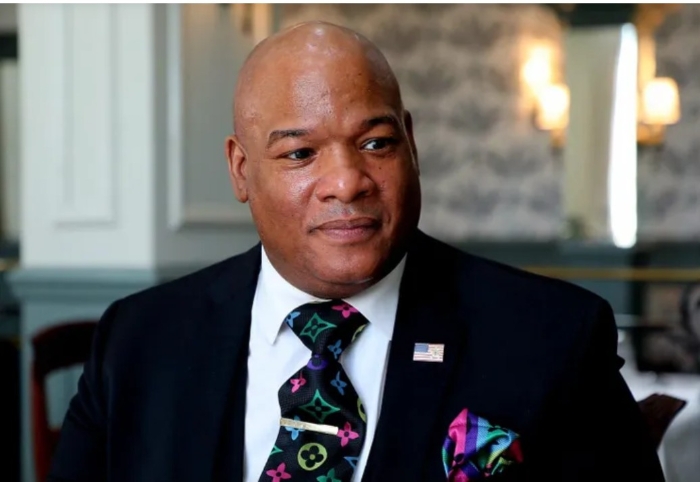
Pastor Mark Burns, labelled by Time Magazine as Donald Trump’s Top Pastor, thinks the measure is justified:
This is a complex and sensitive matter. The issue at hand, whether Mayor Trukhanov of Odesa holds Russian citizenship, is ultimately for the Ukrainian legal system to determine. According to the Ukrainian Constitution, the President does have the authority to revoke citizenship if an individual is found to hold dual nationality, as Ukraine does not permit dual passports. So the action itself is within the scope of Ukrainian law.
Now, whether or not it is the “right” decision depends on the legal findings and national security assessments, which I am not in a position to judge. However, I will say this: since 2014, many have perceived Mayor Trukhanov as having pro-Russian leanings. In the context of an active war where Russia has conducted targeted assassinations, deployed intelligence networks, and systematically attacked Ukrainian sovereignty, I believe it’s fair to say that extreme caution is justified.
Any public official with a prior history of sympathizing with the aggressor nation, especially one who has openly criticized Ukraine’s de-Russification efforts should expect heightened scrutiny. This is not about political retaliation. It’s about national security during wartime. The Ukrainian government has the duty to ensure that officials in critical positions are fully loyal to the country they serve. Let the courts handle the legal aspects. But from a broader perspective, I understand the caution being exercised. You cannot afford to be naïve when your country is under active attack.
Mark Burns / Timothy Bernard, Independent Newspapers
The concerns on this decision
Critics warn about the political implications. Some fear that stripping officials of citizenship could set a dangerous precedent that might later be used against others on questionable grounds. The decision is in the hands of the Commission on Citizenship under the President of Ukraine. Under Ukrainian law, such decisions fall to the Presidential Commission on Citizenship. Since elections cannot be held during wartime, the mayor’s powers would typically transfer to the city council secretary. Yet, the establishment of a military administration now seems the more likely outcome. President Volodymyr Zelenskyy ordered to form Odesa City Military Administration and appointed the former head of the Dnipropetrovs’k Regional State Administration Sergiy Lysak as the head.
Odesa deserves more protection and more support. This can be done in the format of a military administration. Too many security issues in Odesa have gone unanswered for too long. All effective decisions will be made. I will appoint the head of the military administration in the near future, — stated Volodymyr Zelenskyy.
Trukhanov has announced plans to file a complaint with the European Court of Human Rights, raising questions about how this decision will be perceived within the EU and whether it signals a shift toward greater centralization.
Sergej Sumlenny, founder of European Resilience Initiative Center, co-founder of unmanned_systems and international layer (LL.M from Berlin University Freie Universität) emphasizes on individuality of such cases for countries:
INTL law does not regulate such cases, they are national.
Some nations (like my country Germany) say, any person who actively apply for a foreign citizenship automatically loses German citizenship (I simply it, but in general it is the case). Of course, it can be that nobody knows treat you as a German, but legally your German citizenship is gone.
Other countries like Ukraine do not have such automatism, but Ukrainian citizenship can be forcefully cancelled if foreign citizenship was found. The first famous case of this kind was Saakashvili.
As a non-citizen, Trukhanov cannot be a mayor anymore, but this looks to be automatic.
Sergej Sumlenny / Facebook Sergej Sumlenny
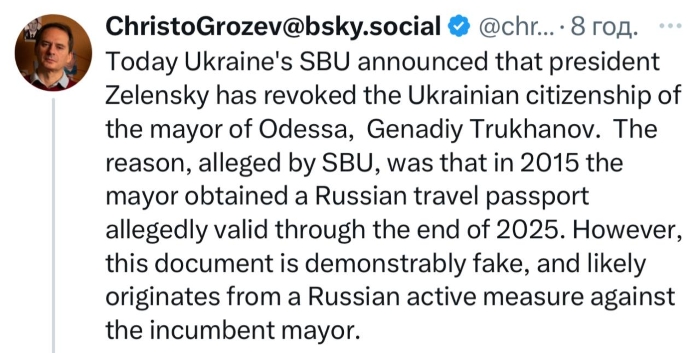
Moreover, Hennadii Trukhanov may use this situation to portray himself as a political victim and frame the government’s actions as anti-democratic. Investigative journalist Christo Grozev denied the validity of the document:
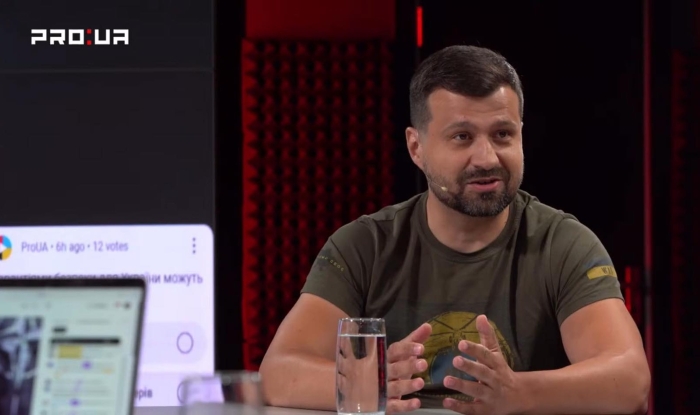
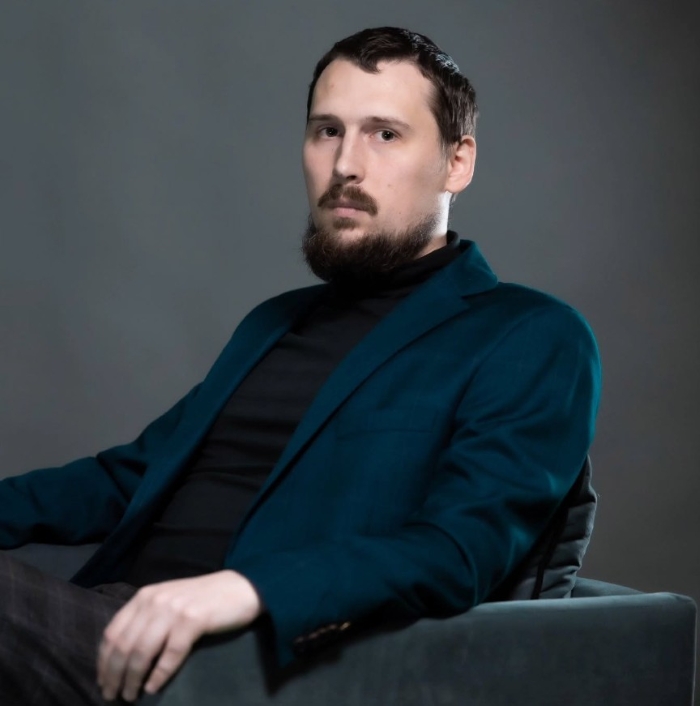
Bartłomiej Wypartowicz, Senior Editor Defence24, thinks that Russia can use this case to amplify propaganda:
I think this situation doesn’t make much sense. In my opinion, such a conflict or confrontation will not lead to anything good. Actions like depriving someone of citizenship or a passport, especially in such a complicated time, only create more tension and division instead of solving real problems.
It would be much better to focus on unity and rebuilding trust rather than deepening internal conflicts. This kind of struggle doesn’t bring positive results, it only weakens the country from within.
Moreover, this situation will definitely be used by Russian propaganda. They will present it as proof that Ukraine is “persecuting” people with any possible connection to Russia, or that the government is unstable and acts emotionally. This narrative will be used to weaken international support for Ukraine and to show the country in a bad light abroad.
Bartłomiej Wypartowicz / Instagram @wypartowiczba
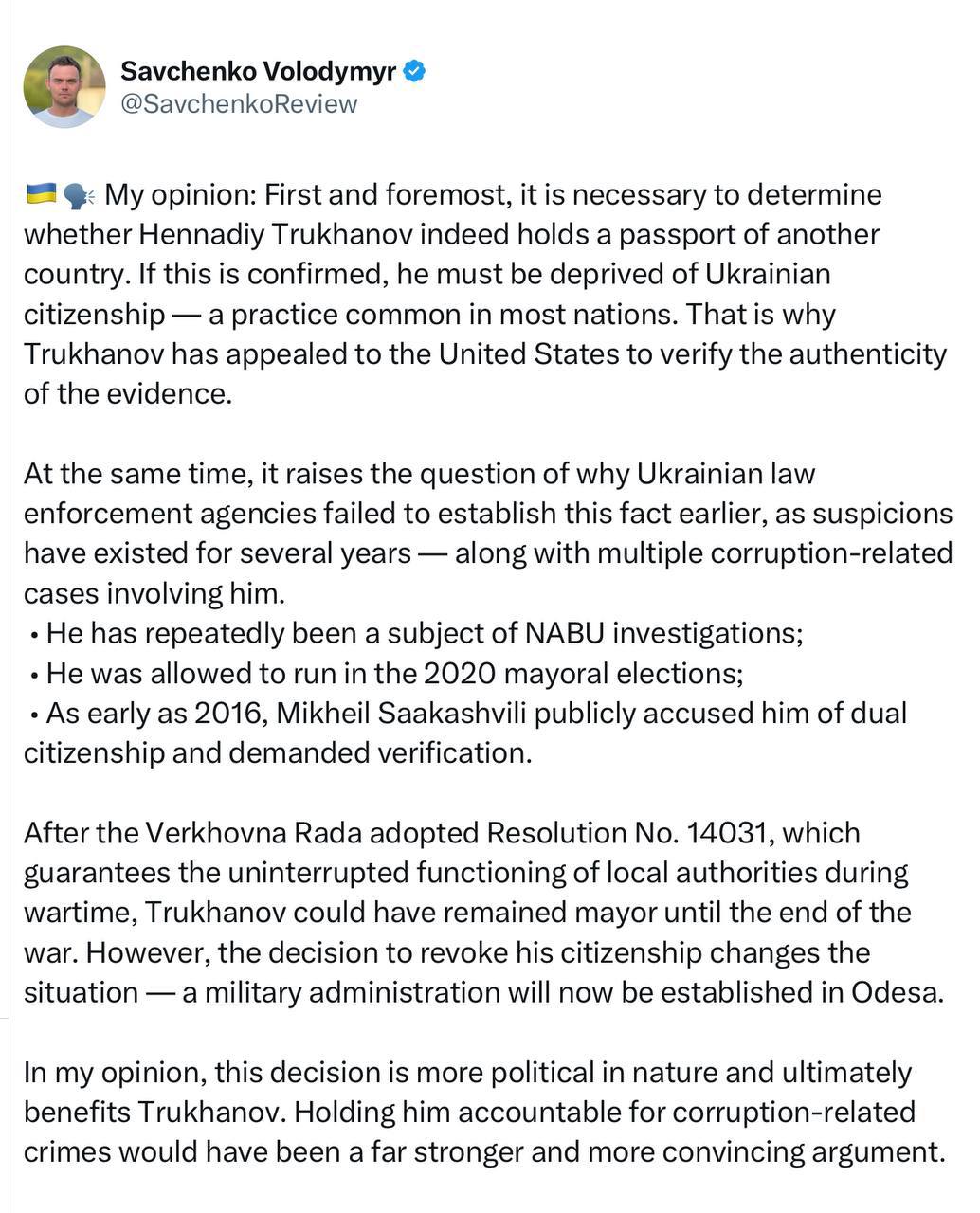
Volodymyr Savchenko, CEO of “The Ukrainian review” expressed his opinion about political nature of this decision:
Opponents also refer to the point, that mayor has been chosen in a democratic way:
To remove Trukhanov? Then please do it only in a legal way. There are many questions to Trukhanov, criminal cases are open against him. So investigate, prove, take the case to court. Open court hearings so that everything is public. So that his voters can see what happened, — wrote people’s deputy Oleksii Honcharenko on Facebook.
Conclusion
The story of Hennadii Trukhanov’s deprivation of citizenship goes far beyond Odesa politics. It has become a test for the Ukrainian legal system and for understanding the limits of state security in wartime. On the one hand, the fact that the mayor has a Russian passport is a matter of national security and the moral legitimacy of the authorities. On the other hand, any decision made without clear evidence and following constitutional procedures risks becoming a dangerous precedent that will undermine the rule of law.