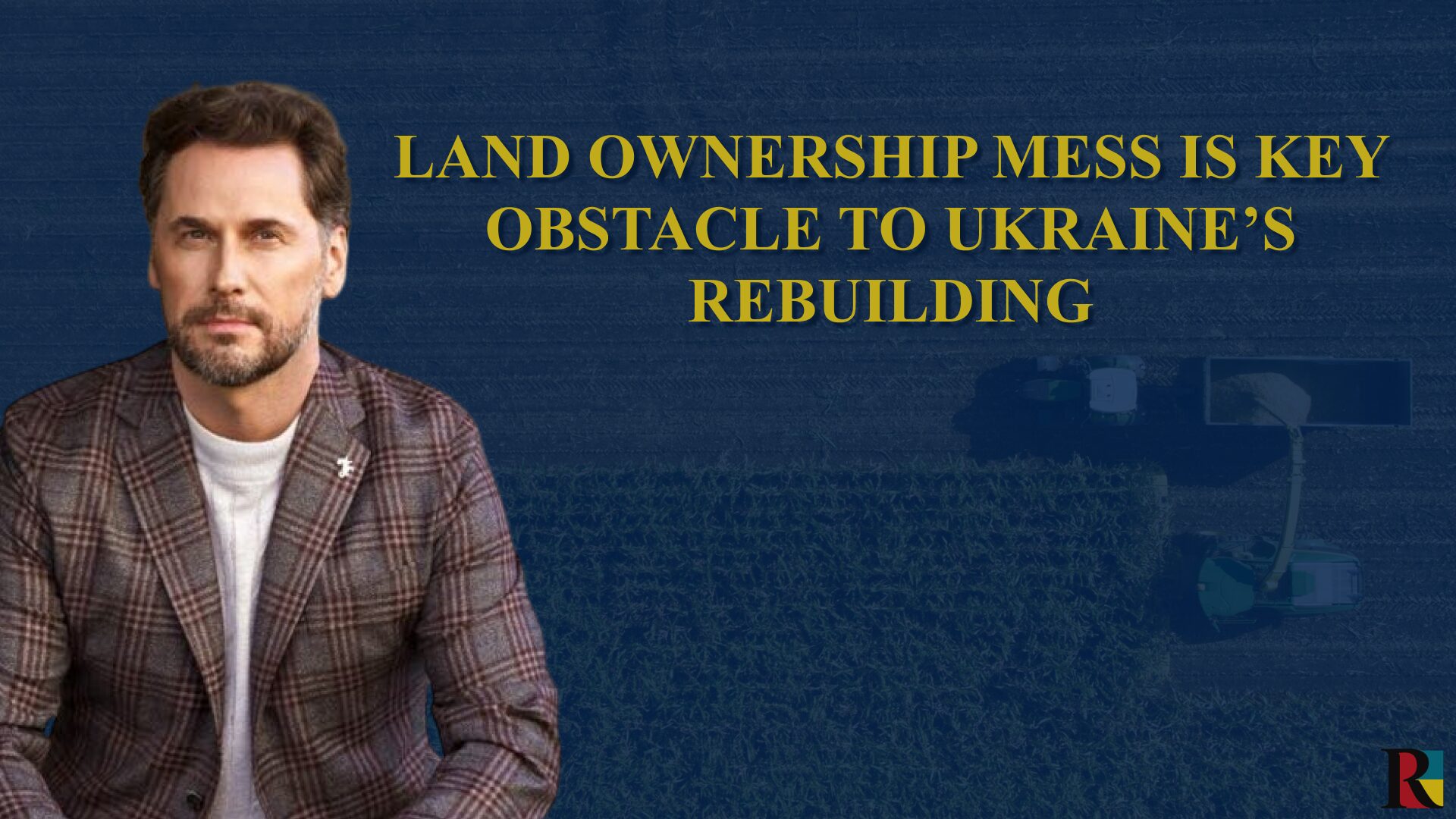


In this interview with Dovydas Vitkauskas* we examine one of the most important issues facing the Ukrainian economy – the issue of land ownership and privatization.
*Dovydas Vitkauskas’ various consultant roles in Ukraine include a Team Leader of EU-funded governance and rule of law reform projects from 2016 to 2021. He has also been acting as advisor to two consecutive administrations of the President of Ukraine.
Q: At various international conferences since 2022, the estimated cost of rebuilding Ukraine to its pre-war level has been set at around USD 500 billion (study by the World Bank, United Nations, European Commission and Ukrainian government). Who can provide such significant resources?
D.V. (smiling): Hard to say. I know who can’t – the European Commission. Despite their promises, Brussels bureaucrats have not been able to even structure the modalities of a long-promised “Ukraine Facility” program, allegedly worth EUR 50 billion. The EU is currently only providing loans to help Ukraine’s budget balance, but no resources for rebuilding. Nor will this money come from frozen, sanctioned Russian assets. Neither will it come from the US Government, for obvious political reasons. Most unfortunately, this caliber of funds is not likely to come from private Western investors, whom Ukraine has consistently spooked over its history of independence since 1991. Having said that, with some external funding, the Ukrainian private sector is capable enough to generate growth necessary for the country to get back on track and ultimately realize its potential – on condition that the Ukrainian government finally gives away the main resource it has always kept away from the Ukrainian people and business – land.
Q: But land was promised to be given to the people already a hundred of years ago …
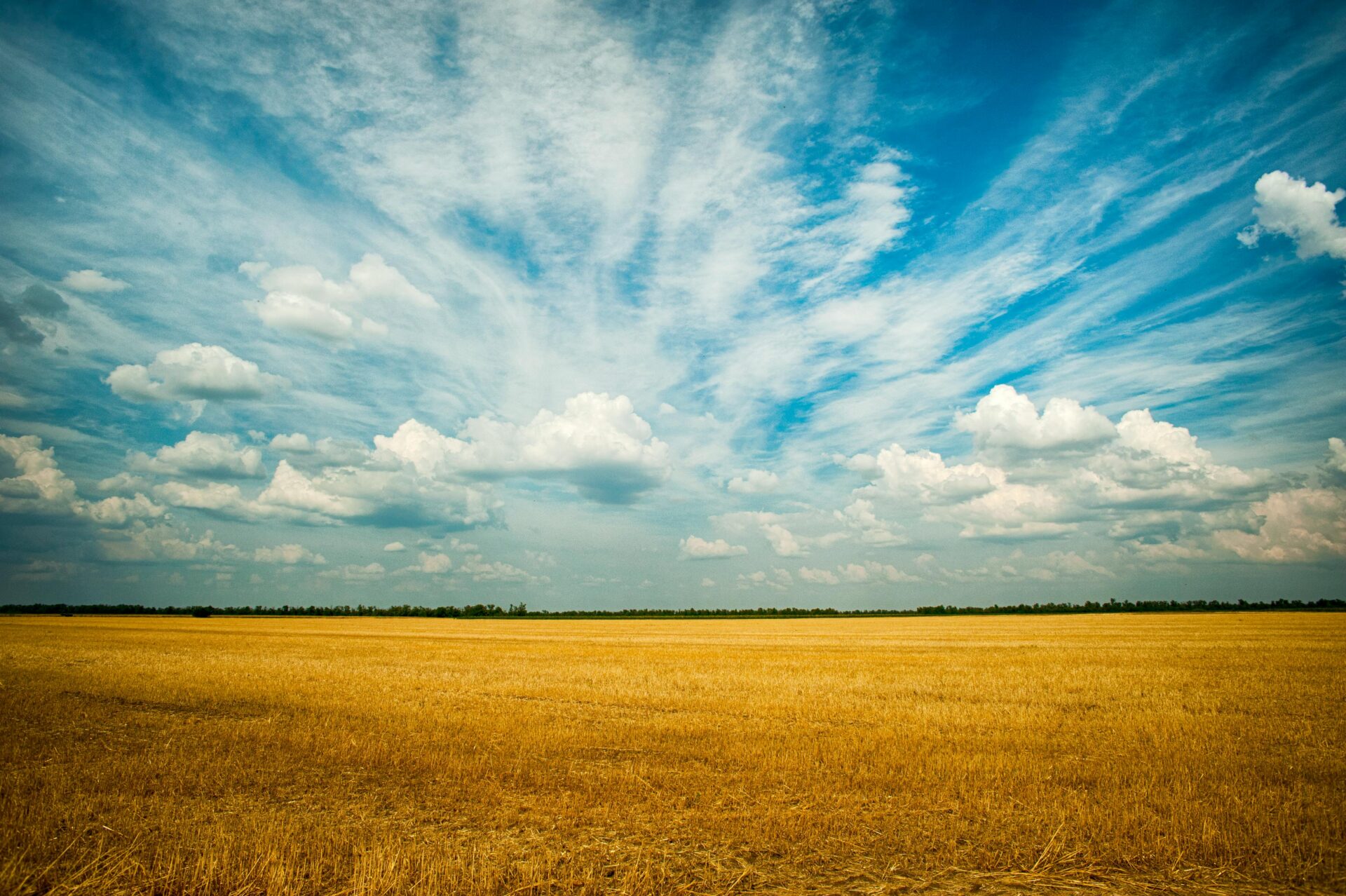
D.V.: The Ukrainian agricultural land was never properly privatised. Lenin’s famous slogan about “land to the peasants!” was never addressed in essence – either by the Soviet authorities, or by those of independent Ukraine for 3 decades. The old Soviet and modern Ukrainian policy on land has in fact, been very similar, despite grand declarations to the contrary. The vast majority of Ukraine’s agricultural land – approximately 40 million hectares (nearly 100 million acres) – was distributed in the early 1990s in small parcels to around 7 million Ukrainian citizens who worked on that land. Most received plots of up to 5 hectares (12.3 acres) in the form of so-called “land shares” (pai in Ukrainian), which could be leased out or used, but not sold. In theory, this was meant as a soft form of “privatisation”. In practice, it became a windfall for local oligarchs – often former Soviet collective farm managers – who quickly amassed hundreds or thousands of such “land shares” on long-term lease for peanuts. Since Ukraine gained independence, about 76% of small farmers and other Ukrainian citizens have leased out their plots under this system. It is no surprise that even today, Ukrainian farmers are often colloquially referred to as kolkhozniks [workers at collective farms] who do not control their main resource – agricultural land.
Q: In 2021 the agricultural land market was finally opened in Ukraine, isn’t it?
D.V.: Very belatedly, by 30 years, compared with other post-communist countries. The 2021 land ownership law was passed only after tremendous pressure from the World Bank, the EU and other international experts. The “open land market” now means that a “land share” can finally be sold and registered properly as a full-fledged real property title. However, the 2021 reform has been shackled by handicaps right from the outset: one individual cannot own more than 100 hectares (247 acres), while legal entities have been, until last year, barred from land ownership. Foreigners are still entirely barred from purchasing Ukrainian land, even indirectly through corporate shareholding.
Q: Any progress since 2021?
D.V.: Gradual privatization of agricultural land has moved at a snail’s pace, due in part to the geopolitical risks brought by the war. Individual landholders still collectively keep around 30 million hectares (74 million acres) under the old system of “land shares” since the early 1990s, and only a tiny portion of that lot has been properly privatized since 2021. In addition, since Soviet times, nearly a quarter of the total Ukrainian agricultural land mass – or about 10 million hectares (12.3 million acres) – remains under direct control of various government institutions or State-owned companies. Only the Ministries of Justice and Internal Affairs of Ukraine control over 50,000 hectares (123,000 acres) in agricultural land each. As in the days of the Russian Tsars and later the Soviet Union, the critical economic resource remains in the hands of State “chinovnicks” [persons employed in the field of public administration – S.K.], who should have nothing to do with agriculture, business development or lending.
Q: Who benefits from the system?
D.V.: Local agro-oligarchs have been – and continue to be – the primary beneficiaries of this system. They have paid very cheaply for long-term lease of “land shares”, theoretically still belonging to millions of small farmers and other individuals. As far as the State-controlled land is concerned, there is no predictable standard or criteria for leasing state-owned assets, nor a comprehensive register of leased or sub-leased agricultural plots. Each public authority operates based on its procedures and approaches, often leading to discrepancies between the legal and actual status of land. A few years ago, satellite data collected with the support of the World Bank revealed that tens of thousands of hectares under the control of Ukraine’s Interior Ministry were actively cultivated. Yet the Ministry’s leadership was unable to explain to international partners who was using the land, or on what legal basis.
Q: How much of Ukrainian land can truly be said to be “private” and available for sale? And how much does it cost?
D.V.: As of mid-2024, only 0.56 million hectares (1.38 million acres) of agricultural land had been properly transferred or registered as land ownership titles in the relevant registers – that is, only 1.35% of the total agricultural land mass. This raises a logical question: how much does land cost in a country, often considered to have the most fertile soil in the World? It is difficult to answer, as there are still too few transactions on the market. Currently, the average price is around 51,000 UAH (about USD 1,200) per hectare, or slightly less than USD 3,000 per acre. But you can buy it only if you are a Ukrainian national [has a Ukrainian citizenship – S.K.], or a 100% Ukrainian-controlled company.
Q: Can agricultural land be used as collateral for business financing?
D.V.: Because agricultural land could not be sold until very recently, it could not be used as collateral for loans or otherwise monetized. The land purchase market is still rather primitive and cash-based. Currently, all Ukrainian banks together hold less than 50,000 hectares (123,00 acres) of agricultural land on mortgage. In the minds of Ukrainian people and business, the word “land” still primarily means a field or soil – not a financial asset. This limits opportunities for smaller farmers, who already face severe restrictions in access to credit. Despite the government’s “5-7-9” programme or other subsidies for farmers, interest rates (loans in foreign currency are not currently issued) on most business loans in local currency exceed 25% annually.
Q: What about land ownership in residential, commercial and industrial sites?
D.V. (smiling): This question reminds me of one international expert who once asked me: “why do buildings in Ukraine float in the air, instead of standing on the surface?” Indeed, since gaining independence, Ukraine has not fundamentally revised its Soviet-era approach to the theory and practice of the status of land beneath buildings. In legal terms, real estate in Ukraine is not unified and indivisible. Land is treated in legal theory – and registered and sold in practice – separately from buildings standing on it. Two separate registers still exist: the land cadaster and the real estate register, overseen by two different ministries with their registration systems. Moreover, in most Soviet era residential districts in Kyiv and elsewhere, land plots under the buildings have not even been created or their boundaries defined – hence the analogy of “building floating in air”, in legal terms.
Q: But that land exists in practice. Moreover, do people park cars or walk their dogs in the courtyards of residential neighborhoods?
D.V.: Indeed, they do it in practice. But land law should be first about theory, which is in a very messy condition in the Ukrainian legal framework and jurisprudence. The land in the courtyards of residential buildings from the Soviet period effectively belongs to the State, even though many people have “private flats” in those buildings. It is not always easy to say which central or local State institution in Ukraine is in charge of managing, leasing, or selling that land, or if it is empowered to do so at all. The “no man’s land” theory and practice, indeed. A logical question arises if a flat or building on the State-owned land can even be considered as fully “private”? Land law in most civilized Western nations does not like the duality between land and buildings. Bar some natural exceptions (“strategic” objects like ports etc.), the land and the building on it would in most cases be the same real property object, and belong to the same owner or owners. Even in rare cases in Ukraine – mostly in rural areas – where the land and the building on it belong to the same owner, the property must be transferred via two separate transactions and registrations: one for the sale of land, and another one for the building. There is also no address register or a similar system integrating geospatial data of actual objects on the ground with the “legal cake” defining those objects – such as the nomenclature and property rights of flats, buildings, street names and the country’s administrative-political divisions. The non-consolidation of this core data creates additional risks and uncertainties for planners, regulators, developers and owners.
Q: State-owned companies of Ukraine are also important landholders, don`t they?
D.V.: Very significant. More than 3,000 state-owned enterprises in Ukraine (17,000 if municipal companies are included) essentially function as real estate holdings, controlling hundreds of thousands of hectares of residential, commercial, and industrial land in urban areas. Local authorities are also both holders and regulators of urban land. Most property developers in Ukraine still build “private” apartment complexes on State-owned land. It is still extremely rare that a developer buys a plot of land to build on it. Among Ukrainian developers, the land is colloquially referred to as ploshchadka (site), intended for construction, rather than something which would imply any permanent ownership. There is no unified system for leasing or managing State-owned land. Hundreds of public bodies – from state enterprises to local governments – issue lease agreements to property developers according to their own rules and procedures. For example, in Odesa, State-owned land is typically leased by the municipal authorities for 10-15 years. The lease arrangement must be done before a building permit is issued. But there is no guarantee that the project will be completed or apartments sold by the time of expiry of that lease. But having properly formalized land is not even necessary in order to build. In Dnipro, for instance, the question of leasing the State-owned land plot to a developer is usually decided by the municipal authorities after the building has already been constructed.
Q: Can a developer be sure of having land rights, even after the completion of construction?
D.V.: He can’t. It’s a risk he must be willing to take. This regulatory chaos primarily affects developers and construction companies, who are subject to changing political moods and leadership, even during a single project’s lifecycle. But the biggest losers are private buyers of apartments in those buildings. Once you buy a flat in the vast majority of new residential developments in Ukraine, you continue to pay monthly rent to the local or central government for the land the building sits on, alongside your utility fees, even though you “own” the apartment. There is no clarity about what that rent will be tomorrow, or whether the lease will even be extended by a State authority. The line between private and public real property ownership is extremely blurred.
Q: Then what’s the use of a building permit to regulate residential, commercial or industrial construction?
D.V.: One upside in Ukraine is that obtaining a construction permit for residential development is relatively quick in most municipalities. But in practice, the building permit provides little legal certainty. Even projects already underway can be delayed due to community complaints about urban planning or design, disrespect for the city zoning requirements and strategic master-plans, objections from neighbors or competitors, or changes in the local government attitude – all that, after the permit had been issued. In many cases, the fate of a building permit is ultimately decided in court. This protracts some residential building projects for years, despite a relatively quick permit process. For complex industrial projects, like port basin deepening, there is no “one-stop” building permit at all. In such projects, developers must navigate a maze of overlapping and often conflicting approvals from dozens of state bodies.
Q: What are the proposed solutions to fix the problems of land ownership?
D.V.: Ukraine must not only continue to improve its digital governance tools (such as the Diia-app front-office, which is a rather quality product), but also focus more on the data quality and its back-office. A move from the “documents-based” approach to the “data-based” approach to property registration is indispensable. This includes standardizing, consolidating and digitalizing all property records – starting with merging the land cadaster and real estate register, centralizing the register management, creating a two-tier register system (“basic” and “other” registers), implementing an address register policy which has been on the table for a decade. Change legal perceptions to disable crooks who live on fabricating data in real property and other registers. The existing data in electronic registers must be granted legal precedence over bureaucratic decisions or paper “proof”. Dozens of loopholes that allow officials to alter even electronic register data at will must be eliminated. In Ukraine, the term “raiding” often refers to fraud, where ownership of real property or a company is effectively fabricated by simply changing the owner’s name or title in the relevant register. Instead of wasting resources on complaint-handling “commissions” or chasing “black notaries”, the government should rather invest in systemic and preventive measures that truly safeguard property rights.
Q: These do not sound like easy solutions.
D.V.: Where there is a will, there is a way. The technicalities of conducting the above reforms have been conveyed to the Ukrainian counterparts by a multitude of international experts and reports long ago.
Q: But private land, especially in the hands of foreigners, is a politically divisive issue.
D.V.: If Ukraine intends to rebuild after the war, the process of privatizing agricultural land must be significantly accelerated, including allowing foreigners to acquire ownership. It is agricultural land – and not opaque ‘rare mineral” deposits – which is by far Ukraine’s greatest natural resource. It is not being used to any proper extent, as the matters stand. The State bodies should stop issuing leases on State-owned land of all types and instead pursue transparent and efficient privatization. “Private” buildings on State-owned land should become the exception (e.g., ports and other strategic assets), not the rule. Land and buildings must be indivisible in theory, as in practice. In rare cases where the use of State-owned land could justifiably continue in private hands, there must be clear standards and procedures for leases to be issued or renewed. The key is not which level of government (local or central) leases the land, but how predictably and foreseeably it does so. This would help develop safeguards to prevent both “raiding” of private property, as well as corruption in the handling of State-owned land.
Q: How can the banking system contribute to a better quality of land rights?
D.V.: Ukrainian authorities and businesses have not yet fully understood that land is a financial instrument. Properly registered private land will eventually lay the basis for a better-quality mortgage, and thus lower interest rates with a healthier credit system. Ukrainian banks are still cautious when it comes to property development or supporting agricultural land privatization. The mortgage market remains very limited because banks see the aforementioned land ownership regulation and practice as a risk. Bank financing using private land as collateral would be critical in improving:
a) ownership security for buyers;
b) developer accountability to planning and construction standards;
c) building quality;
d) energy efficiency;
e) overall project scale and profitability.
Q: Can there be private property of land without the rule of law?
D.V.: It’s the other way round – only once more clear and foreseeable private land ownership takes shape, Ukraine can gradually expect improvements in its rule of law. As long as the State controls a key economic resource such as land, forget dreams about a proper rule of law or anti-corruption. The incentives to use State-owned land as a chance of easy profit will always be greater than any possible institutional checks and balances. The effect of private land ownership on integrity and anti-corruption will present itself as a logical chain:
a) businesses with better-quality collateral such as land will borrow and invest more;
b) the developing concern for credit ratings will encourage long-term thinking in business, as access to financing will depend more on reputation;
c) this, in turn, will promote debt repayment and more sustainable and long-term business partnerships;
d) more and larger bank-financed projects will fuel greater competition among businesses;
e) greater competition will facilitate a genuine demand from the business and political elites for the society to be based on rules, not mere interests supported by blunt use of political or financial power.
Full-fledged private land ownership would also have broader positive effects in society, fostering taking care of your land. All in all, without private land ownership, a wealthy and European Ukraine is not possible.
Interview adopted for a publication by Stanislav Kinka