

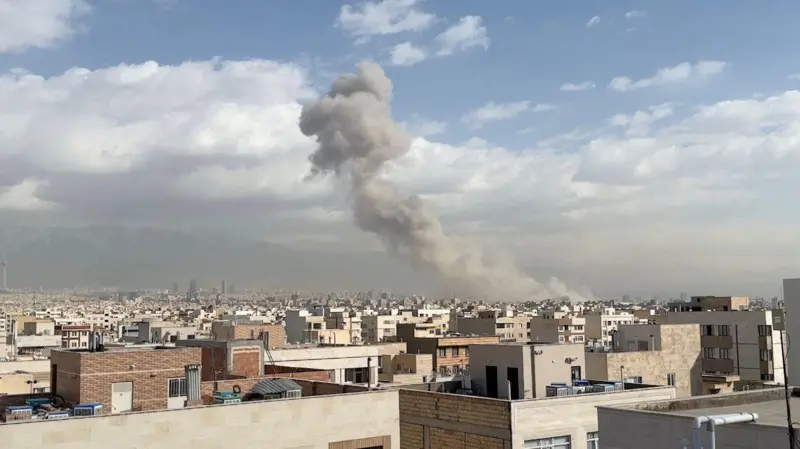
On February 28, 2026, Israel launched a series of strikes against Iranian military and infrastructure facilities in Tehran, Qom, and Isfahan. Defense Minister Israel Katz described it as a preventive operation. The United States joined the campaign, and President Donald Trump announced the beginning of a large-scale military phase. In response, Iran is expanding the geography of its strikes: explosions and airspace closures have already been recorded in the UAE, Qatar, Bahrain, and Kuwait — countries hosting both major energy hubs and U.S. military infrastructure. This fundamentally changes the scale of risk: the issue is no longer just Iranian oil, but the entire Persian Gulf.
Approximately 20% of global seaborne oil supplies pass through the Strait of Hormuz. If hostilities affect tanker logistics or port infrastructure in the UAE or Qatar, the market would face a double blow — to both transit routes and production. Iran produces about 3.3 million barrels per day, but together with Saudi Arabia, the UAE, Qatar, and Kuwait, more than 18–20 million barrels pass through the Gulf daily. This represents a volume critical to the global economy.
Price reactions are already being priced in. If the conflict remains localized and the strait is not fully blocked, Brent crude could stabilize in the $100–110 range. If transit is partially halted or infrastructure in Dubai or Qatar suffers sustained strikes, the market could quickly test $120–140 per barrel. In the event of a full maritime blockade, peak levels of $150 cannot be ruled out.
Economic Consequences for Europe
For Europe, this translates into concrete numbers. As of February 2026, the average gasoline price in EU countries ranges between €1.60 and €1.80 per liter. If Brent rises to $120, prices at the pump could increase to €2.00–2.20. In a stress scenario with oil at $140–150 per barrel, prices could reach €2.20–2.50 per liter in Germany, Austria, or Italy. Diesel may respond even faster due to logistical demand. This implies a 25–40% increase within a matter of weeks.
The EU is no longer critically dependent on Iranian oil. Since 2022, its main suppliers have been Norway, the United States, and Kazakhstan. However, global prices are unified. Even if physical shortages are offset by strategic reserves and increased output from the North Sea or the U.S., the risk premium would remain.
Another factor is the possibility of strikes on Saudi oil facilities similar to the 2019 attacks on Abqaiq, which temporarily cut 5% of global production. If such a scenario coincides with tensions in the Strait of Hormuz, the effect would be multiplicative.
Comparisons with 1973 are understandable but structurally inaccurate. During the Yom Kippur War, OPEC countries imposed an embargo, and oil prices quadrupled. At that time, the West lacked strategic reserves, and the U.S. was not a major producer. Today, the United States is one of the world’s leading producers, and Europe has emergency intervention mechanisms. A repeat of a +300% spike is widely considered unlikely.
The most probable scenario is 3–6 months of expensive fuel, inflationary pressure of +1.5–2 percentage points, and renewed debate over Europe’s energy autonomy. There will be no collapse or fuel rationing, but the psychological and financial impact on households and businesses will likely be felt as early as this spring.