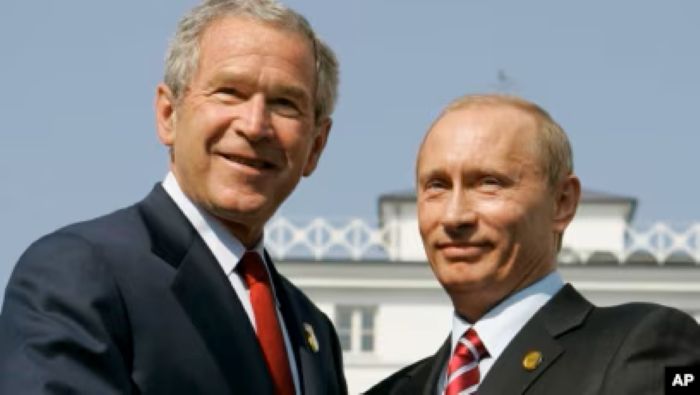


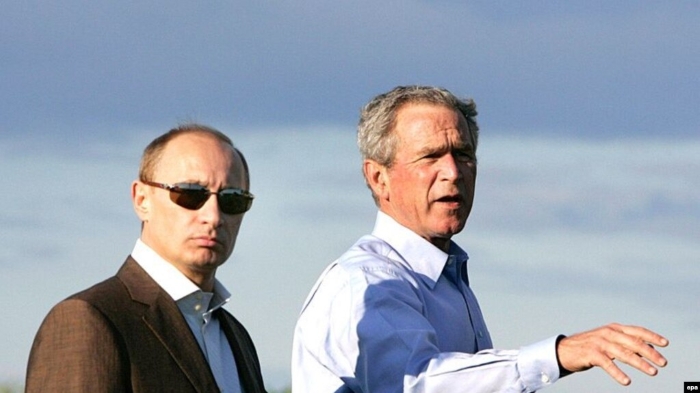
The United States has released verbatim transcripts of meetings and telephone conversations between Vladimir Putin and the 43rd President of the United States, George W. Bush. The documents cover the period from June 2001 to April 2008. These materials once again show that Russian imperial ambitions have deep historical roots. They also demonstrate that misperception of Putin, especially by U.S. presidents, have produced tragic outcomes.
Iran and Nuclear Developments
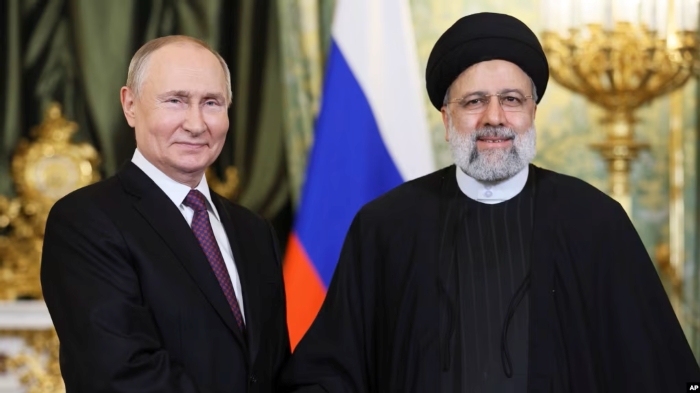
Declassified transcripts reveal discussions between Vladimir Putin, George W. Bush, and Condoleezza Rice, Former US Secretary of State, on Iran’s nuclear ambitions and Russia’s role in them.
The presidents discussed possible strategies regarding Iran’s nuclear program. The U.S. president initially supported Putin’s so-called “ingenious” proposal. Under this plan, Russia would supply fuel for civilian nuclear power plants. This approach aimed to deprive Iran of arguments in favor of independent uranium enrichment. Putin stressed that the construction of new reactors is a long-term process that can take up to 15 years. Therefore, he argued, Iran had no urgent need to enrich fuel at that stage.
Russia formally insisted on the scheme and its good role. However, Moscow simultaneously blocked tough sanctions in the UN Security Council. It also delayed or softened resolutions addressing Iranian violations. After 2022, Russia began using the Iranian nuclear issue as a bargaining chip in its dealings with the West.
Threats to Other Countries
The transcripts also expose Putin’s nostalgia for the Soviet Union. At the same time, he blamed Soviet leaders for the collapse of the state.
Putin described the dissolution of the USSR as an unprecedented act of “goodwill.” He claimed that Soviet authorities voluntarily gave up thousands of square kilometers of territory.
What really happened? Soviet good will changed the world, voluntarily. And Russians gave up thousands of square kilometers of territory, voluntarily. Unheard of. . Ukraine, part of Russia for centuries, given away. Kazakhstan, given away. The Caucasus, too. Hard to imagine, and done by party bosses. Then there was Chechnya. Russia left in 1996 and then what happened? Radicals came in from Arab countries and attacked neighboring provinces, stated Russian dictator.
This narrative shows that Putin views post-Soviet states as inherently “Russian.” He seeks to keep the region under imperial influence. He does so either by installing loyal governments or through direct military occupation, as seen in Chechnya and Georgia as well. Within this framework, Putin repeatedly labels Ukraine as an “artificial” state.
NATO Enlargement
President Bush argued that Russia no longer constituted an enemy and should welcome NATO enlargement. In his view, the Alliance stabilized Russia’s western borders.
Putin responded by saying that Russia felt “left out” of NATO. He turned to historical arguments and recalled the Soviet Union’s application to join the Alliance in 1954. NATO rejected that request. The Alliance cited unresolved Austrian and German settlements, totalitarian control over Eastern Europe, and a lack of cooperation in UN disarmament efforts.
Putin argued that, by the time of these discussions, all those conditions no longer applied. He suggested that Russia could therefore qualify as a potential ally.
Conclusion
These transcripts demonstrate that Putin has consistently portrayed Ukraine as an “artificial” state. In this sense, He is a product of long-standing Russian imperial thinking. He openly views the collapse of the Soviet Union as the greatest mistake in the history of the Russian state.
The documents also reveal a persistent pattern of manipulation on Russia’s part. During the Soviet period, Ukraine remained silenced. After regaining independence, Russia treated it not as a legitimate sovereign state but as a temporary anomaly. Putin repeatedly portrayed Ukraine as a patchwork of territories taken from others. For years, he demanded a halt to NATO enlargement while mimicking “Western” politician. He played a double game and prepared the ground for aggression across the post-Soviet space.
Today, the overwhelming majority of Ukrainians have clearly demonstrated that they do not identify as Russians. Therefore, the international community should no longer accept Putin’s claims about partnership and reject his alternative version of history.