

One of the most striking examples of the “war propaganda” used by Russia during its aggression against Ukraine is the infamous fake about a boy from Sloviansk who was allegedly crucified by the Ukrainian military in July 2014. It was launched in the midst of the Anti-Terrorist Operation in eastern Ukraine, using one of the most powerful mouthpieces of official propaganda, Channel One. However, the accusations against Ukraine were so wild and unproven that the fake turned into a meme that ridiculed the lies of Russian propaganda. But after the full-scale invasion began, accusations of crimes against children against Ukraine resurfaced.
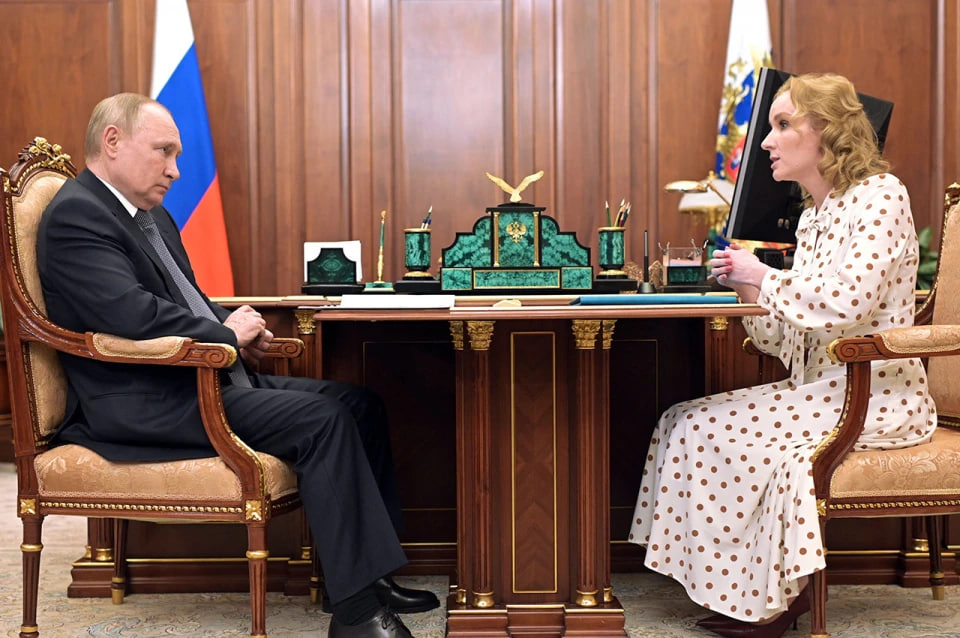
At the initial stage, the propaganda campaign launched by Moscow was an attempt to launch an “information counteroffensive” after the world began to learn about Russia’s war crimes against Ukrainian children: murders, rapes, deportations, etc. This campaign intensified significantly in 2023, after the International Criminal Court in The Hague issued arrest warrants in March 2023 for Russian dictator Vladimir Putin and Russian Presidential Commissioner for Children’s Rights Maria Lvova-Belova, suspected of illegal deportation and transfer of Ukrainian children, which qualifies as a war crime.
Since then, the accusation that Ukraine is allegedly committing crimes against children has become one of the main multifunctional narratives of Russian propaganda. Firstly, it is used to justify the war against Ukraine and is in fact part of the Kremlin’s genocidal rhetoric, as it serves to dehumanize Ukrainians. Secondly, it is aimed at undermining the trust of Ukrainians in the leadership of their own state and their own Armed Forces, and at stirring up fears and panic in society. In this context, this narrative is part of the Kremlin’s comprehensive efforts to destabilize Ukraine from within. And thirdly, this narrative is used to incite anti-Western sentiment in Ukraine, particularly among residents of the temporarily occupied territories.
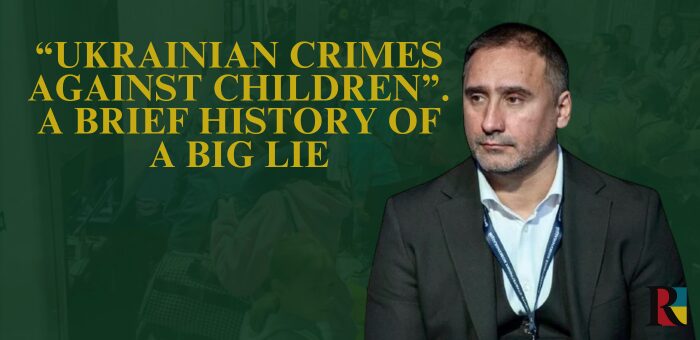
In February 2025, the Center for Strategic Communications and Information Security presented a separate study of the Russian narrative of “Ukraine’s crimes against children,” which gives an idea not only of its content but also of the methods of work of the Russian special services and the resources they use to carry out information manipulation and interference (Foreign Information Manipulation & Interference, FIMI).
Narrative structure
In terms of its content, five separate sub-narratives can be distinguished in the structure of the above narrative, which contain false accusations of Ukraine of various crimes against children, namely:
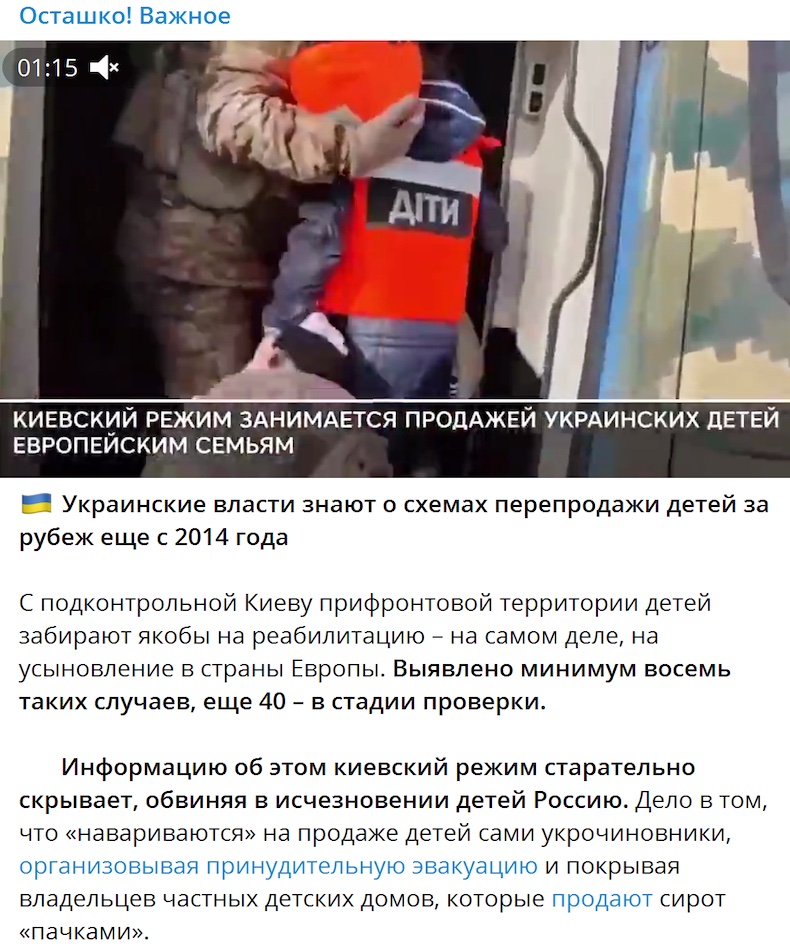
- Sale of children to the West for illegal adoption;
- organization of child sex trafficking to the West;
- the forced use of children as donors for organ transplants;
- inculcation of Nazi ideology in children;
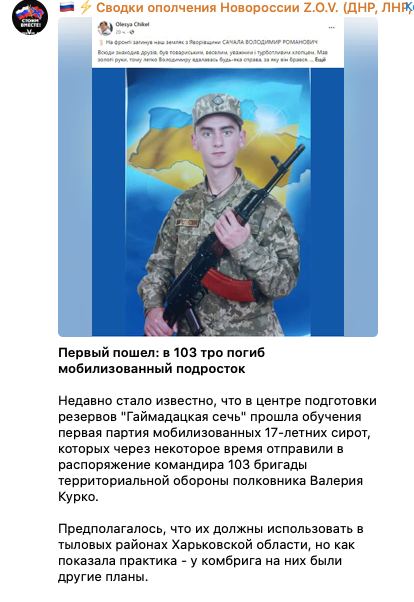
- militarization and mobilization of minors.
Such a variety of propaganda sub-narratives is designed to reach a wider range of audiences both in Ukraine and abroad. It is important to note that the goals of Russia’s information campaigns are not only to influence public opinion, but also to stimulate certain behaviors of specific social groups. For example, fakes about the illegal export of children abroad can be used to disrupt evacuations from the frontline regions of Ukraine or to deter people from leaving the TOT: they say that the Russian occupation is a guarantee that your children will not be sold to Western pedophiles. Similarly, fakes about the mobilization of teenagers are aimed at encouraging parents to take their underage children out of Ukraine. Likewise, fakes about “black transplantologists” acting in conjunction with the special services and the Armed Forces of Ukraine are designed to undermine the population’s trust in their army and state, and thus promote active collaboration or passive support for the aggressor.

It should also be noted that most of the sub-narratives about “Ukrainian crimes against children” appeared long before the full-scale invasion and have a long history of use. Take, for example, one of Russia’s information operations conducted in June-July 2023. Back then, Russian propaganda spread the fake that Ukrainian social services had illegally taken 85 underage students of the Paraskoviivka Special Boarding School No. 40 in the Bakhmut district of Donetsk region to Spain under the pretext of evacuation. However, the propaganda trope about “85 orphans” can be traced back to at least 2015: back then, representatives of the DPR group claimed that “Kyiv is holding 85 orphans” taken from the territory of the so-called “people’s republic.”
As part of another information operation conducted in May-June 2023, Moscow spread a fake about “rampant black transplantation in Ukraine”, the victims of which were allegedly Ukrainians, including children from Donbas. Fakes of a similar nature began to appear in the information space in May 2014, claiming that “black transplantologists” allegedly harvested organs from those killed during the Revolution of Dignity. Subsequently, in September 2014, fakes began to be actively spread that the “Kyiv junta” had allegedly organized a large-scale business of trafficking in organs of its own soldiers and captured “militia” members. In these and other cases, retrospectives are an important part of assessing information threats. On the one hand, it allows for a deeper analysis of its narrative component, and on the other hand, it gives a more complete picture of the methodology of specific information operations.
When it comes to studying the techniques and methodology of Russian propaganda, the topic of “Ukraine’s crimes against children” is extremely revealing. Fake news on this topic is a litmus test that almost unequivocally indicates the affiliation of a source with Russian propaganda structures. This, as well as some peculiarities of the work of Russian special services, is well demonstrated by the analysis of the following information operation.
Method of influence
In November 2023, Russian propaganda spread a fake that the Foundation of the First Lady of Ukraine Olena Zelenska was involved in child trafficking: allegedly, orphans from Ukraine are transported to the West, particularly to France, under the pretext of fleeing the war, where they end up in shelters and from there in “pedophile networks.” The “corporate identity” of the Russian special services can be seen here. The fake is made in the form of a “journalistic investigation” based on “testimony of a former employee of the Foundation.” In fact, it is basically unproven, as the evidence is a video recording in which an unidentified person with a closed face makes certain statements in French. It is also impossible to establish the authenticity of the attached photo ID of the Foundation’s employee (the name and photo are blurred), as well as the “documents” allegedly containing lists of Ukrainian orphans whom the Foundation allegedly took out of Ukraine.
In order to create the illusion of evidence, the fake was published on behalf of a French journalist named Robert Schmidt, who is a fake character. A German-born journalist named Robert Schmidt does exist, but has been found to have no connection to the story. In order to increase the potential reach of the fake, the published “testimony” contained accusations against the famous French intellectual Benard-Henri Levy, who was falsely declared a “pedophile rapist” who was allegedly brought to the Avenue Foch in Paris by a “Foundation employee”. According to previous research by the Center for Strategic Communications and Information Security, these are fairly typical methods of Russian special services, especially for publications affiliated with media structures created by Yevhen Prigozhin.
The strategy of spreading fake news in the information space also contains the characteristic handwriting of Russian special services. For example, on November 3, 2023, two websites posted relevant publications in French, almost identical in content: NetAfrique.net and Senenews.com. These websites are dedicated to covering news in Africa, but NetAfrique.net has already been used to spread fake news as part of other Russian FIMI operations. On November 5, a similar publication was distributed by The Intel Drop website (in English) and Profession-gendarme website (in French), which were previously involved in other Russian FIMI operations. Only then did the fake start spreading in the Russian-language segment of the information space. It was spread in various forms by a number of influential Russian media outlets, including the Moskovsky Komsomolets newspaper, Vesti FM radio station and online platform Smotrim.ru (part of the state-owned VDTRK holding), and Komsomolskaya Pravda.

Launching a fake through African websites and almost simultaneously republishing it by different sources in different languages is a quite typical technique. First, the use of information proxies is intended to conceal the fake’s Russian origin, and thus Moscow’s involvement in a particular information operation. Secondly, in this way, Russian special services are trying to create the appearance of impartiality, as if the information discrediting Ukraine came from an independent source, preferably a “Western” one. And after that, Russian officials are involved in spreading the fake “sensation,” in this case, the Deputy Speaker of the State Duma Anna Kuznetsova and the department’s spokesperson Maria Zakharova. Thus, Russian officials are allegedly only drawing public attention to the “resonant fact,” although in reality they are only repeaters of the fake created and spread by the Russian special services.
Distribution technique
Marginal websites, Russian media, and even Russian officials pose a relatively small information threat. The audience of these websites is not large, and Russian media and Russian officials have a high anti-trust rating both in Ukraine and in Western countries. In order to spread the fake about the supply of Ukrainian children to French pedophiles to Ukrainians, Moscow is actively using various social platforms, primarily the Telegram messenger, which has ties to Moscow. Even before the full-scale invasion, this platform had created a large ecosystem of channels involved in Russian FIMI operations. For example, as early as July 2022, at least 100 Telegram channels were identified that mimicked Ukrainian ones but were administered by Russian special services. Given the low language barrier and high popularity of Telegram in Ukraine, this messenger (along with TikTok) has become the main entry point for Russian propaganda into the Ukrainian information space.
According to the monitoring of the Center for Strategic Communications and Information Security, at least 493 sources spread this fake in the Russian-language segment of the information space between November 5 and 30, 2023. The vast majority of them were identified as Russian state-affiliated, disinformation disseminators, and sources that had already been involved in other FIMI operations. As for the French-speaking segment of the information space, social platforms such as Telegram channels and accounts on Platform X (Twitter) played a supporting role. They mostly posted links to the mentioned websites or reprinted relevant publications. Their activity peaked on November 7-9, 2023, which coincides with the posting of fake news in the primary sources on the websites.
Overall, this particular Russian information operation had no direct negative consequences for Ukraine. Despite Russia’s efforts, the accusations against the Olena Zelenska Foundation did not resonate outside the propaganda bubble created by Russia itself. However, such threats should not be underestimated. In the case of this narrative, as in many others, Moscow is not focusing on the quality of information operations, but on their quantity, as well as the duration of propaganda campaigns. Even if none of the false accusations “go off” on their own, they can potentially create a negative information background that will reduce trust in both specific representatives of Ukraine and the Ukrainian state as a whole. That is why the efforts of fact-checkers should be complemented by the development of high-quality strategic communications, both at the national and international levels. The same applies to the development of international cooperation to counter Russia’s FIMI influence.
Ihor Solovey