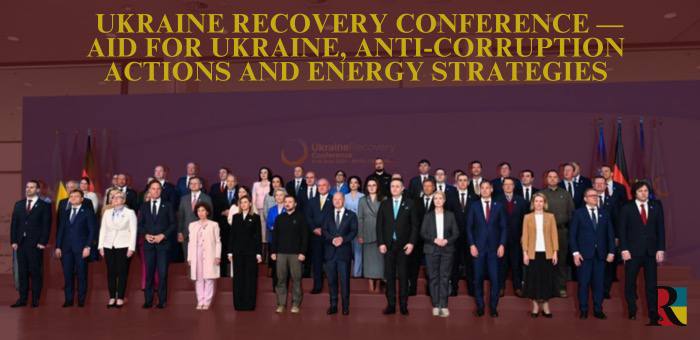


On June 11-12, the Ukraine Recovery Conference – URC2024 – took place in Berlin, bringing together leaders of governments, international organizations, businesses, and civil society. This year’s conference was held under the slogan “United in Defense. United in Recovery. Stronger together”. An EU member state hosted the event for the first time.
The conference’s main topic was further internal changes in Ukraine, which are necessary for sustainable and effective international cooperation.
The main idea of the Ukraine Recovery Conference 2024 was more reforms by Ukraine to enable new stages of support from other countries. According to the rhetoric of the conference participants, the key requirement is Ukraine’s conscious readiness not only to make high-profile commitments dictated by the desire to receive sufficient funds for reconstruction and recovery, but also to have a clear vision and strategy for concrete steps and actions.
The partners expect specific technical steps in the roadmap of transformational reforms and put forward clear requirements: a strong anti-corruption infrastructure and anti-corruption safeguards for reconstruction and recovery, effective project management in central and local authorities, sustainable political and social institutions, and capable communities.
The main topics discussed at the conference were security, energy, and political interaction.
Reforms to prevent corruption
The issue of corruption in Ukraine was also discussed. Recent sociological surveys and reports show that corruption is one of the main threats that impede the country’s reconstruction and recovery. Western partners are well aware of this problem and are signaling it. Ignoring the obvious is either professional ignorance or, worse, dangerous playing with fire.
The focus of our partners is on structural reforms in the areas of anti-corruption, decentralization, transparency, accountability, and the rule of law.
Representatives of European governments spoke in unison: we must ensure a sustainable and effective recovery ecosystem by implementing urgent anti-corruption measures and structural reforms envisaged by the Ukraine Facility plan (more than 150 indicators in 69 areas) and agreements with the IMF. This will create conditions under which accountability and transparency will become a real tool for public control over the allocated funds.
That is why Ukraine is integrating the mandatory use of the DREAM ecosystem into the key legislative framework for the country’s reconstruction and recovery – the draft law “On the Basic Principles of Recovery.” DREAM is to become a comprehensive digital solution for planning and managing public investments. Today, more than 3000 projects from more than 1000 communities have already been entered into DREAM.
Another digital tool to ensure transparency and accountability will be the Geographic Information System for Regional Development. It will ensure transparent and effective data-driven governance, strategic planning, and interaction with stakeholders at the local level, as well as monitoring of the development of regions and communities.
Human resources are a priority
Implementation of projects on the ground requires efficient and effective teams, as well as managers and supervisors who can organize their work, create clear and measurable KPIs, and ensure their implementation. We need people who will take responsibility for the recovery strategy, create a roadmap for its implementation, and promote the capacity of communities to form project groups and teams and implement their plans.
The key to success is human interaction and the provision of the necessary resources. Communities need professionals with skills in project management, strategic and spatial planning, fundraising and donor relations, grant writing, and good English, who are truly interested in the success of their endeavors.
Today, 524 communities are benefiting from international technical assistance, 160 communities are working on developing recovery programs, and 45 communities have created Community Support Teams. However, there is still much work to be done.
- In March 2024, the Government approved an action plan for the implementation of the decentralization reform following extensive public consultations with the public and international partners. It is synchronized with the Ukraine Facility and identifies key points of recovery and growth of territorial communities during the war and in the postwar years. A large part of this plan is devoted to community capacity building.
- A summary of the conference results
- The Ministry of Economy of Ukraine presented 95 investment projects worth more than $27 billion.
- European Commission President Ursula von der Leyen announced that Ukraine will receive an additional €1.9 billion from the Ukraine Facility by the end of this month.
- Vice Chancellor of the Ministry of Foreign Affairs of Estonia Marijn Ratnik reports that the Estonian Foreign Ministry fund has transferred 400 thousand euros to the Ukrainian Energy Support Fund.
- Prime Minister of the Netherlands Mark Rutte announced a new aid package of €138 million for energy infrastructure repairs, humanitarian aid, and recovery initiatives.
- EIB President Nadia Calvino announced the signing of new financial agreements providing over €1 billion in loans to support small and medium-sized enterprises in Ukraine.
- Ukraine’s Finance Minister Sergiy Marchenko and Director for Ukraine, Moldova, and Belarus Arup Banerjee signed grant financing agreements worth USD 109 million.
- During the Conference on Rebuilding Ukraine in Berlin, Ukraine joined the New Leipzig Charter for Urban Development.
- The governments of Ukraine, Germany, and nearly 50 countries have created the Skills Alliance, which aims to provide retraining or qualification opportunities for more than 180,000 people over the next three years.
- The United States is providing $824 million to support Ukraine’s energy infrastructure, said Penny Pritzker, the US Special Representative for Ukraine’s Economic Recovery.