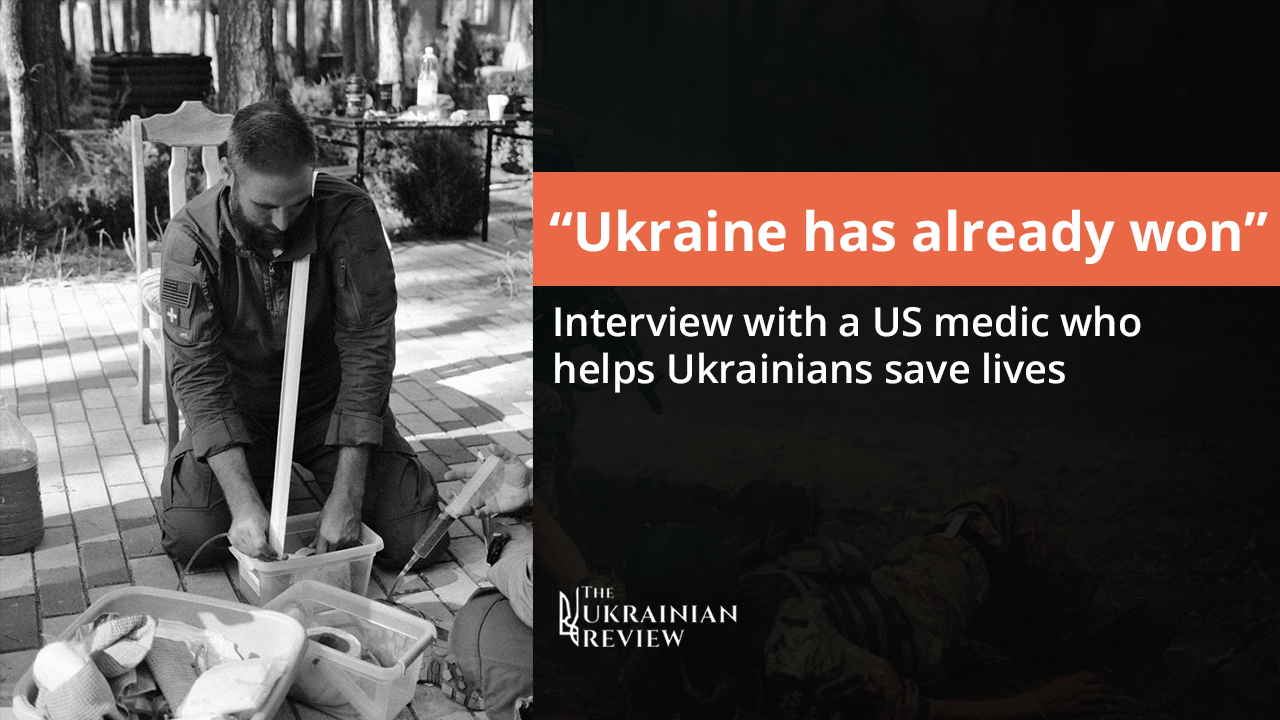


We bring to your attention a text transcript of an interview with an American medic who, since the beginning of Russia’s war against Ukraine, has been helping Ukrainians in first aid training.
I greet our listeners. Here is the Ukrainian Review. Today we have the pleasure of meeting Philip Van Benthem from Global Outreach Doctors. Philip is an advanced medical training specialist from the United States of America. He has been a paramedic since 2004, and he specializes in hostile, remote, and austere medicine. He has a master’s in international relations from Johns Hopkins University. Now Philip helped Ukrainians with the medical training, and I gave the floor to Philip.
Thank you for having me, Stanislav. It’s my pleasure to be here.
Could you tell us a little bit more about your initiative involved?
Global Outreach Doctors has been in Ukraine since October of 2022. We initially started with performing civilian evacuations, but more recently we’ve been focusing on evacuations of wounded soldiers, assisting the military, and providing medical assistance training. We focus on traumatic life support for soldiers who are wounded in combat.
And what is the first aid training for the military and the civilians? Who should attend these first aids? Is it [only] for the people who live close to the front line, or just for the people who live in Ukraine [at all]? Because you know that now in Ukraine, in a lot of cases, the Ukrainians are wounded or bled to death as a result of Russian shellings. Could you tell us about the training more specifically?
Absolutely. The training is for everybody, not just the soldiers. And not just the civilians living at the front line. We do focus on what we would call in the United States to stop the bleed. We teach the Western standards using PHTLS [Pre-Hospital Trauma Life Support — ed.], and the tactical emergency combat casualty care courses. We train a lot on tourniquets, wound packing, and chest seals. But for the civilian population, we also focus on training how to do [Cardiopulmonary resuscitation — ed.]. For people who have chronic heart disease, we also train on CPR. So, we train on [how to respond to] cardiac arrest outside the hospital. Those who receive good-quality CPR before the ambulance arrives have a much higher chance of survival. It’s not so pertinent for soldiers on the front lines. But it’s definitely going to help citizens in Ukraine. Not from Russian attacks and shellings, but just from regular cardiac arrest that kills, you know, hundreds of thousands of people every year.
And how long does the training take? And what amount of knowledge is sufficient, for example, for the military man, and for the civilian?
We understand that there are a lot of time restraints. We understand that the soldiers are very busy, and they don’t have a lot of time to train with us. We try to get as much in as possible. We’ll do a training on combat casualty care just in one day. An eight-hour course is all we need to be able to train soldiers how to effectively use their tourniquets, how to do wound packing, and how to use chest seals. And these are the primary things that are going to kill a soldier who’s wounded on the front line. And it’s the same with civilians. We will teach them how to do this and do CPR in eight hours. If we have more time, we’ll definitely train them on more advanced techniques.
Do you have only one course, both for the military man and for civilians, or some differences?
We do have additional courses. It depends on how much time we can get with the soldiers. But yes, if we have a soldier for two days or three days, we will give them more advanced training. Our ideal time is at least one week, and we can train soldiers all the way through what we call the MARCH algorithm. And it will prepare them to be a combat medic.
And what does such training allow us to achieve? Reducing the number of deaths or serious injuries. What does it give to the military man and to the civilians?
So, of the people who die from survivable injuries in combat, more than 60% of those die from hemorrhage. By teaching them how to control hemorrhage and then stop something like tension pneumothorax, we can prevent a great deal of combat deaths. And for the civilians, when we teach them CPR. If a civilian does high-quality CPR on a person who suffers from cardiac arrest outside of the hospital, that person has a two to three times more likely chance of survival if they receive that CPR. Everybody can benefit from this type of training, and we’re happy to deliver it.
Is it possible to gain this knowledge without any practice or your courses? Does it mean only the practice [during the time of this course]?
In our courses, we really strive to focus on repetition because you don’t rise to the occasion, you fall to the level of your training. We do repetition, repetition, and repetition. We focus on practicing tourniquets a great number of times in any given situation, or any given training. A soldier will put on a tourniquet or have one put on him at least 20 times. The fact that you don’t have a lot of experience, that’s not a problem. People train on this all the time, and you can become proficient after just an eight-hour course.
Are your trainings available for small or large groups? I know that the current situation is not very good to show all the information, but maybe some insights from the courses to our listeners.
Our trainings are as small as four people, but we’ve had trainings as big as 35 people. They can vary. It depends on a lot of different factors. Mostly, it’s contingent on how many trainers I have available to me. If I have too many students, we’re not doing a great job if we don’t have enough trainers.
Are there different protocols [for doing such trainings] in America? [I am not sure, but] in Ukraine, we have a lot of different protocols. Could you learn something from the Ukrainian [medics] right now? Because a lot of military men experience a lot of challenges on the front line. Maybe they can teach you or your colleagues in this sphere of first medical aid.
We are learning a great number of lessons from the Ukrainians right now, and they’re doing an incredible job given the circumstances. We’re very proud and honored to work with them. Now, the way we teach to the Western standards. We use tactical combat casualty care protocols, and we teach to PHTLS protocols. We don’t try to skimp on it. We try to make sure that everyone’s getting proficient Western-style training and credentials. The Ukrainians; they are teaching us lessons every single day about the way they practice medicine and such austere and challenging environment.
[What] do you mean: the Western type of trainings? Does it mean the NATO standards? Could we call it the NATO standards or Western standards? Because in Western countries… different countries, have different standards, or is it just the American standard? Could you clarify this thesis?
No, it’s an international standard. Yes, you could call it a NATO standard. I believe NATO teaches the same to the same protocols. And that’s exactly what we’re trying to teach. It’s not some American standard. This is an international norm in how we train. These are protocols developed and they’re tried and true and tested among many different European Union and NATO standard countries.
You were in Iraq; you were in Syria. Could you say that you face some difference between the war in Ukraine and wars you’ve been in before in Iraq in particular? In Ukraine, a lot of people, struggle from the landmines, from the mines and they are injured, and they lost their limbs. Could you tell us a little bit more about this question? Varieties between the different wars?
In Iraq, Afghanistan and Syria, a lot of the wounded soldiers and civilians were suffering from IEDs [improvised explosive devices]. The mechanism of injury is similar in the sense that they were losing limbs, they were hemorrhaging out. This was killing a lot of the soldiers there. It’s not dissimilar in Ukraine. In Ukraine, there are a lot of landmine injuries and there are a lot of shrapnel injuries. In that realm, they’re very much the same. Now, where Ukraine is different is the number of head injuries that they’re suffering from. There’s the sheer number of artillery rounds that are coming close to soldiers is causing profound and long-lasting head injuries. And this is going to be a problem that Ukraine is going to have to deal with for many years to come.
And a personal question. What is your motivation? To come to Ukraine and to teach Ukrainian soldiers and civilians medical trainings? Because as I know, sometimes you appear close to the front line. It’s really dangerous for you and for your colleagues. What is your personal motivation to come to Ukraine?
My personal motivation is that in my heart of hearts, I’m a humanitarian. And when I was watching the television at the beginning of this war, 2022, I was just, I was taken back and I was deeply saddened to see what was happening to Ukrainians. None of the Ukrainians asked for this. They didn’t want this invasion. They were just sitting in their homes and it was unfair. It was unjust. And it was cruel to see what Russia was doing to the Ukrainian people. And I could not stand idle. In my heart of hearts as a humanitarian. It was my duty to respond and do what I can to help Ukraine. And I’m not alone. There are hundreds and thousands of people around the world who join forces to support Ukraine. And we all work to make sure that you will be victorious in this fight.
Thank you for your work. And maybe the very last question. Unfortunately, we cannot forecast the future, but what is the Ukrainian victory from your point of view? What does it look like?
Stanislav, in my opinion, Ukraine has already won this war. Because before this war and before the Maidan revolution in 2014, Ukraine was a fledgling nation. They didn’t know who they were yet. They didn’t know if they were the old guard of the Soviet Union. They were existential, they didn’t know if they were yet. They didn’t know if they were the old guard of the Soviet Union, they didn’t know if they were the new youth who wanted to be with the European Union, and the whole world was unsure of who Ukraine was. Well, after this war, Ukraine united. The Ukrainian government didn’t fall and you’ve become stronger than ever. And if Putin’s entire goal was to take over Ukraine and collapse the government, he failed. And if his goal was to weaken the European Union, he failed because it’s stronger than ever. And if his goal was to disassemble NATO brick by brick, he failed there too, because in the process of this, NATO joined two members. In my opinion, Ukraine already won this war.
Thank you very much for your work and for your time now. We put a link to donate to Global Outreach Doctors. And I really appreciate that you come and share your opinion and share your knowledge to our listeners. Thank you very much, Philip.
You can support Global Outreach Doctors via the link.
Interviewed by Stanislav Kinka