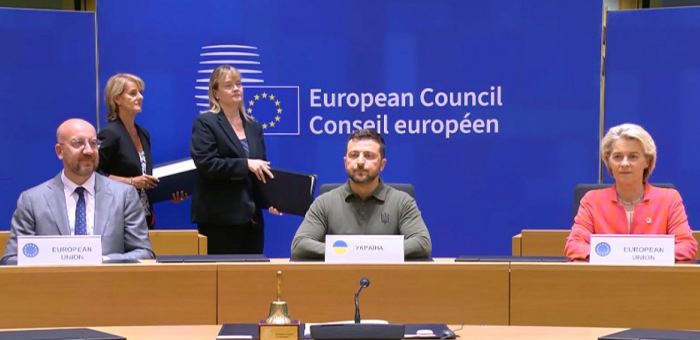


On June 27, the European Union and Ukraine signed a security agreement on the sidelines of the EU leaders’ summit. Security agreements were also signed with Lithuania and Estonia.
This was reported by a Suspilne correspondent from Brussels.
The agreement was signed by President Volodymyr Zelenskyy, who arrived on a visit to Brussels. On the EU side, the security agreement with Ukraine was signed by European Council President Charles Michel and European Commission President Ursula von der Leyen.
Other European officials also arrived at the summit on June 27, including Dutch Prime Minister Mark Rutte, his Polish counterpart Donald Tusk, German Chancellor Olaf Scholz, and other leaders.
Earlier, Zelenskyy said that three security agreements were planned to be signed in Brussels, one of which is with the European Union as a whole. For the first time, the agreement will enshrine the commitment of all 27 member states to provide Ukraine with broad support despite any institutional changes within the country.
On June 19, the Office of the President of Ukraine reported that the negotiating teams of Ukraine and the European Union had agreed on the text of the security agreement.
According to Suspilne’s sources in diplomatic circles, as well as a number of media outlets, the document contains two main sections on security guarantees. The first focuses on defense issues. The second deals with broader commitments on the part of the EU.
The previous text of the document contained two main sections on security guarantees, each with nine points, including:
- 50 billion euros of support budgeted in the EU budget for the next four years under the Ukraine Facility program; money to reimburse EU countries for weapons provided to Ukraine from the European Peace Fund; five billion for weapons from the Ukraine Assistance Fund and proceeds from frozen Russian assets.
- The first section of the agreement focuses on the long-term supply of military equipment, military training and defense reform, cooperation between the defense industries of Ukraine and the EU, cybersecurity, intelligence sharing, etc.
- The second section deals with “the future of Ukraine and its citizens in the European Union”, demining and reconstruction, continued support for refugees, maintaining and strengthening anti-Russian sanctions, creating a special tribunal for the political elite of the Russian Federation, etc.
- A separate section of the agreement outlines an action plan in case of possible future aggression. In particular, it refers to urgent consultations to be held within a day.
On June 25, the EU Council approves a draft agreement on security guarantees with Ukraine.