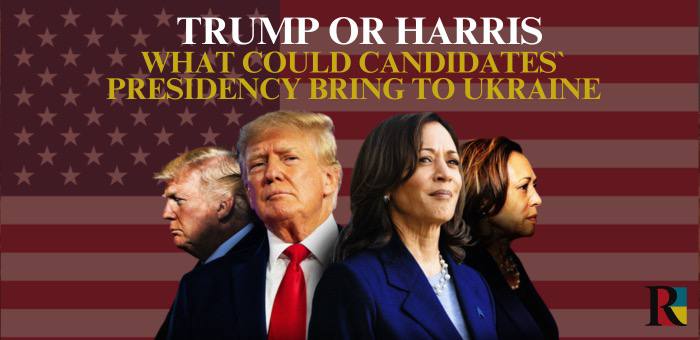


The world is observing the upcoming US election since the result could impact international politics in many ways. The topic of the Russian-Ukrainian war is the part of the discussions between Donald Trump and Kamala Harris. This article discusses what each side’s victory could mean for the future of Ukraine based on prominent quotes of the candidates and their team members, events and experts’ opinions.
Trump-Harris Debate: Understanding the General Positions
On September 11, the first debate between the two officially approved candidates for Presidency took place.
In the context of the question regarding the Israel-Hamas war Donald Trump repeated his statement from his debate with Joe Biden:
If I were president Russia would have never, ever — I know Putin very well. He would have never — and there was no threat of it either, by the way, for four years. Have gone into Ukraine and killed millions of people when you add it up.
Turning to the topic of Ukraine more specifically, the 45th President added:
I want the war to stop. I want to save lives that are being uselessly — people being killed by the millions. It’s so much worse than the numbers that you’re getting, which are fake numbers…I want to get the war settled. I know Zelenskyy very well and I know Putin very well. If I win, when I’m President-Elect, and what I’ll do is I’ll speak to one, I’ll speak to the other, I’ll get them together…We’re playing with World War 3.
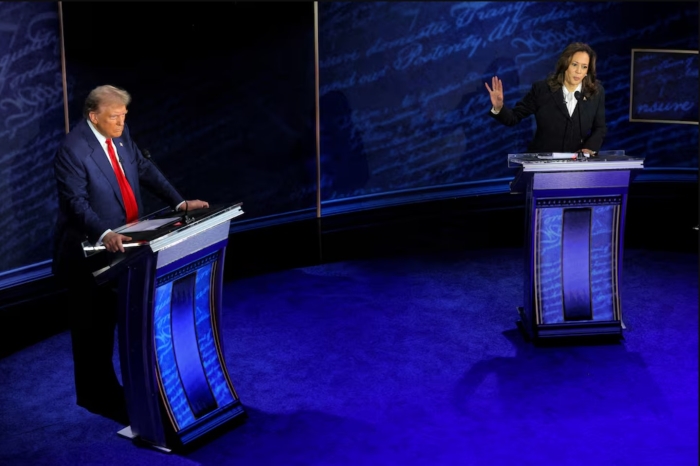
In short, Kamala Harris’s response was as follows:
I believe the reason that Donald Trump says that this war would be over within 24 hours is because he would just give it up. And that’s not who we are as Americans…I actually met with Zelenskyy a few days before Russia invaded, and tried through force to change territorial boundaries to defy one of the most important international rules and norms, which is the importance of sovereignty and territorial integrity… Days later I went to NATO’s eastern flank, to Poland and Romania. And through the work that I and others did we brought 50 countries together to support Ukraine in its righteous defense. And because of our support, because of the air defense, the ammunition, the artillery, the javelins, the Abrams tanks that we have provided, Ukraine stands as an independent and free country…Otherwise, Putin would be sitting in Kyiv with his eyes on the rest of Europe. Starting with Poland.
If, during the debate with Trump and Biden, the topic of Ukraine was mentioned only briefly, so room for guesses and interpretations was left, this time the conversation continued in a clearer manner. Furthermore, Donald Trump highlighted the treat of nuclear weapons, while Kamala Harris emphasized that the USA is a leader, upholding international rules and norms.
Donald Trump: hope on unpredictability
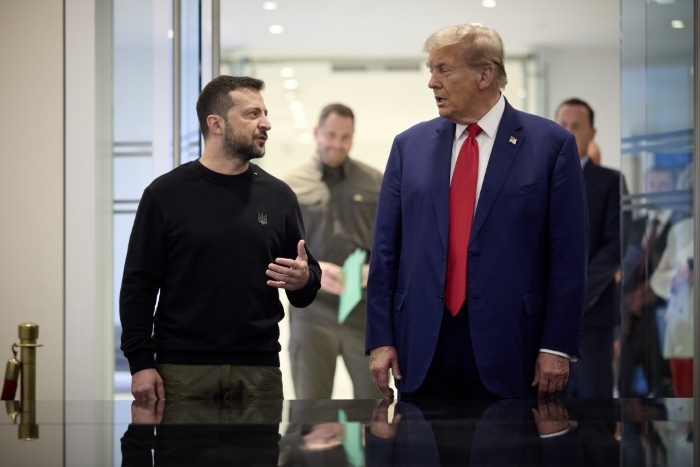
A few weeks after the candidates` debate The President of Ukraine Volodymyr Zelenskyy visited the USA, where he met with the current President Joe Biden, as well as both candidates, Vice President Kamala Harris and former President Donald Trump, despite the last appointment being considered unlikely. In New York, Trump and Zelenskyy discussed the Ukrainian Plan for Victory.
I think we have a common view that the war in Ukraine has to be stopped. Putin can’t win. And Ukrainians have to prevail, — said Zelenskyy before the meeting, as his official website reports.
Trump shared his impressions of:
He [the President of Ukraine — Ed.] has gone through hell, and his country has gone through hell like few countries have ever — it has not happened anywhere. Nobody has ever seen anything like it. It is a terrible situation.
The 45th president of the U.S. even accepted the invitation to visit Ukraine once.
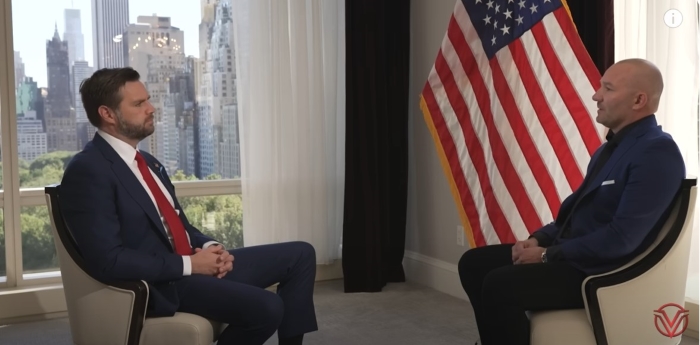
As The Washington Post reports, Ukrainian officials are ready for are prepared for the possibility that Trump could become president. It is discussed that if swift decisions would not include concessions of the territory, it may be the optimal outcome. However, Republican vice-presidential nominee JD Vance discussed on ‘The Shawn Ryan Show’ the idea of freezing the war and creating a demilitarized zone. He began his answer to a question about ending the war with the phrase I think what this looks like is Trump sits down… JD Vance added that Ukraine must remain neutral to meet Russian conditions, which would mean not joining NATO. This episode raised concerns that he articulated answers had previously remained vague in Trump’s interviews.
The 45th president also appeared on this podcast himself, though he did not specify methods to end the war, repeating that it should never have happened. He acknowledged the bravery of Ukrainians, but added that without the support of the USA, it would have fallen, and now the storage with ammunition in the U.S. are empty, as a large portion was provided to Ukraine. Additionally, Trump argued that Europe should increase its involvement in helping Ukraine resist Russia and equalize their contributions with American amount of aid.
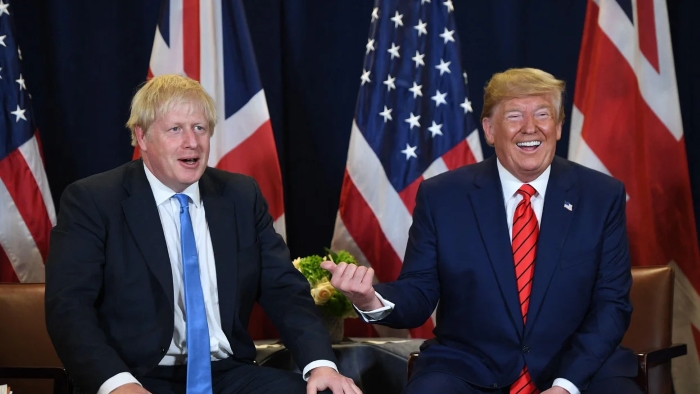
In his interview with The Telegraph Boris Johnson, former Prime Minister of the United Kingdom, known for his comprehensive support of Ukraine, reiterated Trump’s prominent debates`narrative:
Vladimir Putin would not have invaded Ukraine if Donald Trump had been president, Boris Johnson has suggested, saying the world is a better place when the United States has a strong leader. The former prime minister believes that Trump’s unpredictability would have been enough to persuade Putin not to take the risk of going to war with a sovereign country, — reported The Telegraph.
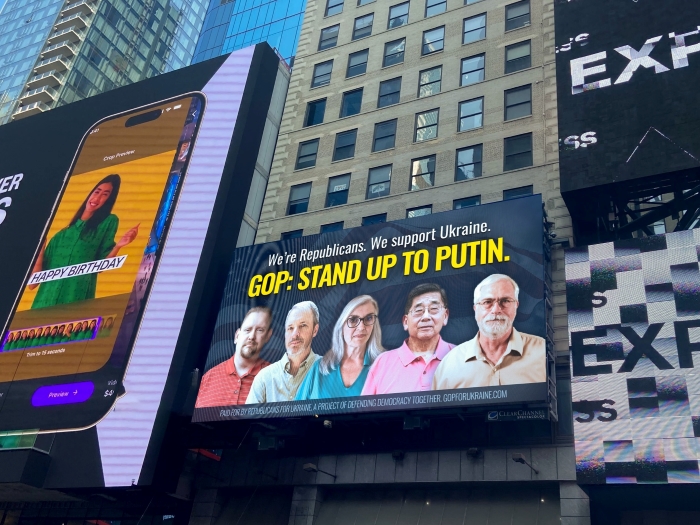
However, there are unambiguous supporters of Ukrainian sovereignty among the Republicans. “Republicans for Ukraine” coalition publishes reports, grading each Republican in the House of Representatives from A to F based on their votes on key provisions relating to aiding Ukraine. Their website states, Most Republicans in Congress have voted to support Ukraine.
John Conway, Director of Strategy for Republicans for Ukraine, shared his thoughts on the upcoming election with The Ukrainian Review:
For generations, Republicans were the party of American leadership, a strong military, and standing up to anti-American dictators like Putin. Now, that’s changing. Parts of the Republican Party still believe in these values, as Ronald Reagan did—but another part of the party is isolationist and wants the United States not to be a world leader, but to be another unexceptional country that never looks beyond its shores. Worse, some parts of the party are even actively supportive of Putin and other dictators. There’s a fight for the soul of the Republican Party and it’s not clear yet who will win.
For a long time, Trump didn’t make any specific pronouncements about Ukraine policy because he didn’t want to alienate any part of the Republican Party. Now, though, he seems more and more to be coming under the influence of the isolationists in the party and even those who admire Putin. It’s amazing that a man so focused on winning refused to say in the presidential debate that he wanted Ukraine—and therefore also the United States—to win against Putin. Many Republicans still believe in victory, even if Trump doesn’t.
He added that the next president must not only continue supporting Ukraine but also ensure its victory, asserting American leadership:
The next U.S. president needs to commit to helping Ukraine win and Russia lose. Reasonable people can disagree about the best way to do that, but this much is clear: The interests of America, Ukraine, and peace and stability in the world would be best protected if Putin were to be so thoroughly and soundly defeated that no one tries this kind of invasion again for a long time.
The Ukrainian Review also spoke with Jimmy Brannon, a lawyer who, after about 40 years as a Republican, changed his party affiliation. He mentioned Ronald Reagan’s approach as well:
Former U.S. President Ronald Reagan, a Republican, was a vocal opponent of the former Soviet empire and an advocate for the build up of American military interests. A hallmark of the Reagan philosophy was the “Peace through Strength Initiative,” for example, which advocated the build up of American military strength and deployment around the globe wherever Soviet forces might be. Part of the idea was that the economy of the United States and the Western alliance was such that the Soviet empire could be isolated and unable to expend the resources to ‘compete’ with the American and Western buildup.

Regarding the possible agreement between Ukraine and Russia he shared next suggestions:
Given Putin’s history in Ukraine and elsewhere, I would be more interested in efforts to drive Putin back into Russia. The best answer is a united allied support for Ukraine across Europe, leaving all options on the table, military, economic, and diplomatic. Clearly, any war crime issues under Trump would go away…He borders on war criminal status himself.
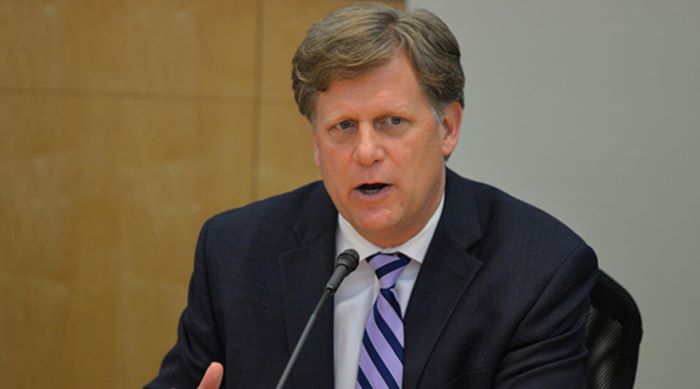
American academic and diplomat, the United States ambassador to Russia from 2012 to 2014 Michael McFaul noted in his blog that Trump doesn’t criticize Putin and instead admires his strength and justifies his barbaric actions. The professor also emphasized that Kamala Harris is convincing in highlighting the threat to other countries, recalling historical examples of unchecked dictators. In his opinion, it would challenge the American leadership and encourage other authoritarian regimes to take action:
Ms. Harris thinks strong allies can help the United States achieve its security interests most effectively and efficiently. Mr. Trump is a unilateralist who threatened to withdraw from our alliances when he was president.
Kamala Harris: stability or increasing assistance
Kamala Harris has strongly been supporting Ukraine. The only concern about her presidency is whether the amount of aid coming would be sufficient to defeat Russia.
We will continue to stand with Ukraine in its fight for freedom against Russia’s aggression – congratulated she the Ukrainians with Independence Day on her X account.
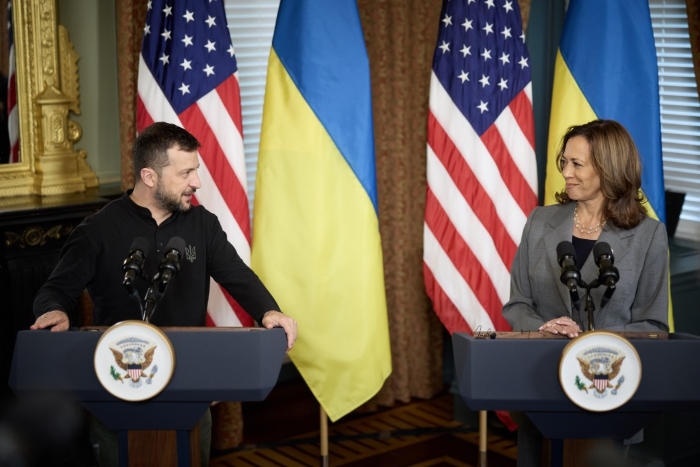
Kamala Harris noted that this was her seventh meeting with Volodymyr Zelenskyy and assured of steadfast support for Ukraine, — written on the official presidential website after the presentation of the Victory plan in Washington. During their meeting with the press, she, not mentioning Trump directly, assured that the idea of freezing the war is perilous:
There are some in my country who would instead force Ukraine to give up large parts of its sovereign territory, who would demand that Ukraine accept neutrality and would require Ukraine to forego security relationships with other nations. These proposals are the same as those of Putin. And let us be clear: They are not proposals for peace. Instead, they are proposals for surrender, which is dangerous and unacceptable.
Her vice-presidential nominee, Tim Walz served as the 41st governor of Minnesota since 2019. In his position, he expressed support to Ukraine and visited the Ukrainian embassy, in particular in order to establish the partnership between Minnesota and Chernigiv Region.
In 2022, after the invasion of Ukraine, he signed a law to divest state investments in Russia, the Economist reports.
Moreover, Walz showed his awareness regarding Russian aggression back ten years ago. Asked during a 2010 Editorial Board endorsement interview to identify a global threat that kept him up at night, U.S. Rep. Tim Walz pointed to Russia and nuclear security, reported The Minnesota Star Tribune in 2014.
Oksana Barchuk, Associate Director of Government Affairs at Razom for Ukraine, shared with The Ukrainian Review whether attitudes toward Ukraine have shifted during the election:
During the election this year we have seen a growing partisan split with fewer Republicans supporting Ukraine, and that’s something that magnifies the importance of reaching out to Republicans to make the case for why they should support Ukraine. One interesting shift we saw is that Ukrainian Americans—traditionally a bulwark for Republicans due to associations with Reagan and the defeat of the Soviet Union—have started to possibly shift their voting behavior towards Harris based on the perception that she would be a stronger supporter for Ukraine than Trump. The Harris campaign started making a concerted effort to reach out to Americans of Eastern European descent, and we’ll see if this pays off (especially in Pennsylvania).
She confirmed that U.S. voters are mostly driven by domestic politics when making decisions:
On candidates’ strategies for Ukraine, we haven’t seen a significant signal that it is a driving force in this election—which is normal, since most Americans do not vote based on foreign policy. The only group where it might be a significant motivator is among Ukrainian Americans and other Americans of Eastern European descent.
Dr. Benjamin L. Schmitt, Senior Fellow at the University of Pennsylvania’s Kleinman Center for Energy Policy commented the topics of the role of NATO and sanctions against Russia:
Since the outset of Russia’s assault against Ukraine, overly incrementalist and always delayed Transatlantic decisions on supporting various weapons systems, defensive strike options, and deliveries of localized air defense systems has left much of Ukraine’s sprawling energy landscape vulnerable to Russian strikes, and hindered more rapid exploitation of Ukrainian opportunities for victory.
In mathematical terms, the policy equation of some U.S. and European leaders and national security advisors has consistently fit an (x – 1) equation, where ‘x’ represents the defense system du jour needed to support Ukrainian defense and ultimate victory. In other words, our collective support of Ukraine has been and continues to be consistently one step behind the military reality on the ground.

When it comes to the Western response to support the defense and resilience of Ukraine’s civil energy system – just as with the Western response to support broader Ukrainian victory – the cycle of incrementalist measures to support Ukraine needs to be broken, whether it be on the supply of weapons systems and longer-distance strike options urgently needed by Kyiv to defend its population, preserve its civil energy systems, and push Russia from its territory, or on sanctions and technology export controls measures to reduce Putin’s ability to wage war against Ukraine in the first place. In this sense, the time for incrementalism was never called for, and should permanently be dismissed from any strategic thinking by whoever wins the U.S. Presidency.
And to those policymakers that still aren’t swayed by arguments to rally to Ukraine’s moral cause at the front lines of the global democratic struggle against revanchist authoritarianism – as a growing number of politicians on both sides of the Atlantic are seemingly incapable of accepting – they need to be reminded of some simple economics: rebuilding the majority of the energy infrastructure damaged by the Russian military across a country the scale of Ukraine will ultimately cost far more than surging the needed air defense equipment and allowing Ukrainian long-distance strikes on launch sites around Ukraine’s periphery in Russian territory to protect Ukrainian energy systems now.
Trump and Harris present markedly different approaches to the Russian-Ukrainian war. For Ukraine, considering the current situation on the frontline, the stakes are high, so the main task is to establish the dialog with new U.S. President regardless of the outcome.