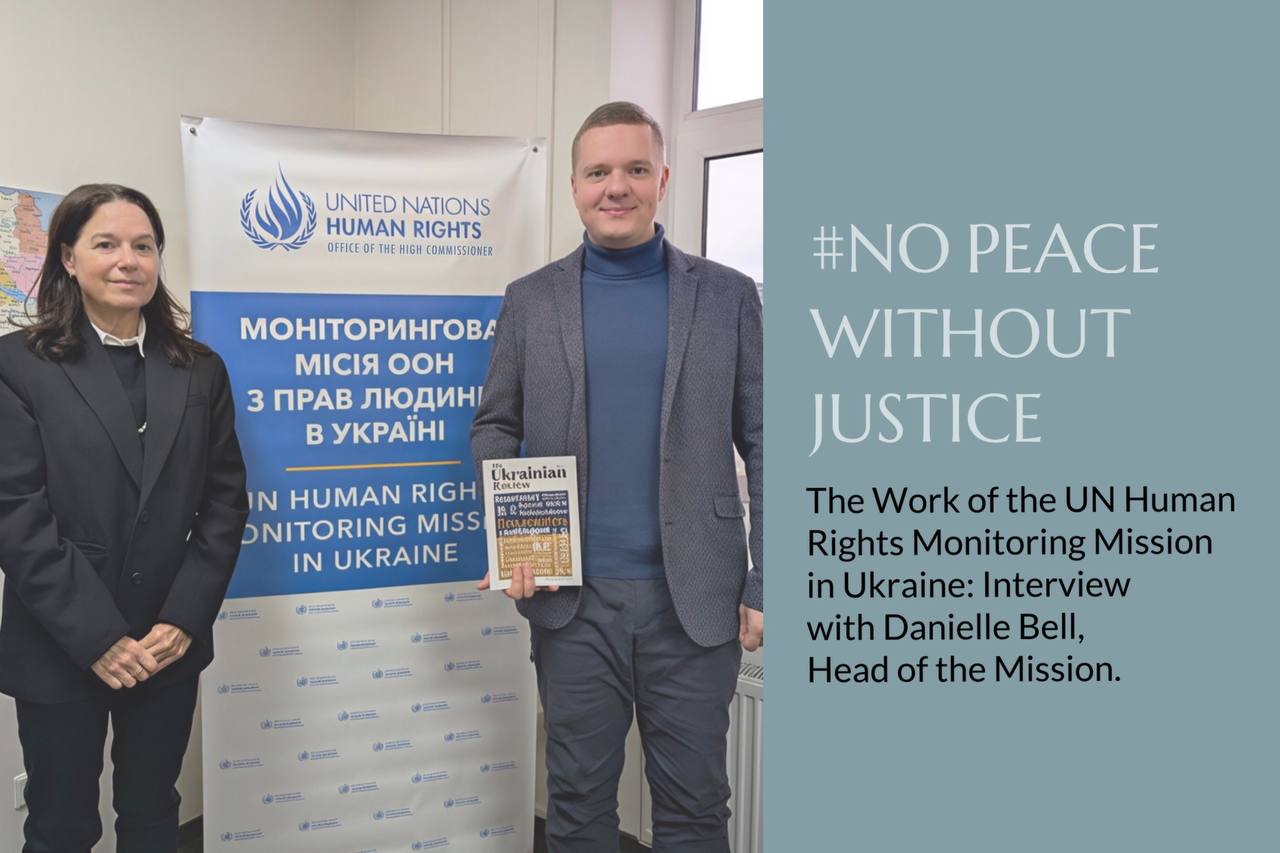


The editorial team of The Ukrainian Review met with Danielle Bell, Head of the UN Human Rights Monitoring Mission in Ukraine, to discuss a range of critically important issues.
Clarifications we received during this conversation will form the basis of our upcoming publications. In particular, a specially prepared interview on the situation of Ukrainian prisoners of war, produced within the #NoPeaceWithoutJustice initiative, will be published soon. This material, meanwhile, focuses on a highly important subject — the work of the UN Human Rights Monitoring Mission in Ukraine.
Further — Danielle Bell`s direct speech.
We’ve been here since 2014 and have a team of 85 staff. They’re based in Dnipro, Odesa, Kharkiv, and of course Kyiv, and a remote team based in Moldova that supports with remote monitoring, including of occupied territory.
We’re consulting with Ukrainian authorities, with NGOs, with wide sources to make sure that what we’re documenting is comprehensible, reliable, and timely.
And so, in summary, I think the capacity for monitoring and reporting is quite strong. But it’s not just us. There are several other international organisations that are working on monitoring and documentation that perform a slightly different function.
International and national documentation
So, for example, the Commission of Inquiry is documenting and making legal assessments and then looking at trends and patterns. And they have a different approach than we do, but it’s certainly complementary to what we do. The Council of Europe Registrar of Damage is also registering individual cases for future reparations.
International NGOs, such as Human Rights Watch, are also taking thematic issues affecting civilians, which is so important. But you asked about the capacity of international monitoring. I think it’s crucial to also recognise domestic documentation.
So, for example, the Office of the Prosecutor General documents these international human rights violations as violations of international humanitarian law.
We work closely with the Office of the Prosecutor General in all of the areas that we work in, including treatment of the prisoners of war, attacks against civilian objects, individuals, infrastructure, conflict-related sexual violence, and other war crimes.
At the same time, with other Ukrainian organisations that share information with us, we will then take that information, and we will independently verify it. So we often receive referrals, cases, but we have to do our own independent verification. So if someone gives us a list of 10 cases and says we have these 10 killings in this area recorded, we still have to conduct our own fact finding.
Statements by Member States in the Human Rights Council
We also see our work being used as the basis for member state interventions at the Human Rights Council.
Every year we issue two reports that cover recent developments in the human rights situation, as well as two thematic reports that discuss a particular issue in depth.There are three interactive dialogues and an intersessional dialogue, which is based on our public reporting. And of course, our High Commissioner bases his remarks on it.
And you can see that member states, when they’re doing their interventions, they refer to our reports. But at the same time, more broadly, within the Human Rights Council, there are the special procedures of the Human Rights Council, including special rapporteurs.
For example, the special rapporteur on torture, Dr Alice Edwards, will use the reporting that we do on torture, ill treatment of prisoners of war and of civilian detainees. So we also feed into the special procedures as well as the special rapporteurs. But where our work is really also used, and this is the less visible part, is by the treaty bodies.
So with the treaty body procedures, Ukraine, both Ukraine and Russia, report to the treaty bodies, whether it’s the International Covenant on Civil and Political Rights, which covers the issues of torture, whether it’s the International Convention on Enforced Disappearances, which Ukraine is a party to, International Convention on the Rights of the Child, Covenant on Economic, Social, Cultural Rights. So when Ukraine and Russia are up for review by different treaty bodies, the treaty body committees, look at our public reporting to guide the questions that they present to them.
In summary
And for Russia, it’s relating to the human rights situation in occupied territory because our mandate covers Ukraine, which of course includes both Crimea as well as Donetsk, Luhansk, Zaporizhzhia, Kherson, and also we report on the situation in Sumy, Kharkiv and other areas affected by the conflict so that the human rights concerns get raised in every possible form.
Civil society, and NGOs both international and national, will use our findings, our reporting, so that they can do their own shadow reporting. So that’s how it’s used within the international human rights framework.
Interview conducted by: Oleksandr Yavtushenko, Ukrainian journalist,
Advisor to the Governor of Kyiv Region