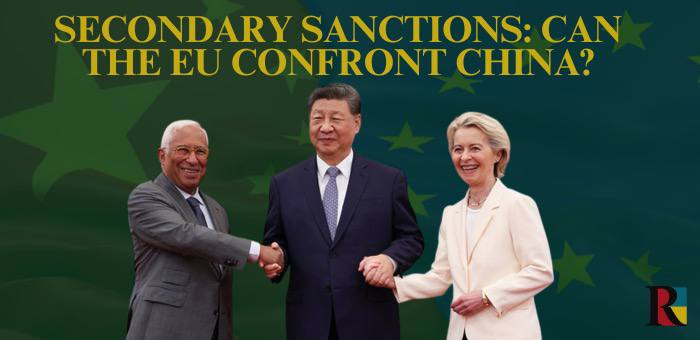


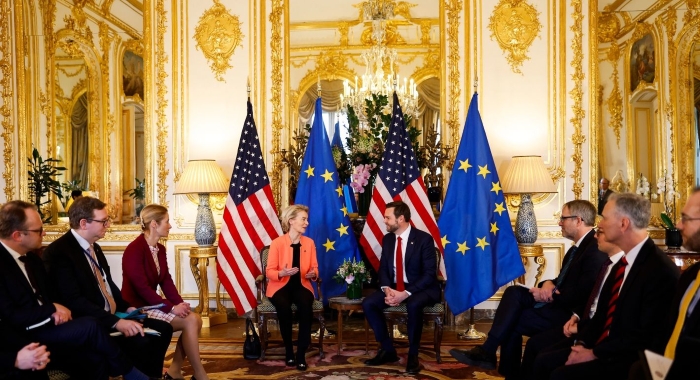
The United States is pressing the EU to join a tariff confrontation with China and India under the framework of secondary sanctions designed to punish purchases of Russian oil. Yet the EU economy is not prepared for such far-reaching restrictions. Tariffs on imports from China approaching 100 % would cause sharply raise prices on the European market. According to Politico, this could trigger record inflation and undermine the competitiveness of European businesses.
The U.S. Interest
The plan’s key feature is that it punishes Russia in a way that mostly benefits the United States. Bans on Russian energy imports strengthen America’s position as a supplier, as it is already expanding liquefied natural gas exports to Europe at higher prices. Russian gas still accounts for about 20 % of EU imports, reduced by 25% since the full-scale invasion. For Ukraine the advantage is straightforward: the less revenue Russia receives, the better. But European countries want to achieve that goal in a very particular way.
Strong EU–China Links
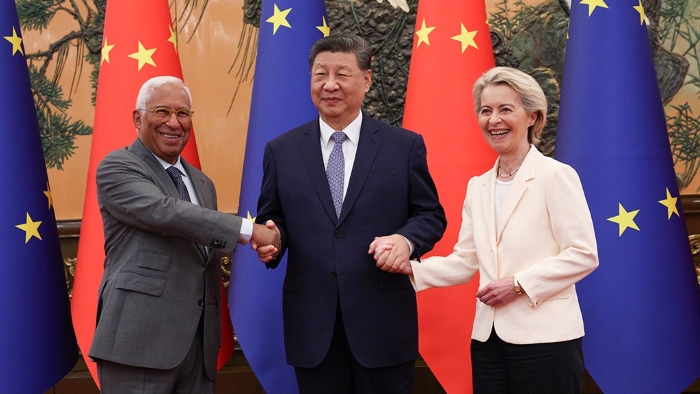
China has openly urged the EU not to take this step. Foreign Minister Wang Yi called on the Union to resist “the abuse of tariffs” by some countries. Brussels, in turn, is trying to persuade Washington to focus on stricter measures against Russia itself. China is the EU’s third-largest export partner and its biggest import partner. The largest category of EU imports from China is electrical and electronic equipment, especially telecommunications gear, office machines and data-processing equipment. Around 96 % of imports consist of manufactured goods, making this a question of entire supply chains rather than raw materials. Together, the EU and China account for nearly 30 % of global trade and over 30 % of global GDP.
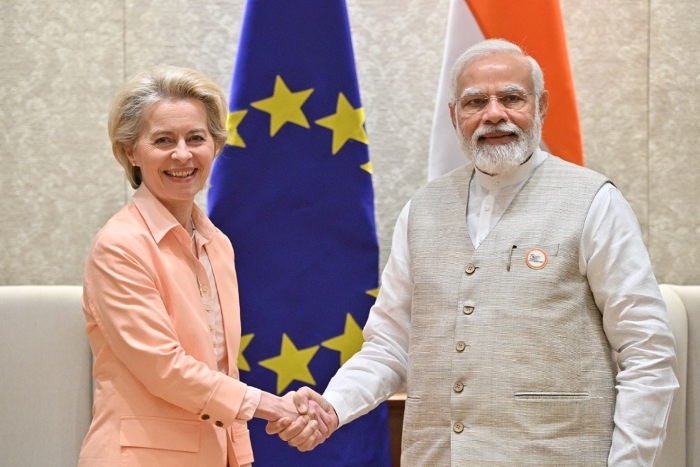
At the same time the EU has launched a new agenda aimed at reducing Russia’s influence on India, another target of U.S. pressure. Instead of sanctioning New Delhi, Europe hopes to weaken Russian-Indian ties through a trade deal, while Washington also seeks to curb India’s rise.
Conclusion
The EU faces a difficult choice. On one hand, it needs to increase pressure on Russia in cooperation with allies, especially the U.S. On the other, it risks serious economic disruption and instability in relations with China, its key trading partner. The question is whether Europe is ready to sacrifice economic comfort for long-term political and security goals. The EU seems prepared to sanction Chinese companies linked to the Kremlin, but it remains unclear whether Washington would view that as enough.
Daria Maslienkova