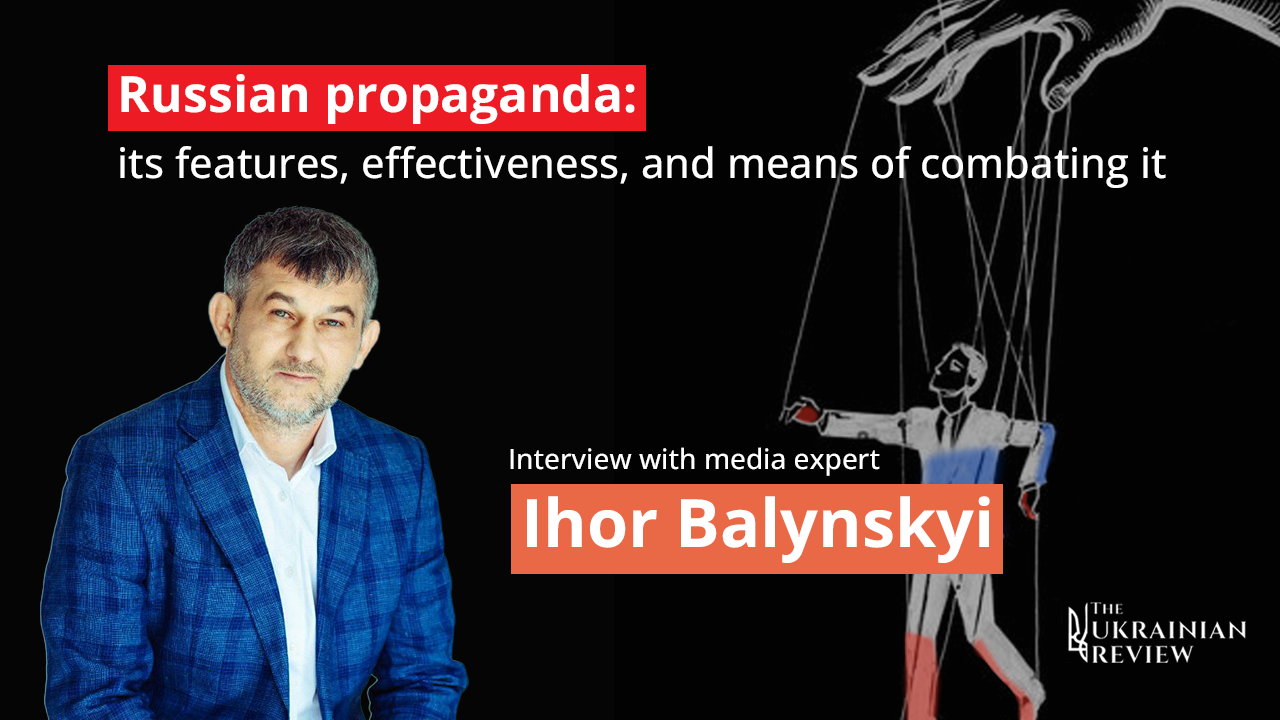


Ihor Balynskyi, media expert, lecturer at the Department of Journalism, Advertising and Public Relations at King Danylo University (Ivano-Frankivsk), a candidate in social communications and co-organizer of the Lviv Media Forum (2012-2018). We decided to ask Ihor about the theory and practice of Russian propaganda and the means it uses in its campaigns against Ukraine. We did not miss the question of the participation of social media in the spread of fakes, and the participation of foreign media (consciously and unconsciously) in the spread of these pro-Russian narratives.
Here we provide you with a text version of our conversation and watch the video on our YouTube channel.
The topic of our conversation today is Russian propaganda. We meet its manifestations every day, both in classical media and in social networks. In this regard, my first question is: what types of Russian propaganda do we, as consumers of information, encounter most often, and how to identify this propaganda, if it is about social networks?
This question is one of the most difficult. Detecting and countering Russian propaganda, in particular, which spreads through social networks, is one of the most difficult. Let’s start with the question of the nature of Russian propaganda and its effectiveness. Modern people have short memories. But Russian propaganda is like an octopus, and it is quite logical to continue the propaganda and intelligence work that was carried out by the special services of the Soviet Union. At one time, Timothy Snyder, a well-known American historian and public intellectual, compared what is now happening on the part of Putin’s propaganda channels and what was happening in the Soviet Union. And here are a few things that I recorded for myself, which from my point of view are very revealing and very bright. We are talking about total propaganda in the 21st century, which is faced not only by Ukraine but by the whole world. A similar story took place, say, in the 1930s. We remember the classic case of Walter Duranty. There, the New York Times became one of the legitimizers of Joseph Stalin’s regime. That is, the totality of propaganda, is characteristic of the Soviet Union and modern Putin’s Russia as its heir. The second thing that is typical now is repression against dissenters. We are talking about the media sphere, we are talking about analogies that were in the 20th century and in the 21st [century they continue].
We are talking about quite bright personalities [who spread propaganda – author], we are talking about both useful idiots and people who work for money. The modern grain crisis provoked by Russia is, to some extent, much more global than the Ukrainian famine of the 1930s. That is, if we look at the nature of Russian propaganda, we are talking about the fact that modern Russian propaganda, in general, is simply a technological continuation of the direction of propaganda that was carried out by the special services of the Soviet Union, the diplomatic corps of the Soviet Union. And when I talk about technology, I’m talking primarily about modern channels and the possibility of getting propaganda to the target audience, to the target groups of consumers of this content.
And in that context, social networks have turned out to be the most convenient environment for spreading propaganda. However social networks still have certain filters and safeguards. You can turn to Zuckerberg and appeal that Facebook has become a source of propaganda, hate narratives, and so on. And they will react. I would talk about a much deeper problem. This is the work of Russian propaganda through messengers. First of all, if we take the Ukrainian dimension, it is Telegram and Viber. These are uncontrolled flows of information, this is the possibility of manipulation, and this is the lack of verification and verification of the source of information. Therefore, today it is one of the key challenges, not only in the context of Ukraine, considering the war situation. In general, this is one of the key challenges for the expert media community when we talk about the channels, speed, and volume of the spread of Russian propaganda.
And in fact, we appeal to social networks and messengers, because we do not have clear mechanisms for regulating textual things. But believe me, the research I conducted at the Lviv Media Forum shows that the unconscious spread of Russian propaganda narratives, particularly anti-Ukrainian ones, is typical of a large part of Western media, at least in the countries where we conducted research. Among them are Germany, Italy, Latvia, and Hungary, as a separate case in this situation, and France. That is, this is still one of the most difficult tasks: in what way can we resist propaganda, what can be done, and whether the media can develop tools, in what way to disavow this propaganda, in what way to work with the audience. An even more difficult question arises from the fact that we have a situation where the audience for quality but classical media, whether it is television, radio, or online, is much smaller today. It is significantly inferior in the influence of the audience that is in social networks, which does not perceive information critically. These are challenges to which there is no clear answer yet.
If we talk, at least, about the last 9-10 years, how did these narratives or forms of Russian propaganda regarding Ukraine change from 2014 to 2022? And what new forms have appeared, and you, as researchers, have discovered them at a time when the war has already moved from a hybrid form to an open military invasion of Ukraine?
I wouldn’t call 2014 a turning point. I would say around 2007-2008. It was then that the current agenda of the Kremlin’s propaganda ideas regarding Ukraine began to take shape. It should be connected with Putin’s so-called Munich speech. To be more precise, this happened when Ukraine lost its political and informational influence over Crimea, during the time of the late Viktor Yushchenko. Then Crimea gradually began to become an informational, cultural, and educational part of Russia. We are also talking about the so-called university of the former mayor of Moscow Luzhkov, which was opened in Sevastopol [in 1999, Luzhkov founded a branch of the Moscow State University named after Lomonosov — author]. Accordingly, I think that this history of anti-Ukrainian Russian propaganda originates in this period. 2014 exacerbated all these things. These narratives gradually formed and became a kind of coherent picture. We are talking about key things that were primarily consumed by the Russian audience. About the fact that Ukraine is not a state, that Ukraine is a state that did not happen, that Ukraine is a state without a past, that Ukraine is an artificially created state with territories donated in the period after the Second World War. That is, Ukraine is a construct of the Soviet Union and, in particular, Joseph Stalin. Narratives about the dominance of so-called Nazi propaganda in Ukraine. It starts from 2014, it is used through, in particular, the Azov regiment. This is one of the features of Russian propaganda. And every aggravation of the Ukrainian-Russian confrontation – informational or physical – as it began in 2014, only deepened and made this propaganda more aggressive.
The important thing is that this propaganda had several recipients. I believe that the basic internal addressee was the Russian audience, which needed to be convinced of those theses of artificiality and inadequacy of Ukraine as a state.
The second audience was the pro-Russian part of Ukrainian citizens who lived in nostalgia for the Soviet Union. They were formed by Russian media content and, to a certain extent, brought up by Russian culture.
The third block of propaganda is aimed at erasing, relatively speaking, the weak but existing subjectivity of Ukraine in the Western media expert and political fields. That is, it is a systemic campaign that has been going on for the past 12-15 years. The effectiveness of these disinformation campaigns can be measured. There are certain criteria.
And what are these criteria?
For example, in social networks, it is measured by the activity of the audience. You see the audience, you see their profile, you see how they react, how they comment. And you can gradually form certain groups around this community and artificially support the narratives you need. And look, even now, when we see the security measures carried out by the SBU to identify Russian agents who act as correctors of shelling, there are sufficiently educated people among them. These are former officers of the Soviet special services, they are university teachers, that is, they are people whom I would call ideological. That is, this is not, relatively speaking, a woman who was tempted by several thousand hryvnias and believes that she did nothing.
On the one side, Russian experts and Russian analysts felt that a part of Ukrainian society had matured more or less to the point of not resisting the beginning of Russian aggression. Hence the idea of capturing Kyiv in three days and so on. It seems to me that one of the key propaganda narratives that prepared Russian society for the start of the war is the promotion of the thesis that Ukraine has become anti-Russia, that is, a territory that is completely a puppet of the West. This thesis was very actively promoted through various communication channels. It seems to me that the moment of launching this thesis into the information space is precisely the point when the decision was already made that it was impossible to avoid a full-scale invasion of Russia. That is, Russia was [already] ready [to attack]. It was only a matter of time.
Peter Pomerantsev, a British propaganda researcher, argues, and we agree with him on many points, that what we call Russian propaganda is something more than just propaganda. This is a certain modeling of everyday life that the media, pro-Kremlin special services, and technologists can allow you, provided you have a suitably prepared audience that is ineffective from the point of view of critical thinking, from the point of view of a certain activism or resistance. This happened to Russian society.
For me, a very good example of what I call informational fear is the emotional reaction and responses of Russians to polls that were conducted, at least some time ago, on the streets of Russian cities. That is, to a simple question, what is your attitude to the so-called special military operation, as Russia calls this war, two things are indicative. The first reaction is emotional; most people who are asked this question have an expression of fear on their faces. They are afraid to talk about it. And the second answer, as they like to say, “You know, we are not interested in politics, we have nothing to say about it.” That is, it is already an amorphous behavior that does not involve a reaction, at least an emotional reaction and does not involve resistance, indignation, or disagreement.
And that’s why I believe that if we talk about the three groups of audiences that Russian propaganda was aimed at during the last 12-15 years, then, of course, it turned out to be the most effective for the domestic audience. I do not believe in the hypotheses of Western researchers that, as they say, sociological surveys of support for Putin’s actions in Ukraine do not correspond to reality. That is, we say that it ranges between 70-80% [Putin’s support — author]. That, they say, there are hidden answers, intentionally given false answers. The level of protest is much higher. Sorry, it doesn’t work that way. That is, it does not work in the sense that a dehumanized image of Ukraine has already been created in Russian society. In the sense that he has no empathy [for Ukraine — author], and accordingly has no desire to stop it in any way, to express a protest. And, as it turned out, the influence of Russian propaganda on the Ukrainian audience, let’s say, turned out to be less than expected. I would say that its effect turned out to be much less than one might expect, if we draw parallels with Russian society and with a part of, let’s say, pro-Russian Ukrainian society. It quickly came to nothing due to the shock state of the beginning of the war, shelling, the behavior of the Russian military, the destruction of infrastructure, and so on.
To this day, it remains a mystery to me how Russian propaganda continues to be somewhat effective when it comes to working for a Western audience. When it comes to working with a very intellectual audience, relevant expert media political circles of the West. We can talk about Germany, we can talk about Italy, we can talk about France. Russian propaganda is making some gains there, and we can see it in the waves of doubt being expressed about how this war should end. How they achieve this efficiency can be said in different ways. Some media were directly founded by Russia or financed by Russia. But there are a lot of absolutely relevant Western media, which in one way or another are not fully aware, but are carriers and spreaders of Russian propaganda narratives. Yes, these media react with surprise when you send them a certain report and say, friends, look, this is a repetition of Russian narratives, and so on. And they only at this moment begin to ask themselves why this is happening. This process is very complicated and slow.
Slow changes are possible only if there is feedback from the Western media space and the expert environment. When we did this research on five countries, we came to one unpleasant conclusion. We put it before the Western media: what exactly do we consider to be the standard and whether it is the standard of information honesty, and credibility when we talk about such a conflict, this type of information warfare? And this was one of the first cases when we tried to undermine the ideas of the Western media community that standards are not dogma. Sometimes it seems to me that the standards in the West are treated like something so ideal, laboratory. In life, everything is much more complicated: there is a context, and nuances are much more important than maintaining a balance and opinions, sometimes this balance-thought is not a balance.
I want to add my point of view. I studied the Baltic countries, mainly during the years of Perestroika. And, of course, those ideas that related to Ukraine, for example, that Ukraine does not have the idea of permanent statehood, all of this was broadcast even earlier to the Baltic countries, given that they should already be in the sphere of interests of the Russian Federation. All this was tested in the Baltic countries. And I have a question. In the Baltic countries, there is a rather strict position on counter-propaganda. Broadcasting of certain TV channels is prohibited there; certain media are closed and this is not the situation of the last two years. That is, they worked with counter-propaganda. How did Ukraine work and work now? How did Ukraine position itself during these years, from 2008 to 2014? Was there even a strategy to combat anti-Ukrainian narratives?
Regarding your thesis about the Baltic states, you are a little mistaken. In addition to Lithuania, Latvia and Estonia have a certain linguistic balance. He is shaky. And very often a situation arises when the Russian-speaking media, or now the opposition Russian-speaking ones, use the liberal legislation of the European Union very well. A very simple example was in Latvia. If I’m not mistaken, it was a year ago. Following all legal norms, the Radio Rocks radio station was registered in Latvia. By the way, there were a lot of questions and indignation from Ukrainians that it was complete plagiarism. I don’t know how this situation was resolved, but Radio Rocks submitted conceptually that it would be a radio that would rebroadcast the so-called Russian political rock. So, in the playlist that they submitted, there was a good half of the groups that today support Putin’s policy in Ukraine. This radio received a broadcasting license. They legally used all the flexible possibilities provided by the legislation of the European Union in the field of media, in particular Latvia. There were protests against it, but formally the regulator had no reason not to allow them to work on the air. And there are quite a lot of such stories. In Latvia, the number of Russian-language media is quantitatively greater than the number of Latvian-language media. We are talking about this year’s situation because this year we conducted research and conducted expert interviews. These are comments on previous theses. But you are right. Just the story of the formation of the image of the Baltic countries in Russia, it is also deeply Soviet. It is based on all these Soviet narratives about Nazi henchmen, and forest brothers in the Baltic countries. This is the same story with Western Ukraine already in the Ukrainian context.
Were we ready? Well, look, we never engaged in counter-propaganda, disavowing Russian propaganda throughout independence. Moreover, at one time I had a very tough discussion with Oleksiy Mustafin when he was the head of the STB TV channel. We talked about sending Russian serial content on the Ukrainian airwaves. Different, from detective to melodramatic. And I asked him a question about this: I say, Oleksii, but if a person lives in a foreign context for decades, how then can we talk about things that are related to identity, with distinction in the end, and not superimposition, absorption of one reality by a more aggressive, Russian reality Ukrainian He believed that it was not significant, because, well, they say a light genre, they are quickly forgotten, that is, they do not leave a deep mark. It seems to me that this was a very big mistake, in particular, of the Ukrainian media space, which, relatively speaking, to a certain extent was a parasite on the rebroadcast of higher-quality technologically Russian content. We can talk about music, we can talk about cinema, we can talk about a serial product.
To a certain extent, we are all guilty, we all contributed to the fact that at one point we formed an image in the Kremlin of our secondary nature, formed an image of a country that does not have its own identity. Add here the specifics of ownership of the Ukrainian television space. It was quite a typical thing that even during Euro-2012 we invited Russian football commentators, who were considered to be much better, more professional, and more interesting, to commentate in Ukraine. Half of those people today sing along and work at all the Kremlin’s masses. That is, I think that in such a situation of connection of Ukrainian show business, on earning in Russia, to talk about the fact that the creation of strategies, alternatives, and countermeasures to the informational and cultural expansion was seriously considered is not serious enough. Those who were seriously engaged in it, or talked about it, were called freaks, marginals, or nationalists. Moreover, we did not work with an external audience. That is if you researched a little how Russia worked, through which tools of self-representation in the West. So, let’s say, such an interesting structure, if I’m not mistaken, as Rossotrudnichestvo, created huge activities, in particular, both in Kyiv and in many countries of Western Europe. It was one of the additional tools of influence and spread of Russian propaganda despite the special services, embassies, and classic export of Russian culture abroad. We are just now creating a Ukrainian institute. We are just now trying to create Ukrainian offices, and Ukrainian houses abroad and fill them with some authentic representations.
Only the war posed a very unpleasant question to us, what have we been doing all these 30 years, and are we partly to blame for the way Russia perceived us and what image it formed for us in particular in the West?
Yes, you have raised a very important question and, based on that question, my other question is how to regulate the media in times of war; after all, is it prohibition or freedom? We know that it is almost impossible to regulate social networks. The state and society cannot influence social networks either. Therefore, here we are faced with the paradox that in internal use we have a certain information product, and in parallel with it, there is another product, which is formed by various telegram channels, social networks, and so on. From a professional point of view, how to regulate these media during wartime. What should the state rely on? For regulation, for prohibition, or for freedom and education or self-education of residents, citizens, who, after all, have to distinguish for themselves where there is propaganda, where there is truth, and where there is content that should not be consumed?
I do not have a clear answer to this question, I will tell you honestly. In fact, in the case of such things as regulation and information dosage, and prohibitions in wartime, one would like to rely on certain practices, certain analogies. But the analogy with the Second World War or with local conflicts is incorrect here, so I would not like to use it. We have what we have, we act sporadically, blindly in many things, and mostly act in the simplest, most convenient way. We try to limit and dose information and cover uncomfortable topics, uncomfortable information with certain media information campaigns. That the state limits access to certain information and tries to block channels and media that are a threat to security seems logical to me and I cannot say that this is something threatening.
But we are talking with you now about certain problems that exist in the media space, in the media environment. We do not understand what we can do with social networks, with sites on the Internet. You can’t block YouTube, you can’t block a person from accessing a channel of Shariy, for example. You may only block the internet. But this is also practically impossible now. This sporadic chaos that exists now, is a continuation of these decades without the information policy that should have been. There are several environments, media, and public organizations, by the way, Lviv Media Forum, the Institute of Mass Information, and other research environments that try to investigate these things and offer certain options are among them. As far as I know, they interact with the authorities and form certain communication strategies on how to behave in this or that situation.
I do not expect that shortly we will receive a more or less balanced information policy with you. Weighed in the sense of permitted and prohibited. First of all, when we talk about the media. When we talk about social networks, in general, I do not imagine the possibilities of regulation or conducting information campaigns that could disavow openly Russian propaganda and fakes. Of course, the root of this problem is largely in the low level of critical thinking in society, even in the group we call youth. Yesterday [it was December 5, 2023 — author] the Ministry of Education of Ukraine published the results of the study, shocking from my point of view. They studied 15-year-old schoolchildren, their ability to acquire mathematical and natural knowledge, and their level and meaningfulness of the reading process. This is an important thing, because reading as such, it allows you to form thinking, logical connections, associative connections, and so on. The study found that the difference in the reading level between schoolchildren, we are talking about 15-year-olds, that is, those who will enter universities or higher education institutions in a year or two, between schoolchildren who study in rural areas and urban schoolchildren, in Ukraine is 5 years.
That is, relatively speaking, for a schoolboy from the village to reach the level of a schoolboy from the city at this point, he needs to be in the same state and develop, and study for 5 years. Children leave school after 2 years and enter higher educational institutions, and we have a huge problem of not being able to work with the text, to delve into the text. Without these basic skills, when we talk about reading, where do the critical thinking skills, and the discernment skills come from? Concept of media literacy. Let’s put it this way, everyone talks about it, but no one does it. Problems of media education, media literacy among children and schoolchildren. This is a question related to the lack of reform and the quality of school education itself, to the disproportion of development of different Ukrainian regions, to the disproportion of development between the city and the countryside, a large city and a small town. That is, we now have a very difficult situation. Add to that the quality of education because of COVID and now because of the war, the quality of distance learning. We have a bad situation, and I don’t think that we, in the conditions of war, can radically change it, but at least voicing these problems is important. Finding solutions is also necessary. But I do not see the capacity among state institutions to make these decisions now. In part, this function is performed by independent analytical centers, research centers, or public organizations. But their problem is that it is very difficult for them to implement the developed decisions or recommendations, given the contradictions between the vision of the situation on the part of civil society and on the part of the authorities, which should implement these decisions.
Can you name the main features of Ukrainian media positioning in the world? Your point of view, how should it be in an ideal situation, what is the structure, hierarchy, what is the philosophy of Ukrainian positioning in the world?
This is a good question. I will not try to paint a complex image of Ukraine and the representation of this image in the world, but it seems to me that this direction should be focused on two vectors. That is, the Ukrainian media and the voices of the people to whom these media provide platforms for external representation should work on two components. That should be the first thing, I call the distinction. We then have the problem and inability of the Western audience to distinguish. As Leonid Kuchma once said, Ukraine is not Russia. The second thing is highlighting and conveying the uniqueness that distinguishes Ukraine amid the diversity, at least, of the countries of the European Union. These are two important things. This uniqueness can be different from the stability of the military and the resistance we offer to Russian aggression to the cultural, historical, and other content that we can and should represent. Uniqueness gives subjectivity, and uniqueness does not allow blurring our identity, which Russian propaganda tried and is trying to do. It seems to me that this is quite a realistic task if you work systematically and do not scatter in many other directions. That would be enough. This would sometimes give the Western audience an understanding of why we are not Russia, and how we stand out, what makes us unique, as a country that geographically and in terms of value claims to be among those countries that formed or are forming the European Union.
Interviewed by Stanislav Kinka