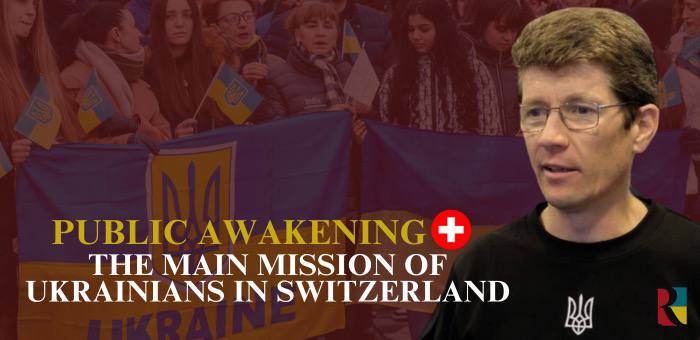


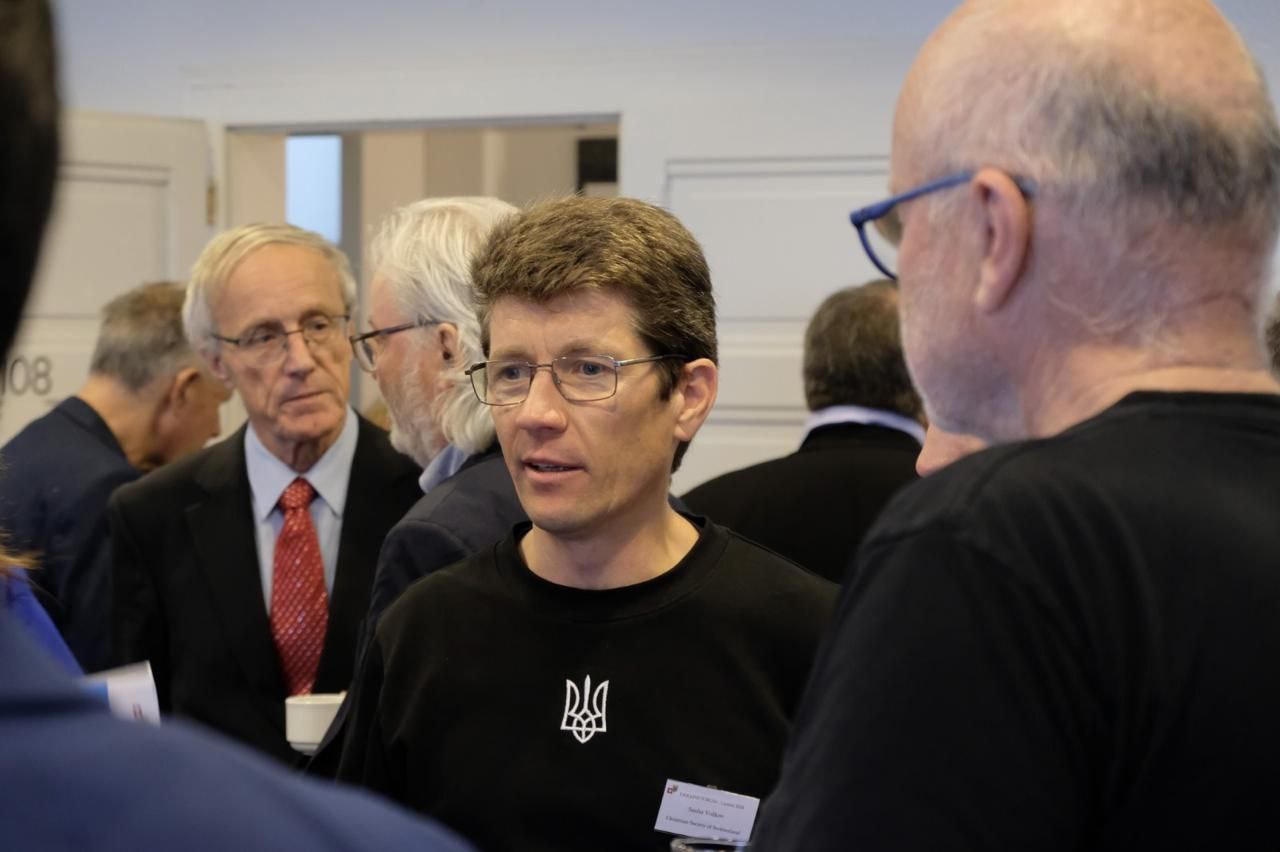
Oleksandr Volkov, a Ukrainian by origin, is a citizen of Switzerland, a civic activist, and a board member of the “Ukrainian Society in Switzerland”. He is a patriot of Ukraine, not just in words but through his actions. His speeches, delivered both in Ukrainian and German, are often heard at Ukrainian demonstrations and socio-political events in Switzerland. During such events, no one can ignore or remain indifferent to the Ukrainian cause.
Awakening the public: a key mission of Ukrainians in Switzerland
The most important thing we Ukrainians in Switzerland can do for Ukraine is public engagement, providing practical help, and informing Swiss society about Ukraine, – says Oleksandr.
He believes that the primary role of Ukrainians abroad is to shape a positive opinion about Ukraine, and, during the war, to do everything possible to lobby and mobilise support for Ukraine and to win the information war.
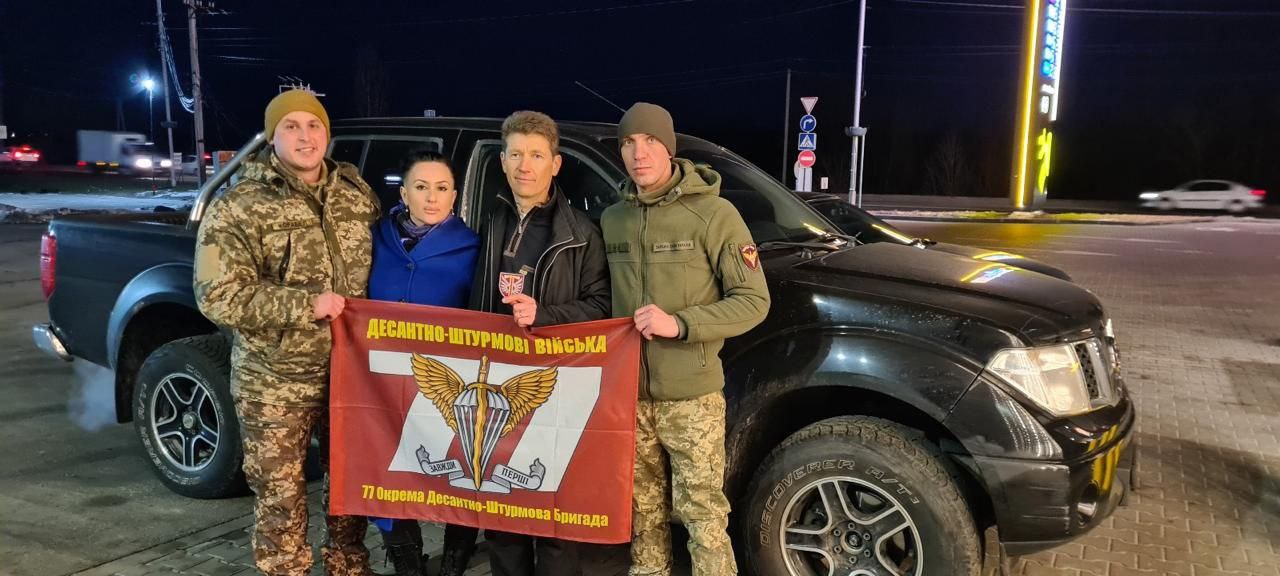
During our interview, Oleksandr was simultaneously negotiating with a car seller for a vehicle he was purchasing for the Ukrainian Armed Forces, which he intended to drive to Ukraine himself. During the preparation for the interview on July 8, Kyiv experienced one of the largest and most brutal missile attacks since the full-scale invasion. Several actions were held in various cities, including Bern.
I called Oleksandr to ask if this event had changed his plans to deliver the vehicle to Kyiv. His response was short and clear: “No, everything is still on – the soldiers are waiting!” Meanwhile, in Switzerland, meetings were held in Bern, Zurich, and other cities of the Confederation – these were protests and demonstrations by the Ukrainian community in response to the Russian terrorist attack on July 8 on the children’s clinic “Okhmatdyt,” a reproductive health centre and other civilian facilities.
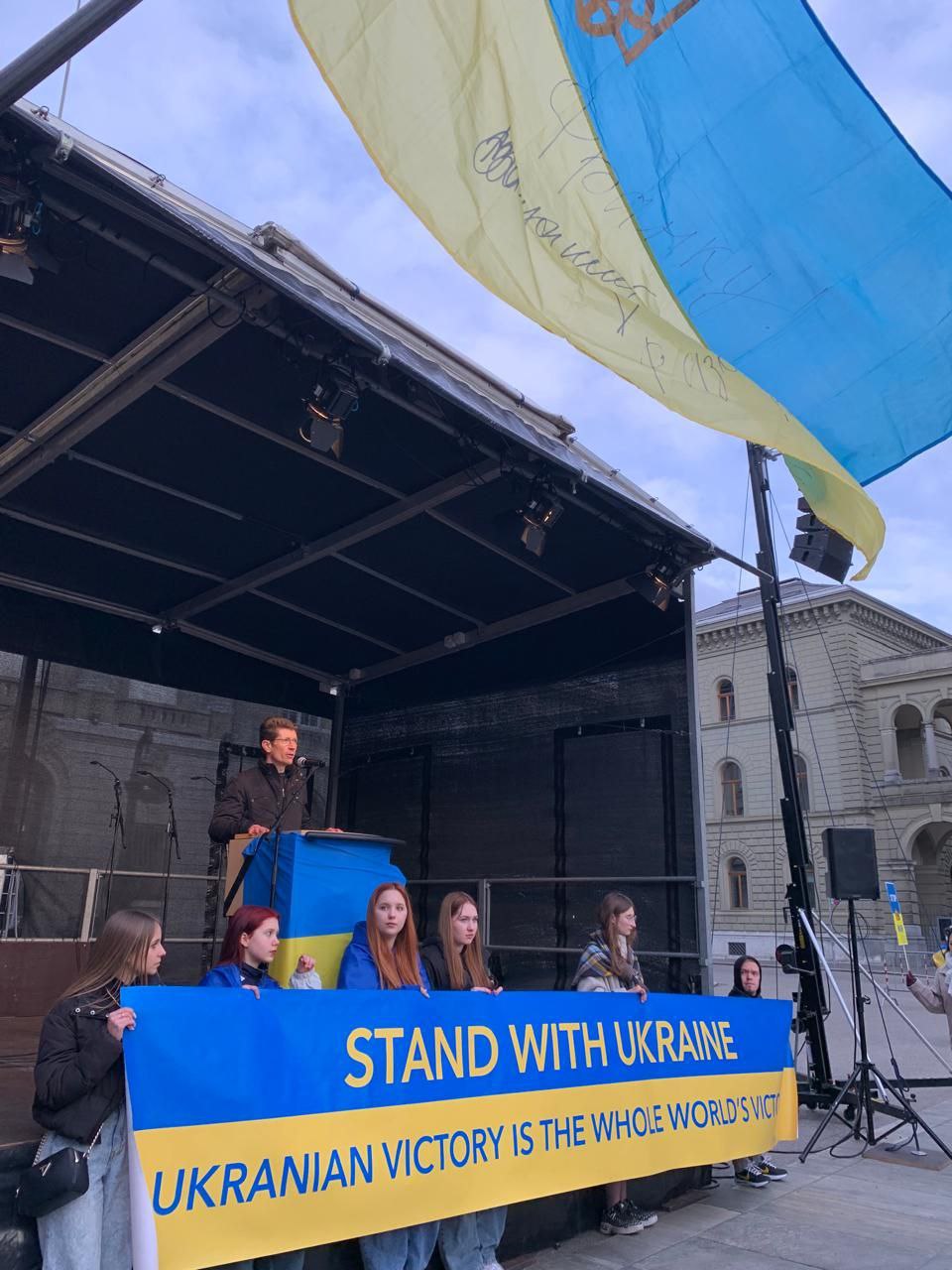
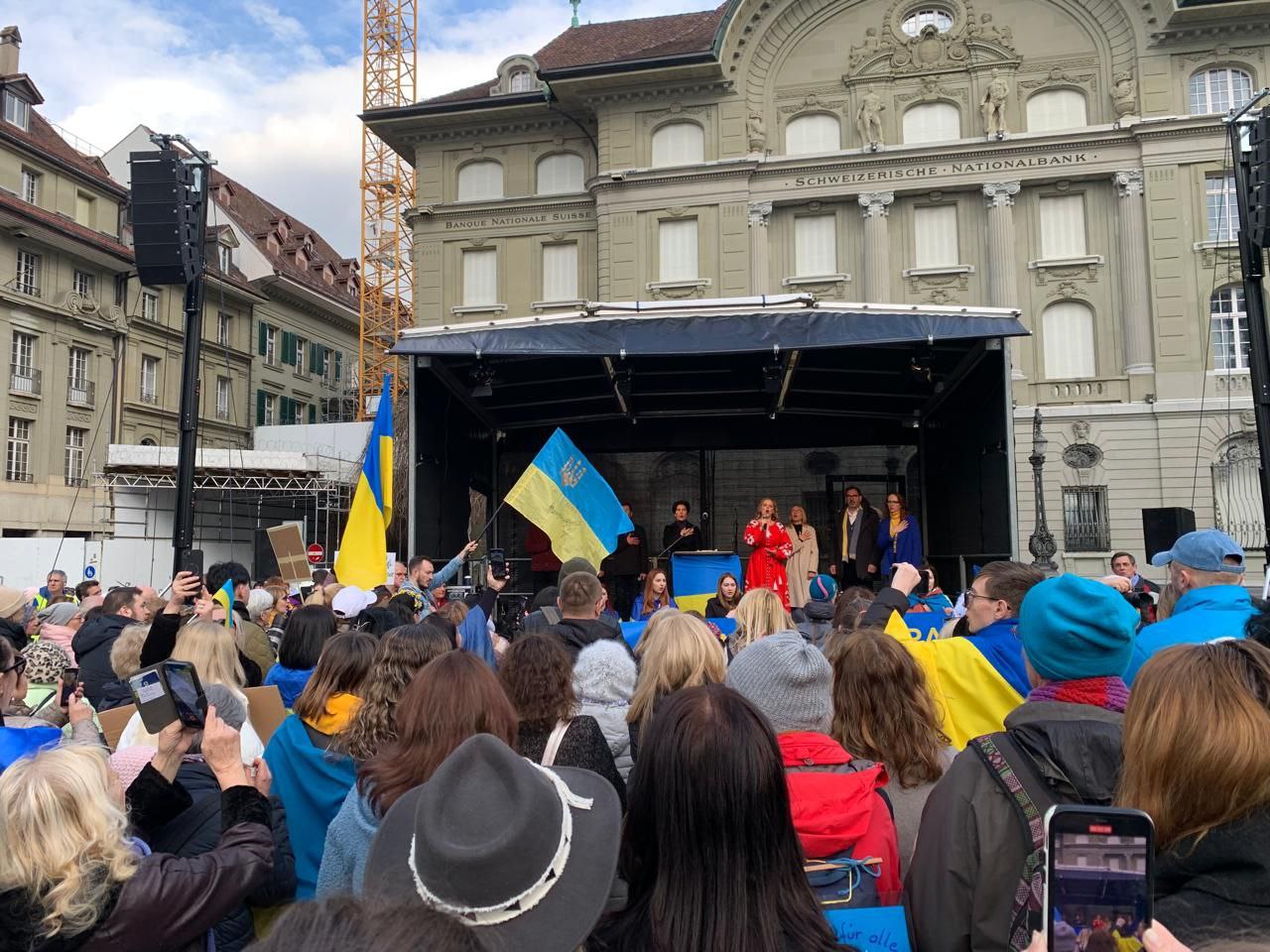
Active and conscious Ukrainians in Switzerland consider it their mission to draw the attention of Swiss society, which needs to be informed not only by the news but also about the war crimes committed by Russia and the challenges faced by ordinary Ukrainians. Oleksandr Volkov has long held Swiss citizenship and is one of the most active members of the Ukrainian community.
The path of Oleksandr Volkov: from economic cybernetics to civic activism
Olena Pantsiuk (O.P.): Oleksandr, your fluent German, which I could often hear during your speeches at events in Switzerland, suggests you have been in the country for a long time. Could you tell our readers about your journey to Switzerland?
Oleksandr Volkov (O.V.): I am originally from Slovyansk. In the 90s, I entered the Taras Shevchenko National University of Kyiv, majoring in economics. I chose economic cybernetics, a rare speciality at the time. It was a new direction for Ukrainian education, but I was very interested in this field and saw my future prospects in it. Most of the programs where I could deepen my knowledge were in Western universities, mainly in German-speaking countries. So, I also started studying at the Faculty of Foreign Languages, where I learned German. I applied to study at the University of St. Gallen in Switzerland and won the opportunity to study there for a year.
Thus, in 1997, I first came to Switzerland. After finishing my studies, I returned to Ukraine, convinced I should be in Ukraine. However, at the same time, I wanted to be needed and earn a decent salary. After completing my master’s degree, I looked for a job in my speciality, but it was an unsuccessful attempt. Then, friends in Switzerland persuaded me to move, as there were better job prospects here then. In 2000, I signed my first employment contract and started working for a consulting company in Zurich. Since then, I have lived in Switzerland and worked in my field – consulting in information technology and the implementation of large systems for enterprise process management.
Changing public opinion about Ukraine
O.P.: Oleksandr, since you have been living in Switzerland, has the public opinion about Ukraine changed?
O.V.: It was difficult when I first arrived here because people generally didn’t understand what kind of country Ukraine was. They couldn’t even find it on the map. Even in the early 2000s, I still met people whom I had to explain that Ukraine is ‘not Russia, not Belarus, and not even Chechnya.’ At that time, Ukraine was more associated with negative things like Chornobyl and corruption… Now, that’s no longer the case! Now, there is an understanding of what Ukraine truly is. Despite the terrible war, Ukraine has more positive associations for Switzerland, especially thanks to the respect earned by the Ukrainian Armed Forces since the full-scale invasion. All in all, the arrival of Ukrainian refugees has given Switzerland the opportunity to learn that Ukrainians are truly intelligent, educated Europeans. After the full-scale Russian invasion, when the entire Ukrainian nation stood up to defend its statehood and nation, Switzerland could see the Ukrainian free and indomitable spirit, who we are in essence, and what we are fighting for and defending in this war. And this evokes a strong sense of respect among the Swiss.
Activism in Switzerland: countering Russian propaganda and supporting Maidan
O.P.: Oleksandr, could you say that your work and the activities of the ‘Society’ and Ukrainian activists, in general, contributed to these positive changes in Swiss public opinion regarding Ukraine?
O.V.: Even though I have lived and worked in Switzerland for more than 20 years, I have never stood aside from the socio-political processes that were taking place in Ukraine during this time. I was always in touch with my parents, and my homeland, followed events in Ukraine, and read Ukrainian independent press, particularly ‘Ukrayinska Pravda’. The assassination of its editor-in-chief, Georgiy Gongadze, deeply affected me. I informed my colleagues, friends, and all my acquaintances about what was happening in Ukraine. Then there was the Orange Revolution. I decided I had to be an observer in the second round of elections because, as I said then: ‘I expect either manipulation or revolution.’ Thus, my environment also learned that Ukrainians are a freedom-loving, independent nation ready to fight for their democratic values. At the beginning of 2014, I received Swiss citizenship, but as a Ukrainian, I actively supported the Maidans. I remember how my boss, a German, approved my decision to go to Ukraine as an observer for the elections and said with that German humour: ” If you get arrested and in prison, we will find a way to get you a laptop and set up Wi-Fi so you can work without interruption”. Working remotely from prison wasn’t necessary. However, I had to sever ties with many relatives who did not share our nationalist views and did not believe in Ukraine’s democratic and European path.
During my time in Switzerland, I saw how direct democracy works. There are not many instruments of direct democracy, but they complement the normal mechanisms of representative democracy. And here, you can truly see how effective the influence of the community is. And from the time of the Maidans in Ukraine, I understood the strength of Ukrainian civil society. However, unfortunately, abroad at that time, I saw that the attitude toward Ukraine was mainly as a country ‘from which nothing good will come.’ Frankly, Russian propaganda at that time – in 2014-2015 – was so powerful here that we were openly losing in terms of information. As soon as we managed to refute one Russian fake, they would create another twenty new ones. I remember that in the summer of 2014, this kind of ‘fighting against windmills’ just led to despair.
And then, here in Switzerland, we also started organising events, demonstrations, and socio-political actions to support Maidan and counter Russian propaganda. We refuted Russian fakes and myths and countered the promotion and imposition of Russian narratives on Swiss society. And I can say that our activity in Switzerland, and especially the civic activity of Ukrainians during the Maidans, fundamentally changed the Swiss view of our country and our nation. Overall, it changed the view of Ukraine and our nation worldwide. This was also aided by the Ukrainian Society in Switzerland, founded in 1945 by Ukrainian students who fled the Stalinist regime after World War II. For a long time, the Society focused on preserving Ukrainian traditions, culture, and history. Previously, it existed to unite and communicate with the Ukrainian community in Switzerland – to meet, talk about Ukraine, recall their history, sing songs, and eat their favourite Ukrainian dishes.
This was important work because the Swiss generally knew almost nothing about Ukraine then. But our young independent state needed ideological support from the community abroad, especially at that time and now. We could and had to counter Russian propaganda. Therefore, when my colleagues and I became more actively involved in the Society’s work, its activities became more politically oriented. I can say that thanks to the wave of young Ukrainian emigration with which I ended up in Switzerland, there was an ‘awakening’ of the ‘Ukrainian Society in Switzerland’ to new directions of work. And thanks to all of us, the Ukrainian community in Switzerland also ‘awakened’. The community became more active, and public awareness regarding the Ukrainian issue and the formation of public opinion in Switzerland about Ukraine took on new features with Ukrainian narratives. We demanded more active actions with greater involvement in politics and political issues. In general, Ukraine, in Switzerland and abroad, should not be represented only through culture, embroidery, and borscht. Ukrainian culture, our borscht, and varenyky are what the Swiss loved very much, but the narratives of national statehood, freedom, and European choice of Ukraine are what the Swiss community had to know. These are the values shared by most Swiss people and which prompt them to show solidarity with Ukraine.
The reaction to the full-scale invasion: Swiss society and government responses
O.P.: Oleksandr, could you share how the Swiss public and authorities reacted in the first days of Russia’s full-scale invasion of Ukraine? What actions did your organisation take?
O.V.: When it comes to protecting Ukrainian citizens in Switzerland who are war refugees, including the creation of a special S status, our assistance was hardly needed. This decision came from the European Union, and de facto, Switzerland had no choice but to comply, and it did. However, where there was a choice, it imposed sanctions against the aggressor country. Since 2014, Switzerland had not done this, only introducing restrictive measures that would prevent Russia from circumventing European sanctions via Switzerland. French cheese or other European products could not be exported to Russia through Switzerland; these were the so-called ‘sanctions.’
Regarding sanctions, I can say that we were the ones applying ‘bottom-up’ pressure, where we needed to influence and awaken society and the authorities. Although there was also ‘top-down’ pressure from the European Union, it was not enough. I remember that shortly before February 24, 2022—five days before the full-scale invasion—we decided to hold an action against Russian aggression. Not everyone in the Ukrainian community supported this, as many did not fully believe in the possibility of a full-scale invasion, but we still decided to organise such an action in Zurich. The main question was what the critical demand should be in case Russia did launch an invasion. We came up with a short and concise slogan: ‘Not a franc to the aggressor’ – Keinen Franken dem Aggressor! And when the invasion began, actions resumed again just a few hours later, and we kept repeating this slogan.
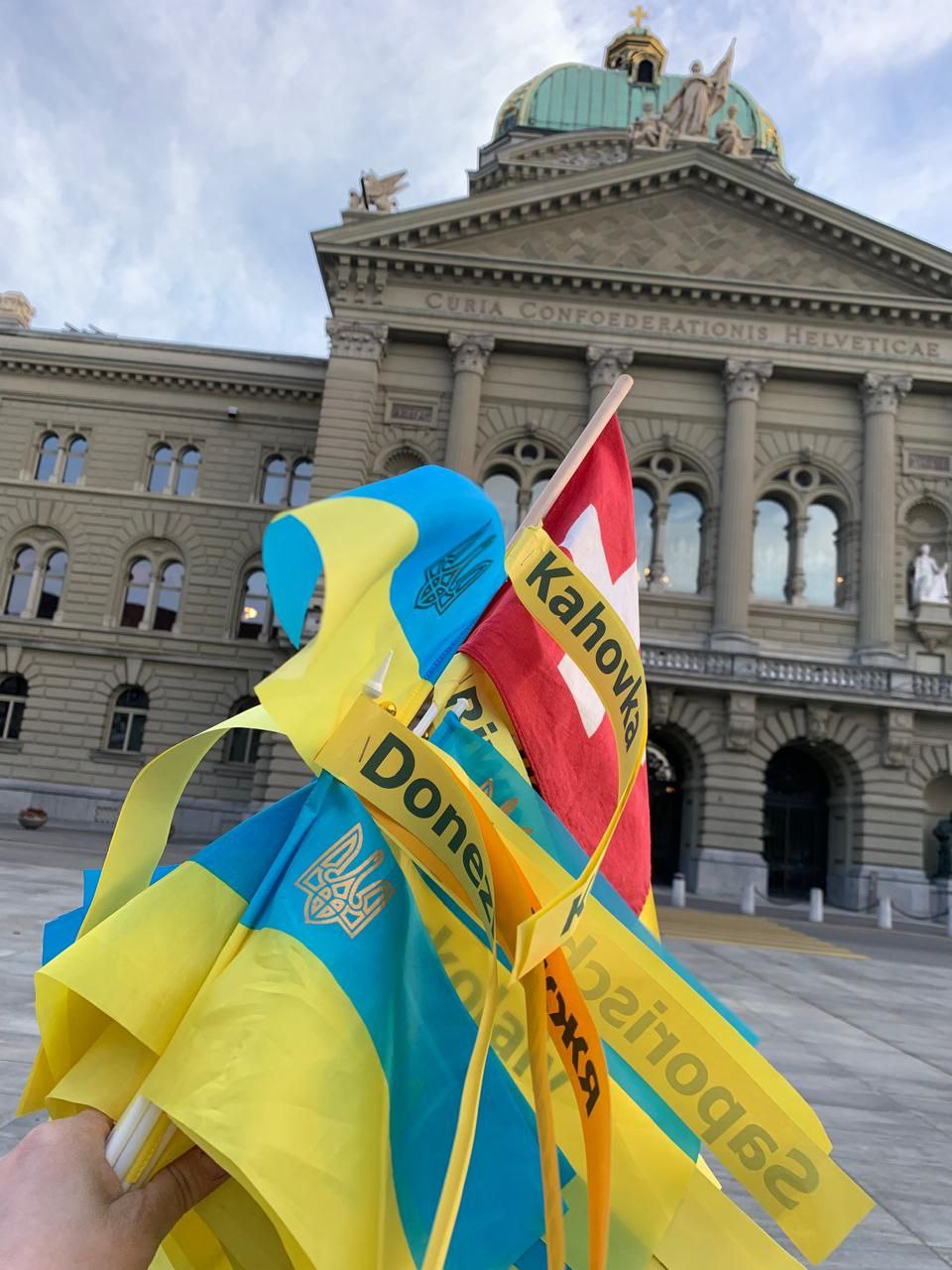
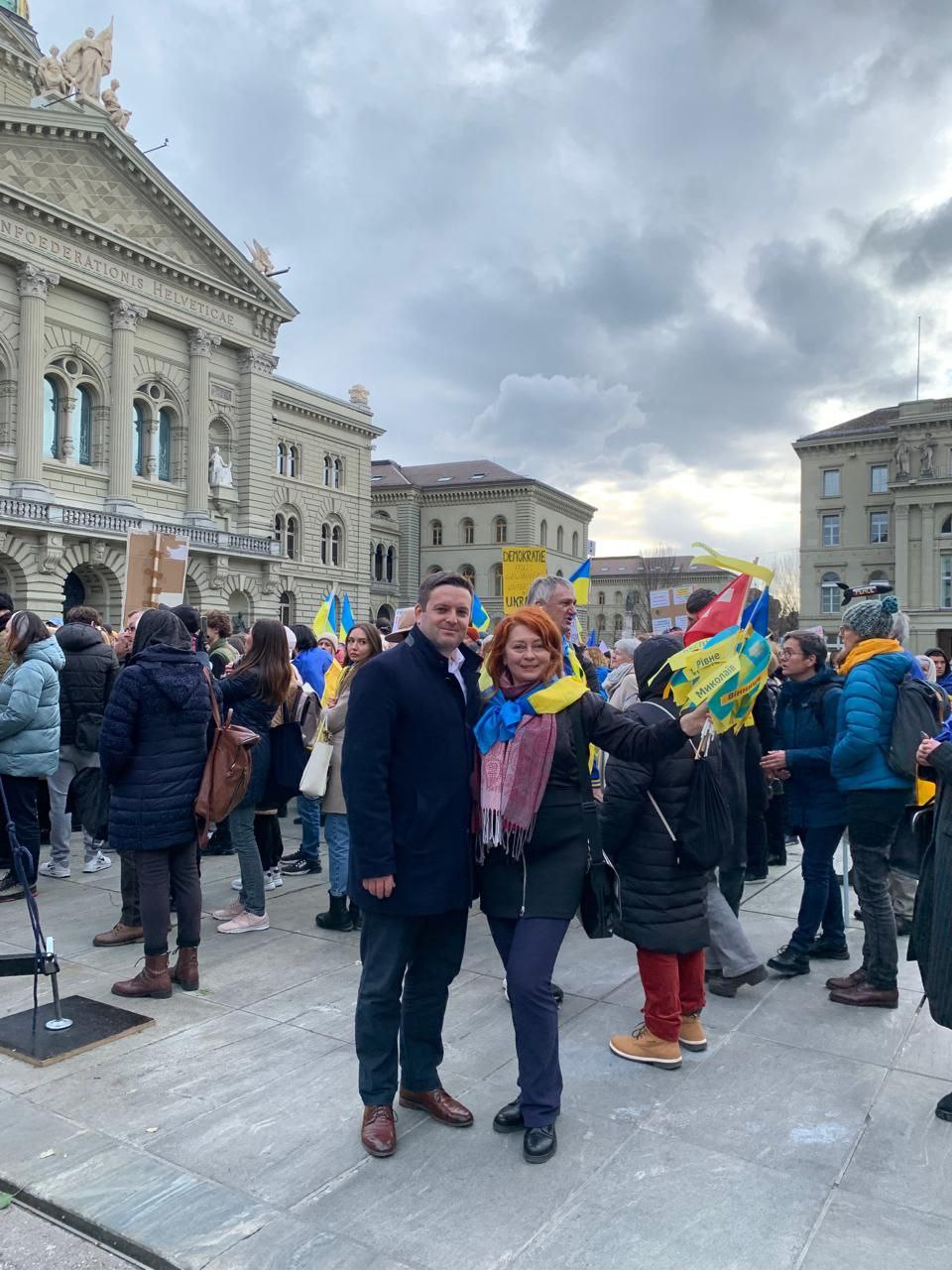
Afterwards, the Swiss government was still deliberating, and on Saturday, three days after the invasion began, a massive, by Swiss standards, demonstration took place in Bern, with the same demand: Keinen Franken dem Aggressor! By Monday, the government announced that it would impose sanctions in line with the European Union. At that time, the primary organisers of these large-scale meetings were Swiss public organisations and Swiss political parties. We were not in a position to organise actions ourselves but participated as speakers in the numerous actions organised by the Swiss.
Cooperation with Swiss political parties and public organizations: challenges and achievements
O.P.: Oleksandr, how is cooperation with Swiss public organisations and political parties established now?
O.V.: My team consists mainly of Ukrainians. However, the ‘Ukrainian Society in Switzerland’ is a Swiss public organisation, and many of its members and leadership are Swiss. They help us better understand the system and communicate more effectively, and our Swiss activists often have a positive moderating influence. When conflicts arise among us Ukrainians—something that is inevitable in public work—it is very helpful to have a wise Swiss person nearby to help find a compromise. When large demonstrations, events, and marches are organised, such as the one held in Bern on February 24, 2024, on the second anniversary of Russia’s full-scale invasion of Ukraine, we collaborated with many NGOs and parties.
First and foremost, we invite representatives from all political forces, as this is a democratic approach. We explain the goals and demands of our actions and coordinate the speakers’ speeches. Not all parties participate, but left-wing and liberal parties are often involved with us in organising. Such events are attended by Ukrainians, Swiss, and citizens of other countries in solidarity with Ukraine. For example, during the event in Bern, on the second anniversary of the start of the full-scale war, the Polish Ambassador, representatives from five political parties, and two charitable organisations spoke at our rally. Representatives of other Ukrainian organisations in Switzerland, such as Helvetia for Ukraine, also participated in the organisation. The Embassy of Ukraine in Switzerland is involved through speeches by the Ambassador of Ukraine and the participation of embassy representatives. So, we have support at the Swiss parliamentary level.
It’s mainly left-wing parties, the Socialists and the Greens, who support us. However, for example, the issue of re-exporting weapons to Ukraine was not supported by the majority of Socialists and Greens. Liberals and Сentrists also mainly support Ukraine, but so far, contact with the Swiss People’s Party, which has a right-wing orientation, is not very well established, although, at the level of individual deputies, there is contact and understanding. But in Switzerland, it must be said, you can discuss with all representatives of the Swiss national representatives. Their openness and accessibility to ordinary people and voters are truly impressive. So, thank God, there are lobbyists in the Swiss Parliament for the Ukrainian cause. There is a parliamentary group of friendship with Ukraine, consisting of deputies from different parties, but there is understanding and cooperation.
O.P.: Oleksandr, when it comes to critically important issues for Ukraine at the moment, such as the re-export of weapons, do you try to influence their resolution in any way?
O.V.: We are a Swiss public organisation—this is also important. Therefore, we try not to ‘overstep’ in this regard. For most Swiss, Switzerland’s neutrality is a sacred thing that needs to be preserved regardless of the demands of the time. We respect that. Soon, there will even be a referendum in Switzerland where questions about the interpretation of Swiss neutrality will be addressed. For now, what is proposed is a rather orthodox interpretation of neutrality. However, the world is different now, and the demands of the time are different, but the citizens of Switzerland decide everything.
In Switzerland, therefore, it is essential to work a lot with the public and the media, substantiate your position, and explain that the war is not as far away as it seems to some. Switzerland is still a small country, a small country with large neighbours. In this, Switzerland is similar to Ukraine for me. And the language spoken in Switzerland and the language spoken by the big neighbour – Germany – are the same. And all the big neighbours around – Germany, France, Italy – they are all much larger than Switzerland. But at the same time, of course, we try to lobby our issues ourselves as much as we can. However, this works best when we create a platform, such as the ‘Ukrainian Forum’ in Parliament. There, representatives of the Ukrainian parliament and Ukrainian civil society, such as Oleksandra Matviychuk, head of the Center for Civil Liberties, have the opportunity to speak on the matter. This is more powerful than just us coming and asking for something. One of our main activities is to create a platform where representatives of Ukraine and Switzerland can communicate directly.
O.P.: During the ‘Global Peace Summit’ in Bürgenstock, how did your organisation and the Ukrainian community participate?
O.V.: On the first day of the Summit, together with the relatives of Ukrainian prisoners of war, we organised and held an action: a rally and march in Lucerne, not far from Bürgenstock, demanding proper treatment of Ukrainian prisoners of war in Russia according to the Geneva Conventions, the exchange of prisoners of war, unconditional release of civilian prisoners, and the return of Ukrainian children home. We helped formally organise this event, but its main participants were three Ukrainian public organisations, including the NGO of Prisoners of War and the Civil Liberties Fund, supported by the Ukrainian World Congress. Ukrainians from all cantons of Switzerland came to this action. The fact that our demands were heard in Bürgenstock and beyond is illustrated by the fact that shortly after this event, ten civilian prisoners were released from captivity.
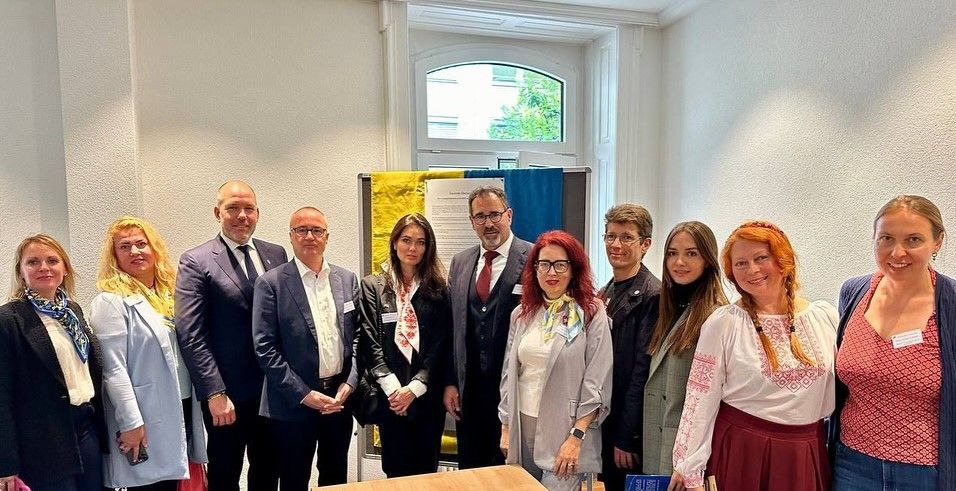
In parallel, during this action on the first day of the Peace Summit, we held our ‘Ukrainian Forum,’ a civil society conference involving representatives from Switzerland, Ukraine, Canada, and other countries, including government officials, diplomats, and opinion leaders. The mayor of Bern, a former Swiss ambassador, and the president of the World Congress of Ukrainians personally participated in this conference. The outcome of this conference was the signing of the ‘Lucerne Declaration.
O.P.: Oleksandr, do you have your own information resources, and how do you cooperate with Swiss media?
O.V.: Currently, our primary communication tool is our Facebook page – Ukrainian Society of Switzerland. We announce and cover all our events on our page. However, we actively engage the press because our events are newsworthy and essential to the media. It’s important that almost all our large actions are covered on Swiss television, such as SRF, TeleZurich, and in local newspapers (20 Minuten and Der Bund).
News about our largest actions and the most powerful events often appears in the broadcasts of national and local TV programs. All media holdings, in one way or another, provide information about our public and political actions. We work systematically with journalists, and the main thing we strive for now is that it should not even occur to them to bypass us when covering something about Ukraine. If they write something meaningful about Ukraine, they should ask for our opinion so that we can comment on it. We constantly contact colleagues, friends, and relatives in Ukraine. About once every three months, or four times a year, as soon as work here in Switzerland (and public work too) allows, I go to Ukraine. We know the situation not from the news and not from second-hand sources, so we can comment as it really is, not as it is convenient for Russian propaganda, for example. So far, this works more or less. And I can already say that thanks to these efforts and such active work, we are not losing the information battle today as we were before. We are not winning it decisively yet, but we are much stronger. And our enemy is weaker due to their constant self-discreditation with the aggression, terrorism, and war crimes they commit daily in Ukraine. And we are winning this information battle just as Ukraine will achieve its main Victory. I believe in this, and I live and work with it.
Olena Pantsiuk, journalist, civic activist, representative of the Ukrainian community in Switzerland and head of the ‘Svit-Merezhivo-Spitze’