

According to the Defense Intelligence of Ukraine, Russia has lost up to 20% of its oil processing capacity. At the same time, Bloomberg reports that Russian oil product exports are at their lowest levels since 2022. Total seaborne traffic averaged 1.89 million barrels per day.
According to Russian Deputy Prime Minister Alexander Novak, oil production in Russia for 2025 was projected at 515–520 million tonnes. This converts to roughly 10.3–10.4 million barrels per day. Officials expected production to be higher than in 2024, but actual figures have reached some of the lowest points seen during the war.
New attacks
October ends as a record month in terms of the number of attacks on Russian energy facilities.
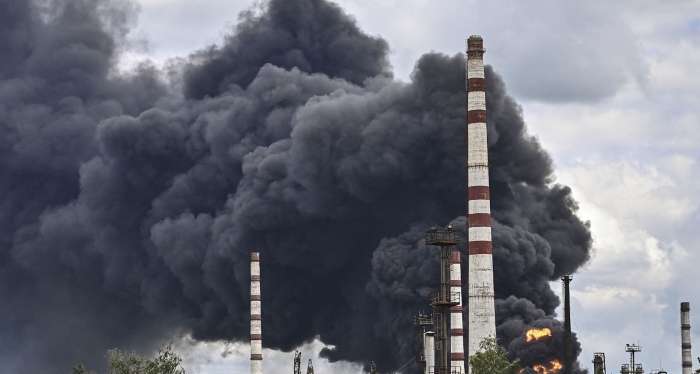
On the night of 31 October, energy facilities in the Oryol, Vladimir and Yaroslavl regions were struck: a thermal power plant in the Oryol region, the largest electricity and heat generator in the area, was damaged. Also, an electrical substation in Vladimir region was hit, and the Novo-Yaroslavsky oil refinery in northern Russia was also struck.
On the night of 29 October, Ukrainian drones reportedly targeted two oil refineries and a large petrochemical plant in Russia.

New Sanctions
Several countries have expanded measures against Russia’s oil sector and its shadow fleet. New Zealand has added sanctions targeting the shadow fleet and the oil industry, listing 65 vessels as well as a number of companies and individuals from Belarus, Iran and North Korea. Earlier measures came from the United Kingdom, the United States, which imposed sanctions on Russian oil companies, and the EU, which adopted its 19th package of sanctions.
At the same time, countries such as Hungary, Slovakia and Serbia have asked the U.S. to soften sanctions for their markets or energy needs.
According to analysts at the Kyiv School of Economics (September 2025), export revenues from oil in 2025, given current prices and weak enforcement of some sanctions, are estimated at roughly $154 billion. By comparison, the Kiel Institute’s support tracker estimates total assistance from Europe since 2022 at €177.01 billion. Thus, even under restrictions, Russia’s annual oil revenues remain comparable to European assistance figures. Russia’s cumulative oil export losses stemming from the full-scale invasion have been estimated at $157 billion.
Conclusion
Both attacks and sanctions are already having an effect on Russia. Losses are evident, particularly in processing capacity and export revenues. At the same time, incomes from oil remain significant. Sanctions have not led to Russia’s catastrophic exit from the oil market. Rather, they have produced gradual weakening. Large buyers, such as India and China, continue to import Russian oil, albeit often at substantial discounts.
Diplomatic signals have been mixed: for example, discussions between former U.S. President Donald Trump and Xi Jinping touched on the Russian-Ukrainian war, but no public shift in China’s approach to Russian oil purchases was announced afterward. Beijing is not ready to reduce imports.
A sanctioned but still functioning shadow fleet helps Moscow mitigate some sanctions. Meanwhile, physical disruption of energy assets remains a reliable tactic to constrain Russia’s ability to finance the war machine.