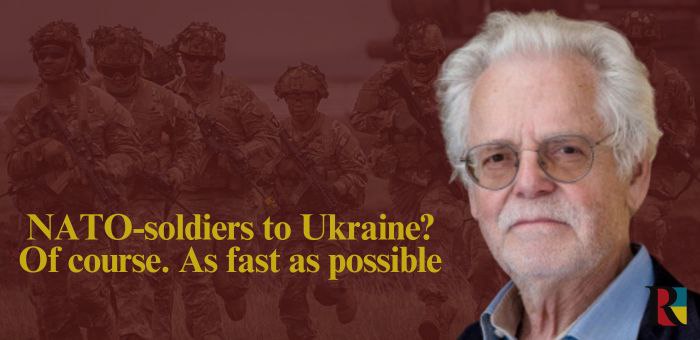


Did US Foreign Minister Blinken during his surprise visit to Kyiv discuss the issue of NATO countries sending soldiers to Ukraine? Danish journalist Per Nyholm, travelling in Ukraine, believes that he did. Will the US provide boots on the ground? Probably not for the moment. Europe should do it and do it fast.
Kyiv
If you didn’t know better, you could think Ukraine was in a state of early summer peace. I just travelled the 500 kilometers from Lviv, the ancient Habsburg city, to Kyiv, a fascinating blend of Slavic Orthodoxy and European modernity: very few traces of the war going on in the east, where barbaric Russia has invaded Europe in the shape of Ukraine, wounded, but courageous Ukraine, which is defending the West, Western democracy and Western lifestyle.
In Kyiv I meet friends, walk the city, visits an exciting new bookshop, called Sens, on the Kreschatatyk, find the statue of Wilhelm von Habsburg, who imagined himself as king of a future Ukrainian state. One more deadly illusion. A war there is, no discussion, the bloodiest and most destructive war in Europe since World War II. My homeland, Denmark, is part of it. In our own interest, or better yet ideally, we supply Ukraine with money, missiles and fighters, the famous F-16s, which should be in the air before the autumn sets in.
Should Danish and other Western ground troops also be sent to Ukraine? Absolutely. French President Macron is right, when he suggests, that NATO countries, not NATO as such, should think of helping our Ukrainian brethren with manpower, booths on the ground as they say. In Kyiv, military experts estimate that a 20,000 men strong multinational force deployed simultaneously with an increase of the Western material assistance could be a significant, perhaps decisive factor in the dynamics of the war in Ukraine, now in its third destructive year.
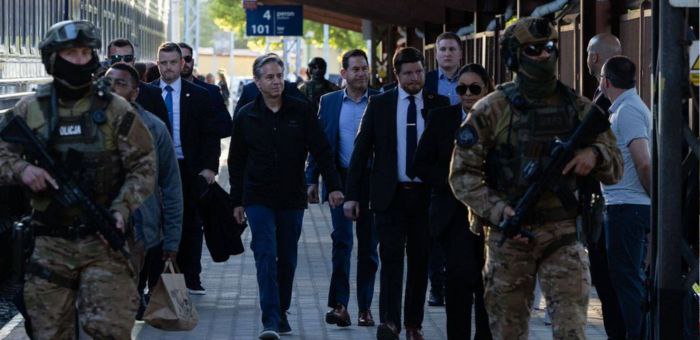
Was this question of supplying Ukraine with troops discussed between President Volodymyr Zelenskyy and US Foreign Minister Blinken as the latter this week passed Kyiv – on his way home from one more mission impossible in the Middle East? I cannot imagine that it was not. And I can well imagine Blinken nodding his discreet acquiescence, then assuring the Ukrainian Head of State that for the moment the US will limit itself to deliver weapons, which both can and will make, what the guest called “a difference”. The American superpower feels less threatened than Europe and have global responsibilities, which do not pertain to the Europeans. That does not make Ukraine a mission impossible. Ukraine surely is winnable, provided that the Europeans in the center and the west provide the Europeans in the east with the necessary means.
The Ukrainian military leadership is much and positively interested in Macron’s proposal. The government of President Zelenskyy apparently fears that problems could emerge along the chain of command. Really? Why? Each national unit will have its own commander, who is part of a joint staff under Ukrainian chief of defense, General Oleksandr Syrskyi. There cannot possibly be any difficulties in it. The foreign troops will operate in various support capacities behind the front. They should not participate in actual fighting. Military circles believe that four or five western brigades could cover the border with Belarus and protect airports and other military and paramilitary facilities. This should free 30,000, perhaps 40,000 Ukrainian soldiers to serve up front, commanded by Ukrainian officers.
Add to this scenario the psychological effect: Ukrainians and Russians alike would realize that Western troops on Ukrainian territory means that the West has no intention of deserting Ukraine, and that the West will respond to any Russian escalation with its own escalation. In Ukraine, this will ease a difficult situation, characterized by a few tactical defeats on the battlefield and the beginning of war fatigue on the home front. The Kremlin will scream and yell and threaten, but will not dare to attack regular Western army units. Pressure will grow on Russia’s demoralized soldiers, who has not seen much change, since the Russian invasion was stopped in the spring of 2022. Once again, those Russian generals, who can and dare think, will tell Vladimir Putin that he can prolong his war, but he cannot win it, a kind of repeat of Nazi-Germany’s situation in 1943 after Stalingrad.
The ouster of the despised defense minister Shoigu may change the balance of power in the Kremlin, but hardly the situation on the battlefield in Ukraine. Shoigu was seen as a friend and a crony of Putin, a civilian dressed up as a general. Shoigu’s successor, a civilian economist by the name of Andrey Belousov, will command even less respect among the upper brass, itself scheming and largely incompetent. Does the fall of Shoigu indicate a weakening of Putin? Possibly, but the carnage will go on, having killed or seriously wounded maybe up to 800,000 human beings, among them, according to the newest estimates, about half a million Russians.
Denmark and other NATO-members already have provided personnel and equipment to international military missions in the Balkans, Libya and the Middle East. There is all good reason, why the Nordic and Baltic countries, as well as Poland, the Czech Republic, Romania, France, the United Kingdom, and even Germany should expand their assistance to Ukraine by sending voluntary, professional soldiers to Ukraine. Most NATO countries are already de facto at war with Russia, taking the view that if Russia’s warlord and fascist Führer kicks down the door to the European home, sooner or later he will enter their living rooms.
Denmark, with its responsibility for the transit waters between the Baltic and the North Sea plus a large part of the Arctic, is well aware of its strategic importance to the Kremlin. The government in Copenhagen, a grand coalition of liberal and social democratic politicians, value the Ukrainian contribution to its security, including a consistent Ukrainian fight against Russian sabotage and Russian terror. A large majority of Danes understands that the defense of their nation and their freedoms begins in Ukraine. Denmark with the rest of Europe has a vested interest in seeing President Macron’s proposal implemented as soon as possible – at the same time as Danish F-16s finally take to the skies.
By Per Nyholm
*These opinions are solely those of the author. The Ukrainian Review takes no position and is not responsible for the author’s words.
Per Nyholm has been a Danish journalist since 1960. He is based in Austria and is a columnist and foreign correspondent at the Jyllands-Posten, a liberal Danish daily newspaper.
Tetiana Stelmakh adapted this text for The Ukrainian Review.