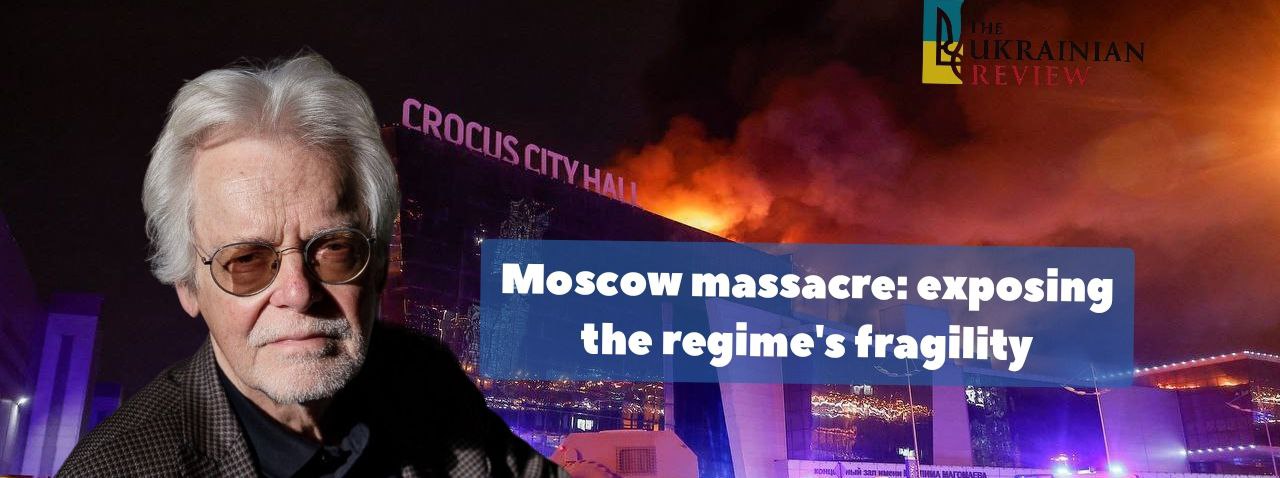


The burned-out cultural center in Krasnogorsk stands this weekend as another monument to the propaganda, lies, and other illusions, provided by the Putin regime. Krasnogorsk is reminiscent of the series of bombings and terrorist attacks that have rocked Russia since 1999.
The massacre in a cultural and shopping center on the northwestern outskirts of Moscow is a story of a predictable disaster, ignored by an imperial power, which in its arrogance and brutality has removed itself from reality. Two weeks ago, the United States apparently warned the Kremlin of an impending terrorist attack in the Russian capital. At the same time, Western embassies warned their citizens not to approach places of mass gatherings, theaters, cinemas, concert halls, etc. The Kremlin did not react. It was preoccupied with a so-called election campaign, which – formally and theatrically – was to add six more years to President Vladimir Putin’s already 25-year-old dictatorship.
It hardly matters to Putin that considerably more than a hundred of his subjects were killed in a hail of gunfire on Friday night. Nor is it particularly important to him that he is facing a colossal security failure right after having told the Russians that he and he alone can guarantee peace at home and victory abroad, garnering him on that now hollow message an unbelievable 87% of the votes cast.
Important for him now is how to capitalize politically on the terrorist attack at the Krasnogorsk complex, only an hour’s drive northwest of the Kremlin. Will he tighten his dictatorship, which is already Russia’s hardest in half a century? Will he escalate the war Russia-Ukraine? Even as rescuers pulled out the dead and wounded, former President Medvedev, now deputy head of the National Security Council, threatened to assassinate President Zelenskyy and other leaders in Kyiv. One of the regime’s cronies, billionaire monarchist Konstantin Malofeev, even suggested a nuclear attack on Ukraine.
The cynicism in the Kremlin is almost unbearable, manifesting itself in a constant drumbeat that Ukraine is the culprit in its role as an instrument of evil, perverted, decadent West. That any blame could fall on holy Russia, mother Russia, paragon of decency and humanity, innocent and wounded, always the victim, cannot be given even. The slightest thought.
It is astonishing that four, five, or more men, dressed in camouflage uniforms and armed with assault rifles and petrol bombs, can drive through Moscow, one of the most controlled cities on the planet, and pass through the security chain around a concert hall, where thousands of people are gathering, without any alarm being activated. Who can be responsible for this tremendous failure? Who might benefit from such an attack? Formally, the Islamic State (ISIS) claimed responsibility for the massacre, but ISIS nowadays is a shadow of the terrorist army, which years ago ruled large parts of Iraq and Syria. Could it be that the remnants of ISIS in The Russian Federation’s Muslim republics, such as Chechnya and Dagestan, have been revitalized by forces in or near the Kremlin? As so often before in the murky world of Russian politics and power, the public has no access to the script or even scripts in play.
According to the Kremlin, every effort is made to unravel the attack and detain the perpetrators. Such is the ritual, and already here the drama or tragedy of Krasnogorsk begins to unfold. The burned-out cultural center now stands and for quite a time will stand as one more monument to the propaganda, lies, and illusions of the Putin regime. Krasnogorsk recalls a series of bombings that rocked Moscow and other cities in 1999, killing up to 300 people and creating an atmosphere of panic that helped Putin become president at the expense of the discredited Boris Yeltsin. In 2002, terrorists – allegedly Chechen – seized the Dubrovka Theater in Moscow. 172 people died during the so-called liberation of the building. Another incident, which left a suspicion that it was intended to strengthen Putin, took place in North Ossetia in 2004. Here, Chechens attacked a school in Beslan and took 1,200 students hostages. A counterattack by security forces shortly after claimed the lives of 332 children.
The massacre on the outskirts of Moscow looks like an act of pure and evil terrorism. However, it could also have been organized to allow Putin to strengthen his rule after two events that did not quite follow the Kremlin’s script – the funeral of dissident Alexey Navalny and the re-election of the president, both marred by various demonstrations. Or are we perhaps witnessing a carefully prepared atrocity, the purpose of which is to weaken Putin? Who could be interested in such an affair? Perhaps the military intelligence directorate (GRU), which knows, how bad things are in Ukraine, and which has seen several generals and other senior officers dismissed after the Wagner Group and Yevgeny Prigozhin mutiny in the summer of 2023, this mutiny in itself is a sign that many within the Russian elite would like to see Putin removed from office or even shot in the basement under the Kremlin.
Russian authorities do not go easy on their subjects. It is estimated that the Ukraine war now has cost Russia more than 430,000 dead and maimed – far more than the army that started the war in February 2022. The task of the average Russian is to die for the powers – for the tsar, for the general secretary of the Communist Party, or as it is now for the fascist Führer. It is unlikely that the Krasnogorsk massacre will ever be fully investigated and explained, but it is hardly wrong to see it as a sign that not only is Putin’s dictatorship weaker than many believe. It also, fatally, feels weaker, and it knows, even in the inner sanctums of the Kremlin, that as the war in Ukraine today drags on, this weakness, this primitivity, this perennial distance to the real world, will course its defeat and possible the fall of the Russian Empire.
By Per Nyholm
*These opinions are solely those of the author. The Ukrainian Review takes no position and is not responsible for the author’s words.
Per Nyholm has been a Danish journalist since 1960. He is based in Austria and is a columnist and foreign correspondent at the Jyllands-Posten, a liberal Danish daily newspaper.
Tetiana Stelmakh adapted this text for The Ukrainian Review.