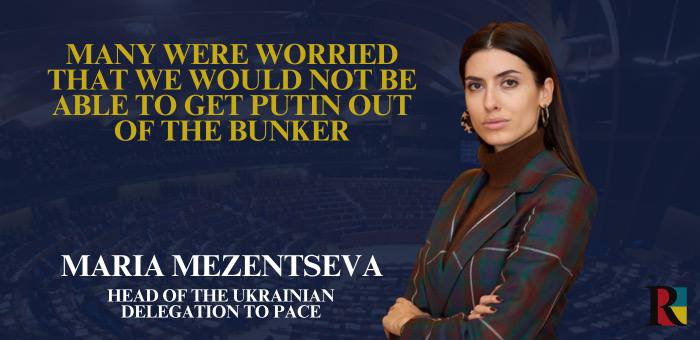


Establishing a Special Tribunal to bring Russia’s top leadership to justice is one of the key activities of the Ukrainian delegation to PACE. In particular, Maria Mezentseva, the head of the delegation, regularly speaks about this topic. She shared with The Ukrainian Review the latest news and her thoughts on this process, and emphasized that Russia will be punished only if there is strong international pressure.
Kostyantyn Grechany (K.G.): The Special Tribunal and the ICC – what is the difference between prosecuting Russia in these two instances?
Maria Mezentseva (M.M.): The International Criminal Court, by its very nature, cannot prosecute the crime of aggression as a leadership crime, so we had to create a tribunal, a special court by a separate treaty, using the Council of Europe as a base, and connecting all countries that believe in justice and that aggressions should not only not be repeated, but should be punished. That is why, since 2022, we have initially fought to debunk the myth that the International Criminal Court can do this. It cannot. It was, you know, diplomatic jealousy, to put it right.
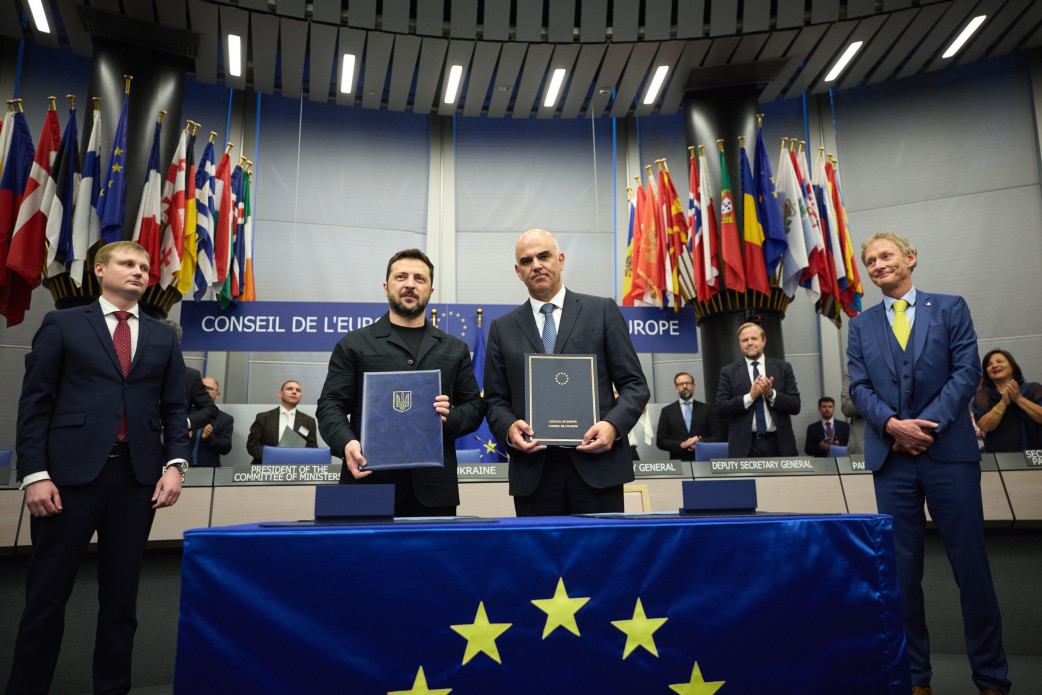
How did this happen? And then we just followed the rules and procedures. And now, after more than two years of work by working groups at the level of ministries, legal and international advisers, and more than 40 states, we have an agreement to be signed between the Council of Europe and Ukraine. And then the treaty, which can involve more partners and already condemn the political and military leadership of the Russian Federation, is about 20 people.
Not only Putin, not only Shoigu, not only the names we know, but these are not ordinary people, these are the top leadership who planned, gave orders and encouraged this aggression. We believe that this is a worthy response. Many people did not give this construction a chance – even legally. But I think we have won the position that the tribunal has the right to live and we sincerely believe that in the near future it will be established in the Netherlands, in the city of The Hague, which is already taking on the obligations of establishing and providing the technical base.
Our office has been working all this time on the evidence base. Because, let me give you an example: it is much easier to prove Russia’s aggression against Ukraine now than, for example, war crimes such as sexual violence against an eight-year-old child, as recorded by the Office of the Prosecutor General, committed by a Russian soldier, where he is now is unknown.
That is, of course, a conviction in absentia, as it is called, is also possible. Many people were worried that we would not be able to get Putin out of the bunker and so on. But it’s not just about Putin and not just about his physical presence. It’s about the special tribunal in general. We believe in it, and legally, the structure is correctly written. The question here is political – how many partners we can attract to its base. I think it will be a large number of states.
K.G.: Can the peace agreement have any impact on the creation of a special tribunal?
M.M.: It was a very important moment when all the procedures were agreed upon. Do you remember if it was just before the talks in Istanbul or between the two phases – I honestly don’t remember.
I was also confused by this issue, because it seemed to me that there would be no political expediency. Thank God, our partners did not abandon what they agreed to back in 2022. The tribunal has not been canceled, and the document is still valid today. I do not believe that the tribunal is equal to the failure of peace agreements or deals.
And who knows when these peace agreements will be reached? Because, given the different approaches to negotiations that we, our partners, and Russia have, they have a list of demands and manipulations, and constant changes of position, terror. On our part, it is constructive, which, for example, in the latest version was not even considered by the Russian side.
That is why we need to use international pressure and international law, which is what we are doing in the right way.
K.G.: Borys Tarasyuk, Ukraine’s representative to the EU, said that Ukraine should sign an agreement with the EU on a special tribunal in the near future. Actually, should we expect this agreement in the near future?
M.M.: I want to clarify: the agreement will not be with the EU, it will be with the Council of Europe. Why am I clarifying? Because many of our readers may have seen in the media: in Lviv, the European Union confirmed the creation of a special tribunal. That was the message, and that was the event. But it is the Council of Europe that is creating the tribunal, of course, with the EU’s involvement.
And I’m sure that any country in the world that believes in justice, from Fiji to Japan, will be able to join in. This is very important – this wider geography. We don’t want the tribunal to be called a purely regional or European tribunal, God forbid. I believe we could sign this document by the end of this year. And let’s see how it comes true over time.
K.G.: So, no forecasts yet?
M.M.: Yes, preferably by the end of this year.
K.G.: This is understandable. The Special Tribunal and the ICC will not be able to physically prosecute a number of criminals, and this is understandable for many reasons. What solutions in this context would be optimal for us?
M.M.: Well, you know, we talked to Ukrainian citizens, especially those who have survived the occupation, torture, deportation, displacement, loss, and this is almost every Ukrainian family.
I don’t know a family that hasn’t suffered losses, material or non-material. Everyone wants justice. And the very fact that the tribunal was established is a huge step towards justice. Even if we don’t see Putin behind bars physically. Because we don’t even know if this is the Putin who should actually be behind bars. If it is some variation of him, I think many people will be satisfied with it.
But long before this full-scale aggression, there were many slogans: “Putin is waiting for The Hague”. Well, not only him. Let’s be honest. And let’s look at who else might be involved. This includes the Belarusian leadership. By the way, there have been a lot of discussions about whether this tribunal could be about, for example, the aggression that took place against Georgia. It was also committed by Russia. Even the expansion of the geography was proposed.
But now we want to focus on what has happened to Ukraine since 2014, the continued temporary occupation of the territories, their seizure and full-scale aggression since 2022. And, in principle, we are moving in this direction. We, of course, insist that the convictions be physical.
We know that there have already been countries that have violated their obligations under the International Criminal Court. After signing the Rome Statute, they did not detain Putin when he was in Mongolia, for example, if I am not mistaken. And then there were some excuses. That is, we see deviations and derogations from their obligations under international law.
So here we have to take into account all these elements and just follow the procedure. And over there, well, life is long – you have to look at different political processes, life processes. No one is eternal. So, you know, we may have to bring them in absentia, posthumously. Nobody knows. So we will look at the realities.
K.G.: Well, not the worst option, really. Now the sanctions are directed mainly against Russia, but also against Belarus. Maria, in your opinion, is it worthwhile and legally possible to impose similar sanctions on, let’s say, the outspoken partners of the Russian Federation who support this aggression? This is North Korea, partly Iran, partly even China.
M.M.: Yes, absolutely. I will tell you that the 17th package of sanctions includes such states as, if I’m not mistaken, Turkey, the United Arab Emirates and Kazakhstan, and not only. That is, for the first time, such workarounds for Russia’s use of, for example, the shadow fleet and more are named. Therefore, it is very important to call groups of countries by their proper names. And this is definitely the case with Iran. By the way, we mentioned it in the PACE resolution as a sponsor of terrorism, as a partner in this aggression. North Korea was also mentioned.
So, for example, we have done our job in this regard. And many countries have already imposed sanctions on these countries, and I can think of the US sanctions against Iran, which were perhaps the most painful in the history of any sanctions. We need to move on here, and it’s not about the 18th or 19th package, it’s about the substance – that is, what we put in there – so that we don’t have a situation where every month we just say, “Oh, sorry, we forgot this company, this country, and this addition.
And let’s not forget that they require approval, they require consensus. This is not an easy job, given that our partners do not always support the sanctions approach.
But I want to emphasize to those who will read my interview that sanctions work. They are effective. They are really hurting Russia’s economy, which is going through a difficult time.
The economy is overheated, neither in terms of the Central Bank’s rate, nor in terms of the foreign exchange reserve, nor in terms of anything else. It is at a peak that could lead to a serious default. And I think we will see something interesting at the beginning of next year.
Because to continue in this dynamic of the war economy, of spending, of all these salaries that are being paid to soldiers who are sent to kill in Ukraine, all this cannot but have consequences.
That’s why we want more. And we are confident that we can do more in terms of sanctions.
K.G.: In your opinion, what is the likelihood that the aggressor will pay us reparations? And is there a procedure for forcing them to do so?
M.M.: Let’s recall the last of Russia’s demands, so they were precisely about not paying us reparations, such was the condition for us and our partners to forget about reparations. The register of damages and compensation, which we have discussed, depends on this. The whole approach to justice depends on this. Okay, let’s imagine: Russia will not do this. Then who will? Who should rightfully become the party, the state that will be responsible?
There is no such party. It should and must be only Russia. That is why, Konstantin, we have no escape routes. We have only the way to put pressure and achieve this. You know that there are already 350 billion of frozen assets of the Central Bank, but this is not all, this is not yet the amount that can cover those modest estimates of the World Bank, which no longer fit into zeros, ones, some ideas, because every day the Ukrainian private sector, the public sector, the level of the Ukrainian family, and the Ukrainian state, of course, loses significant funds.
But despite this, we find and raise funds to ensure that we do not default, that our economy continues to work, that investment projects are still implemented, and that recovery takes place. Therefore, there is no option to think about the bad.
We now have an option – legal structures for different countries: separately for the US, separately for the UK, for the EU, for Switzerland, in the EU separately for Luxembourg, separately for Liechtenstein. That is, we look at different jurisdictions. For example, Belgium, which has a frozen asset recovery agency on its territory, speaks and sends us a message: “Look, friends, it would be easier and better for you to use the interest on frozen assets for a longer period of time. It’s just like making a deposit as usual, and you can withdraw your deposit with interest only once, but here you have such great conditions, you can withdraw this accumulated interest on the deposit in installments all the time.”
But the amounts here are absolutely not those that can meet the needs of our state today.
That’s why I see no options here, honestly. We need to continue working on this. We often hear “impossible”, which then turns into “well, you can move a little bit or change your position”.
K.G.: And the last big question: what is the delegation doing to improve the situation of our prisoners of war in captivity? What else, besides what has already been done, can the European Union do to help us with the issue of prisoners of war, both military and civilian?
M.M.: Yes, because the Council of Europe is a broad platform of countries where we can talk about captivity and conditions of detention not only to European nations, but also to many cultures of the world.
I think that the participation of the Canadian delegation, for example, although they are again in observer status, they have the right to speak, to participate in committees, and they are trying to actively help us in promoting this issue, because each of the countries is basically a co-organizer, a major donor and sponsor of the International Committee of the Red Cross, the only organization that has a mandate, first of all, for access, secondly for direct communication, and thirdly for the return of our prisoners. The reason why the mandate is difficult to work with is that Russia is trying to block access from its side, even to the temporarily occupied territories.
Ukraine provides all the necessary permits, but Russia blocks them, does not provide access for inspection. Or, when access does occur, it is done by the Russian side, so that everything looks okay, give or take.
I’ve been to a Russian prisoner of war camp in Ukraine and I can say for sure that this is a huge difference. You know, the prisoners are fed there, they have access to hygiene and treatment. That is, we as a state adhere to all the Geneva protocols and conventions, while Russia does not. But this does not mean that we should be like them, and we will not do that.
Our task now is to create constant international pressure. We really believe that this will work.
And also communication. Communication between families waiting for civilians and the military. For example, the stories of those released from captivity – that’s how you can listen to the story of a marine who would have been sentenced to 49 years in prison if he had not been released and the state had not helped him, and his family and his wife had not fought for him. There are many, many stories like this.
And your fellow journalists who have been released are helping us. A terrible story is the recent return of your colleague’s body without some of his internal organs. This cannot leave even colleagues, just people, indifferent.
This resonance, this information campaign, the stories, the dissemination of stories, they create international pressure. That is, when this topic cannot be silenced.
And we will continue to work on this on the basis of the PACE and within the framework of resolutions, and become the voices of the prisoners. Rather, we will involve their families in advocacy campaigns. Because sometimes you feel that this is all you have.
But we see the success of the coordinating headquarters for the exchange of prisoners, the ombudsman’s office, the Ministry of Internal Affairs, the Security Service of Ukraine, and the President’s Office. All those involved in this process, but it is a painstaking, hard work.
As for civilians, we will have to work even harder. We have to convince them and look for alternative ways. After all, we have no one to exchange them for: according to the Geneva Protocol, we cannot even take civilians prisoner, but Russia does, and it does so deliberately.
Ukraine has no Russian civilians in captivity, Russia does. And it says: “Who are we going to exchange them for?” So they are in this situation of a legally incorrect strategy on the part of Russia.
We are no strangers to this. Almost 300 civilians – 294 to be exact – have already been returned home. But the number of those who are still in detention centers is large.
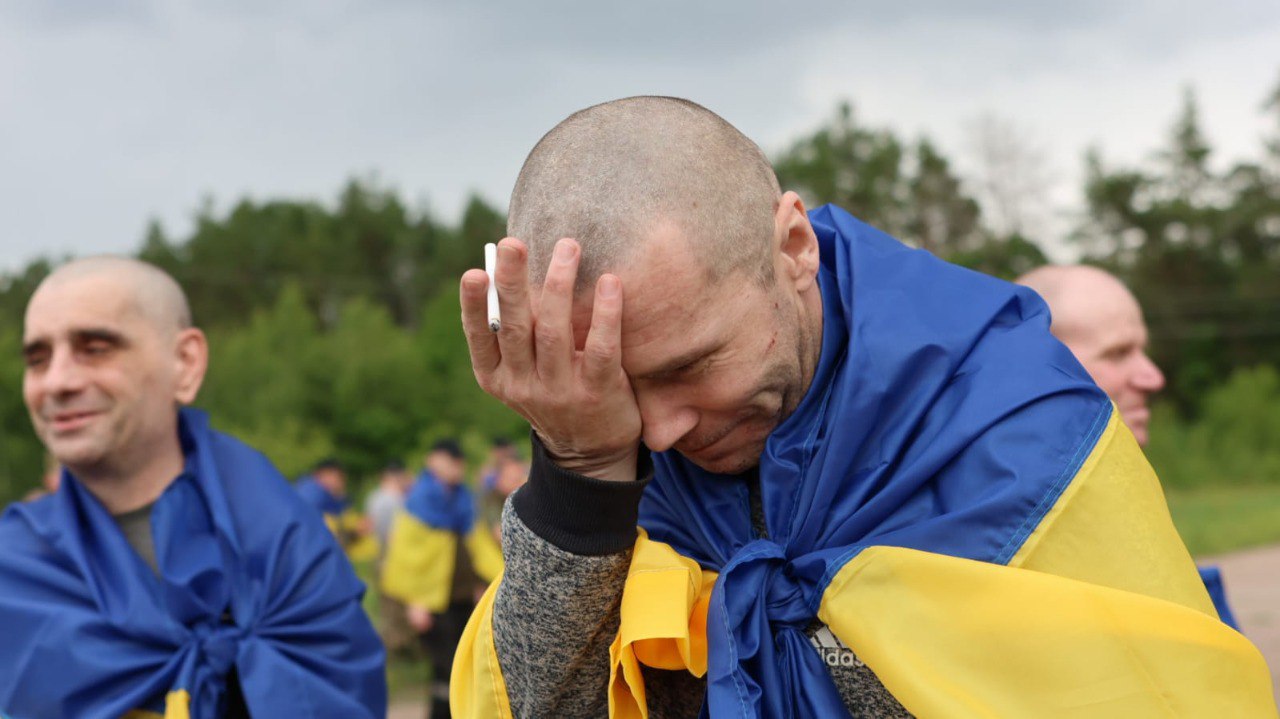
We are not stopping our work. We hope that personal visits – both by the coordination center and the Ombudsman’s Office – will help.
And always one question: “How can we help?” One colleague from Iceland said: “I am ready to get a Russian visa”. But the Russian embassy in Iceland was closed. He was told: “They won’t give you anything. They won’t give you a visa.
We are ready to do it ourselves, but we are on certain sanctions lists, not just Russian ones. And our Council of Europe immunity will not work. We can simply be killed or taken prisoner.
And so are our colleagues from PACE. All are sanctioned because we are working against Russian aggression. It is important to find these alternative mechanisms and channels of communication. And very often I speak at various international platforms, on various global information platforms.
Whatever the topic, I always talk about prisoners. And let’s be honest – this is probably the only topic that has really worked effectively.
Let’s just say that five important exchanges have already taken place. Today, we are repatriating even more bodies, more than a thousand defenders. This means it is working. It is very difficult, but it works.
We just need to look for additional ambassadors of this topic – public figures, those who can influence Russia, mediators.
Such non-standard countries as Qatar are helping to return children. And not only that. We need to find these voices, and those communicators who can use soft power, soft power, to ensure that these exchanges continue and become more numerous.
Kostyantyn Grechany
Tetiana Stelmakh