

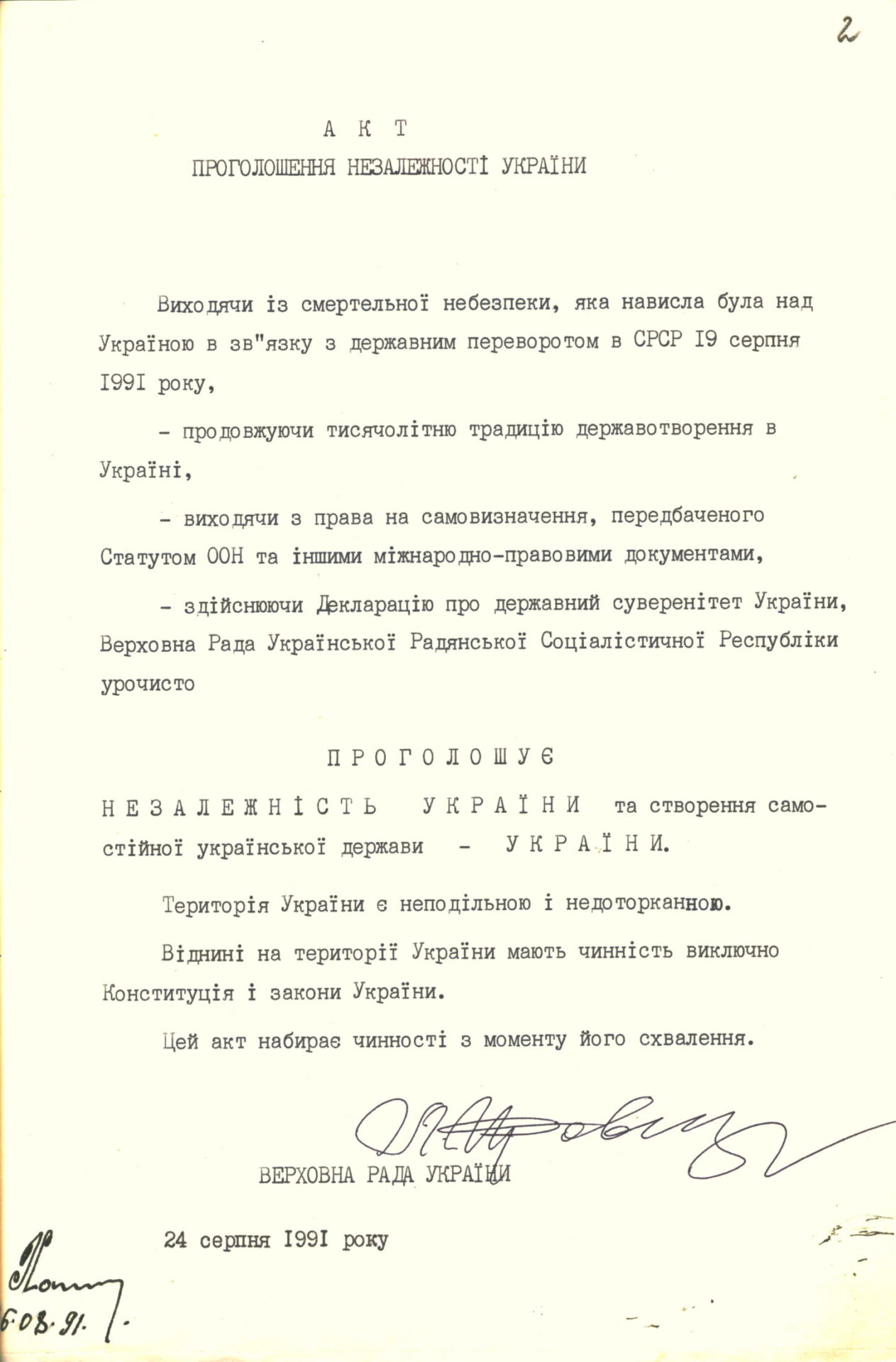
А 33 years ago, the Verkhovna Rada of the Ukrainian Soviet Socialist Republic adopted one of the most important documents in the history of the Ukrainian state – the Act of Independence of Ukraine. However, international recognition of the newly independent European state began only after the referendum on 1 December 1991, in which 90.32% of participants confirmed this document.
Although the declaration of Ukraine’s independence was not the hottest topic in the foreign media in August 1991 (the attempted coup by conservative Soviet officials against the reformer and leader of the Soviet Union, Mikhail Gorbachev, was more actively covered), they could not ignore it.
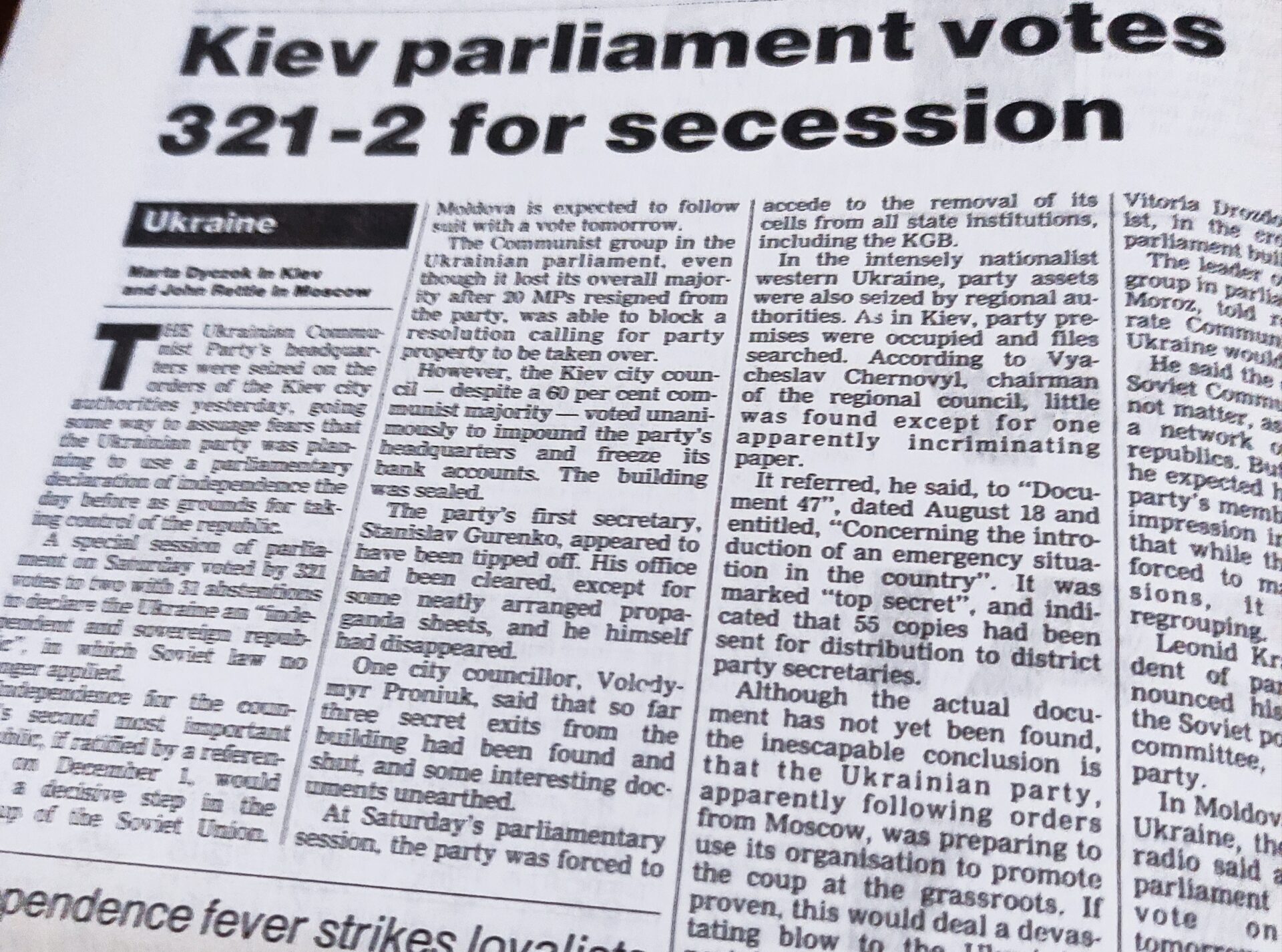
Guardian
On 24 August, the British newspaper Guardian did not have time to publish the news of the Verkhovna Rada’s adoption of the Act of Independence, but noted that the leaders of the second most powerful Soviet republic seemed to be moving cautiously but inexorably towards separation.
Already on 26 August, the Guardian published a short article entitled: “Soviet break-up gains pace: Independence moves by Ukraine, Belarus and Moldova threaten Gorbachov”.
In the next issue of the newspaper, the article was more extensive and emphasised the importance of the Declaration of Independence for the continued existence of the USSR:
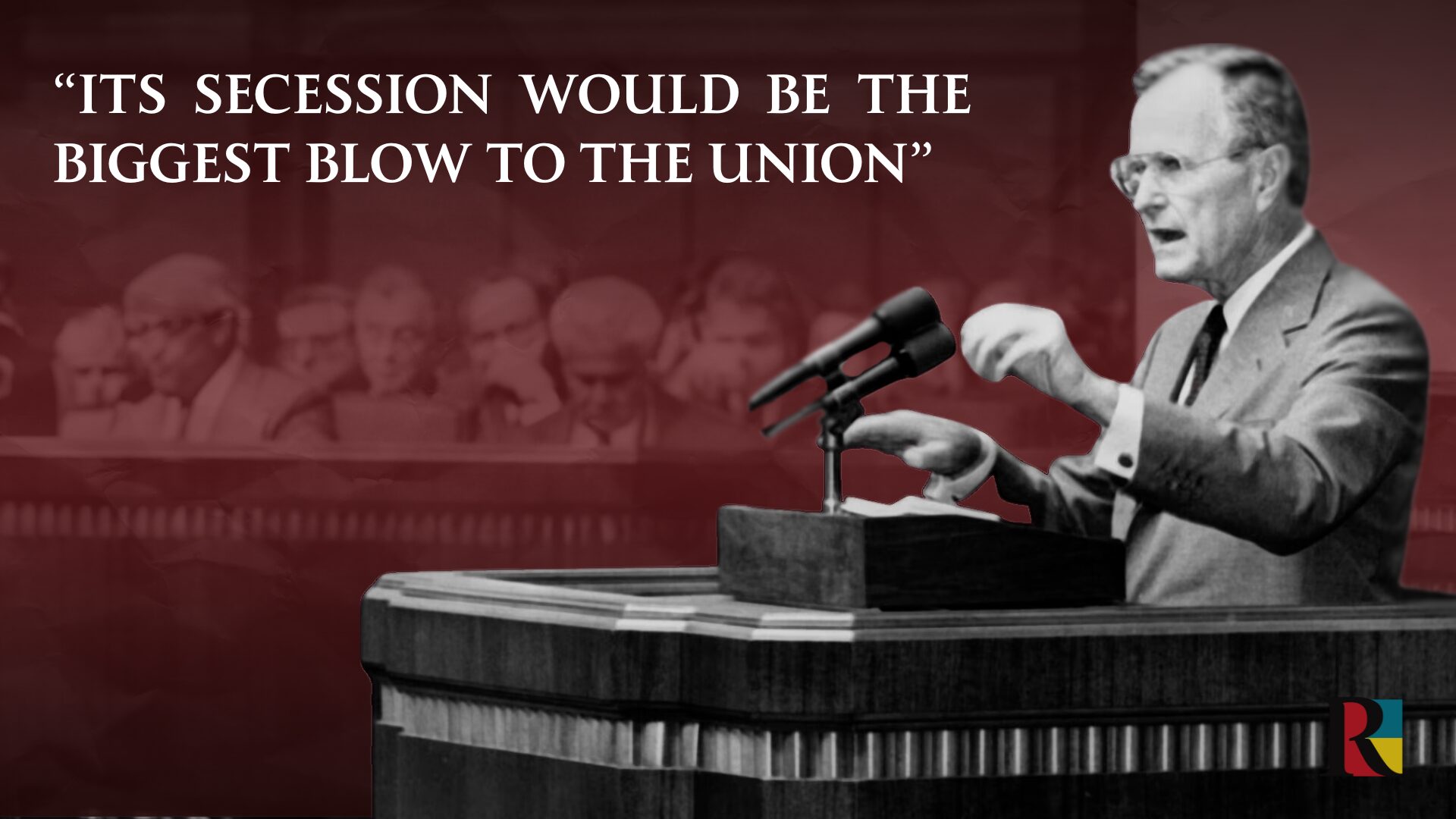
With A population and size similar to France, Ukraine is by far the most important republic after Russia. Breadbasket and industrial centre, its secession would be the biggest blow to the union…It is difficult to picture Russia without Ukraine.
Financial Times
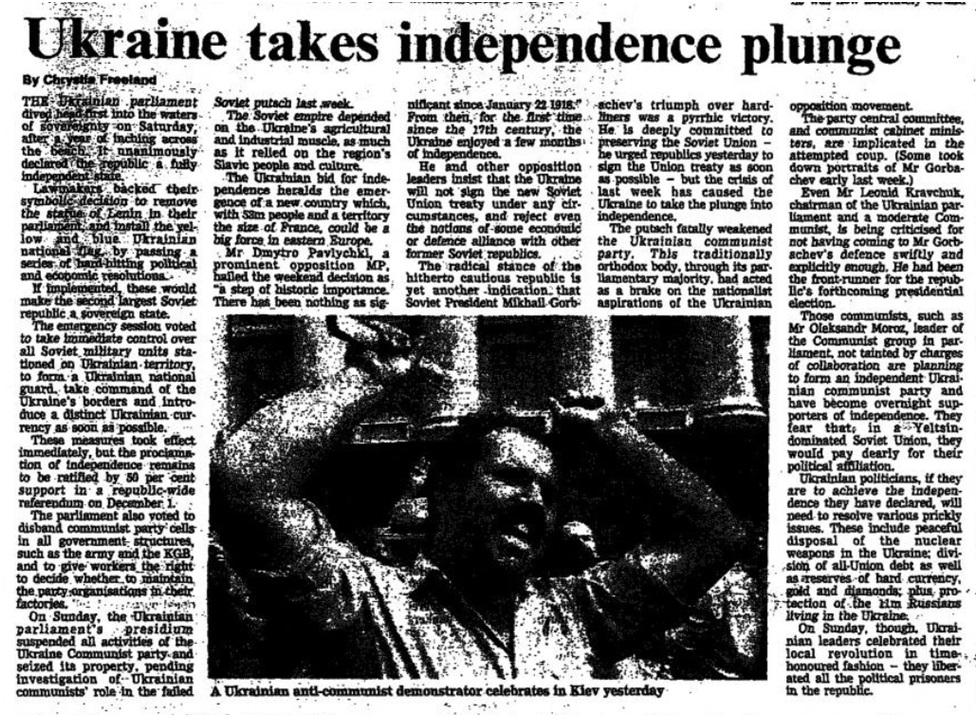
On 27 August 1991, the British newspaper Financial Times published a short article about Ukraine’s declaration of independence, “Ukraine takes independence plunge”. It emphasised that the new country of 53 million people ‘could be a major force in Eastern Europe’.
The article described the new challenges that Ukrainian politicians would face.
If they are to achieve the independence they have declared, Ukrainian politicians will need to resolve various prickly issues. These include peaceful disposal of nuclear weapons in the Ukraine; division of all Union debt as well as reserves of hard currency, gold and diamonds; plus protection of the 11 million Russians living in the Ukraine.
Libération
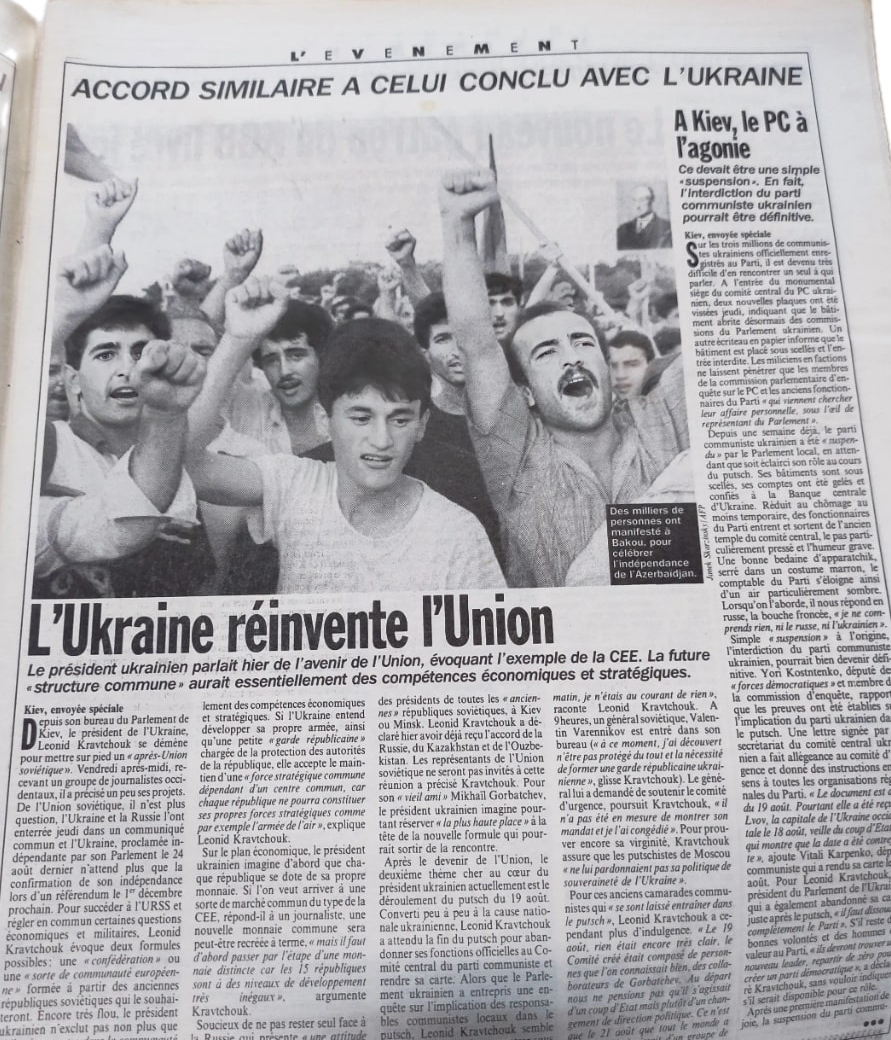
In early September 1991, the French newspaper Libération published several articles about the events in Ukraine and the declaration of its independence. One of them was devoted to a meeting between the chairman of the Verkhovna Rada, Leonid Kravchuk, and a group of foreign journalists, where they announced the possibility of forming a confederation of former Soviet republics. Another article with the loud title ‘In Kyiv, the Communist Party is in agony’ reported on the banning of the Communist Party in Ukraine after a failed coup attempt.
Time
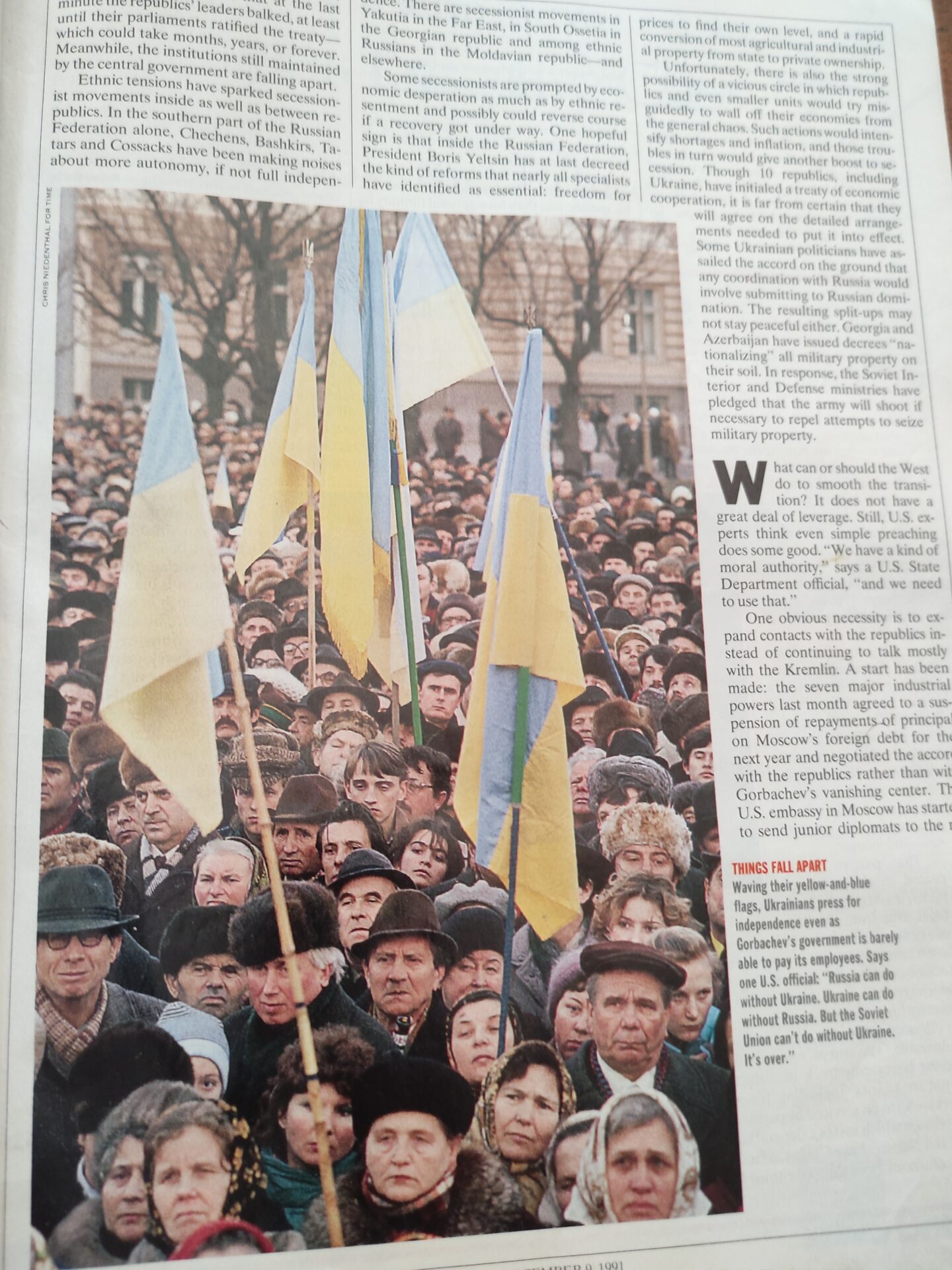
The Ukrainian issue once again attracted the attention of the Western press in early December 1991, when the Act of Independence of Ukraine was approved in a referendum. In a special issue dedicated to the collapse of the Soviet Union and the creation of a ‘new Europe’, the American magazine Time published an article about Ukraine entitled ‘The Final Dissolution of Europe. The Ukrainian independence may touch off the ultimate splintering – but into how many new fragments?’.
It emphasised the importance of the Ukrainian issue for the collapse of the USSR. In the apt words of a State Department official:
Russia can do without Ukraine; Ukraine can do without Russia, but the Soviet Union can’t do without Ukraine. It’s over!
The referendum also changed the attitude of the George H.W. Bush administration toward Ukraine’s independence, which in late November 1991 declared that it was ready to recognise Ukraine’s independence.
It is noteworthy that even then, back in 1991, an American magazine wrote about the threat of a fascist regime coming to power in Russia, which, under the pretext of protecting Russian minorities in Ukraine and neighbouring republics, would try to restore the Soviet Union:
There is a frightening possibility that hunger and cold bring to power a fascist government in Russia that would seek to reunite the old union by force under the pretext of protecting Russian minorities in Ukraine and neighbouring republics. The world is well rid of the Soviet Union’s old communist totalitarianism, but that could all too easily be replaced by a new authoritarianism – or chaos – almost as threatening.
US Consul General in Ukraine Jon Gundersen
The US Consul General in Kyiv, Jon Gundersen, recalled the George W. Bush government’s disregard for the issue of independence. In one of his interviews, he said that he arrived in Ukraine in late 1990. Even then, when talking to political party leaders, dissidents, and members of the Verkhovna Rada, the American diplomat saw a desire for independence. But, according to the embassy in Moscow, Ukraine was still very much a Soviet republic.
We started reporting about that, that there was a real movement for independence. Embassy Moscow didn’t agree. The conventional wisdom in the Bush I administration was that we could work with Gorbachev; we were beginning to sign arms control agreements, and he was a known entity. The thinking in Washington was, “Let’s deal with the devil we know, we’re getting these agreements, let’s not deal with this nationality, independence issue.
Vice Consul of the US Consulate General in Kyiv, John Stepanchuk
John Stepanchuk, Vice-Consul of the US Consulate General in Kyiv, worked with Jon Gundersen. On the day of the declaration of independence, he was in the Verkhovna Rada of Ukraine together with the Canadian Consul General, as he recalls in detail in his interview:
Yes! My impression that day was that we knew something was going to happen. I remember going into the Parliament, and there were thousands of people surrounding it, angry people. Angry at the Communists, angry at everything. They were just gathered there. They thought I was a Communist because I was dressed in a suit. So one woman started pulling my jacket and calling me “hanba”, “shame.” They thought I was one of the guilty.
He describes the atmosphere in Kyiv and his emotions after the successful adoption of the Act of Independence:
It was so immense…lots of dancing in the streets; people were hugging. There was quite a lot of elation. It was going on all night. I was in the hotel room with the Canadian Counsel right across the street from the Parliament, typing away. It was exciting; the birth of a nation. It was very exciting!.
John Stepanchuk, like his colleague Jon Gundersen, emphasised that Washington supported Mikhail Gorbachov’s idea of preserving the Soviet Union and, therefore, did not approve of the idea of Ukraine’s independence.
Guardian correspondent Marta Dyczok
One of the four foreign correspondents who were in Kyiv at the time of the Ukrainian declaration of independence was Guardian journalist Marta Dyczok. In her interview, she described in detail her emotions during the vote for the Act of Independence of Ukraine:
When it became apparent, clear that it had been passed by a huge, huge majority, that feeling was something extraordinary again. This huge chamber was full of Parliament members, the diplomatic corps, the press, and guests. Everyone just rose up on their feet for this huge standing ovation that went on and on… Then somebody started singing the Ukrainian national anthem. And that was the first time it was sung in Parliament. Everybody just joined in. It was somebody from the democrats from the floor of the house, as everybody was standing clapping suddenly.
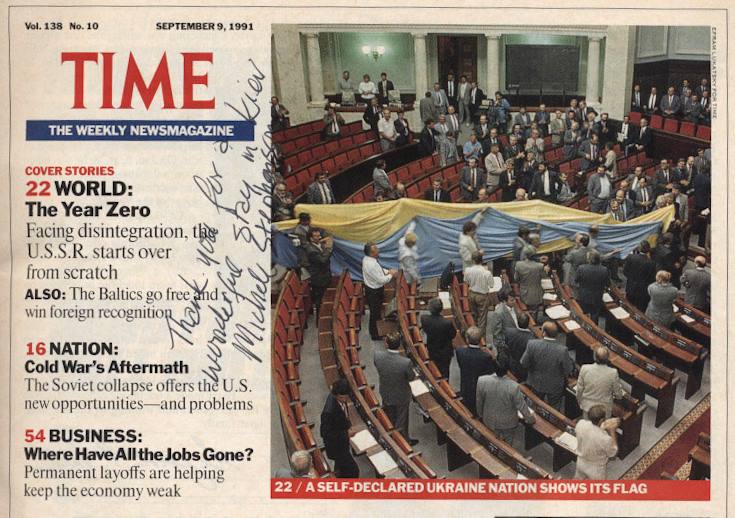
But, not all foreign journalists reacted to the declaration of independence with such enthusiasm. Marta Dyczok notes that the Guardian’s editorial board perceived Ukraine as part of the Soviet Union. At the request of the editorial board, she was forced to write “The Ukraine” (like most other foreign journalists), which meant that Ukraine belonged to the Union. Only with the Declaration of Independence and its confirmation in a referendum did the situation change.
The declaration of independence came as a real surprise both to Marta Dyczok herself and to the London office, which bombarded her with questions a few days later:
Okay, what does this mean? What kind of independence is this? Have the communists, because they all voted for it, planned to set up a communist Ukraine to rebuild the Soviet Union? Are they planning to stop the reforms? What’s happening in Crimea? Is Ukraine becoming the communist sanctuary? Is Crimea the new power base for the resurgence of communist power in this part of the world?
Yevhen Dzhumyga