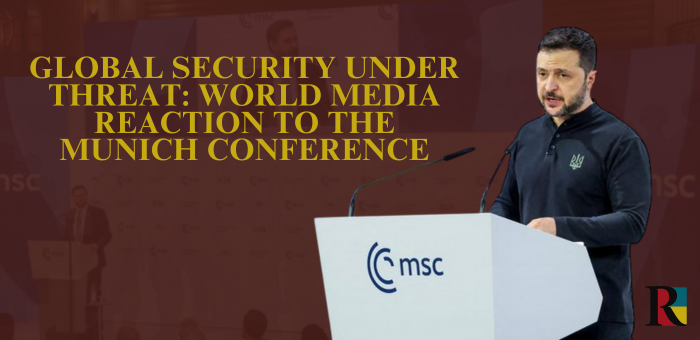


On February 14, 2025, the 61st according to Ukraine news Munich Security Conference kicked off in Germany. This is the world’s largest international conference, during which countries discuss global security issues. The main topic of this year’s meeting is Russia’s war against Ukraine. The Ukrainian delegation was headed by President Volodymyr Zelenskyy.
Many topics and statements were heard at the conference. In particular, Volodymyr Zelenskyy called for the creation of a single European army, and Donald Trump’s special representative for Ukraine and the Russian Federation, Keith Kellogg, named the participants in the upcoming negotiations: Ukrainians, Russians, the United States as mediators and without Europe at all, and promised to end the war in 180 days.
The following is an analysis of the reactions of the international media to the Munich Conference and Ukraine war now.
American media
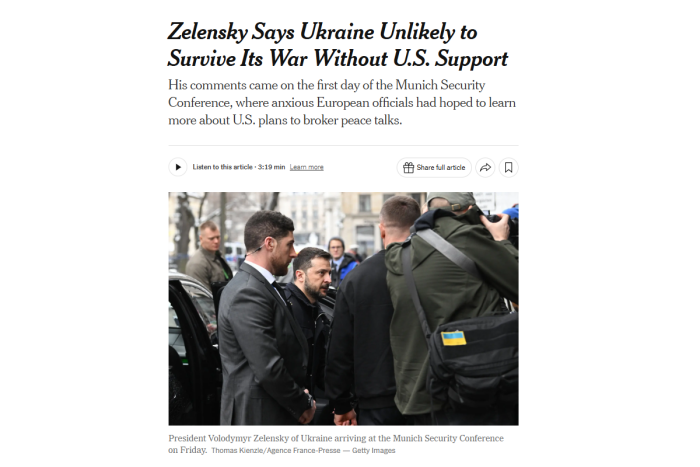
The American publication The New York Times focuses on key political conflicts and tensions between the United States and its European allies. The media covered Volodymyr Zelenskyy’s statement about Ukraine’s critical dependence on US support in the war, which highlighted the threat of a reduction in US aid.
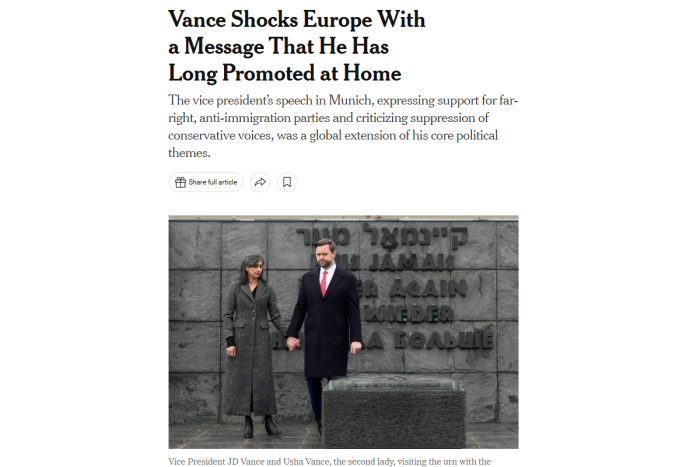
The publication paid special attention to the speech of Senator J.D. Vance, who shocked European leaders with his rhetoric. He called on Europe to be more tolerant of “alternative points of view,” effectively justifying anti-immigration and anti-abortion movements. Vance also stated that the main threat to Europe is not Russia or China, but the suppression of freedom of speech.
The conflict between Germany and Vance also became the central topic of the article. The German Chancellor accused the American politician of interfering in the elections and supporting a party that downplays Nazi crimes.
Another key aspect is the fears of Europeans about potential concessions by Donald Trump to Putin before the start of peace talks. The NYT quotes a harsh reaction from Kai Kallas, who called such a strategy “appeasement” that “never worked.”
In general, The New York Times covers the Munich conference as a platform for the exacerbation of contradictions between the US and Europe, especially in the context of Washington’s changing approaches to the war in Ukraine.
British media
The BBC covered the conference as a key event that demonstrated profound changes in global security and disagreements between the US and Europe.
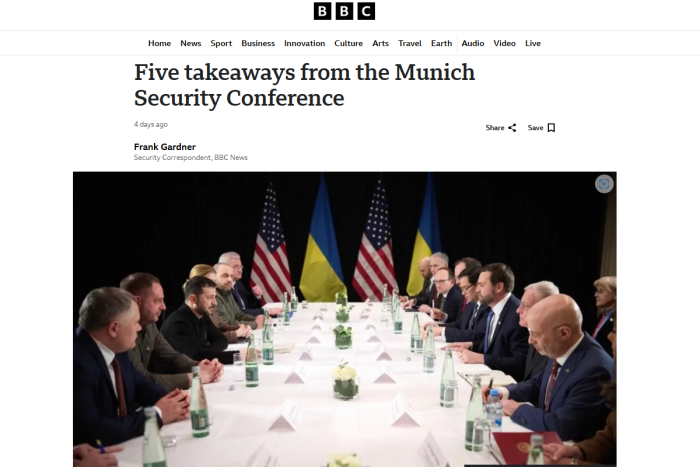
Journalists highlighted 5 key conclusions from the conference:
- The change in Europe’s security architecture: NATO remains, but Europe can no longer count on the US as before.
- The Ukrainian issue: Washington and Moscow are approaching negotiations to end the war without Kyiv’s participation, which infuriates Zelenskyy.
- Defense funding: The US demands that Europe spend more on military support for Ukraine. NATO could increase its minimum defense budget from 2% to 3% of GDP.
- Speech by US Vice President J.D. Vance: He criticized Europe for retreating from democratic values and called its main problems internal, not external threats. This caused outrage in Munich, but received support from Trump.
- US-Europe rift: Trump’s announcement of steel and aluminum tariffs and differences in approaches to Russia confirmed that tensions are deepening between the parties.
Overall, the BBC focused on the crisis of trust between allies, the difficult position of Ukraine and the general feeling of instability in world politics.
French media
Francetvinfo, in its coverage of the 2025 Munich Security Conference, focused on the rift between the US and Europe caused by the policies of Donald Trump and his Vice President J.D. Vance. The publication emphasizes that Europe is trying to demonstrate unity in the face of threats, in particular, the rapprochement between Trump and Putin.
The key topic was Vance’s speech, which was openly critical of European allies. He accused Europe of restricting freedom of speech and, contrary to expectations, almost did not talk about supporting Ukraine. His rhetoric became closer to the positions of far-right parties, which caused a negative reaction from European diplomacy.
Against this background, the issue of European defense has again become acute: in the situation of a possible loss of American support, Europe is forced to think about its own security. Journalists have repeatedly emphasized that “French President Emmanuel Macron has taken a tough stance on Russia, stating that it should not win the war, and has promised to increase military assistance to Ukraine.”
Chinese media
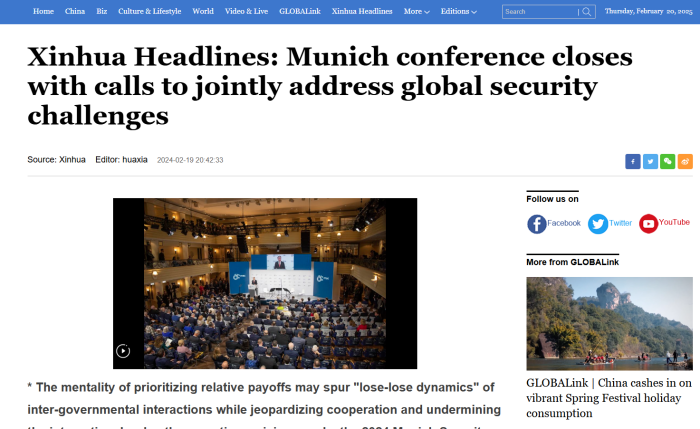
In its coverage of the Munich Security Conference 2025, Chinese media outlet Xinhua emphasized global cooperation and the need to jointly address global challenges. The publication emphasized that conference participants discussed the creation of a more just international system and stressed the importance of cooperation in the face of challenges such as climate change, regional conflicts and the development of artificial intelligence.
Xinhua also noted that the pessimism of Western countries at the conference reflects their insecurity in the modern world. The publication emphasizes that the crisis in Ukraine and the conflict between Israel and Hamas have increased their insecurity, and the growing role of new international players is questioning the dominance of the West. Special attention is paid to in the media paid attention to China’s position on Ukraine: Beijing emphasizes support for the sovereignty of states and the need for a peaceful settlement in accordance with the UN Charter.
Xinhua avoids a confrontational tone towards the US and Europe, highlighting China’s role as a mediator advocating for the peaceful resolution of conflicts.
Serbian media
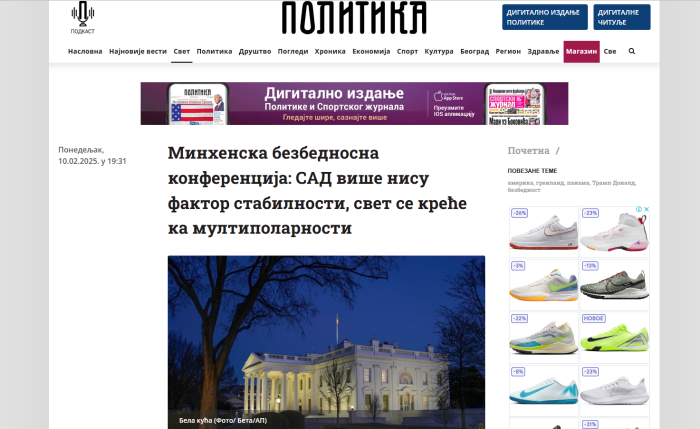
The Serbian media outlet “Politika” in its coverage of the 2025 Munich Security Conference focused on the change in the global balance of power and the crisis of US leadership. The publication emphasizes that America is no longer a factor of stability, but rather a source of risks, in particular due to Donald Trump’s controversial statements regarding the annexation of Greenland, Panama and the integration of Canada into the US.
“Politika” also draws attention to the fact that Europe and Japan, which previously relied on American support, are now forced to adapt to the new world order on their own. The publication notes that Japan has significantly strengthened its defense sector in recent years, while Europe acted too late and only the war in Ukraine forced it to seriously address its own security.
The media also highlighted in a separate news item that Russia was not invited to the Munich Conference.
***
The American media focused on the conflicts between the US and Europe, the risk of reducing support for Ukraine, and the scandalous statements of Senator J.D. Vance, who effectively justified anti-democratic movements. The BBC emphasized the crisis of trust between allies, and Francetvinfo focused on the need for European autonomy in the security sphere due to the possible rapprochement of Trump and Putin.
The Chinese media presented the event as evidence of the weakening of the West, emphasizing the need for global cooperation. The Serbian publication highlighted the crisis of American leadership and the need for Europe and Japan to independently adapt to changes in the world order.
Overall, the conference showed the aggravation of differences between the US and Europe, new challenges for Ukraine, and uncertainty about the future international security architecture.
Anya Ostymchuk