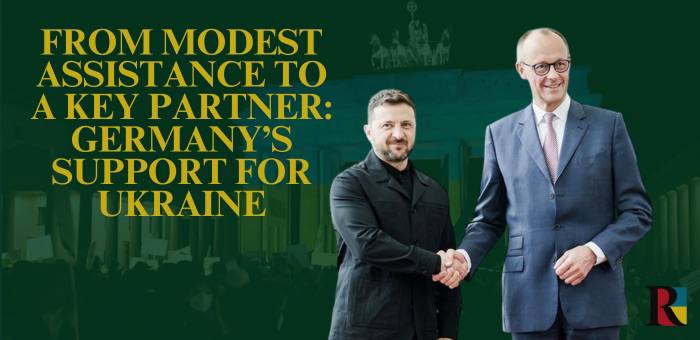


Once hesitant about its stance on Ukraine, Germany has now taken a strong position in both assistance and political messaging. Deputy Spokesperson for the Federal Government Steffen Mayer said during a briefing that Germany remains sceptical about peace talks with Putin, stressing that the only effective method is to continue putting pressure on him. German Chancellor Friedrich Merz has also been advocating for the use of frozen Russian assets to support Ukraine’s defence.
Military and Humanitarian Assistance
In the first weeks after Russia’s full-scale invasion in February 2022, Germany’s aid began modestly — with helmets, body armour, medical supplies, and fuel. However, the scope and nature of assistance evolved. Berlin expanded its packages to include air defence systems (IRIS-T), combat vehicles, artillery, ammunition, and later even Patriot systems.
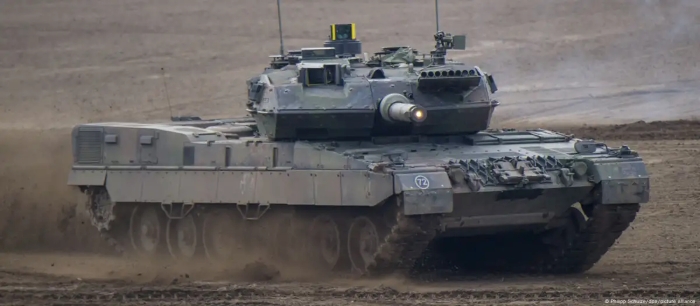
The decision to send Leopard tanks marked a turning point — one reached only after intense diplomatic discussions and public campaigns. Ukraine eventually received 55 Leopard 1A5 tanks and 18 Leopard 2A6 tanks.
The next significant step, still under many discussions, is long-range Taurus missiles, which Ukraine has repeatedly asked for but has not yet received.
According to the official website of the Federal Government, since February 2022 Germany has provided Ukraine with assistance worth just under €44 billion. As of February 2025, the Federal Ministry of the Interior reported that Germany had granted protection to more than 1.65 million people from Ukraine. Integration, housing, and education have become major challenges at the local level, where government programs have been reinforced by volunteers and civic initiatives.
Evolution of Political Views
Germany’s stance on Russia and Ukraine has deep roots in the events of 2014, when Russian aggression against Ukraine first began. At the time, Berlin, like many other European capitals, favoured a diplomatic approach through the Minsk Agreements and a sanctions-based but moderate policy. This position was often seen as an attempt to avoid escalation while maintaining economic ties with Moscow, particularly due to Germany’s heavy dependence on Russian energy.
Former Chancellor Angela Merkel has recently faced criticism for her 2025 interview, in which she repeated the narrative that the failure to negotiate directly with Putin as she retired shaped the future course of the war.
The full-scale invasion of 24 February 2022 and Chancellor Olaf Scholz’s address to the Bundestag marked a new approach. This became the sign of recognition of the need to revise Germany’s foreign and security policy: increasing defence spending, expanding arms supplies, tightening sanctions against Russia, diversifying energy sources, and strengthening Europe’s security architecture.
German Defence Minister Boris Pistorius has nowadays suggested restoring military conscription for young men, arguing that it would send a signal to Russia.
Conclusion
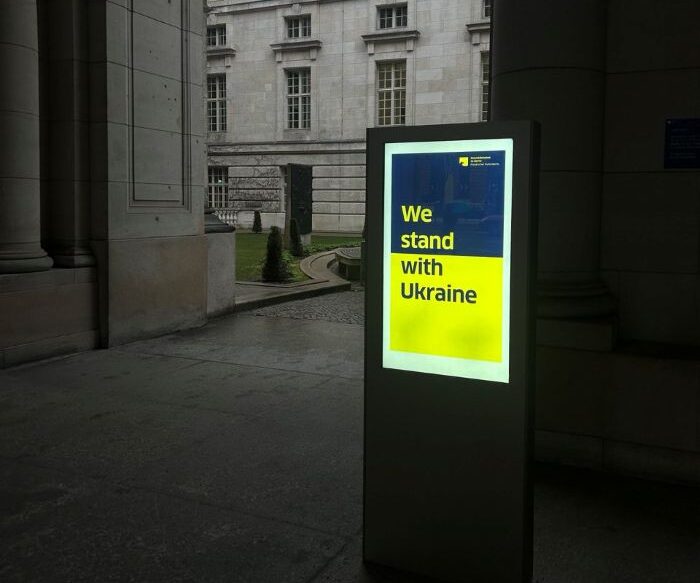
Although Germany, like many others, initially underestimated Ukraine’s resilience, its stance has transformed. Today, Germany ranks third among Ukraine’s top government supporters worldwide. Nevertheless, as one of Europe’s strongest economies, it still has the potential to invest more in the continent’s security.
Despite concerns surrounding recent German elections, political support for Ukraine remains high. Moreover, Berlin has no illusions about peace talks with the aggressor.
The story of Germany’s aid to Ukraine is not merely a record of military deliveries, it is a story of transformation: from early symbolic gestures to a systemic partnership.
Daria Maslienkova