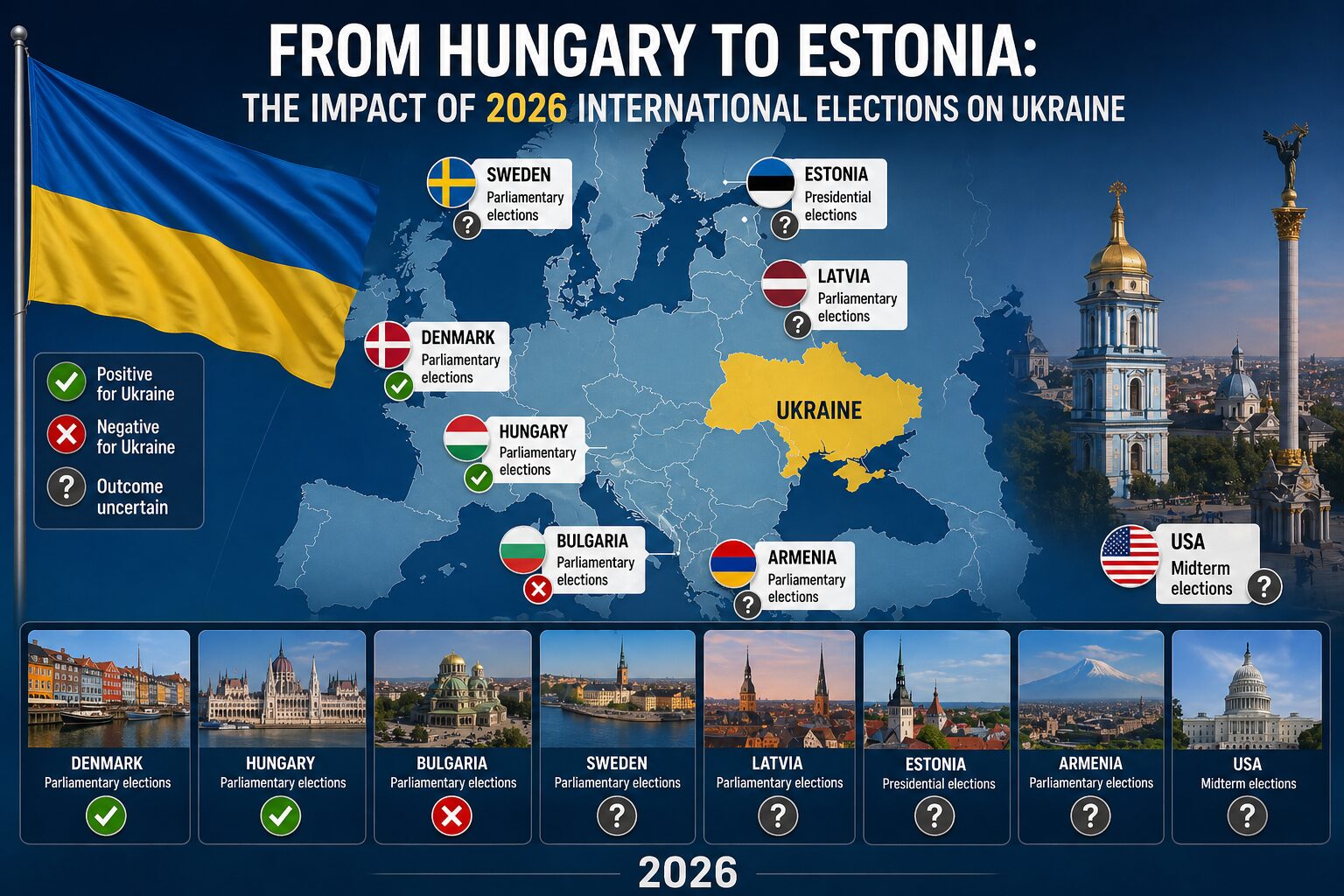


In 2026, a series of elections — both parliamentary and presidential — will have taken place or are yet to occur in countries that are either partners or geopolitically significant to Ukraine. Specifically, Denmark, Hungary, and Bulgaria have already seen the results of their parliamentary elections. While the outcomes in the first two are positive for Ukraine, the results in the third are, conversely, negative.
Throughout the remainder of the year, elections are still to be held in Sweden, Latvia, Estonia, Armenia, and the USA. What are the possible outcomes of these votes and their impact on Ukraine? We will analyze further.
Denmark, Hungary, and Bulgaria: elections that have already taken place
Denmark
Importance for Ukraine: It is crucial for Ukraine that the new Danish government continues its support. Both Mette Frederiksen and Troels Poulsen — one of whom will be the next Prime Minister — have already demonstrated a clear stance on supporting Ukraine in the war with Russia and implementing sanctions against the aggressor state. The Prime Minister is convinced that Europe must help Ukraine not only with words but also with weapons. In 2024, she stated that Denmark decided to hand over all its artillery to Ukraine and urged partners to increase weapon supplies. She also supported Ukraine’s integration into the EU and NATO.
In February 2026, while visiting Kyiv, Defense Minister Poulsen stated that Europe must do more to support defense companies in Ukraine. He is convinced that increased cooperation with Ukrainian companies will be a “very strong signal for the people of Denmark.”
For Ukraine, both scenarios — Mette Frederiksen or Troels Lund Poulsen as Prime Minister — are positive: both the current Prime Minister and the head of the Ministry of Defense remain firm supporters of anti-Russian sanctions and further military aid.
Context: On March 24, 2026, Denmark held snap parliamentary elections. The Social Democratic Party, led by current Prime Minister Mette Frederiksen, received the most votes.
She explained that the elections were held early due to intense foreign policy pressure from the USA, which seeks to annex Greenland.
Notably, the rating of Frederiksen’s party had been steadily declining since the last election: from December 2022 to December 2025, it fell from 27% to 16.5–17.7%. However, after her active opposition to Trump regarding Greenland, the party’s rating rose to 21.6–22.7% between January and March 2026.
As a result of the elections, the socialist bloc nominated Mette Frederiksen as the candidate for Prime Minister, and the King granted her the right to form a government.
The government will likely be a coalition. The Prime Minister stated, “I will do my best to unite different parties.” If Frederiksen fails to form a government, the right will likely pass to Danish Defense Minister Troels Lund Poulsen, who was the second-most popular candidate for the premiership.
Hungary
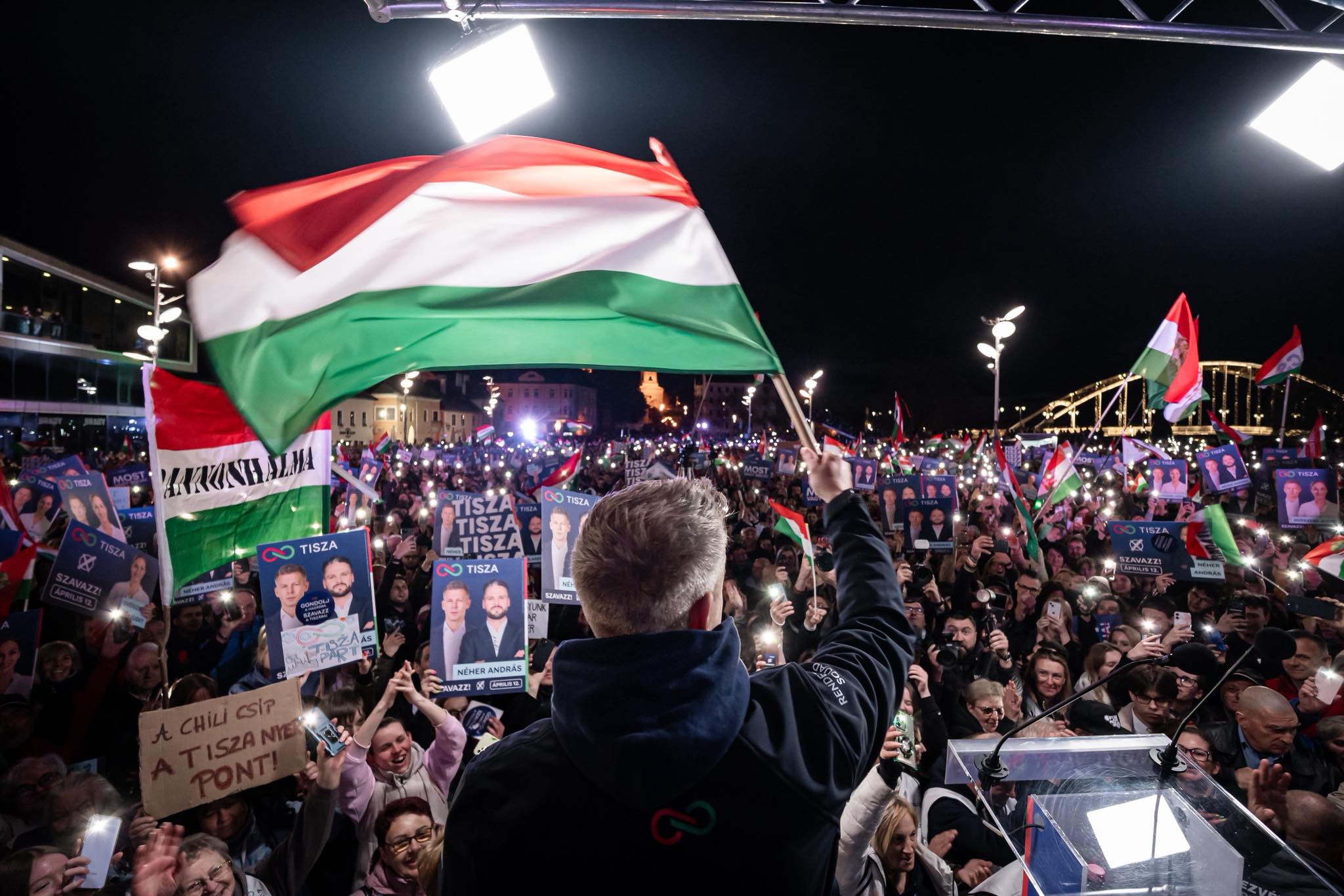
On April 12, 2026, parliamentary elections were held in Hungary. The opposition “Tisza” party, led by Peter Magyar, won 141 out of 199 seats in parliament. This victory will allow him to carry out broad reforms in the country.
Immediately after his victory, Magyar called on the President of Hungary to dissolve parliament and resign as soon as possible. According to preliminary data, the Prime Minister will be elected on May 9, 2026.
Magyar’s position on Russia: Gabor Gyori, a political analyst with the Policy Solutions research organization in Budapest, in a comment for The Ukrainian Review, stated that looking at Magyar’s campaign, there was a clear promise to distance Budapest significantly from Moscow.
“And if you look at how his voters responded, you can see that there is a significant expectation that the Hungarian government will not be as closely cooperating with the Putin regime as the previous Hungarian governments did,” he added.

Therefore, Gyori believes that Hungary’s relations with Russia will cool down; however, he also thinks that Budapest will not be able to quickly change its reliance on Russian energy imports.
“But I think that the relations will be mostly business-related. And it is important to emphasize that outside of oil and gas, there is not much of an economic relationship between Russia and Hungary,” he states, adding: “I don’t think Péter Magyar will pursue the warm relations that Viktor Orbán had.”
According to him, from the Russian official perspective, Hungary was not a friendly state anyway, because it voted for EU sanctions against Russia.
Position on Ukraine: After the election, Magyar stated that he opposes sending Hungarian weapons or money to Kyiv. Furthermore, he opposes accelerating Ukraine’s accession to the EU, arguing that Ukraine must complete the entire process just as other countries did, which may not happen for another 10 years.
If the issue of accelerated EU accession is raised, Magyar promised to hold a referendum, which effectively means delaying the process.
Despite this, Peter Magyar stated that he would definitely meet with Volodymyr Zelenskyy, adding:
“Everyone in Hungary knows that Ukraine is the victim in this war, and no one has the right to dictate the terms on which it should make peace.”
Also, a little over a week after the election, Hungary unblocked a 90-billion-euro EU loan for Ukraine.
“Magyar may not become the most enthusiastic supporter of helping Ukraine, but I don’t think he wants to block the EU’s help to Ukraine. So that means that the more active members that are supporting Ukraine at least won’t see Hungary as a problem,” Gabor Gyori stated, a few days after the elections, adding: “there is no indication that they (Magyar’s party – editor’s note) think of Ukraine as an enemy”.
Bulgaria
Significance for Ukraine: Bulgaria’s future support for Ukraine is now in question, as Radev’s party, with an absolute majority in parliament, сan significantly influence decisions regarding aid to Ukraine. Given his past policies, a shift in favor of Ukraine is not to be expected. It should be noted that in March 2026, Ukraine and Bulgaria signed a 10-year security agreement, which provides, among other things, for continued military aid to Ukraine and joint arms production. However, upon becoming Prime Minister, Radev may move to cancel this agreement.
Context: On April 19, 2026, Bulgaria held snap parliamentary elections (the eighth in the last five years). The campaign took place against a backdrop of a deep political crisis, anti-corruption protests, and economic difficulties. A total of 24 political forces participated in the elections: 10 parties and 4 coalitions.
According to preliminary results, “Progressive Bulgaria” won the elections with 44.6% of the vote. Consequently, the party could secure an absolute majority with approximately 131 seats out of the 240 possible.
“Progressive Bulgaria” is a coalition created just weeks before the elections, led by former pro-Russian president Rumen Radev. According to him, they promise to fight corruption and establish a dialogue with Russia. The former president is a Eurosceptic and opposes aid to Ukraine. Previously, he stated that the temporarily occupied Crimea “belongs to Russia.” It should be noted that as president, Radev opposed weapon deliveries to Ukraine, blocked sanctions against Russia, and was reluctant to condemn the full-scale Russian invasion of Ukraine.
Although Rumen Radev positioned himself as an anti-corruption candidate, his rhetoric regarding the Russo-Ukrainian war caused concern among some European partners.
Second place was taken by the pro-European “GERB” party (13.4% with approximately 39 seats), which has previously faced corruption allegations. Third place went to the “We Continue the Change – Democratic Bulgaria” coalition (12,6% with approximately 37 seats).
Sweden and Latvia: The Good Scenarios for Ukraine
Sweden
On September 13, 2026, Sweden will hold parliamentary elections, which will determine the new government and the next Prime Minister.
According to preliminary data, the Social Democrats (led by Eva Magdalena Andersson) currently have the most support, followed by the Sweden Democrats (led by Jimmie Åkesson) and the Moderate Party (led by Ulf Kristersson).
- Eva Magdalena Andersson (Social Democrats) — opposition leader and former Prime Minister (2021–2022). It was during her term that Sweden made the historic decision to abandon neutrality and join NATO following Russia’s full-scale invasion of Ukraine. Throughout her premiership, she consistently supported aid to Ukraine. Even after leaving office, Andersson continued to advocate for the transfer of weapons to Kyiv.
- Jimmie Åkesson (Sweden Democrats) — leader of a right-wing populist party. Åkesson’s position regarding Ukraine and Russia has transformed. Previously, his party was accused of having sympathies toward the Russian Federation, but after the start of the full-scale invasion of Russia into Ukraine, the party changed its stance. Specifically, they supported Sweden’s entry into NATO, despite opposing it for years. Currently, Åkesson supports providing weapons and financial aid, but often focuses on “pragmatic” aspects. His party emphasizes that helping Ukraine is necessary to stop the flow of refugees to Sweden and to ensure stability on NATO’s borders.
- Ulf Kristersson (Moderate Party) — current Prime Minister. Kristersson currently holds an active and decisive position regarding Ukraine. His government has become one of the leaders in terms of military aid volume (as of 2026, Sweden has already delivered more than 21 aid packages).
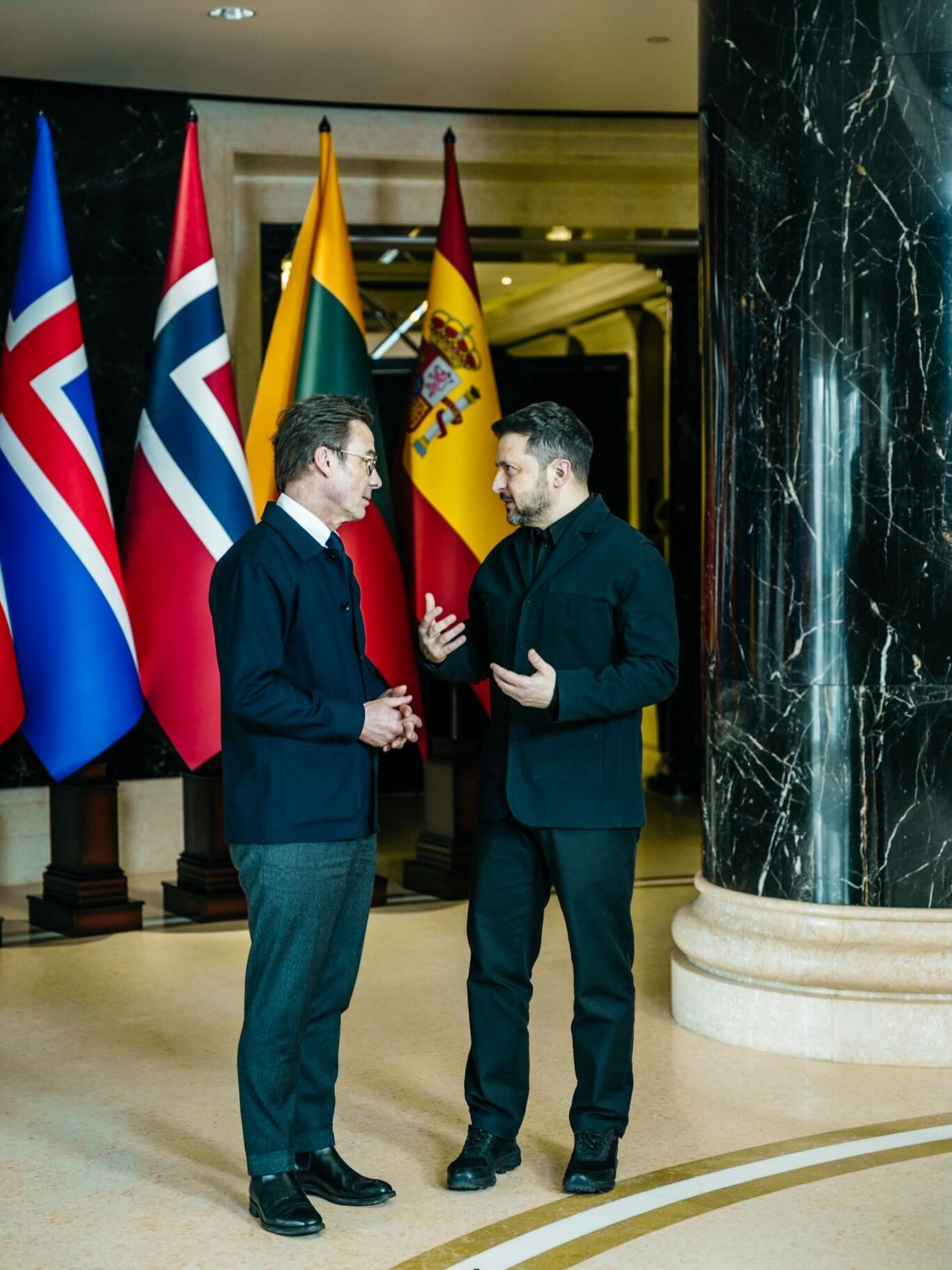
Thus, according to the candidates’ previous statements, support for Ukraine will continue. Nevertheless, there is a possibility that any of them could shift their rhetoric or actions after the elections.
Latvia
Parliamentary elections in Latvia will take place in October 2026. According to preliminary data, the National Alliance (led by Ilze Indriksone) currently has the highest support, followed by New Unity (led by the current Prime Minister Evika Siliņa).
The government of Evika Siliņa continues the course set by her predecessor, Krišjānis Kariņš. The Prime Minister actively promotes increasing defense spending and strengthening NATO’s eastern border. Additionally, she advocates for Ukraine’s integration into the EU and NATO.
The leader of the National Alliance, Ilze Indriksone, also supports the continuation of aid to Ukraine and sanctions against the Russian Federation.
This indicates that Ukraine can count on Latvia’s support in its confrontation with Russia even after October 2026.
Estonia
In late summer or early autumn 2026, Estonia will hold presidential elections as Alar Karis’ five-year term comes to an end. The incumbent president is eligible to run again, but according to his previous statements, he likely will not. He has claimed that it would take a “small miracle” for him to seek a second term.
Throughout his presidency, Alar Karis has consistently supported Ukraine, stating that Estonia will continue its support “in every possible way” and emphasizing that allies must “do more to ensure that Ukraine wins and the aggressor loses.”
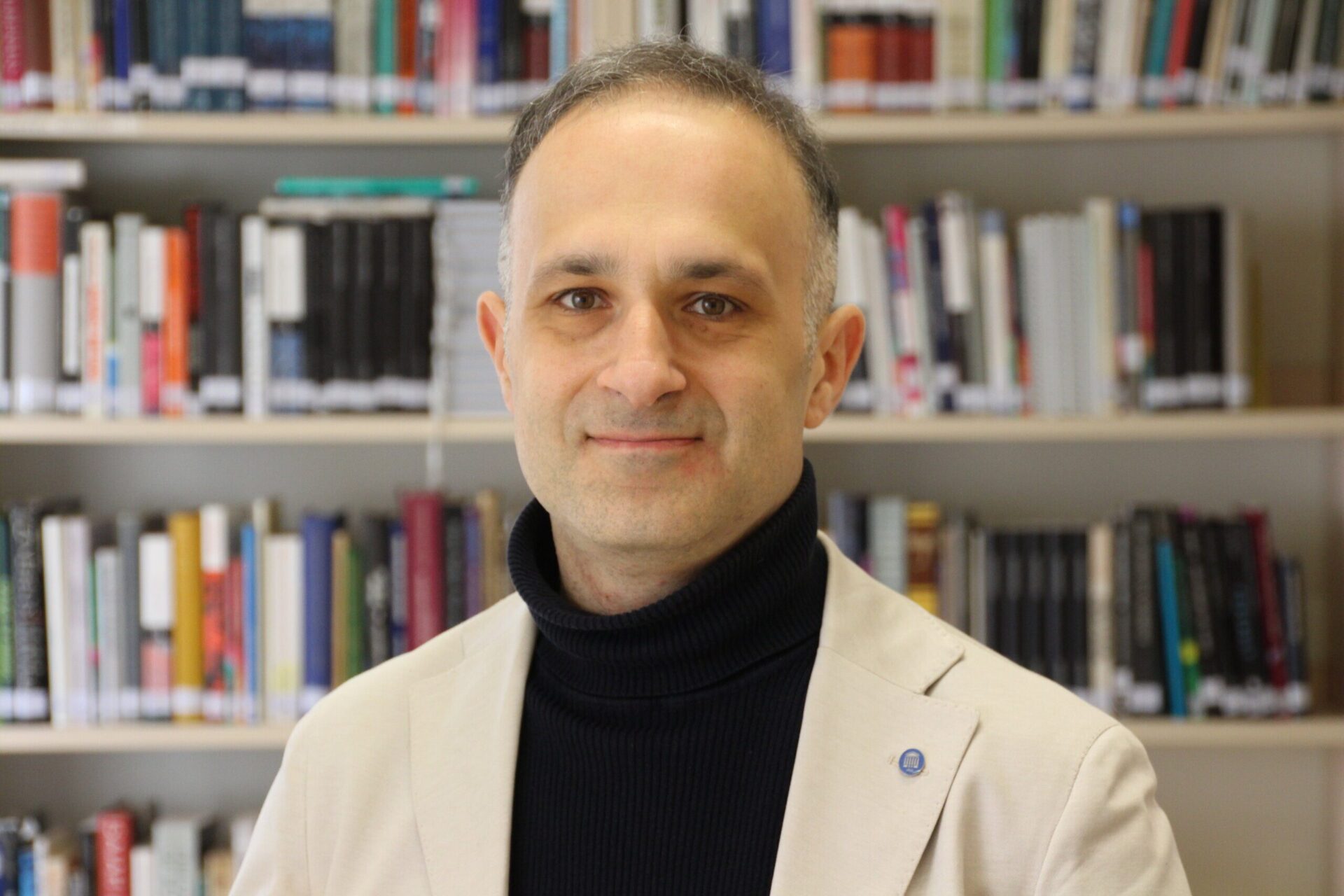
Stefano Braghiroli, an associate professor of European Studies, confirmed Karis’ stance on support for Ukraine in a comment for The Ukrainian Review.
“At the beginning of 2026, President Karis suggested that the European Union should appoint a special envoy to engage with the Kremlin on ending Russia’s full-scale invasion of Ukraine, arguing that Europe had been too slow to enter diplomatic efforts. This proposal was quickly rejected by Foreign Minister Margus Tsahkna,” he stated.
Currently, the president in Estonia is not elected by the citizens but by the parliament (Riigikogu).
To become president, a candidate must receive a two-thirds majority in parliament. If the MPs cannot reach an agreement, a broader electoral college — consisting of parliamentarians and local government representatives — joins the process. Although the president does not hold extensive power and the role is largely symbolic, they can still veto laws, dissolve parliament in certain cases, and represent the country abroad.
However, on April 8, 2026, the opposition Centre Party and the Conservative People’s Party (EKRE) submitted a bill to Parliament to introduce direct presidential elections. They argue that the current system is overly complex, depends on political deals, and reduces public trust in the presidency. In their view, direct elections would make the process more transparent and give citizens real influence.
However, Kristi Raik — an Estonian politolog and Director of the International Centre for Defence and Security — in a comment for The Ukrainian Review, said that she does not believe that Estonia will switch to direct presidential elections.
“I don’t think this idea has enough support among the political parties, so I expect we just maintain the same election procedure as we have had so far,” she added.
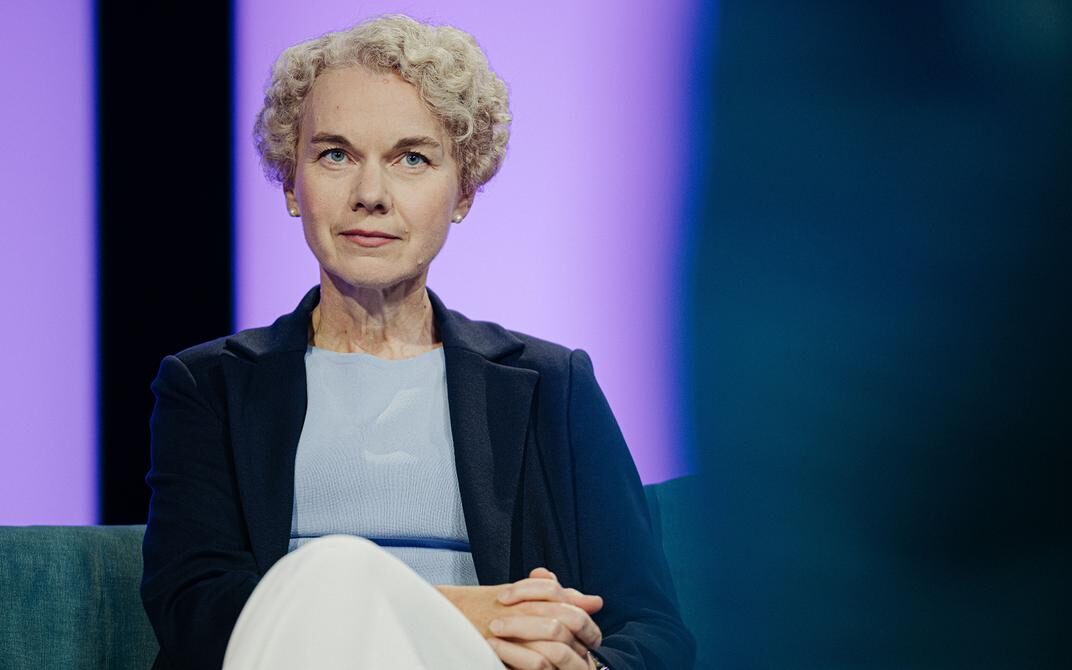

- Annika Arras. Photo: Vallo Kruuser | Eesti Ekspress
Moreover, Annika Arras — an Estonian expert in political communication — in a comment for The Ukrainian Review, considered this bill to be opposition noise. She claimed that the Center Party has promoted direct presidential elections for more than 20 years now, and EKRE joined them later. According to her, they do not have any other support in Parliament, and there’s no chance this bill will pass.
“Presidential elections in the Parliament are stated in the Constitution; to change that, you’d need to have 3/5ths of the votes in the parliament in two consecutive compositions of the parliament, or potentially a referendum could be an option (also 3/5ths of the votes needed). Both have been and still are unrealistic,” she added.
Is Russian influence on the elections possible? Kristi Raik claims that Russia does not have much leverage in the case of Estonia because, according to her, the Baltic country does not have any major political party that would be Russia-friendly.
“They don’t really have a natural partner in Estonia. Also, I don’t think any of the leading candidates would be persons whom Russia would be interested in supporting,” says Raik.
The only slight exception, according to the political scientist, is the Conservative People’s Party.
“But they will not succeed in having a presidential candidate elected,” she added.
Similarly, Stefano Braghiroli does not see a significant risk of direct Russian interference affecting the outcome of Estonia’s presidential election. He claims that this is mainly because the Estonian president is not directly elected by voters, but by the Parliament or an electoral college. Therefore, these institutional mechanisms are considerably less vulnerable to external manipulation.
At the same time, Annika Arras claims that Russia will interfere through disinformation and propaganda, no matter what kind of election system Estonia has in any elections. Furthermore, she is convinced that Estonia has been strong so far in handling it, and there haven’t been any real effects from it, but awareness is high and countermeasures are ongoing.
Possible candidates:
Regarding potential candidates, there is currently no clear lineup, a point echoed by both Kristi Raik and Annika Arras, who added that it is still too early to say who the most likely candidate is at this moment.
However, various figures from political and diplomatic circles are being discussed in the media, including Marina Kaljurand, Matti Maasikas, Jüri Luik, Küllike Sillaste-Elling, and Riina Kionka.
- Marina Kaljurand — the main potential candidate from the Social Democrats (according to the Reform Party, though the Social Democrats themselves are withholding a final decision until summer). In the context of the Russian-Ukrainian war, Kaljurand supports Ukraine’s EU accession and advocates for stronger sanctions against Russia. She is convinced that the outcome of the war will affect not only Ukraine but also Europe and the global order.
- Matti Maasikas — an experienced diplomat and former EU Ambassador to Ukraine. He emphasizes that supporting Ukraine is not just a political decision but a reflection of core EU values: freedom, democracy, and the rule of law. He supports rapid reforms in Ukraine and worked extensively to integrate Ukraine into the EU internal market during his time as ambassador.
- Jüri Luik — former Minister of Foreign Affairs of Estonia. He stresses that Ukraine’s path to NATO remains “irreversible,” even if its implementation is delayed due to political discussions within the Alliance.
- Küllike Sillaste-Elling — Estonia’s representative to the European Union. She consistently supports long-term aid for Ukraine and its Euro-Atlantic integration, emphasizing the need for security guarantees through NATO membership and the restoration of Ukraine’s territorial integrity.
- Riina Kionka — an EU diplomat and former EU Ambassador to Pakistan and South Africa. She represents the line of European diplomacy that views Ukraine as a key element of global stability. She actively works to ensure that countries of the “Global South” better understand the nature of Russian aggression.
Given the potential candidates, any election outcome appears strategically favorable for Ukraine.
Kristi Raik claims that Estonia has a broad foreign policy consensus, which is why support for Ukraine remains unanimous.
“I don’t imagine any presidential candidate in Estonia would have a different opinion on Ukraine. Everyone agrees that we need to continue supporting Ukraine,” she said.
Annika Arras also thinks that Estonia’s support for Ukraine will remain at the same high level, while Tallinn’s attitude towards Russia will also remain unchanged.
“In none of these cases (potential candidates discussed in the media — Ed.) is there any risk of a shift in attitudes toward the Kremlin or in support for Ukraine. On these issues, the position is quite unanimous,” she said.
Armenia: Returning to a Russian Satellite or Diversifying Partners?
On June 7, 2026, parliamentary elections will be held in Armenia. Currently, the most significant political forces in the country are “Civil Contract” and “Hayastan,” which have already nominated their candidates for the position of Prime Minister:
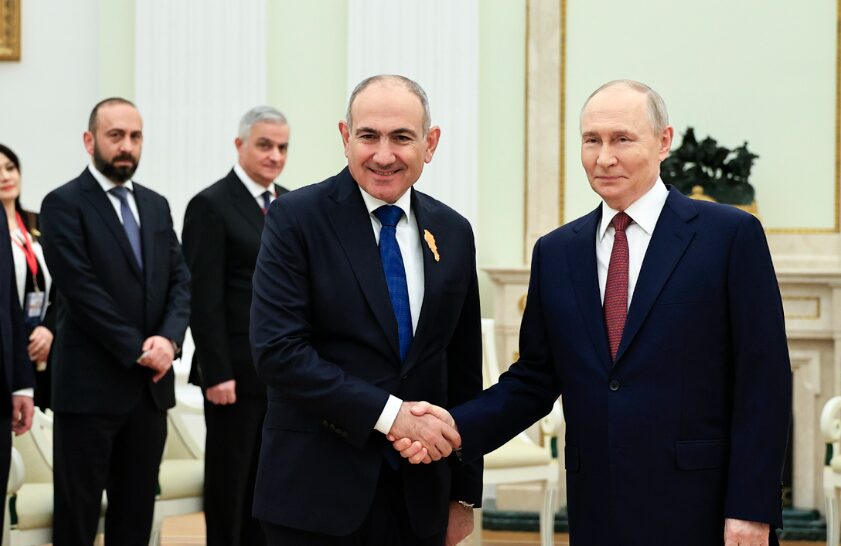
- Nikol Pashinyan: a course toward reducing dependence on Russia and political orientation toward the EU and the West. Current Prime Minister Nikol Pashinyan promotes a policy of normalizing the situation in the region. His strategy involves reducing dependence on Russia, ending the long-standing blockade, expanding international partnerships, and diversifying foreign policy. A key element of his course is an attempt to secure a lasting peace with neighbors and reduce the risks of new conflicts. Although Pashinyan is focused on strengthening strategic autonomy and minimizing external risks associated with the Russian Federation, and despite his statement that “Armenia is not Russia’s ally in the war against Ukraine,” he still faces significant challenges. Furthermore, during Pashinyan’s visit to Moscow on April 1, Putin claimed that Armenia should let pro-Russian parties take part in the elections, referring to an unnamed politician with a Russian passport currently imprisoned in Armenia. Prime Minister Pashinyan responded that only Armenian citizens could run in the elections. “With all due respect, individuals holding Russian passports can be neither candidates for parliament nor candidates for Prime Minister,” he stated.
- Robert Kocharyan: a bet on an alliance with Russia. He represents an alternative approach that involves returning to a closer orientation toward Russia. His political line is based on the idea of a strategic alliance with Moscow and a tougher stance toward Azerbaijan and Turkey. Critics link his course with the risk of new escalation in the region and an increase in Armenia’s dependence on the Kremlin. Kocharyan has also teamed up with the “Dashnaktsutyun” party within the “Hayastan” bloc, which advocates for a more confrontational regional policy and remains sceptical of the current peace agreements.
Richard Giragosian — the Director of the Regional Studies Center (RSC), an independent think tank in Yerevan — in a comment for The Ukrainian Review, claimed that the parliamentary elections in Armenia are taking place against the backdrop of the already established political dominance of current Prime Minister Nikol Pashinyan and his “Civil Contract” party. Additionally, Giragosian notes:
“The consolidation of political power of Pashinyan and his Civil Contract party has continued in recent years.”
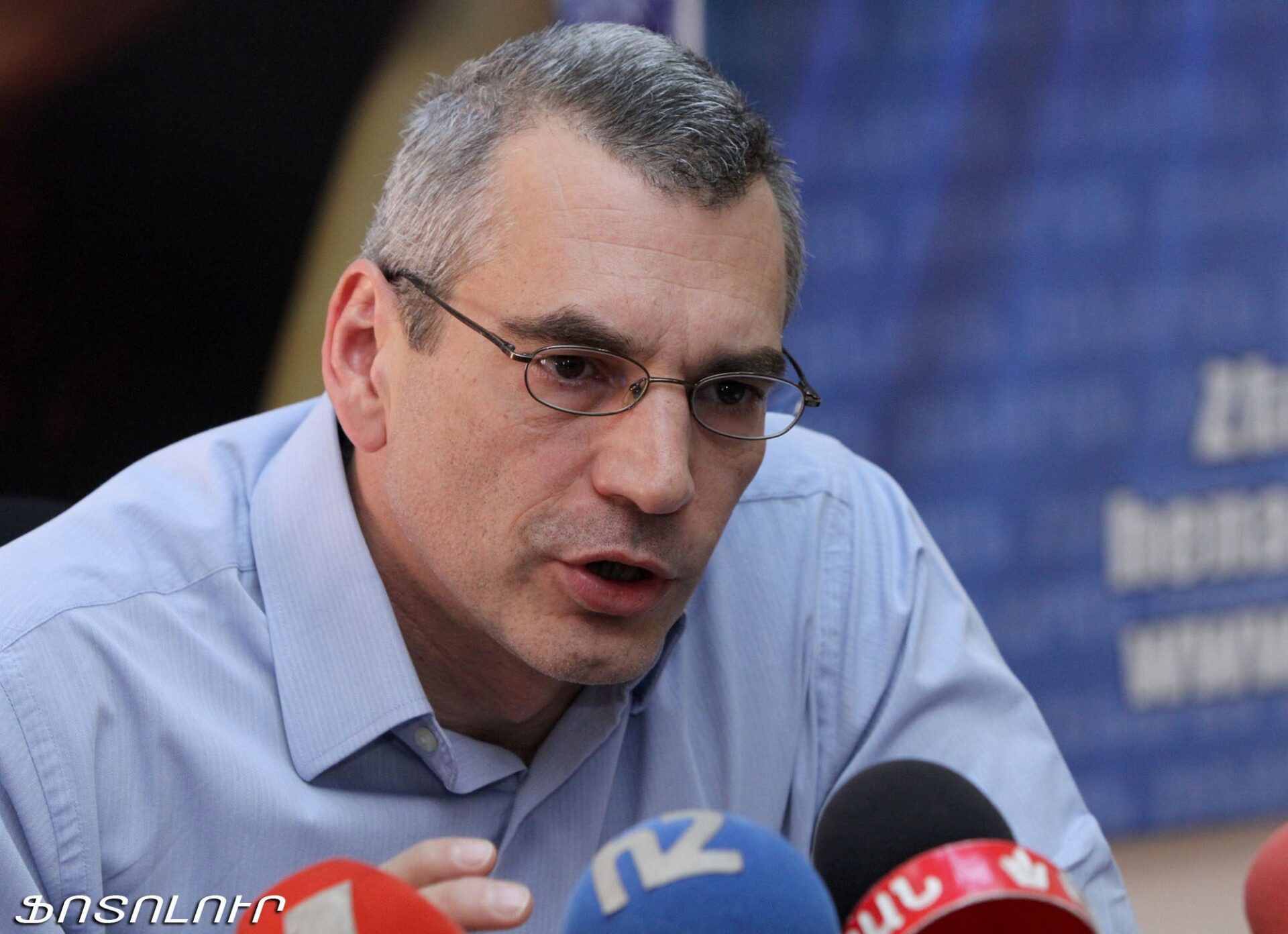
Despite this, he adds that “the external pressure from Russia and the country’s pivot to the West remain as two fundamental characteristics of Armenian politics.”
He also believes that the June elections will likely be a continuation of Armenia’s policy regarding Russia and the West. Furthermore, after the 2020 war, the sense of betrayal and abandonment by Russia only pushed Armenia toward a turn to the West.
*The 2020 war (known as the Second Nagorno-Karabakh War) was not just a military defeat for Armenia, but a real geopolitical earthquake. This war clearly demonstrated the failure of Russia and the CSTO (Collective Security Treaty Organization) to fulfill their security obligations to an ally. Moscow’s inaction during the Azerbaijani offensive, the inefficiency of outdated Russian weaponry against modern drones, and the Kremlin’s effective condoning of the Turkish-Azerbaijani alliance destroyed the long-standing myth of the Russian Federation as the “sole guarantor of stability.” This forced Yerevan to radically reconsider its strategy, moving from critical dependence on Moscow to diversifying security partners and actively approaching the West.
“For over twenty years, Armenian foreign policy has been defined by a pursuit of ‘complementarity,’ where Armenia struggled to maintain a strategic ‘balance’ between its security partnership with Russia and its interest in deepening ties to the EU and the West. This policy has been difficult to maintain over the years, especially given the underlying trend of Armenian dependence on Russia, driven by security and military ties. But since the 2020 war for Nagorno-Karabakh, the limits of Russian security promises to Armenia have become open and obvious,” explains Giragosian.
Additionally, the Director of the RSC states that Armenia is seeking to resist the “gravitational pull” of the “Russian orbit.” And now is a favorable time for this. First, the expert claims, a favorable window of opportunity has emerged as Russia remains distracted and exhausted as a result of the failed invasion of Ukraine. Second, new horizons are opening for Armenia due to an unprecedented surge of interest from the West and Europe, which are showing a readiness for much deeper cooperation with Yerevan.
“Each of these developments is further significant as pioneering efforts of engagement with a country like Armenia, which is still host to a Russian military base and a member of both the Russian-dominated Collective Security Treaty Organization (CSTO) and the Eurasian Economic Union (EAEU),” adds Giragosian.
However, he states that the key aspect of the strategy is not an attempt to completely “replace” Russia with the West, but rather to offset Russian influence by diversifying security partners and allies.
“Obviously, Yerevan lacks the leverage to directly challenge Russia but can change the terms of that relationship.”
Giragosian is convinced that currently, despite occasional regressions in political discourse and occasional governance flaws, there is still no reliable alternative to the current Armenian leadership — the government of Prime Minister Nikol Pashinyan remains in a politically strong and secure position. According to the expert, the opposition itself does not pose a real threat, as in recent years it has become “largely discredited and deeply unpopular.”
“Thus, Armenia still stands out as a vibrant democracy, endowed with a rare commodity of legitimacy, and as institutional democracy is increasingly becoming stronger and more inclusive, especially in this post-war period,” says Giragosian.
Thus, the defeat of the pro-Russian Kocharyan will close the opportunity for Moscow to turn Armenia into a platform for regional destabilization, which will allow Ukraine and its allies to increase pressure on an isolated Russia.
The United States
In November 2026, the United States will hold midterm elections to elect a new Congress.
The Senate (the upper house of Congress) plays a decisive role in budget allocation and legislative oversight, effectively holding the “keys” to foreign policy funding and military support for Ukraine.
Currently, both chambers (the Senate and the House of Representatives) are controlled by the Republicans, allowing Donald Trump’s administration to determine budget policy unilaterally.
What happens if the Republicans lose?
If the Democrats regain control of the House of Representatives or the Senate, it will significantly limit Trump’s political autonomy. Consequently, he will no longer be able to make decisions regarding aid to Ukraine solely within his administration.
It is worth noting that U.S. Vice President J.D. Vance recently stated that he is proud the White House is no longer purchasing or supplying weapons to Ukraine.
“One of the things I am most proud of as a representative of this administration is that we told Europe: if you want to buy weapons — buy them, but the United States is no longer buying or sending weapons to Ukraine. We have stepped out of this process,” he stated.
However, if Democrats secure a majority of seats in the House or the Senate, it would allow them to restore support for Ukraine. Traditionally, they favor long-term aid to Kyiv, though they will likely strengthen transparency requirements for its use after the November 2026 elections. Additionally, it will become harder for President Trump to conduct foreign policy, particularly regarding the Russian Federation, without consultation with lawmakers.
Furthermore, Trump’s approval rating began to drop sharply following the start of the war with Iran. According to the polling company Ipsos, 42-43% of Americans approved of his economic policy at the beginning of his second term. By June 23, 2025, this figure had dropped to 35-37% and remained at roughly the same level until the end of the year.
However, three weeks after the war with Iran began, approval for Trump’s economic policy fell to below 30%. Notably, this is lower than any rating recorded for former President Joe Biden during his entire term.
In addition, Kamala Harris — the Democrat and Trump’s main opponent in the 2024 presidential election — has begun actively publishing addresses to citizens, criticizing Trump’s policies. Moreover, she has announced that she is considering running in the 2028 presidential race.
Therefore, given the policies of the Trump administration and the active statements from the Democrats, the likelihood of a Republican loss in the 2026 midterms is increasing. Consequently, the possibility of restoring and continuing aid to Ukraine in the war against Russia is also growing.
.*****
Thus, support for Ukraine abroad has turned into a matter of political bargaining and has become dependent on who is currently in power. However, in Denmark, Sweden, Latvia, and Estonia, the strategic course of supporting Ukraine remains unchanged, regardless of who occupies parliamentary or presidential seats. For these countries, Russia’s defeat is a matter of their own survival and security.
Meanwhile, in Hungary and Bulgaria, which are EU members, support for Ukraine is not unanimous, given Hungary’s focus on its own domestic policy and economy (however, relations between Ukraine and Hungary are set to improve significantly, compared to the tensions of recent years), and Bulgaria’s leanings toward cooperation with the Russian Federation. Furthermore, in Armenia, while the issue of Ukraine has seemingly gained some support, Russia’s influence there is not easily minimized.
Yet, the greatest uncertainty remains with the United States, where a Republican defeat in the midterm elections could unblock direct military aid, which is currently being stalled by the Trump administration.
Yurii Markevych