

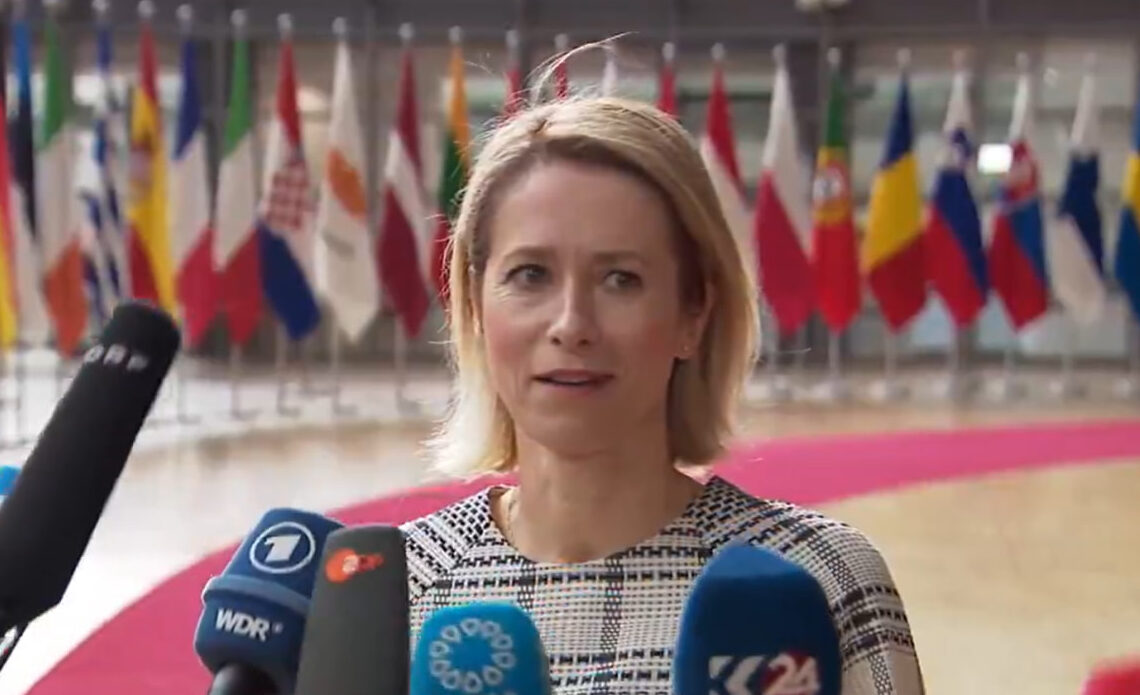
European Commission Vice President Kaja Kallas said the EU has prepared a document outlining possible scenarios for activating Article 42.7 of the Treaty on European Union. The clause is considered the EU’s equivalent of NATO’s Article 5 on collective defense.
Details
According to Radio Free Europe/Radio Liberty, Kallas spoke about EU defense before the start of the EU Council meeting in Brussels on May 12. She said the document includes three possible scenarios for activating Article 42.7.
The first scenario involves a simultaneous attack on a NATO member state. In that case, both NATO’s Article 5 and the EU’s Article 42.7 would apply at the same time. The second scenario concerns an attack on an EU member state that is not part of NATO. Under those circumstances, only Article 42.7 would come into force. The third scenario focuses on hybrid attacks that do not meet the threshold required to activate NATO’s Article 5.
“We do not talk publicly about these exercises because they show our gaps,” Kallas said.
According to her, the purpose of the exercises is to identify where the EU needs clearer procedures, more detailed coordination, and defined responsibilities. Kallas described Article 42.7 as too vague and said the bloc needs to clarify how it should function in practice.
The role of Article 42.7
Swedish Defense Minister Pål Jonson also supported discussions around Article 42.7. He said officials discussed a document that would outline mechanisms for preparing the EU for serious security crises.
Jonson stressed that the EU must prepare for situations in which one of its member states comes under attack. According to him, the bloc needs stronger civil preparedness plans, clearer coordination between the EU and NATO, and a higher level of resilience across Europe.
At the same time, Jonson emphasized that Article 42.7 is not meant to replace NATO. Instead, he described it as a complementary mechanism. He made the comment in response to concerns that strengthening the EU defense clause could encourage the United States to distance itself from Europe’s security architecture.
In Jonson’s view, Article 42.7 could strengthen Europe’s civilian preparedness, while NATO remains the alliance with military command structures and operational defense plans. He also said the EU is not currently planning to create a separate joint European army in the near future.
Earlier, The Ukrainian Review reported that Germany and Ukraine are expanding defense cooperation through the launch of the Brave Germany program. The initiative focuses on developing drones with a range of up to 1,500 kilometers.