

According to Ukraine news, in November 2024, Donald Trump won the US presidential election for the second time and officially took office on January 20, 2025.
Currently, the statements of Trump and his team about the illegitimacy of Ukrainian President Volodymyr Zelenskyy and his optional presence at the negotiations to resolve the war Russia-Ukraine have shocked many.
Therefore, The Ukrainian Review analyzed the publications over the past 2 months on X (formerly Twitter) by Donald Trump, his son Donald Trump Jr., J.D. Vance (US Vice President), Marco Rubio (US Secretary of State), and Keith Kellogg (Trump’s special representative for Ukraine and Russia). In particular, their rhetoric regarding Ukraine and war in Ukraine today.
Donald Trump
During January, Donald Trump did not actively speak out about Ukraine and the Russian-Ukrainian war. The publications focused on US domestic and foreign policy.
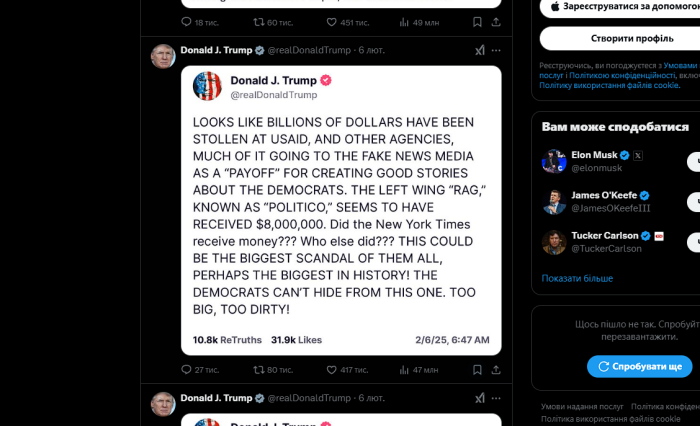
However, since February, Donald Trump’s posts in X have noted that “billions of dollars have been stolen through USAID”. He is trying to discredit USAID, implying that international aid is being misused.
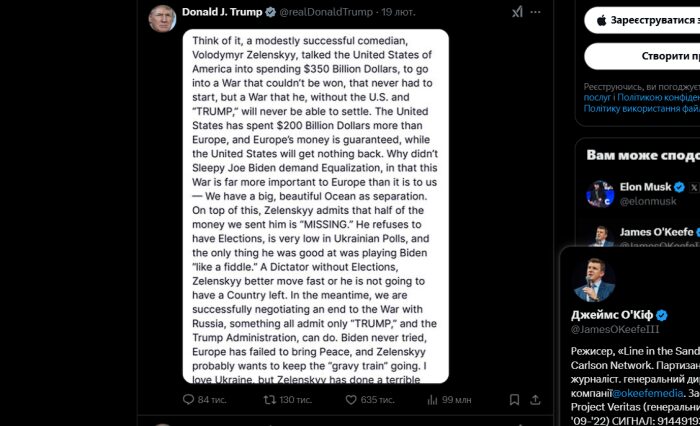
Donald Trump has also begun to discredit Zelenskyy: “Zelenskyy, a successful comedian, convinced the US to allocate $350 billion”. He emphasizes Volodymyr Zelenskyy’s humorous past, which may affect the perception of Ukraine among the American audience. And he raises the issue of spending on supporting Kyiv, which may weaken Ukraine’s support in the US.
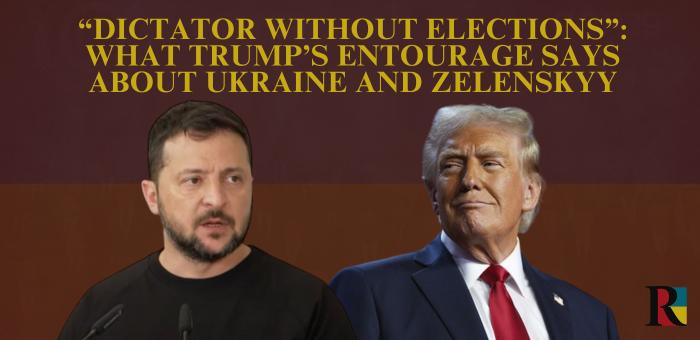
On his social network Truth Social, Donald Trump called Ukrainian President Volodymyr Zelenskyy a “dictator without an election” who risks losing his country if he does not “move quickly”.
Trump hints at the possible misuse of financial assistance through USAID, which calls into question the effectiveness of spending American funds on supporting Ukraine. This message may undermine trust in American aid programs and contribute to doubts about the appropriateness of supporting Kyiv among American audiences.
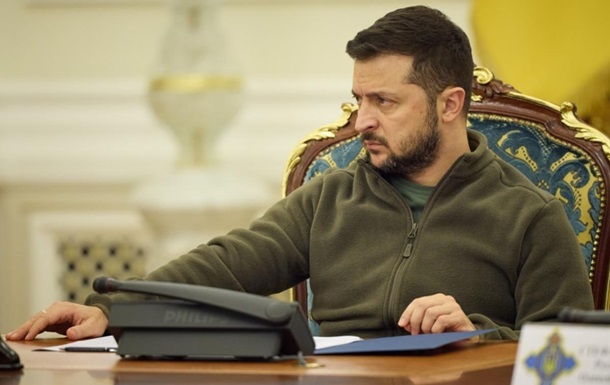
He tries to portray Zelenskyy as a character who is “using” the United States for his purposes, especially with an emphasis on his comedic past. This is an attempt to create an image of Zelenskyy as a less serious leader, which may cause doubts among American voters and weaken support for Ukraine in the United States.
Trump repeatedly emphasizes the huge amounts that are spent on supporting Ukraine, insisting that this does not justify itself in the context of internal US problems. This is used to mobilize a conservative audience that may be concerned about the costs of foreign aid, instead of focusing on the US’s problems.
At the same time, Donald Trump provides false data. For example, Ukraine received $67 billion in weapons from the US and less than $32 billion in budgetary support.
The purpose of these publications may be to reduce support for Ukraine in the United States and change the audience’s perception of Volodymyr Zelenskyy. Ukraine can use these statements as a signal to strengthen diplomatic work with American elites and society, explaining that support for Kyiv is an investment in US security, and not just “handing out money”.
Donald Trump Jr.
Donald Trump Jr.’s statements published on the X social network over the past 2 months focus on criticizing American policy towards the war in Ukraine, emphasizing the necessary “peaceful approach”.
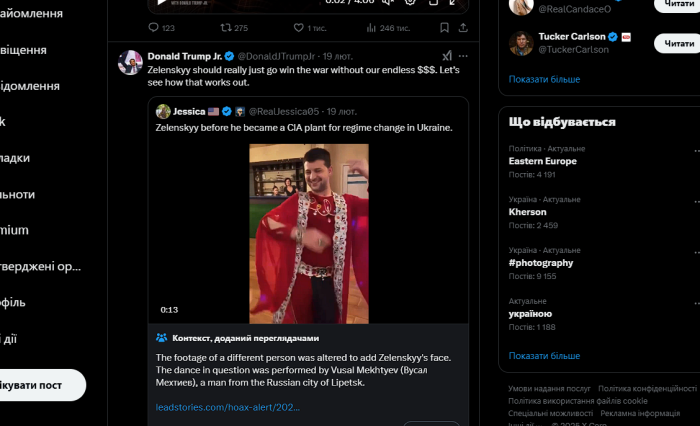
Trump Jr. believes that support for Ukraine “continues the killing and increases costs without bringing significant results for the United States”. He seeks to convince American society that spending money on fighting in Ukraine is a wrong policy that does not correspond to US national interests.
He actively promotes the idea of the need to end the war through peace negotiations. Trump Jr. advocates for the US to limit its role in the war, which, in his opinion, will stop “unnecessary death” and “reduce the costs of the conflict.”
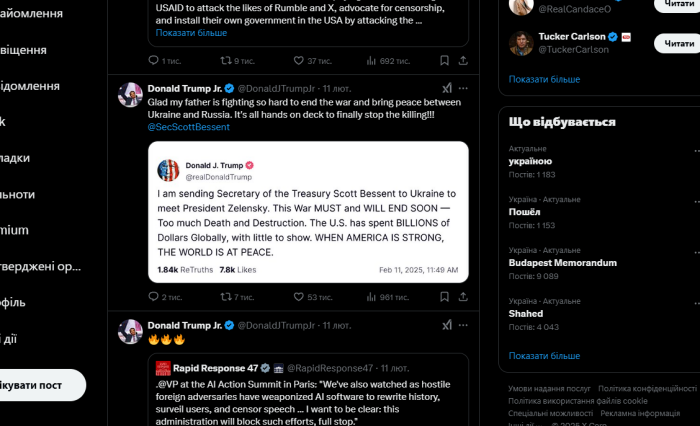
Trump Jr. also fully supports the policies of his father, Donald Trump, and often quotes and praises him, claiming that he has been successful in resolving international problems.
Ukraine may observe a changing political situation in the US, where the opposition views presented by Trump Jr. may influence the formation of future US foreign policy on the conflict. Since his statement emphasizes costs and national interests, this may mean that for Ukraine this will mean the need to work hard to prove the importance of US support through diplomatic channels.
J.D. Vance
During January, J.D. Vance did not mention Ukraine, and his publications focused on domestic US political issues.
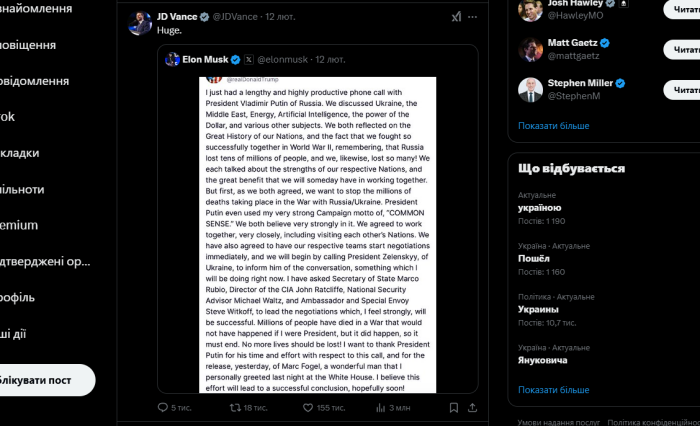
After Trump’s phone call to Putin, J.D. Vance wrote “Huge.” further in his publications, the US vice president says that the US and other Western countries are spending heavily to support Ukraine, but this money does not produce significant results in the war, because Ukraine “has no real path to victory, and Russia’s advantage in manpower and weapons remains unchanged.”
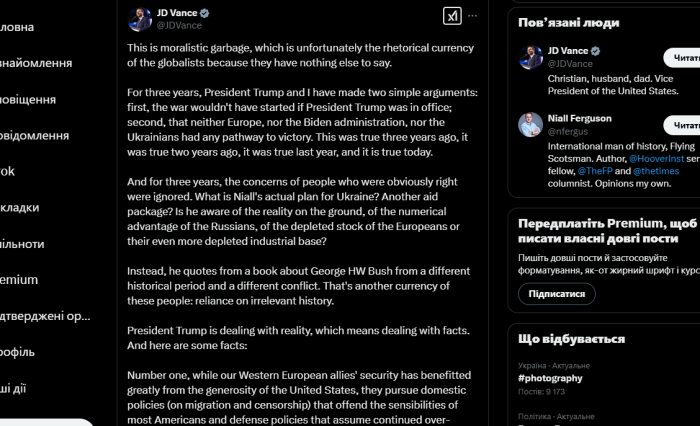
J.D. Vance is also actively promoting the idea of “seeking peace through negotiations”. An important part of this campaign is criticizing the position of the Ukrainian leadership and European leaders, who allegedly cannot realistically assess the situation. Vance argues that negotiations with Russia are “necessary to achieve peace, and only through dialogue can a compromise be reached”.
That is, J.D. Vance is trying to convince the public of the need to review policy towards Ukraine and focus on negotiations and a “peaceful resolution of the war”. Vance also quoted Trump’s message: “Zelenskyy convinced the US to allocate $350 billion”.
Marco Rubio
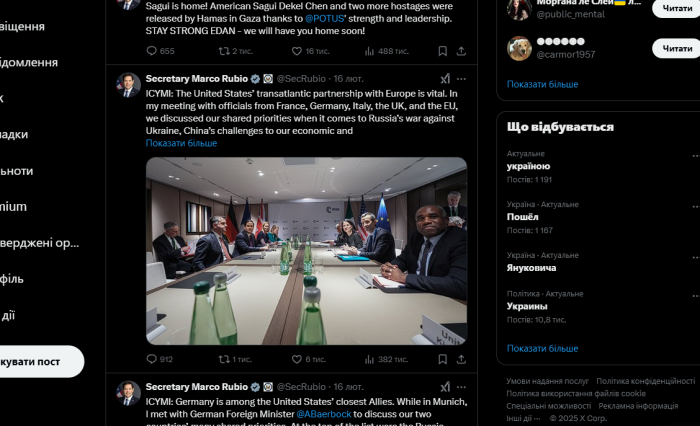
In his January publications, Mark Rubio focuses on US domestic policy, as well as diplomatic efforts to resolve domestic issues. He emphasizes the importance of returning citizens who are illegally in the US, and puts this in the context of “America First”. Ukraine is not mentioned in these publications, which indicates that Rubio is focusing more on issues of internal security and immigration during this period.
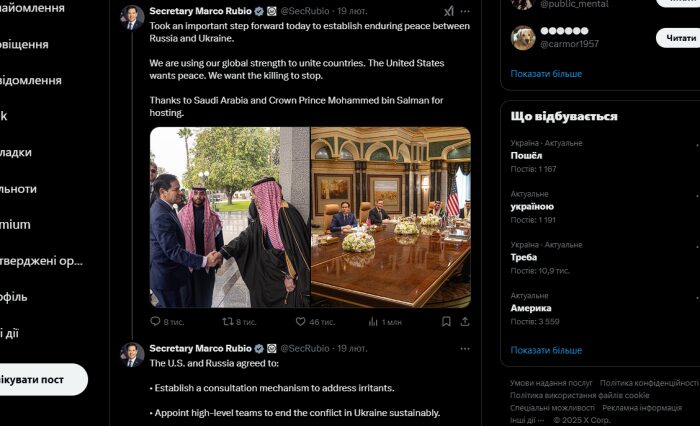
In February publications, Rubio declares an important step for peace between Russia and Ukraine, which indicates an active diplomatic position. He emphasizes the role of the United States in uniting countries to achieve peace, expressing gratitude to Saudi Arabia for facilitating peace negotiations. This indicates an active role of the United States in diplomacy and efforts to create mechanisms to end the war.
Rubio, through diplomatic initiatives, seeks to promote peace between Russia and Ukraine, using peace negotiation mechanisms, and support US initiatives in international organizations to find ways to peace.
Mark Rubio’s information campaign aims to emphasize the role of the United States as a leader in international diplomacy and support for peace initiatives. For Ukraine, this is a signal that the United States is ready to work on a “peaceful solution.” Unlike Donald Trump himself, Mark Rubio does not make sharp attacks and accusations towards Volodymyr Zelenskyy and the war in general.
Ukraine should be careful about such publications, as they can influence public opinion in the United States, especially among conservative voters who support Vance’s policies. By emphasizing the economic costs and promoting peace talks with Russia, he may weaken support for Ukraine among certain political groups in the United States.
Ukrainian diplomacy should work to argue the need for continued US support, in particular through humanitarian, security and geopolitical perspectives, and to provide informational support in the international arena so that Vance’s counterarguments do not have an impact on strategic support.
Keith Kellogg
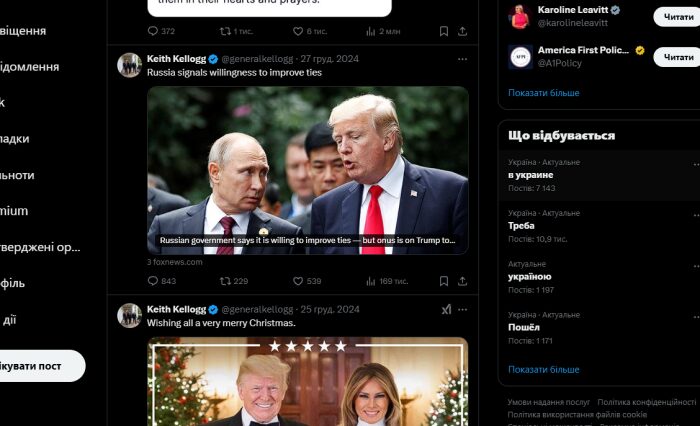
In his publications, Kellogg often mentions the need to end the war and find ways to establish a stable peace in Europe. This includes active negotiations, in particular through dialogues with the Ukrainian leadership. His approach is to make the US and European partners more committed to finding a peaceful settlement, while maintaining a strong position to deter Russia in Europe.
In his publications, Kellogg expresses support for President Trump, reposting his statements, in particular, on the importance of cooperation with Russia. This also reflects an attempt to expand relations with Russia.
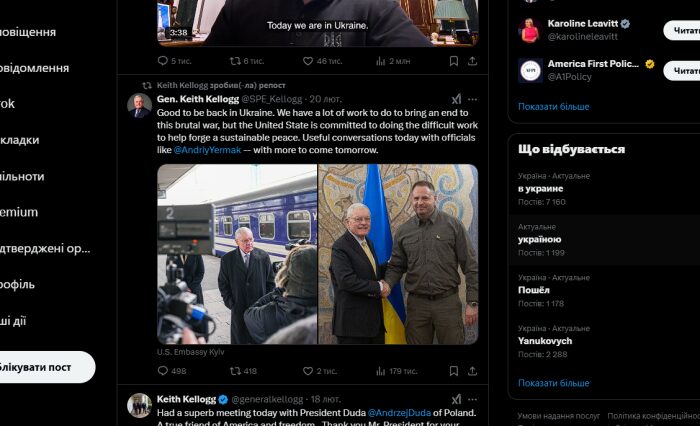
Kellogg also actively emphasizes the importance of the US role in ensuring stability and security in Europe through support for European security initiatives. However, he advocates for an end to hostilities and finding a path to peace, which may lead to a review of approaches to military support for Ukraine.
On the one hand, Kellogg’s public statements emphasize US support for the need to help Ukraine, but on the other hand, his message about the need for peace negotiations can be perceived as pressure on Ukraine and an attempt to force it to compromise with Russia.
Kellogg’s main goal is to invigorate the peace process, as well as create conditions for greater cooperation between the United States and European states, while trying to reduce the role of the United States in continuing military assistance to Ukraine.
***
In general, public statements by representatives of Donald Trump’s team in the last two months demonstrate an increasing emphasis on peace negotiations and reducing spending on supporting Ukraine, which is likely to affect the strategic position of the United States regarding the war in Ukraine.
For Ukraine, these statements can be a signal to strengthen diplomatic work with American political elites and society, explaining the importance of US support due to security, stability and humanitarian aspects. Ukrainian diplomacy must be ready to respond to arguments about costs and national interests in order to ensure continued international support and resist attempts to reduce its level.
Anya Ostymchuk