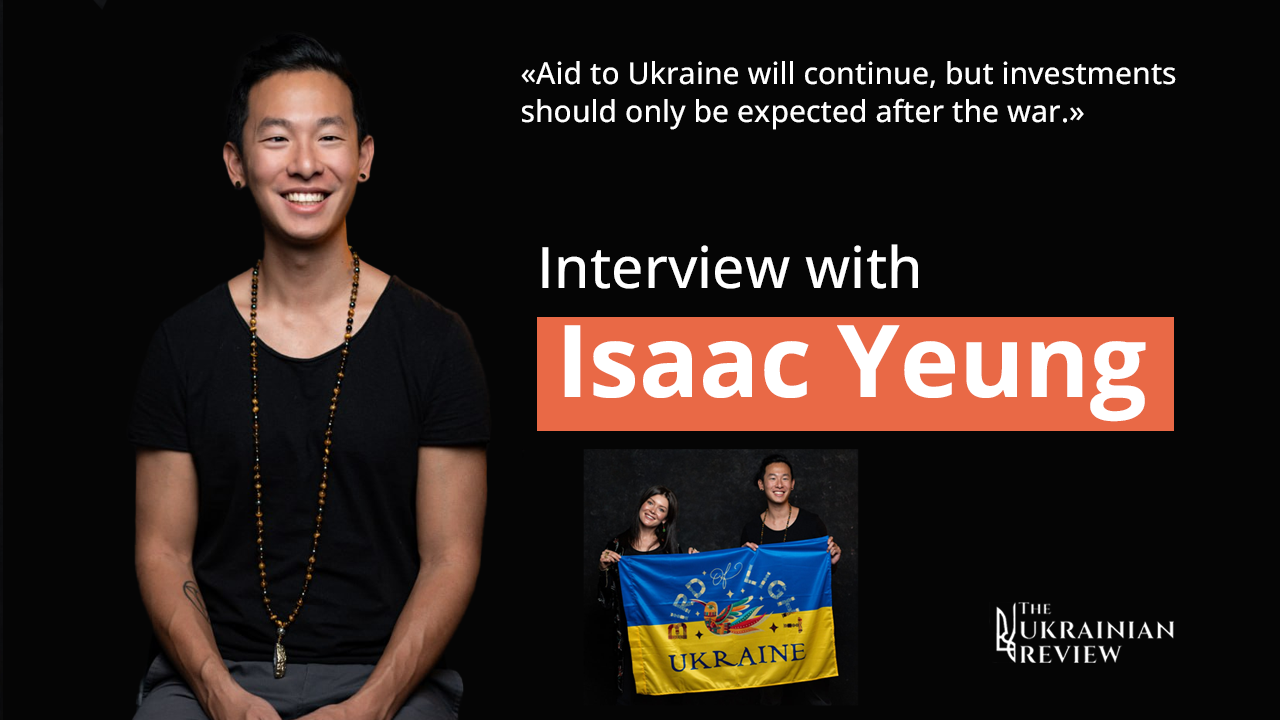


Is aid to Ukraine decreasing? Are Westerners “tired” of war? These stereotypes are debunked by Isaac Yeung, cofounder of Bird of Light Ukraine, a charity that has been operating since the outbreak of the Russian war against Ukraine.

We talked with Isaac Yeung who has a business degree from Simon Fraser University in Canada, about how the Bird of Light Ukraine organization is helping Ukraine and why it is worth waiting for investments only after the end of the Russian war against Ukraine.
We present to your attention the transcript of the video interview. The video version is available on the Ukrainian Review YouTube channel.
Hello dear listeners, you are on the Ukrainian review channel. I thank you Isaac for joining us today. Here is Isaac Yeung. He represents the organization Bird of Light Ukraine. Can you tell us a little bit more about the Bird of Light Ukraine organization?
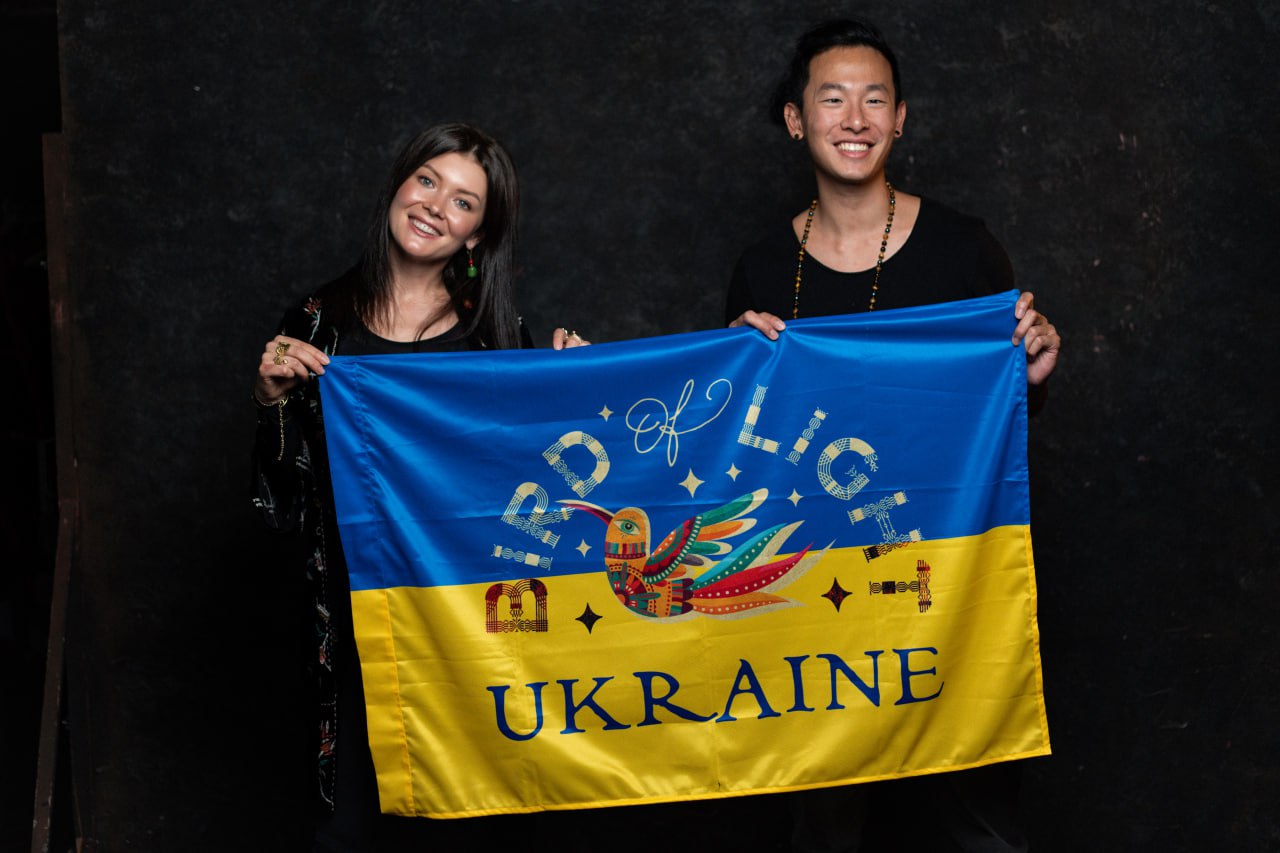
Sure. My name is Isaac. I am from Bird of Light Ukraine. We are a charity that was founded in Ukraine during the early days of the war in February 2022. And since then we’ve been operating in the country. We’ve delivered over $5.5 million in aid and we’ve been quite active across the country.
If we talk about the aid to Ukraine, what is the difference between nowadays and the beginning of the war? Is it that more people share their money or it’s just a little bit difficult to find aid for Ukraine now than one and a half years ago?
There are significant differences compared to the beginning of the war. The biggest thing I would note is that the donations from individuals have certainly decreased but also donations from larger institutions have increased. And so, I want to say it’s changed. But I think it’s changed a lot for the better. As you can see the donations that come from for example governments, that come from large charities, come from corporations are a lot more substantial than what individuals are able to produce. I think it’s definitely a change but it’s also one that’s been for the better my opinion.
How and with whom to talk about helping Ukraine? Now is it more funds, more large enterprises, or just individual donations?
First of all, I think It’s gonna come from large institutions. It’s not gonna come from small individuals anymore. If we’re talking just strictly on the topic of fundraising, you’re gonna want to talk to large charities, you’re gonna want to talk to wealthy individuals. Because those are the individuals that have the ability to deliver meaningful impact in the contributions are able to create those are also the ones that have greater impact within society. They can make larger changes. Yes, I will say you definitely be talking to larger entities about this. But is there something perhaps you would like to elaborate on this question?
I wanted to talk about the change in the position between the institutions and the local population and the Individuals from the beginning of the war and now. Because now a lot of people are tired of the news about the war etc. But Ukraine needs more assistance even now because Ukraine faces a lot of difficulties and challenges in the face of the winter, in the face of the Russian offensive. My question is that. Is that not Americans or Canadians tired of donating to Ukraine? Do they have this spirit? Because this war is not stopping in forecast weeks, months, or even more.
So, I actually have a lot to say about this topic. When it comes to donations, it’s the general or when it comes to support for Ukraine, really the general public already fully supports Ukraine. As you can see in polls, you know Americans, Canadians, the most individuals from Western countries overwhelmingly support Ukraine. It’s really a matter of how much aid should be donated. Individuals can send small dollars, but it’s ultimately governments that control large budgets. America can improve billions of dollars. Germany can improve billions of dollars. Same with Canada. I think the question should be pivoted slightly into how much aid should be delivered to Ukraine. Because there’s actually if you notice in the how to aid has been delivered to the country. There are internal debates about this topic, for example when Ukraine was asking for HIMARS there was hesitation, and when there were Ukraine was asking for Leopard tanks or Abrams [tanks] there was hesitation. I think instead of a conversation around does the public supports Ukraine is there enough public support the question should really shift to how much Ukraine needs, how much aid should be sent, and specifically on this topic. If you take a look at it, there’s actually an internal debate between two caps, I would say. One you could call political realists and those are political idealists. Now realist is a term in Geopolitical theory and we’re not going to get into that but not the way you can look at it is a debate between the pragmatists and idealists because the pragmatically minded people, for example, we’ll see that Russia, sorry Ukraine losing is a terrible thing; Ukraine in the current status quo is okay, but a Ukrainian victory is a little bit of a confusing situation. And there’s an unexpected element there. There’s fear around Russian nukes from Russian retaliation. What does a world order look like if Russia collapses? There’s a lot of hesitation in this debate around how much aid to be delivered.
How might the US position change after the election of the new speaker of the House of Representatives and after the election of the US president in November 2024? What is your opinion? It’s a lot of polls that Trump can [win the presidential election] after four years of Joe Biden`s. Is it a threat? [For] Ukraine it’s a very painful question for the rest of the East European states [and for Ukraine]. These countries face an existential threat from Russia. Will the United States of America continue to support Ukraine if the Republicans [Trump supporters] win?
I’m not a political polling expert. I actually don’t think that the current situation in American politics is necessarily that bad for Ukraine. Yes, the Speaker is holding hostage the passing of bills, and that makes it difficult to pass new spending bills for Ukraine. But that being said Democrats and Republicans overwhelmingly support Ukraine. The ones who are holding out are a vocal minority the MAGA Republicans, but generally, you see a lot of support from older. Republican Mitch McConnell, for example, is very supportive of Ukraine. Also, I have a lot of Republican-oriented sponsors for my charity. There is a lot of support from both sides of the aisle. I believe that there are ways to get around this situation. And I believe that because there’s so much will to sponsor Ukraine, there will be alternative funding solutions. They’ll just have to be a little bit more creative than passing spending bills. I would also say that I don’t believe that the current situation in the house is necessarily bad for Ukraine. In the sense that it has shown a lot of Americans in how Republicans have been governing and it doesn’t exactly paint a good picture. So well, yes, it is bad that spending bills cannot be passed so easily right now. I think that this situation is helping Democrats in winning the next election just by showing the difference in ability to govern.
My question has just two parts. The second part of the question: do the people in Canada in particular face Russia as a threat? Because you are across the ocean and you don’t feel this threat so close. But what is the feeling in public opinion about the Russian threat? Russia can use not only weapons. But, for example, [some sort of] media or proxies or cyberattacks. Do the people across the ocean face the Russian threat?
If you were to ask an individual the answer is No. Because most individuals are not quite aware. But if you ask someone who is a little bit more [involved] for example, [if] you ask for my opinion I would say that the threat of Russia is primarily Ideological. And that is also something that is it can’t be dismissed. Because Russia represents in many ways the authoritarian world versus the liberal democratic world. Russia along with countries like Iran, North Korea, and China. And so, if Russia were for example to seize victory or if they were to make a lot of headway it would give permission to other authoritarian countries to also make aggressive actions. This makes a sense signal that liberal democratic countries are weak. In that sense, Russia is very much an ideological threat. If Russia was to win the United States would lose all its credibility. Their word will have very little meaning. In that sense, yes, they are certainly a threat to the current world order.
Let’s shift to a personal question. Did you face some fakes in Canadian media about Ukraine? [I mean] Russian fakes. Fake news or some [sort] of sources not authorized by the Ukrainian side. [For sure] sometimes they look like the news. But it’s not really news because it’s some sort of lie. Fake news, fake analysis, or fake representative. It can be not only in traditional media but also in social networks, in Facebook and Twitter.
Yes. Propaganda is definitely Russia’s strong suit and Canada’s especially is being faced by a lot of Chinese as well as Russian propaganda. And you can see it as well in America how they penetrated the far-right MAGA Republicans with this. So, yes, I mean in almost all sorts of media you can see quite a strong subtle Russian angle that has been penetrating the media. There are very subtle ways to there’s also the ability to Russian media to launder so to speak their media into Western publications. So the short answer is yes, there is a tremendous amount of propaganda that Canada and America have experienced over the last few decades. And it’s quite Subversive within society I would say right now.
Let me shift from Russian propaganda to Ukraine. Let’s talk about the future and how you see the future of Ukraine in particular. Do you see the perspectives of investment in Ukraine in the forecast future?
Yes, this is actually a topic that I’ve been working on. Of course, there’s a lot of room for investment in Ukraine. But it’s not going to be till the war ends. There are there’s a lot of interest. Let’s take a step back and look at this from a geopolitical standpoint. There’s a lot of will to make sure that Ukraine succeeds post-war. You can see how the European Union is looking to bring Ukraine into the fold. There you can see how America has put its blessings on Ukraine. There’s a very strong incentive for foreign nations to see Ukraine succeed. [But] when I speak to individual investors about the country. There is still hesitation a lot of this comes from the fact that the country is still at war. No one wants to have an investment that is blown up. No one wants to have. Do you know who’s going to ensure an investment in Ukraine? Besides certain entities like the US government. Also, there’s still certainly a fear around corruption for foreign investors in Ukraine. There is a lot of I would say idealism and a lot of hope for Ukraine post-war and a lot of people are quite feeling a lot of kinship, especially Americans. You know America sees itself as the land of the brave and Ukraine today is taking up the mantle as a land of the brave. There’s a lot of willingness to visit Ukraine to support Ukraine and to help rebuild the country but unfortunately, a lot of this won’t come until there is some sort of Peace treaty or until the war is concluded.
You mentioned the corruption. Corruption is used by Russian fake news much more than other topics. It’s a first point. Another is that Ukraine wanted to join to European Union, and Ukraine adopted a lot of the laws and legislation. What is your point of you across from the ocean upon the progress of Ukraine? If you look at Ukraine over the years? Did you see this progress in the law’s regulations and different areas, with the fight against corruption, in particular?
There are still a lot of fears about corruption because there are all these stories planted about theft in Ukraine. And Ukraine has historically had a fairly bad reputation. Excuse me in this regard that being said there’s a lot of from the actions of the Ukrainian people and the Ukraine military and government administration. I do think that there is good progress being made on this front. But it’s hard to tell until everything is settled because one part of it is legislation and the other part is cultural.
Sure. And what is your opinion: how many years does Ukraine need to be adopted into the European Union? From your point of view if the war is over [now], how many years [it takes]? A lot of people in Ukraine thought that it would be in one, two or three years.
I don’t think my opinion is any more accurate than any experts’. I’m a Canadian. I don’t understand European politics. There’s gonna be a lot of requirements and a lot of legislation that need to get passed in order for it to for that to complete.
Let me finish with a personal question. You were in Ukraine. And did you feel safe in Ukraine in the time of war or just completely unsafe in that time?
Well, my tolerance for safety is very different from most people. Simply because I was willing to live in Ukraine during most of the war. Having been in the West Ukraine I believe is very safe as far as the West goes but for most people. You know, even many Ukrainian people there is a sense of anxiety when the sirens go off. There’s a sense of anxiety when you hear a motorcycle go by because it might sound like a Shahed drone in the West. I generally feel quite safe. As in Kyiv, you know, it can be if you can feel not so safe many times especially when there are sirens going off and you know drones. The short answer is – it feels as safe as it can get for a country that is not yet at peace.
Very last question. In what terms you can characterize the Ukrainian victory What is the Ukrainian victory especially for you?
For me, a Ukrainian victory is really a victory for the liberal democratic world. It’s a victory where authoritarianism has been not vanquished but crushed in many ways. It’s a victory where Ukraine not only won the actual physical war but is growing rapidly economically. Now I’m not going to make any statements about what the border looks like. But to me, a Ukrainian victory means a Russian regime change. It means [that] a lot of individuals in a Russian state questioning their political direction and perhaps a shift in the political discourse and political direction in Russia itself. That to me is what a victory would look like.
[Does it mean] no Ukrainian victory without the regime change in Russia? Because some people in Ukraine, in public opinion, and in expert opinion thought that Russia could never be changed at all. Doesn`t matter, Putin or another person on top of the Russian Policy is just Russia cannot change at all. Do you support this statement or do you think that Russia can be changed to a more democratic state and not continue to be a threat to the rest of the world?
Absolutely. Russia can be changed because we’ve seen this so many times in history. Keep in mind for example. Let’s talk about some historical examples. China for many years was a country ruled by an emperor and then the Republic of China came. Of course, communism came after but keep in mind Taiwan was also a dictatorship for many years. Until it became a democracy. Nazi Germany is another example. [Germany] went from a very hard authoritarian fascist country into a democratic one. Italy is the same. Japan is similar. We have to be willing to see that change is possible for that first to happen.
But unfortunately, the last decades [have] shown if not a victory of the authoritarian regimes but the rise of a lot of authoritarian regimes all over the world. You can see that some regimes in Africa, and some regimes in the Middle East. They wanted to rule their nations or neighboring nations by authoritarian means. Does it mean that this is the final hour for the Western democracies to show their strength in the face of the threat from the authoritarian states? Yes, actually let me take a step back. If Western democracies did not stand up to Russia during the invasion in February 2022, then in my opinion that would have been a signal of the downfall of liberal democratic states. But because for example US, the UK, Germany, the European Union and a lot of these countries stood up together with Ukraine it has shown the strength of a liberal democratic country. It has shown China and Russia that you can’t [provide your politics] and that these countries are not so weak ideologically and politically. Is it the downfall of authoritarianism? It’s hard to say to be honest. But I do think that as technology changes how we interact it definitely makes you know Information much more available. It shrinks the borders to cultural differences and as people become more educated. They become more aware. I think this naturally brings about more, I would say liberal tendencies. It’s hard to say from this standpoint, but I definitely don’t think that Liberal democracy is on its downfall. I think it’s definitely on the rise, especially in how the support for Ukraine has been as well as Ukraine’s success against Russia these past two years.
Thank you for your opinion. And I think that Western democracies go through challenges and they pass this exam. And finally, Ukraine wins this war and finally, Russia can represent the democratic regime at last. Thank you very much. It was Isaac Yeung from the Bird of Light Ukraine charity fund in the Ukrainian Review.
Interviewed and adapted to publishing by Stanislav Kinka.