

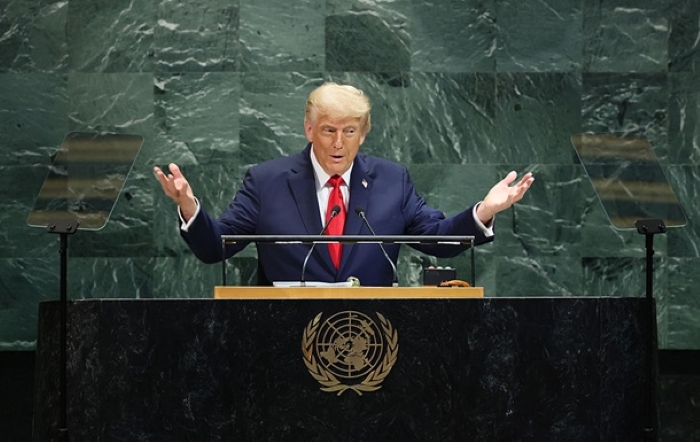
Two weeks ago, during his speech at the UN General Assembly, Donald Trump reaffirmed his statement about ending seven wars through diplomatic efforts. Yet, many of these conflicts were either not in an escalation phase or were resolved primarily through military means. Now, the U.S. President claims he would first “talk to the Russians,” threatening them with Tomahawks, and then, maybe, send these weapons to Ukraine. He describes the Russian-Ukrainian war as a more complicated one, since it is a full-scale invasion. At the same time, reports emerged about a deal between Israel and Hamas, which, according to Trump’s calculations, marks the eighth “ended” war.
Israel and Iran
The 12-day escalation of the decades-long Israel-Iran conflict, which began when Israel struck targets in Iran on June 13, 2025, was de-escalated after U.S. strikes on Iranian nuclear facilities. Among Trump’s “solved” cases, this is the clearest example of a military-first response. Moreover, Iran’s nuclear program remains unresolved, as well as its non-recognition of Israel, making this case more of a ceasefire than a peace agreement.
India and Pakistan
Tensions between the two countries run deep. In the spring of 2025, the world once again witnessed an escalation in Kashmir: shelling, terrorist attacks, and threats of air strikes. Trump publicly declared that he had “stopped the war,” threatening both capitals by phone with trade sanctions and the freezing of military contracts. A few days later, India and Pakistan announced a mutual ceasefire. Pakistan emphasized on Trump’s regulation efforts, while Indian side downplayed the role of the U.S. Yet, territorial disputes remain unresolved, while India even explores compromises with China.
Armenia and Azerbaijan
In August 2025, the U.S.-mediated Declaration on the Establishment of Peace and Interstate Relations was signed in Washington, D.C. The parties pledged not to use force, begin border demarcation, and open transport routes. Militarily, Azerbaijan had already regained control over Karabakh in 2023. The positive outcome of this deal is the weakening of Russian influence in the region, which historically amplified tensions. However, true reconciliation is still far away.
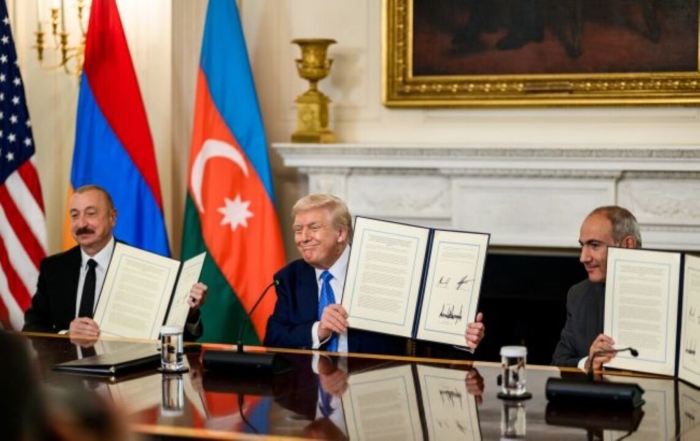
Azerbaijani President Ilham Aliyev and Armenian Prime Minister Nikol Pashinyan while signing a peace agreement mediated by US President Donald Trump / White House
Thailand and Cambodia
This border conflict, which has persisted for more than a century near the Preah Vihear temple, entered a new phase in 2025. Trump warned the leaders of Thailand and Cambodia that he would suspend trade talks if they didn’t agree on a ceasefire. Officials from both sides met in Malaysia and agreed to end hostilities, though the resulting document lacks concrete implementation mechanisms.
Democratic Republic of the Congo and Rwanda
This conflict traces back to the 1994 Rwandan genocide. In June 2025, the Democratic Republic of Congo and Rwanda signed a peace agreement mediated by Trump, under which the U.S. gained rights to develop Congo’s mineral resources. However, military tensions have continued since then.
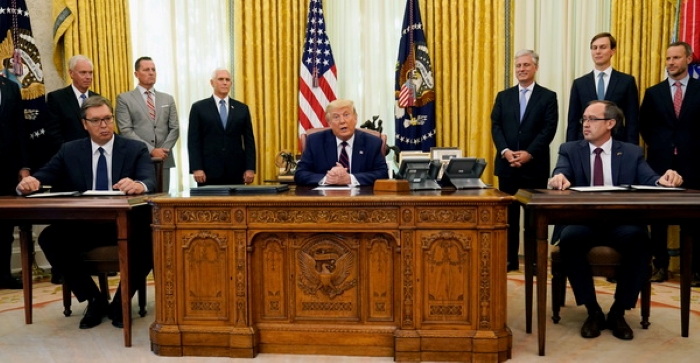
Serbia and Kosovo
During his first term in 2020, Trump mediated a deal between Serbia and Kosovo. Although the meeting in Washington didn’t lead to Kosovo’s recognition, it marked a step toward economic normalization and reduced Russian influence. Yet, in 2025, tensions have reignited — Serbia’s army remains on high alert amid street riots in Kosovo.
Egypt and Ethiopia
In 2011, Ethiopia began constructing a dam on the Blue Nile near the Egyptian border. Although the dispute was intense, it never reached a military level. Trump called for compromise, and now the dam is completed. Still, questions about fair water distribution remain unresolved.
Israel and Hamas
Speaking in the Knesset, Trump claimed the war between Israel and Hamas had ended and that hostages were released. Both sides, however, set numerous conditions, and whether this deal can bring long-term stability remains uncertain and would become clearer soon. So far, the intensity of fire has indeed been reduced.
Conclusion
Each of these cases shows that diplomatic solutions often followed successful military operations in the past or temporarily froze unresolved issues. These conflicts, rooted in decades of hostility, tend to re-erupt periodically with new waves of violence. The peace processes were far more complex than presented. Unfortunately, none of these examples exhaustively ended conflicts lasting 30 or more years.
Russia is unlikely to agree to a ceasefire. Yet, even if it does, it will definitely use the pause to regroup and strike again, potentially against NATO territories as well. Economic restrictions are only one element of a broader, complex international pressure required to achieve a truly lasting peace. Successful assistance in helping to end the Russian-Ukrainian war, if it will follow statements, could outline the U.S. capacity to show leadership in more complicated cases.
Daria Maslienkova