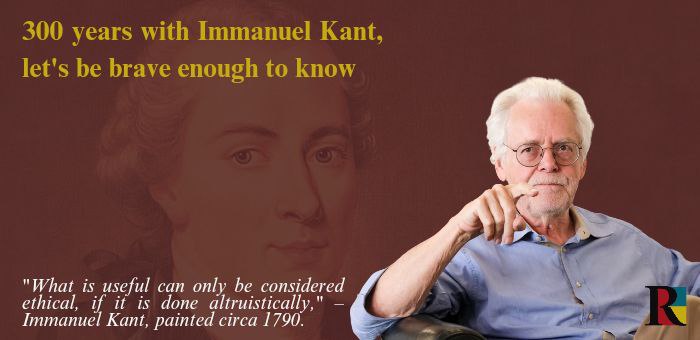


On Monday, 300 years ago, Immanuel Kant, arguably the greatest philosopher of the Enlightenment, was born in Prussian Königsberg, now Russian Kaliningrad. Kant is with us to our terrible days with his statement: Sapera Aude – have the courage to know!
Vienna, Austria.
Years ago I travelled with a group of Danish readers on the so-called state train of recently deposed DDR-dictator Erich Honecker from Berlin to Kaliningrad, long one of those closed communist cities, then partially, after the collapse in 1991 of the Soviet Union, opened to visitor, still a place to be avoided.
The journey through northern Germany and Poland was not exotic, and the train was even less so: very simple compartments, second class at best further to the west. I don’t remember what we did in Kaliningrad, named after Mikhail Kalinin, a faithful servant of Joseph Stalin, formal head of the soviet state from 1922 until his death in 1946. Almost nothing remained of the former Königsberg, the coronation city of numerous Prussian kings, captured by the Russians in the closing stages of World War II. However, outside the poorly restored cathedral, I found a burial site: the grave of Immanuel Kant, insignificant and forgotten, neglected in its depressing surroundings. Kant, arguably the greatest philosopher of the Enlightenment, was sidelined in the Evil Empire, which killed million after million, civilians and soldiers, academics and workers, often cheered on by Western intellectuals who, in their scholarly ignorance, insulted Kant’s central demand: Sapere Aude, have the courage to know.
Monday marks the 300th anniversary of Kant’s birth in Königsberg. He was the son of a saddler, Johann Georg Cant or Kant, and his wife, Regina Dorothea Reuter. The boy grew up in poor conditions. His mother, apparently a woman of extraordinary qualities, who died in 1737, encouraged him to do good and to do so not for his own purpose or benefit. This, in Kant’s later philosophy, should evolve into a debate between selfishness and the disinterested. He believed that good done had ethical value, only when it was done altruistically, for no egotistical or ulterior purpose. Kant insisted – unlike more airy philosophers – on earthly life, on duty and work and responsibility, Prussian virtues, through which he came to his conclusions concerning the absolute or imperative demands.
Kant left us with timeless, vital questions that, unless we answer them with knowledge and courage, will continue to plague us. What is work and duty? What is the responsibility of a statesman, the duty of a saddler, of a soldier, off a farmer? What is pure reason and eternal peace, about which he wrote two of his main works? We may see or feel or sense “the thing”, he argued. But what is “the thing itself”? That is, what matters.
Kant, the eccentric from Königsberg, where he remained unmarried until his death in 1804, is discussed to this day, not least in Germany, where he is honored with symposia, conferences, and a new Kant Museum in Lüneburg, and where his thoughts and theories are incorporated into the very fabric of the Federal Republic. He was a rationalist, a humane rationalist, and long before his time he warned that faith could lead to superstition – unlike the later Søren Kierkegaard in Copenhagen, who believed deeply, attacking what he saw as an unholy church apparatus. Kant as a friend on the narrow paths of philosophy is difficult and sometimes confusing, demanding in his language and demanding in his absolutism. Kierkegaard is nimble and quick-witted, ironic and sarcastic, an easier companion. They may well be two sides of the same European coin with their demands for existential clarity.
Of the two of them, both in their provincial holes, I see Kant as the more important in our confusing and until now terrifying 21st century, important especially in the political and spiritual arena because of his demand for the courage, our courage, to know, this Sapere Aude, which he picked up in ancient Rome. Kant, 300 years on, refutes our illusions, our desire for entertainment and comfortable oblivion, while Russia is killing thousands of people in Ukraine and Israel is killing thousands of people in Gaza, while totalitarian China is expanding its sphere of power, while civil wars are raging in Myanmar and Sudan, while the lunatic and gangster Donald Trump is on trial in New York and closing in on the White House in Washington, while cranks such as Viktor Orban in Hungary, Robert Fico in Slovakia, Marine Le Pen in France and dozens of others are elected and re-elected by a public, which in its amnesia cannot see – or even worse will not see – that our liberal democracies and entire civilized way of life is under being threatened.
Kant in Königsberg would probably have known, albeit vaguely, of the existence of Ukrainians, but most likely he, the German, would have been unaware of the forms of societies and ruling systems, into which they had organized themselves. But with his keen sense of justice – if he were with us today – he would undoubtedly consider the Russian war in Ukraine an irrationality and a crime against humanity. And he would scorn those of his fellow thinkers, who want to appease an aggressor. In this way he is a very modern man.
I try to memorize Kant’s grave in Kaliningrad against the red, burnt brick wall of a decaying, very Prussian cathedral: rusty railings, some greenery, a weathered stone, a wilted bouquet of flowers, probably laid by a German tourist, and I hear his clear voice: Sapera Aude, have the courage to know, have the courage to think, to speak and to act, have the courage to be. Only then, in the words of Kant, can we escape our “self-inflicted infantility.”
Kant, a genius on the brink of the abyss, where European civilisation becomes Asian barbarism, was and remains the European we need: rational, disciplined, above all humane. 300 years after Regina Dorothea gave us her newborn, the son resides on the piano nobile of our common European House – even if we don’t know it.
By Per Nyholm
*These opinions are solely those of the author. The Ukrainian Review takes no position and is not responsible for the author’s words.
Per Nyholm has been a Danish journalist since 1960. He is based in Austria and is a columnist and foreign correspondent at the Jyllands-Posten, a liberal Danish daily newspaper.
Tetiana Stelmakh adapted this text for The Ukrainian Review.