

Russian missile and drone attacks do not stop. According to UN data, three times more power units were damaged in 2024 than in the winter of 2022-2023. In addition, as of June of this year, 73% of thermal power stations have been disabled.
Russia also regularly attacks civilian objects. For example, on July 8, in the morning, Russian troops launched missile attacks on Kyiv, Dnipro, Kryvyi Rih and a number of other Ukrainian cities. The National specialized children’s hospital “Ohmatdyt” was damaged.
Therefore, we offer an analysis of how the world media wrote about Russian missile and drone attacks at the beginning of the full-scale invasion and what they write nowadays.
The appearance of Russia’s comments: American media
In 2022, The New York Times covered the beginning of a full-scale Russian invasion, with an emphasis on the mass shelling of Kyiv and other major cities. They highlighted the humanitarian consequences, including civilian casualties and the destruction of infrastructure.
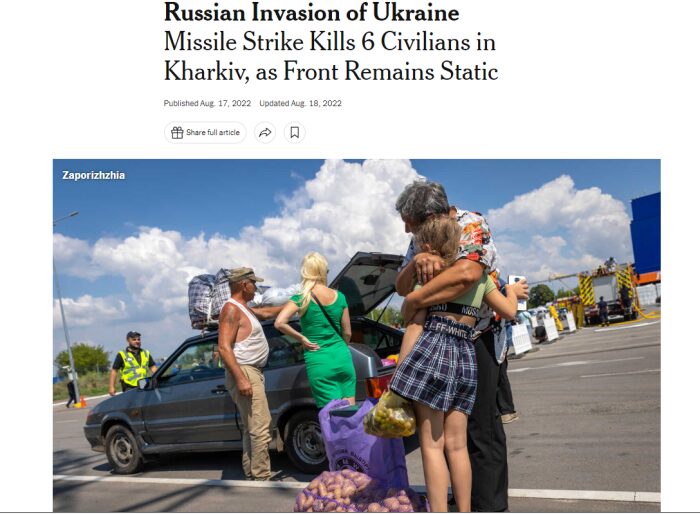
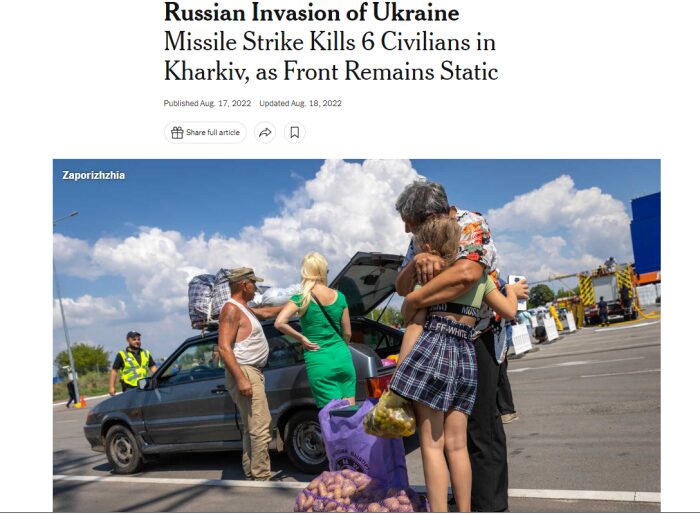
For example, in this article, the journalists emphasise that “Kharkiv, Ukraine’s second largest city, has been subjected to an almost constant flow of artillery, missiles and rockets for the past six months.” They also note the number of victims among the civilian population, citing information from Ukrainian official sources.
In this article, The New York Times reports on one of Russia’s most significant missile attacks on Ukraine and analyses how many missile stocks the Russian Federation still has. The media quotes the words of Ukrainian and foreign high-ranking officials.
In this article, the journalists note that “the arsenal of advanced weapons sent by Kyiv’s allies could not stop Moscow’s exhausting attacks on the energy infrastructure.” They also analyse in detail how many missiles were shot down, how much damage was caused, and what consequences Ukrainians faced.
In 2024, reports on Russian missile attacks are divided into 2 types: general summary information and more detailed reports.
For example, in this article, The New York Times provided general information about the attack on the military academy in the eastern city of Poltava: the number of victims and the words of officials. In this article, the journalists made a more detailed analysis of the event and took a comment from one of the eyewitnesses.
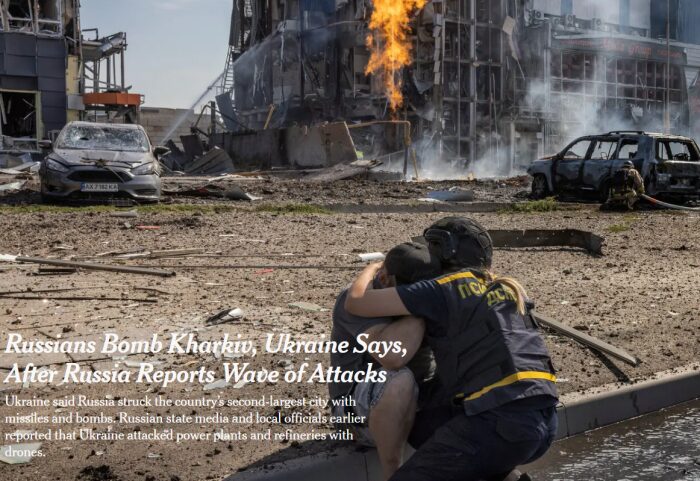
Another difference is the appearance of comments from the Russian side. For example, here the New York Times writes: “The Ministry of Defense of Russia has not yet commented on the strikes in Kharkiv”. In the material about the attack on the military academy, the journalists wrote: “Volodymyr Rogov, the Kremlin-appointed occupation official in southern Ukraine, said in a post on the Telegram messaging application that the military school that was hit during the missile strike offers training in radar and electronic warfare”.
Own analysis and eyewitness comments: British media
In 2022, the BBC actively covered the massive missile strikes on Ukraine, highlighting the terrible conditions in which Ukrainians were forced to live.
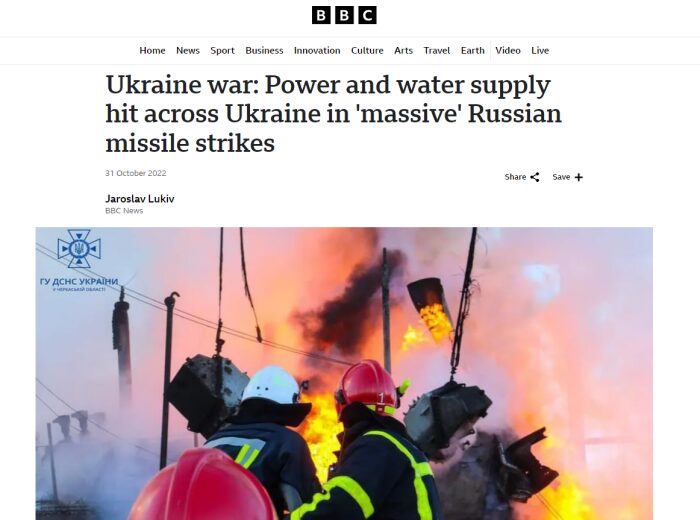
For example, this BBC article analysed the consequences of a massive missile strike in October 2022. They noted that “40% of residents in the capital Kyiv are without water, and 270,000 apartments are without electricity”, and “energy facilities in the northeast of Kharkiv were affected”.
The BBC also conducted independent analyses of missile attacks. For example, in this material, the journalists independently analysed video from surveillance cameras during the Russian attack on the shopping centre in Kremenchuk. Journalists also analysed and debunked Russian fake claims that the attack was “false” or “staged” and that the mall was not operating at the time of the attack.
In 2024, the angle of reporting news about Russian missile attacks has not changed: the BBC continues to cover information about the attacks, and the number of missiles, quotes Ukrainian officials, and emphasises the consequences.
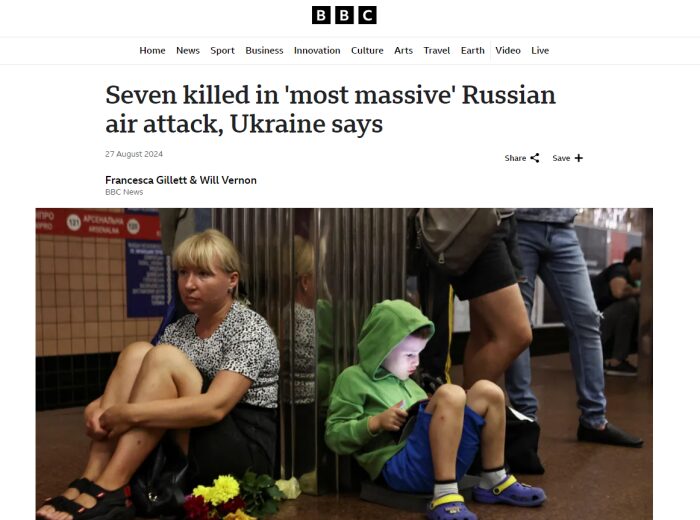
For example, journalists here write that “At least seven people were killed and dozens were injured… The energy infrastructure was damaged, which led to massive power outages”.
The BBC also began taking comments from eyewitnesses. For example, in the material about the shelling on September 1, 2024, they took a comment from one of the parents; in the article about the attack on the military academy in Poltava, journalists “met with 26-year-old Nikita Petrov, a cadet who entered the Poltava Military Institute only two weeks ago by referral.’
The BBC also published “The Consequences of the Deadly Russian Attack on the Ukrainian City of Poltava” and emphasised that the videos were verified by their journalists.
Added Russian news: French media
One of the most visited French news sites, Francetvinfo, in 2022 did not publish individual news about missile attacks. They summarised military news throughout the day. In them, journalists always mentioned massive missile attacks, the number of missiles launched and shot down, quoted Ukrainian officials and talked about the consequences of the attacks.
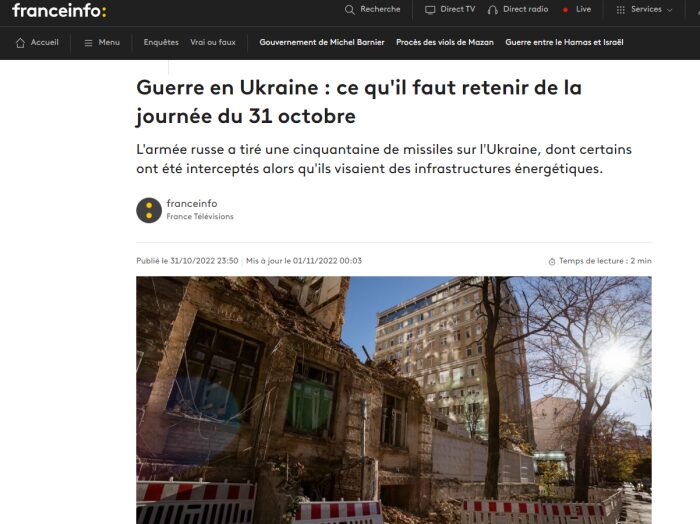
For example, in this material, Francetvinfo wrote: “On Monday, during the day, 80% of the capital’s consumers [remained] without water supply and 350,000 houses were without electricity”. In it, they also wrote about the consequences: “29 objects of the necessary infrastructure, four buildings, and 35 private residential buildings, as well as a school in the capital, were damaged”.
In 2024, there are also general summaries, but separate news regarding military events also appeared. The principle of presentation is the same: the number of missiles launched and shot down, citations of Ukrainian officials and the consequences of the attacks. However, news from the Russian side also appeared.
For example, in this material, journalists write about the rocket attack on Kyiv on September 9, 2024, and write about the consequences.
The same summary refers to the strike in Kharkiv on August 30, 2024, and the casualties. Next, in the news, there is information from the Russian side that “Moscow announces the seizure of three villages in the east.”
Added the view of foreign officials: German media
Der Spiegel, in 2022, covered Russian missile attacks, detailed the consequences, and quoted Ukrainian officials.
For example, here journalists wrote that “Central targets, including critical infrastructure, were hit in Kyiv” after the attack on October 10, 2022, here that “the number of civilian casualties after shelling a residential building in eastern Ukraine is increasing” after the attack on 13 July 2022.
Der Spiegel also sometimes provided an analysis and the purpose of the attacks. For example, in this material, the journalists note that “Kyiv accuses Moscow of a deliberate attack on residential areas, to force Ukraine to sit down at the negotiating table”. According to British intelligence, Russia is now betting on inaccurate missiles – but for lack of an alternative”.
In 2024, the publication publishes information about Russian missile attacks. However, citations of foreign officials were added.
For example, in the material about the attack on the educational institution in Poltava, Der Spiegel added comments from the foreign minister of Great Britain, the Federal Foreign Ministry.
Separating the information of Ukraine and Russia: Chinese media
In 2022, Xinhua covered Russian missile attacks with information on the number of missiles and the consequences of the shooting down, citing Ukrainian officials.
For example, in this article, journalists write about a missile attack on December 29, 2022, quoting Ukrainian officials. They note that “in Kyiv, at least two people were injured as a result of an attack on a private house.”
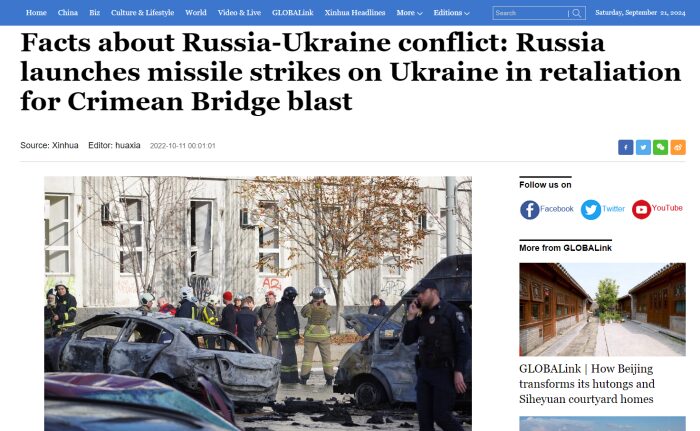
At the same time, there were news about attacks from the Russian side. For example, in this material, Xinhua quotes Vladimir Putin as saying that, “Russia launched a large-scale attack on Ukrainian targets on Monday in response to the deadly explosion on the Crimean bridge”.
In 2024, the situation has not changed. However, news about Russian missile attacks became shorter.
For example, in the material about the attack on the military academy in Poltava, there is only a brief summary of the number of dead and wounded and quotes from the Ukrainian Prosecutor General about the type of missile.
Xinhua also wrote that “Russia stated that 5 Ukrainian fighter jets were destroyed as a result of missile fire”. However, the journalists did not provide references to these “Russian words”.
***
Coverage of Russian shelling in Ukraine in 2022 focused on the humanitarian consequences and details of the attacks, while in 2024, some media shifted to a more generalised format with an emphasis on coverage of the Russian side as well.
The interest of the Western press in Russia’s shelling of Ukraine has not decreased, but the rhetoric and approaches to covering the events have changed. There was a greater variety in the style of coverage: from general reviews to detailed reports. Also, some media began to give “the right to vote” to the Russian side, which is quite strange. Since Russia says in any shelling that it hits “military targets” or “revenges for the operation of the Ukrainian military”.
Anya Ostymchuk