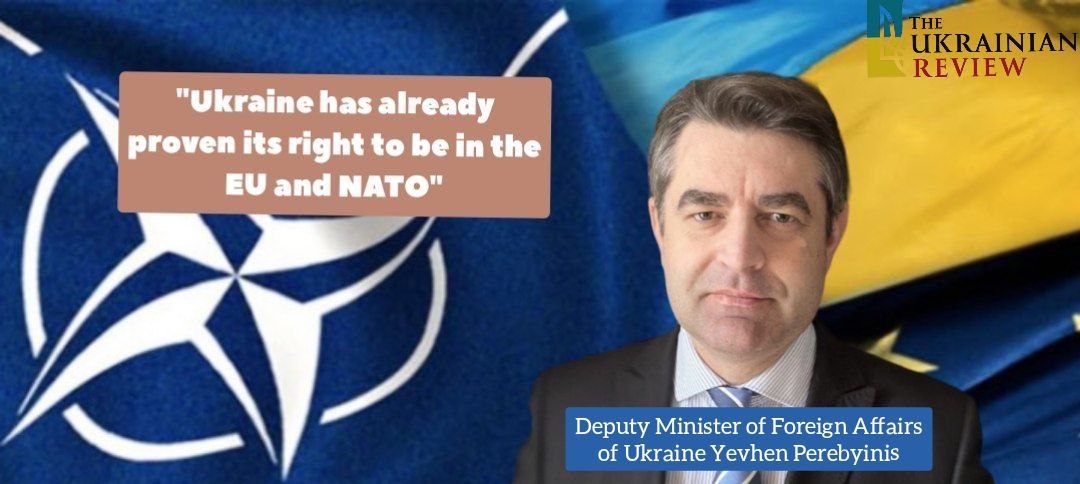


Ukraine is not just fighting a war on the front line. The war is also being fought in a diplomatic format. What have been the successes and challenges for Ukrainian diplomacy during the war years and what are the prospects for the development of multilateral and bilateral relations between Ukraine and the countries of the EU, NATO and the Global South? We discussed this with the Ukrainian diplomat, Deputy Minister of Foreign Affairs of Ukraine, Yevhen Perebyinis.
Could you please tell us about the results of the activities of the Ministry of Foreign Affairs on the track of Euro-Atlantic integration?
If we talk about both 2022 and 2023, the task of the Ministry of Foreign Affairs remains the same: the victory of Ukraine.
The first task is to strengthen Ukraine so it can win this war. There are many different aspects to this task. First of all this is strengthening of our military. Using all possible levers and tools to get modern weapons and military equipment so that they can defect aggressors. But it’s also strengthening of Ukraine politically. Here we are talking about our membership in the European Union and NATO, as this is also part of our victory and our success.
And the second task is to weaken Russia. Here all our efforts aimed to isolate Russia as much as possible in the world, to apply the toughest possible sanctions against Russia. So that ultimately, Russia can’t wage this war, which means, it can’t produce weapons or get the financial resources.
I would like to focus primarily on our relations with the European Union, with NATO, as well as with European countries, since they are our priority partners today. 2023 was a breakthrough year in our relations with the European Union. After we received the status of a candidate for EU membership in 2022, we had to go a certain distance to move from a mere candidate to a country that has started accession negotiations with the European Union. This task was extremely large-scale. We managed to do it in just over a year. The historic decision, taken by the European Council in December 2023 to start negotiations on Ukraine’s accession to the EU, was the step we were all waiting for. And on which we have all worked. And not just the Ministry of Foreign Affairs or our embassies, but the whole state. Since joining the EU is not even a foreign policy task, it is a national task. Everyone knows that there were reservations from Hungary. But Ukraine demonstrated a constructive approach. Especially on the issue of national minorities. And that legislative package, which was approved at the end of 2023, played its role. It was highly appreciated by our EU partners. In combination with the support of all other 26 states, it also made it possible to find a way around Hungary’s veto. Today, we have started the path towards the accession negotiations. The process of reviewing for compliance with the EU acquis has begun.
As for our membership in NATO, this is the second component of our foreign policy strategy. In this area, the year 2023 was marked by extremely important decisions that were taken at the NATO Summit in Vilnius in July 2023. We can say that after this summit, Ukraine took an extremely important and huge step towards membership.
First, NATO member states decided that Ukraine would not need a Membership Action Plan. This significantly shortens our path. That means we are now one step away from membership. Although this step may take a long time, there will be no more intermediate steps like the Membership Action Plan.
Second, in the six months following the decisions of the Summit in Vilnius, we have moved far in the direction of practical cooperation with NATO. In particular, it is said that the NATO-Ukraine Commission was transformed into the NATO-Ukraine Council, and this is not just a name change. We have gone from being a partner country to being an equal partner. During these six months, the NATO-Ukraine Council has proved to be extremely effective. Several meetings were held at different levels. We are moving toward greater interoperability with NATO in the military sphere. De facto, Ukraine is already a member of NATO, because we are very deeply integrated into this structure. Today, Ukraine is a country that fights with NATO weapons, we use NATO intelligence, and we reform our army according to NATO standards, and all of this is provided for by the mechanisms that were approved at the Summit in Vilnius.
How does Ukraine promote its issues on the international agenda, and what tools does it use?
Our foreign policy priorities, which we are promoting at the level of the European Union, in addition to obtaining full membership, include ensuring Ukraine’s defence needs and implementing President Zelenskyy’s Peace Formula. The formation of a multi-level system of guaranteeing the security of Ukraine, increasing international pressure on Russia, in particular, through sanctions, holding Russia accountable. These issues are on the agenda of all, without exception, international meetings, both in bilateral and multilateral formats. It is a priority in practically all the President’s meetings and contacts with heads of state and government. To achieve these goals, we involve all our partners. President Zelenskyy’s Peace Formula is the mechanism that today receives the support of an extremely large number of countries. And the number of countries supporting the implementation of The Peace Formula is growing every day. Of course, the Ministry of Foreign Affairs uses many other tools at its disposal. For example, tools of cultural diplomacy. We need to work not only with governments and parliaments but also with societies. Because it is the societies that determine what governments will be like, what parliaments will be like, and ultimately what policy and support towards Ukraine will be like.
I would also like to mention such an important tool, again on the EU line, as for the first time in the history of the European Union, the meeting of the EU Foreign Affairs Council was held in a third country. It was an extremely symbolic gesture when all the EU ministers of foreign affairs came to Kyiv to see with their own eyes how the state that is fighting against Russia lives today.
In addition to successes, there are also problems. Including with neighbouring countries of Ukraine. How does the Ministry of Foreign Affairs of Ukraine influence the resolution of issues that arise with its neighbours?
You are right that relations with neighbours are one of the priorities of any state’s foreign policy. With our western neighbours, Ukraine is trying to develop as close relations as possible. We have a lot in common with them. As in the past, and I am convinced, in the future. But as with any neighbour, both in everyday life and in foreign policy, some things are developing positively, but there are also problematic issues. The wisdom of foreign policy is that these problems do not affect the general course of relations with these states. Today, with individual states, I would name Poland, Slovakia, and Hungary, there were, including in 2023, problems related to the fact that they unilaterally introduced export restrictions on Ukrainian agricultural products. This led to significant losses for the economy not only of Ukraine but also of the European Union itself. The Ministry of Foreign Affairs, together with other governmental institutions, looked for answers on how to get out of this situation. In particular, the government developed an appropriate mechanism for the verification of Ukrainian agricultural exports, which made it possible to reduce the severity of this issue.
On the part of Poland and other countries, there were periodic blockades at the border. It was a very complex issue that required a whole series of negotiations, consultations, and coordination mechanisms involving various ministries and agencies.
I would like to note that even in such difficult relations as with Hungary, we manage to find a common language. A week ago [29 January 2024 — S.K.], in Uzhhorod, a meeting was held between the head of the Office of the President of Ukraine, the Minister of Foreign Affairs, and the Minister of Foreign Affairs of Hungary, where there was quite a substantial dialogue on the whole range of issues. We managed to reach certain agreements. I hope that they will pave the way for a meeting at the highest level between representatives of Ukraine and Hungary.
I would also like to mention our neighbour Romania. Today, Romania plays an exceptionally important role in cross-border cooperation and Ukrainian exports abroad, especially agricultural products. At a time when the borders of some neighbouring countries were blocked, Romania demonstrated an extremely flexible approach. Thanks to the meetings of the Prime Minister of Ukraine and the President of Ukraine with their Romanian colleagues, it was possible to establish highly constructive interaction with Romania. Today, this is the country through which a significant part of our products goes to the European Union. Our border infrastructure is being developed; new checkpoints are being prepared for construction.
Mr. Deputy Minister of Foreign Affairs of Ukraine, as a person with extensive diplomatic experience, do you see Ukraine in the EU and NATO, for example, in 10 years?
I am personally convinced that in 10 years Ukraine will be in the EU and NATO. We cannot say when exactly this will happen, but we have to do everything now so that it happens quickly after our victory. That is why we are working on it now. I think it could happened earlier than in 10 years. Of course, not everything depends on us. The European Union is a very complicated mechanism. There are 27 countries, and each country has the same right to vote. And if there is no consensus, then in principle no decision can be made. In particular with regard to the accession of another state. Therefore, in addition to working with the European Union as a whole, we also work with each member state to ensure that they provide this support. The EU itself is now going through a period of transformation. The EU has realised that if a number of new countries join, including Ukraine, Moldova and the Western Balkans, the current decision-making system will not be able to work as efficiently and quickly as it would like. Therefore, the European Union is currently preparing a certain reform and this may slow down our movement to some extent. But we insist that these two processes — enlargement and reform — should take place in parallel. It is not a case of reform first and then enlargement, because reform can take years. And this is where certain problems can arise. But I’m sure we will overcome them because our European partners also understand the need to avoid any artificial obstacles in this process.
What about relations with non-EU countries? Ukraine, for example, has already signed an agreement with Great Britain. How would you characterise this vector? The bilateral cooperation with various countries can strengthen Ukraine’s defence capabilities. How can these countries, for example, the USA, Great Britain, and Japan, work together with Ukraine to tackle the threats of the 21st century?
The countries you mentioned are of great importance for Ukraine. First of all, we are talking about the countries of G7 the most influential, the most developed countries. Their help for Ukraine is crucial. Today we are working in parallel on many tracks, including with these states, to ensure their long-term support for Ukraine. This includes financial resources, weapons, and military equipment, as well as appropriate security guarantees for Ukraine until it becomes a member of NATO.
Work on such agreements continues today. One such agreement has already been signed with Great Britain. Shortly, similar agreements will be signed with several other countries. That is why we want to achieve such a situation when we have the unequivocal support of all the important countries in the world. And I am not just talking about the G7 countries. It is also important for us, for example, to develop relations with the countries of the Global South. Our diplomacy is working on ensuring that as many countries as it possible will participate in the forthcoming Global Peace Summit, which is currently being prepared on the initiative of the President of Ukraine.
Why should EU and NATO countries need to support Ukraine? What would you say to our readers in the EU, the USA and Canada?
I think that the support of Ukraine is of fundamental importance for the preservation of the rules-based world order and the preservation of security in Europe and the world since the future fate of the world is being decided in Ukraine right now. If we prove that aggression against another state must be punished and the aggressor must be defeated, then the values, on which Western civilization is based today, will be much stronger.
Also Ukraine’s membership in NATO will undoubtedly strengthen NATO’s military potential since the Ukrainian army is the only one today that has invaluable experience of fighting with NATO’s main enemy. I am sure that Ukraine, as a new member of NATO, will be a reliable pillar of NATO’s eastern flank.
It is important to support Ukraine now, at this moment, to defeat Russia here, otherwise these countries will be forced to fight later on their territory.
Interview by Stanislav Kinka