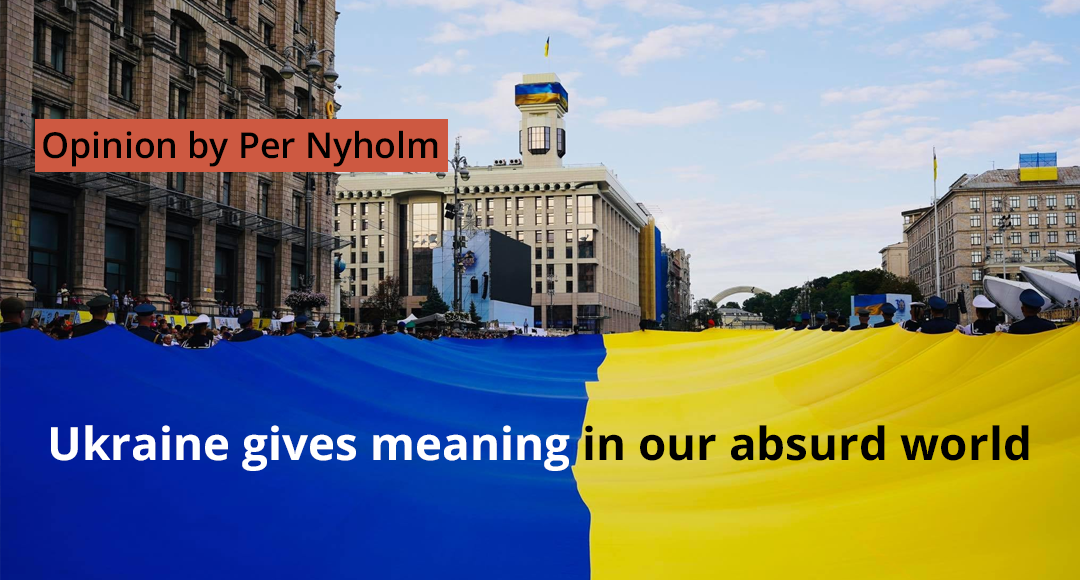


“Ukraine is good for Europe… The war forces us all to take a stand. In the mirror of war, we can see, who we are”.
Yaroslav Hrytsak, Ukrainian historian and philosopher.
Kyiv
Back on the Ukrainian roads. I feel at home in this country. Ukraine makes sense in a world full of chaos and absurdities. The Ukrainians will live. That’s why they die. It is an existential condition, the meaning of which lies in a showdown with its absurdity.
What does this and other absurdities consist of, I ask myself, as we sit, three men in a car, on the main road from Lviv to Kyiv, not quite 600 km through the land of blood and mass graves? They are in the first place fascist Russia’s genocide, terror, and lies. They are also the West’s reluctance to provide Ukraine with the weapons needed by the Ukrainians, so that, on their own behalf and on behalf of Europe, they can drive an Asian-despotic power out of our civilized continent.
Outside the car, safely driven by Yevhen, lies the Ukrainian countryside, flat and rich as far as the eye can see, the famous black soils, an inexhaustible larder, Ukraine’s blessing and Ukraine’s curse, the borderland that everyone wants to grab. Autumn is coming on, biting into forest edges and cabbage gardens. A gentle wind blows in through the half-open windows of the car. The cornfields lie bare, but the harvest cannot be moved to its destinations abroad. The Russian war of aggression includes a blockade of the cities of the Black Sea coast, which affects not only Ukraine but North Africa, the Middle East, and other countries unable to feed themselves. One more absurdity.
Yevhen says very little, my Danish friend Knud even less. He is new to Ukraine before and sits as if on pins and needles next to Yevhen, watching the flat landscape. With my books and notepads, I occupy the back seat and assigned the role of the blind guide dog of our small group.
Hundreds of blue and yellow flags hang over freshly planted graves. Ambulances and other vehicles bring the dead and the wounded in a Western direction. Fresh soldiers are transported out to the east and down to the south. Casualty figures are not officially announced. You don’t want to release information that can help the enemy learn from the dynamics of combat and adjust his tactics accordingly, but we all know that the losses are horrifying. Western estimates put the Ukrainian dead and wounded after 20 months of war at around 150,000 or more, the biggest carnage in Europe since World War II. Russia’s losses are supposed to be bigger, but Russia has a larger population to give away (140 million against 35-40 million Ukrainians) and a tradition that conscripts are there to be slaughtered, an attitude that European Ukraine cannot and will not allow.
Since Vladimir Putin, the Russian fascist leader, launched his war on Ukraine in 2014, I must have been ten to twelve times up and down the motorway between Lviv near Poland and Kyiv on the Dnipro, the mighty river that long ago brought the Vikings, called the rowing people or the Rus-people by the locals, from the Baltic Sea to the Black Sea, down to Constantinople, Miklagård or Storgård (maybe Big Place or just The City) to our Norse ancestors. The Ukrainians, I believe, always felt attracted by their Nordic connection and are more knowledgeable than many Danes about the Slavic origins of our royal tribe. The Russians in their imperial guise prefer to see themselves as Byzantines, the third Rome, heirs to the ancient Rome, which fell in the fifth century, and to the second Rome, which was taken by the Ottomans in 1453, having been drained of blood and strength by western crusaders.
For hours there isn’t much to see, so I spend part of the time re-reading my friend Kjeld Holm’s ”Mennesket er en misforståelse” (The Human Being is a Misunderstanding), a gripping portrait of Johannes Sløk, the great Danish philosopher and theologian of the 20th century. Perhaps I prefer Sløk’s colleague and challenger, K.E. Løgstrup, another prominent Danish thinker of those years. It seems to me that there is more order in Løgstrup’s universe than in Sløk’s. Løgstrup makes his demands, ethical and other, which can be used in our fight against absurdities and even in the war in Ukraine. Sløk is despairing. I cannot rid myself of a suspicion that Sløk – if he was in the car – would allow himself a sarcasm or two, perhaps at his own expense. As I read Kjeld Holm, former bishop of the Aarhus Diocese in Denmark, Løgstrup was into our rights and duties. Sløk had plenty to do with creating order in his own inner chaos.
A good acquaintance, Yaroslav Hrytsak, Ukraine’s great historian and philosopher, is a bit of both, but probably more Løgstrup than Sløk. “Ukraine is good for Europe,” he told me recently. “The war forces us to take a stand. In the mirror of the war, we can see, who we are.” I find it hard to disagree. The showdown with the absurdities – not to be confused with the absurdities themselves – makes sense on this daytrip through the outskirts of Europe.
In the late afternoon, Yevhen maneuvers us into Kyiv’s city center. I am at home.
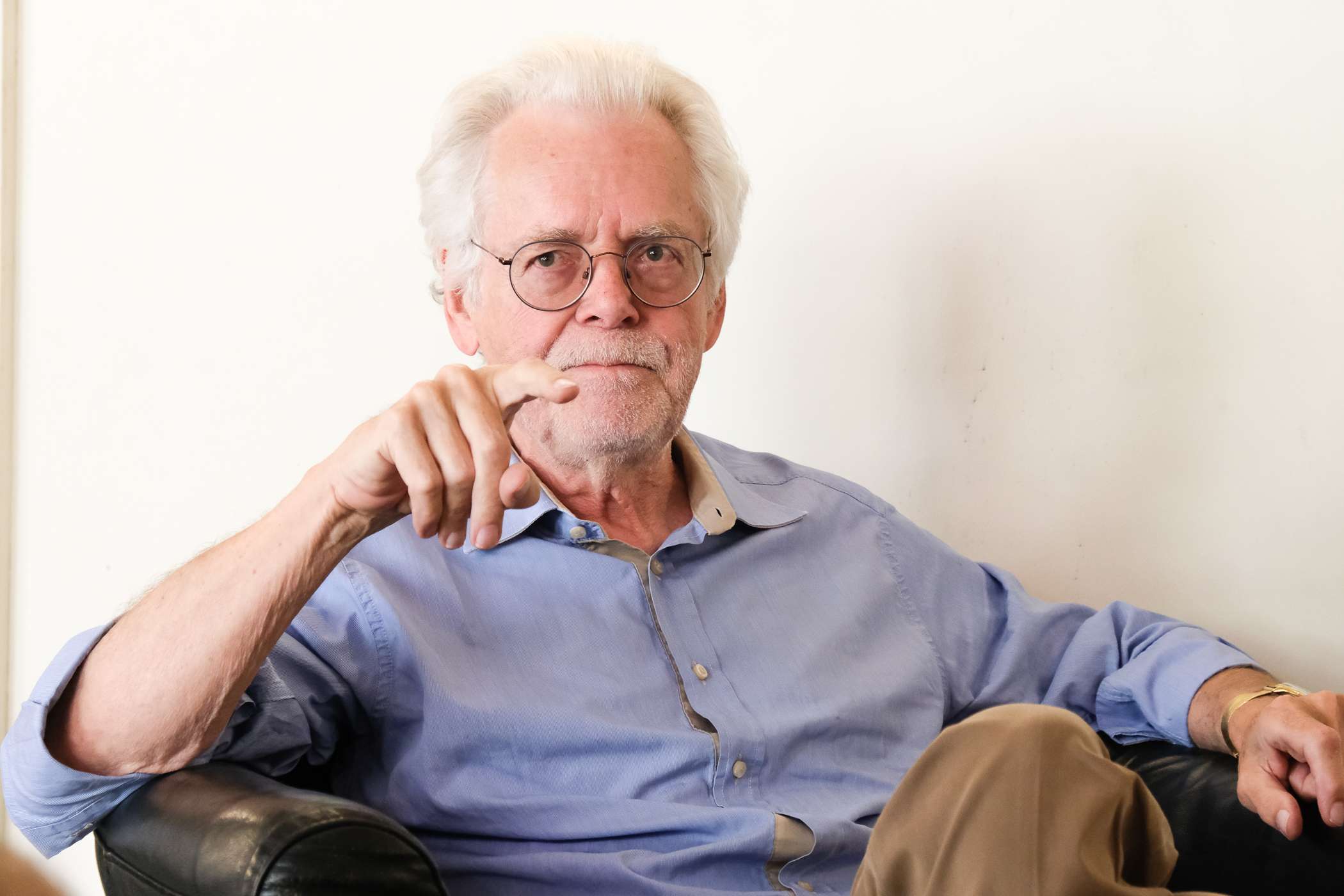
Author: Per Nyholm
Danish journalist since 1960, based in Austria, columnist and foreign correspondent at the liberal Danish daily newspaper Jyllands-Posten. This text was translated and adapted for The Ukrainian Review by Stanislav Kinka.
Per Nyholm´s latest book, “Journeys in the Land of Blood” (Barcelona and Copenhagen, 2023), is freely available to any serious Ukrainian publisher, who might want to publish it.