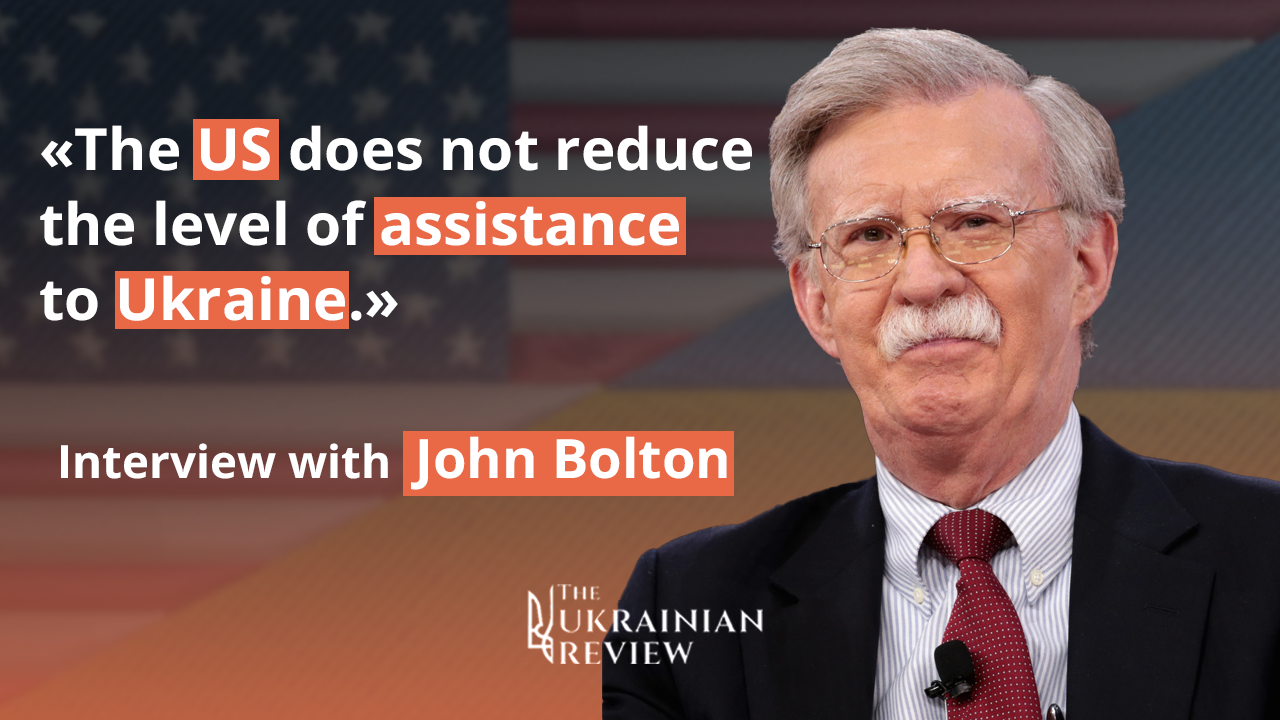


On December 13, 2023, the editor-in-chief of the Ukrainian Review Stanislav Kinka interviewed the former security adviser to former US President Donald Trump, Mr. John Bolton. We offer the transcription of the interview to our readers.
I welcome all our viewers and listeners. Here is the Ukrainian Review, and today our guest is the former security advisor to former U.S. President Donald Trump, Ambassador John Bolton. Mr. Bolton, thank you for joining us today.
Hot news is the visit of the President of Ukraine, Volodymyr Zelenskyy, to the United States of America. What is your first impression of this visit? The US promised Ukraine $200 million, but the result of this visit is so small when compared with the previous visit in 2022.
I think it was important that President Zelenskyy come and speak to Congress. The holdup in congressional approval of the aid is not a function of lack of support for Ukraine. It’s because of American politics, because of the dispute. It’s a dispute between Republicans and Democrats over President Biden’s handling of the southern border issue. Look, in a perfect world, you’d vote on the Ukraine question separately from the Israel question, separately from the Taiwan question, and separately from the southern border question. But politics is politics, and so everything’s tied together. There’s still a small possibility that this might be approved in the next few days. It doesn’t sound like it. It sounds like it will come in early January [2024]. But I do think it will come in early January [2024]. The delay is unfortunate for people who don’t understand the strange ways of the American legislative process. It may look like it reflects a lessening of support for Ukraine, but it’s simply not true. And I think that point will be made when Congress comes back after Christmas and New Year’s.
And to what extent the issue of assistance to Ukraine depends on the election of the new Speaker of the House of Representatives Mick Johnson? Why do Republicans want to tie aid to Ukraine and now to Israel, the situation on the border with Mexico? Please clarify for the Ukrainians and maybe to the worldwide viewers and listeners why the situation on the Mexico-US border is so important for the United States right now.
Well, I think the new speaker, Mike Johnson, actually does support aid to Ukraine. Some people were surprised at that. They thought he would be opposed to it. But in fact, he does support it. The argument is it’s a political argument because of Republican opposition to Biden’s failure on the southern border. The people who hold that view say, why do we care so much about Ukraine’s border with Russia when our border with Mexico is not being protected? And what it’s not being protected from is significant numbers of illegal immigrants coming across the border, and the risk that foreign adversaries, be it Russia, China, Iran, North Korea, terrorist groups around the world, are also coming across the southern border.
It is true. It’s a non-secretary to say, well, we should deal with both together. They’re unrelated. We should deal with both of them separately. But it is a point of political vulnerability for the President, and he opened himself up in this case by putting money for the southern border in the same supplemental bill with Ukraine, Taiwan, and Israel. So, in effect, Biden made the tactical mistake that opened the door for this. But I say again, it’s a good way for Republicans to criticize Biden. It’s not over opposition to aid to Ukraine. It’s a way of putting pressure on Biden on what is an unrelated but politically important issue.
And my next question is, how does the situation in Israel affect the United States, America, and aid to Ukraine? So only the show of the force of the United States Navy has already led to the partly de-escalation, of the situation around the Gaza Strip and the Israel. Will Israel not be able to complete all these objectives of the operation without US military assistance because US military assistance is so needed in Ukraine and now?
Well, I think it’s incumbent on the United States to handle both crises simultaneously. And certainly, those of us who have been involved in national security for a while know that we’re capable of doing it. This administration has a president who’s not in the best condition, frankly, to handle a lot of crises. We’ve got to worry about what China may do while our attention is distracted. But while the Russian invasion of Ukraine is something separate from what’s going on in the Middle East, in one sense, in another sense, they’re closely related. Because we’ve seen Iran grow closer to Russia and China. We’ve seen the growth of a clear Sino-Russian axis in the past year. And just more concretely, Iran has sold Russian drones for Russia to use against Ukraine, and Russia is now selling Iran highly sophisticated fifth-generation fighter jets. So, Russia and Iran are drawing closer, there are other indications of that in the Middle East, and at the center of this conflict, which looks like it’s between Hamas and Israel, at the center is Israel and Iran, which has armed equipped, and trained, and financed Hamas and other terrorist groups in the region. So, the conflict is something that has received attention in Washington and Europe. It distracts somewhat from Ukraine, but it doesn’t change the vital interest that the United States has in the case of Ukraine of seeing the Russian aggression defeated.
Mr. Ambassador, thank you for your time. And my next question deals with the political situation in the next year. So, how do you see the coming year, which will be marked by a lot of elections? For example, in the United States of America, an election in Russia will take place, which we still can call this election in Russia, of course, and the election of the European Parliament in the summer of 2024. Will the change of the current president have to reduce aid to Ukraine? And how do you see the assessed Donald Trump’s chances of the future presidential election? Does he still have the chance despite all the litigation around him?
Well, it’s the only the only outcome we know in any of those three elections is in Russia. We know who’s going to win. Vladimir Putin will be reelected with an overwhelming majority. In the U.S. right at the moment, you’d have to say it will be a race between Trump and Biden. And it’s unpredictable at this point which of the two of them will win, even though 70% of voters surveyed say they don’t want to see a rematch of 2020. They don’t want to see Trump run against Biden again. But that’s unfortunately the direction we’re headed in. I’m very worried if Trump gets the Republican nomination, he could win in November of next year. And I think that would be very bad for the United States for a whole lot of reasons, but one significant reason would be I’m very worried about what he would do concerning the Russian invasion. He said he would get Zelenskyy and Putin in a room together and solve the problem in 24 hours. That’s ridiculous. Zelenskyy basically already said that. And I worry that Putin thinks he knows how to handle Trump and that the result would not be good. And I’m also worried that Trump would try and withdraw from NATO, which would be a disaster if we did. I still, it looks very difficult, but I’m still hoping that we can find a way not to have him get the Republican nomination.
And a little clarification. Could we say that Trump is not a traditional politician and [because] he wanted to make some deal [instead of a political process]? [That] he is not a politician who uses some balance of powers, rule of law, and so on. And does it make a threat to the whole world, to other countries, to other continents, that the authoritarian leaders can see in Trump such a green way to some actions in different parts of the world? Because some of the authoritarian states, feel strong [enough] and see the weakness of the Western world. For example, the situation that is happening around Guyana and Venezuela.
Trump doesn’t really understand international affairs. He thinks if he has a good personal relationship with Putin or Xi Jinping or Kim Jong Un, that the U.S. has a good relationship with their countries. And that’s obviously not true. The authoritarian leaders know what their national interests are and they pursue them unhesitatingly. Trump thinks only about Trump. It’s very concerning for me and many others what would happen around the world to our friends and allies if Trump became president. It’s one reason the stakes are so high in this election.