

Amidst the geopolitical turmoil, it’s crucial to stay informed about Ukraine news. The ongoing conflict between Ukrainians and Russians demands our attention. The Ukrainians’ valiant struggle against aggression underscores the importance of staying abreast of Ukraine conflict news.
Cairo, March 5
For a while, I take leave of the problems in Europe, including the ferocious fight of the Ukrainians against their perennial tormentors, the Russian imperialists, driven as they are by hatred, brutality, and under their Führer, Vladimir Putin, a kind of blind Fascism, not seen anywhere else in the world. From Cairo, I try to observe Israel’s war on the Palestinians, of whom, at the time of writing, more than 30,000 have been killed, the large majority being poor and innocent women, children, and the elderly, mostly refugees.
You can argue that the Israelis, at the very least, are taking revenge for the HAMAS-massacre committed in Southern Israel last October, costing more than 1200 Jews their lives. I do not support that claim. I consider Prime Minister Netanyahu’s actions in Gaza as awful and, in the long run, as self-defeating as Vladimir Putin’s mass killing and mass destruction in Ukraine. Putin has no, not even the faintest legal or legalistic business to do in Ukraine. Zero! The Russian head of state is behaving against a smaller and peaceful neighbouring country as a killer and a gangster, claiming that he is pursuing a Nazi enemy, which in the real world is pure invention. Is Netanyahu also a baddy? In my estimation, yes. He deliberately confuses HAMAS with the much broader and much larger Arab population – both Christian and Muslim – of Gaza, for years a Palestinian ghetto, isolated by Israel, now as ruined as the Warsaw ghetto after the Jewish uprising against the Nazis in 1943.
Of the two, Netanyahu is elected democratically, and the other, Putin, later this week can claim to have been reelected by whatever majority he may desire. The difference is academic. Both men are tyrants and liars, putting themselves above the nations they are supposed to lead.
A general expectation is that Netanyahu will come to the end of his political career when the present war – actually the fifth between Israel and the Arabs – comes to an end. Putin is set to be in power at least until 2030, but even his time seems to be running out. He has not won his war of aggression against Ukraine, initiated in 2014. He has not conquered Kyiv or Odesa, not even Kharkiv and Kherson. The magnificent Ukrainians, few and badly armed, have stopped – yes, stopped – what was considered the world’s second-strongest army, a victory so unbelievable that many in the West began to fantasise about what could happen next, and consequently, now as the war, very naturally, has stalemated, believe that the Ukrainians are facing a defeat. I do not believe in this doomsday scenario.
I expect another two or even four years of war, then a Ukrainian-European victory as the alliance behind Ukraine swings into a serious war economy. The bigger picture tells us already that the Russians are bogged down, suffering disastrous losses of men and material on the front, and that money is pouring out of the Kremlin coffers, and that the Russian public may be slowly waking up to the disaster that their rulers have created and are presiding over, rather nervously, I believe.
That thousands of ordinary Russians the other day decided, against a heavy presence of security forces in the streets, to pay homage to Alexei Navalny, Putin’s leading opponent, on his way to the grave, must have rattled the Kremlin not a little bit. Was Navalny’s death in the icy emptiness of Northern Russia accidental, or was it provoked for the moment leading up to the so-called presidential election? Difficult to say. Seen from Cairo, it was problematic. Why not just keep the guy alive for a few more weeks? Why exercise or even irritate the otherwise passive and obedient mass of people? That may be Western thinking. How the Russian leadership thinks remains a mystery to most of us. Could it be that Navalny’s demise was deliberate? That the purpose was to tell his followers in Russia and the West that we, the almighty pharaohs in the red castle of Moscow, do not care a rap about you and your feelings? It might well be so. One more episode in the theater called Russia.
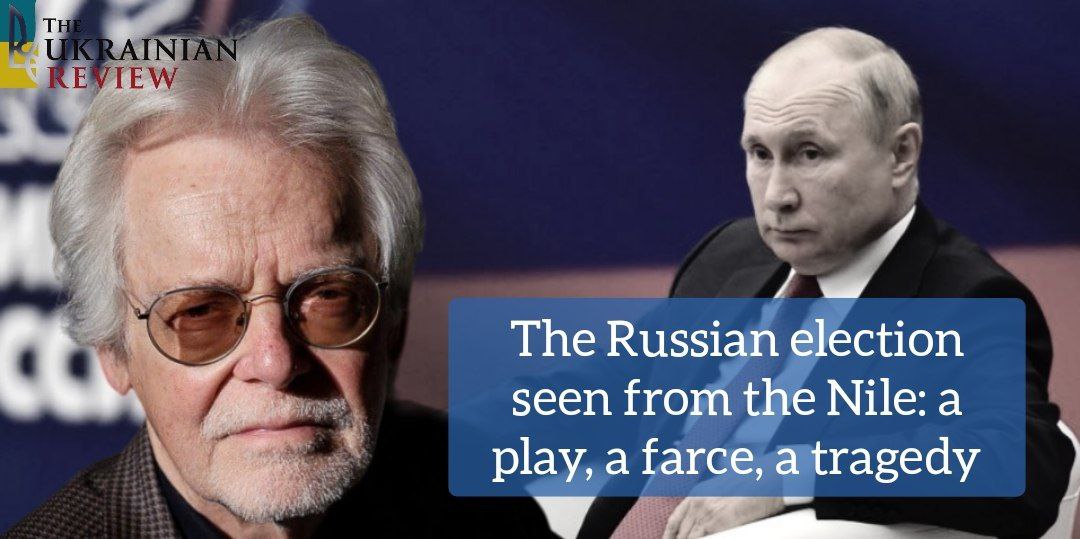
The election, the so-called election, has nothing to do with providing the Russians with a democratic choice. Elections in Russia were always – except for the few years between the revolution of 1905 and the Bolshevik coup d’état in 1917 – a kind of entertainment. It should impress the people, not the rulers. Remember Putin’s political ideal, the mass torturer and killer, Stalin, who is supposed to have said: “he votes are not important, important is who counts the vote.”
There is not the slightest risk, even at this crucial hour in the history of Russia, that the election will affect the top of the power pyramid in Moscow. The result is already decided. The voters are called out, quite literally, to do their patriotic duty, which is to celebrate the czar, until recently the communist party chief, now Putin, once upon a time a troublesome youngster in the streets of Leningrad, now St. Petersburg, then a second-rate KGB-agent. The election process is as false as the painted villages and dancing peasants, whom Potemkin presented to his mistress, the Empress Catharina, as in 1787, she travelled through the newly conquered Ukrainian lands to the Black Sea – both a farce and a tragedy.
The reality of Russia is the abuse and misrule of Russia by Russia’s self-appointed leaders throughout the entire history of the empire, from its modest beginning in Moscow after the removal of the Mongols and the installation of the czars, establishing a state structure, which is visible to this day in the Russian-Ukrainian relationship: Russia, whether czarist, communist or as of now fascist, is a vertical state. Power moves from the very summit, the Winter Palace in St. Petersburg or the Kremlin in Moscow, down, down, down to the lowest peasant, who is treated as vermin and whose task, when necessary, is to die on a foreign battlefield. Ukraine is a horizontal society, village after village, and therefore well conditioned to become – after 300 years in its Russian prison – a democracy, not perfect, but then – show me the perfect Western democracy, and I will invite you for lunch next time I am in Ukraine.
Nowhere is the difference between Moscow and Kyiv more obvious than in these two capitals this year. Russia will have its fake presidential election. We are in no doubt about the result, only as to the figures to be published: Will the Führer take 93% of the vote, or maybe 98%? Who cares? The show goes on. And Kyiv? Due to the war, it would be perfectly legal under the constitution, due to the war, to cancel or postpone the normal presidential election. Would it be wise? I have my doubts. Should Donald Trump – about whom one can say that it has not yet been proven that he is a Russian agent – win the upcoming presidential election in the US, he could claim that the absence of an election in Ukraine means that Ukraine is not a democratic society and therefore cannot be supported. The risk is there! The Ukrainians must consider it carefully.
Meanwhile, Ukraine and the rest of Europe – and I do say the rest of Europe, considering Ukraine an inalienable part of Europe – must rearm and rearm quickly to a degree, where this enlarged Europe, more than half a billion often highly educated, politically mature and very productive citizens, can beat back the Russian challenge, carried by a mere more than 140 million not very impressive subjects and an economy not much greater than that of Italy. Vladimir Putin will be declared the winner of his election, for sure. He can still end up in front of a firing squad in the basement of his Kremlin pyramid.
By Per Nyholm
*These opinions are solely those of the author. The Ukrainian Review takes no position and is not responsible for the author’s words.
Per Nyholm has been a Danish journalist since 1960. He is based in Austria and is a columnist and foreign correspondent at the Jyllands-Posten, a liberal Danish daily newspaper.
Tetiana Stelmakh adapted this text for The Ukrainian Review.