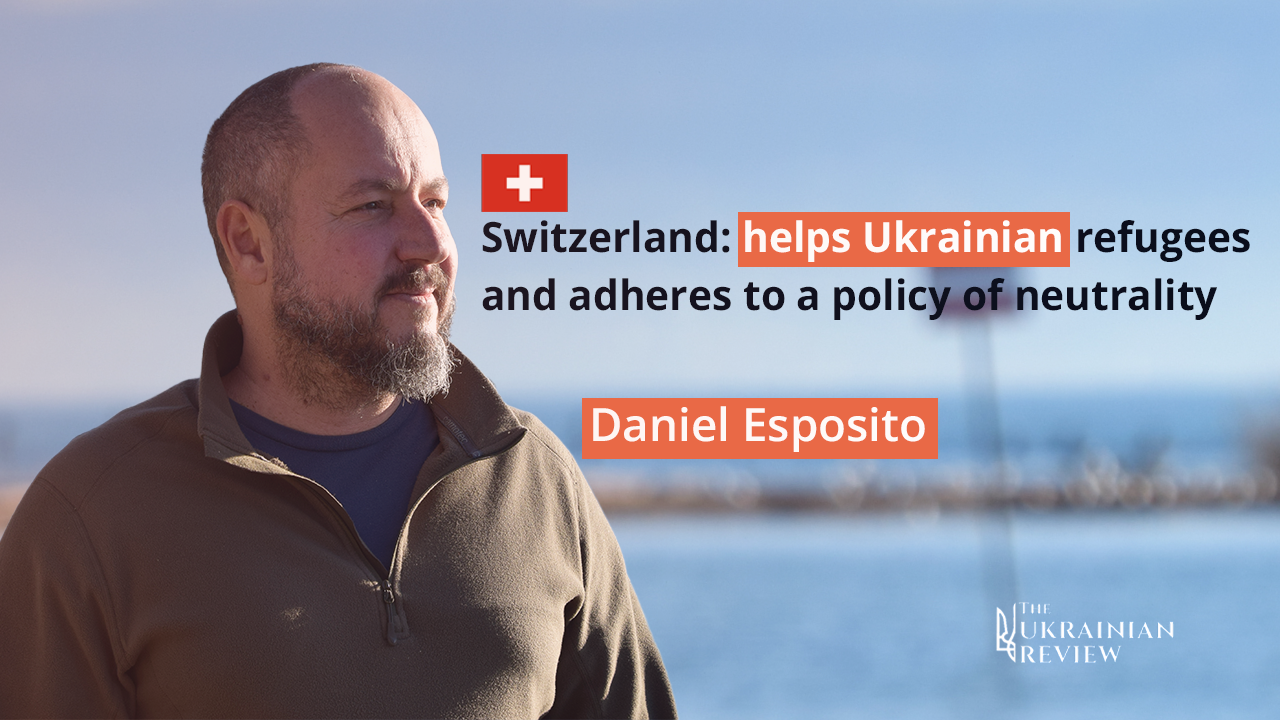


Interview with Daniel D’Esposito, a Swiss social entrepreneur, who worked with the Swiss Humanitarian Aid in Ukraine in 2022.
What is the attitude towards Ukraine in Switzerland compared to February 24, 2022? What was the situation before the war and half to two years after the war after the invasion? And how do the people of Switzerland resist the threat that hangs over Ukraine and all of Europe?
Before the war, I think, people didn’t know much about Ukraine. It was a relatively unknown country and nobody was thinking much about Ukrainians or Ukraine. That’s for sure. As soon as the war broke out, Switzerland like everybody else was caught up with this sympathy for Ukrainians. Extreme sympathy. And they put into place very quickly like everybody else in Europe like Poland, Germany they put into place a very good assistance program to welcome the refugees into Switzerland. They created a humanitarian visa which is valid for everybody, until the end of the war, however long that may be, you know, one, two, three years, and welcomed everybody. They put together a situation where you could arrive at the airport even without a passport and just being Ukrainian is enough to get help and assistance and so on. This has not yet changed. Of course, now Ukraine is no longer in the news but I think there’s still quite a high level of sympathy. People don’t talk about it so much in the media and, you know, there are other priorities now, like Gaza. I was looking at the newspapers in Switzerland and there are indeed fewer and fewer mentions but there are some articles but not as before. But that doesn’t mean that the population doesn’t have this level of sympathy and support and I would say also the level of the government too.
To summarize the response. It’s before the war not much was known. At the beginning of the war huge sympathy and willingness to accommodate as many people who wanted to come now the war is not so much talked about but the sympathy is still there. That’s for sure.
Could you say that this assistance is grounded on the government and local authority support or it’s just civilian population support: the individuals donate to pro-Ukrainian organizations, organize meetings, and so on? Or it’s just a part of the government policy towards the Ukrainian refugees?
I would say it’s both because very quickly there were people who wanted to step forward to accommodate refugees and there was a list of people who wanted to be managed by the government of such host families. I know that a lot of Swiss accommodated people in their homes. That’s one thing. But the government also put into place the main part of the support. The Swiss, I think, what is interesting is that it’s not like in some countries where there is no financial support, provide complex support. It’s a complete package. I think not enough people inside Ukraine know that. I think what you can get is you can get free accommodation you can get something like $500-$600 per month to live on for food and whatever. It’s not enormous by Swiss standards it’s not big at all but it’s enough to live. And after one month you have the right to work if you want to. And we can talk about integration, but just to say it’s a complete support package and I think there are even language courses included.
It means, that there are special programs for the integration of Ukrainian refugees no matter of age, sex, or whatever.
Yes, the kids are integrated into local schools and the parents can go to language courses. They have a travel pass which is worth a lot it’s worth around $ 3,000 per year, so they can travel around on Swiss trains and public transport and go wherever they want and visit Switzerland.
I would like to say there are not enough Ukrainians who benefit from that. I mean everybody has been going to Germany or Poland. A lot of the refugees who came to Switzerland are mostly wealthy people who come with their Porsche Cayenne; not all but you know because they know Switzerland and they know what it’s really like and they dare to go there. They’ve been to Courchevel or Verbier. For them, it’s just going where they usually go. And normal Ukrainians like people from Mykolaiv or whatever would just go to neighboring Poland. Because that’s what they think is accessible to them but actually if they would take one step further and go to Switzerland, they would be super welcomed, they would probably get better support than in Poland because they would get $600 a month per person and maybe $200 per child. It’s not a bad deal plus accommodation, plus travel card, plus school, plus the whole package. It’s a pity that they don’t they didn’t use it. I think they are about 30,000, when I last counted 35,000 refugees. But there could be more. I don’t know the full number to date [in October 2023 there were about 66,000 Ukrainian refugees in Switzerland — author].
But I would say the more people who would go the better I think there was a huge influx at the beginning. When they were overwhelmed in the first few weeks. But then now the refugee reception centers are probably not that much work so they can absorb any amount. If people this winter feel that they want to go to Switzerland they should feel welcome to go there. The population still very positive attitude toward Ukrainians. It’s not because in the media that the support is not there also the Swiss government’s support to Ukraine itself has been quite big. It’s a small country but it’s one of the top donors together with USAID, ECHO, and the top 5 or 6 donors in Ukraine. Even though it’s a very small country you mentioned the financial support when I was here last year. They gave 200 million to Ukraine that’s a lot of money for a small country. They gave 100 million this is another manifestation of support from the parliaments, and there’s an extraordinary parliamentary contribution. The parliaments said we’ve got to do something and they just got together and sent 100 million over out of their motivation and then the Swiss government sent another 100 million at the end of the year and I think this year there’s probably also 100 million this year. They’ve been pretty forthcoming where they didn’t help is in the military aspect because they’re a neutral country.
But one thing it’s a pity. Switzerland banned even the re-export of some cannon shells and equipment made in Switzerland from third countries. Such a decision was made because the Swiss legislation said that it’s forbidden to sell or re-export this military equipment?
Switzerland cannot give weapons because it has been neutral since 1648! Germany wanted to buy some old Leopard tanks that they didn’t use, and also the munitions for the IFV Marder: anti-drone munitions, called Cloudburst that explodes in the air. But that was not possible, so Germany started making them in Germany so they could provide Ukraine directly.
Switzerland is not part of NATO. If Switzerland would help Ukraine just imagine, this is my personal opinion, Putin could theoretically attack Switzerland and he would send missiles, there’s no protection. Do you know what I mean? We are not part of NATO formally. We are in between everybody. We are quite vulnerable. It’s not so realistic. So we make sure we stay out of conflicts, and that we are useful to all sides, for example, we often mediate or host negotiations. Also, our army is very strong because it has conscripts, who then are incorporated into reserve army and train every two years until they are 35 or so. At the exit of the Cold War, the Swiss army was the fifth largest army in the world. The first was China, the second was the Soviet Union, the third was the USA, number fourth was Iran, and number five — was Switzerland. You can imagine, half a million troops that could be deployed in 48 hours. 48 hours! Everybody is ready to go. They have arms and uniforms as well and they have collection points. Everybody has a military booklet with a collection point where they need to go and they need to take food for 3 days with them. They even have ammunition with them. They can be immediately ready. They will receive the company and battalion weapons, their trucks and tanks and whatever, and go to the front line. Now its less, only 140’000 or so, but it’s still an impressive army for a small country.
It could be a good example for Ukraine.
The Swiss army would not be highly competent compared to the Ukrainian army. As you can imagine with a militia army most soldiers only have basic training so they couldn’t do complex operations as you have. Maybe it’s a good idea to have a mix but certainly to have a conscript army and an army of volunteers who can mobilize within 48 hours and the training is every 2 years for 2 or 3 weeks and that’s kind of enough to keep the skills.
My next question is about the money. Switzerland is famous for its banks. And some of the billions of euros accumulated in the Swiss banks — are Russian billions of euros. And this is the question: what is the hypothetic way to use the money for aid to Ukraine? The European authorities and US authorities froze about 300 billion euros and dollars. Almost two years passed and they have no legal ground to use this money. Is the issue of frozen Russian funds in banks being discussed in Switzerland? What is the potential way to use this money?
It could be a discussion at the level of the parliament or diplomatic circles for sure. I would say the general population doesn’t think about this too much. I do know that Switzerland complies with the sanctions. That’s for sure even though they are not part of the EU or whatever they do comply with the sanctions they usually do with all sanctions and certainly with those relating to Russia.
And my last question is about the potential investment into Ukraine. In what terms you can see the Ukrainian victory and from your point of view when Ukraine will be interesting for the Swiss and worldwide businesses?
The attitude is very much to encourage investment in Ukraine and to facilitate investment. It’s not a question, even with the war. It’s a question of each company in Switzerland, whether they want to invest or whether they find common ground or something of interest and so on to invest. But what I can say is that last year 100 million Swiss francs was given by the parliament of Switzerland for humanitarian aid. There was another 100 million that was given to the multilateral institutions to support the infrastructure in Ukraine, for example, the electricity system which was attacked by the Russians last year, and also to repair the train tracks. Those power plants, I know that it wasn’t even a question of giving favorable contracts to Swiss companies or whatever, it was just whoever can supply the best quality at the best price the most quickly. And this year, in addition to the humanitarian aid, Switzerland has allocated 100 million Swiss francs to Ukraine specifically for demining, so you see that the support continues.
Interviewed by Stanislav Kinka