

The issues of reforms and European integration have been the focus of public attention for the past few years. Finally, Ukraine decided to go to the West only after the events of the Revolution of Dignity (2013-2014). As a result of the aggression of the Russian Federation and the beginning of a full-scale war, these topics faded into the background. But the post-war reconstruction of Ukraine and the ways of joining the EU and NATO are topics that will be updated by the society itself. We spoke with Dovydas Vitkauskas, who for a number of years served as the Coordinator of the EU project “Support to Justice Reforms in Ukraine” and other EU-funded projects.
Reforms: the difficulties of Ukraine and the success of Lithuania
Stanislav Kinka: There are more than 30 years of reforms in Ukraine, but they are not as successful as in the Baltic States, Lithuania in particular. From your point of view, what kind of reforms in Ukraine were unsuccessful, and what kinds of reforms were successful in 1990-the 2000s?
Dovydas Vitkauskas: The main difference between Lithuania, the Baltic States, Poland and some other post-communist countries, is that we had a proper party system and political environment. So, for instance, if we look at the eight or nine governments running Lithuania for the last 30 years, we will always have coalitions, that is the first. Second, we always have some parties that have existed for 30 years or so. They include the conservatives, the liberals, and social democrats. Lithuania, other Baltic countries and Poland have had a stable, consistent, and proper political system for the last 30 years.
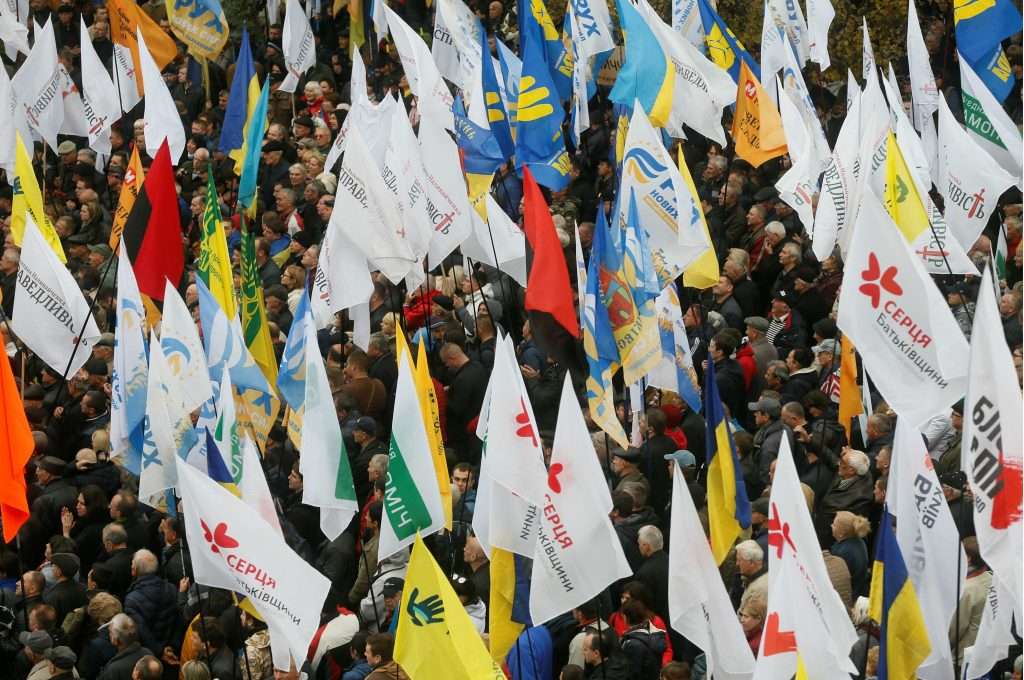
Ukraine was very different in this aspect because it never had a proper party system; left or right political ideology among the different parties. In fact, every four or five years during the election cycle in Ukraine new parties will appear, and they will be pop-ups. They take over the government, and this happens for the last time from 2008-2019. The main difference between Lithuania, other Baltic States, and other post-communist states on one hand, and Ukraine on the other is in the field of ideology of political parties. Ukraine never had a proper party system based on ideology. Ukrainian political parties formed rather like individual political projects.
The political system [in Ukraine] has always been based on personalities. Personalities have always created parties as a temporary project, for four years only. If they manage it may be for longer. I think this is one of the main differences, and because you have no distant party system. There was no ideological debate during each election cycle about what needed to be done. But how to measure the previous government? Ukraine had much more chaotic and much more short-term and unbalanced discourse in politicians on the one hand and society on the other. I think that is the main difference.
The issue is like privatisation. Everyone has an opinion about it, but you never had a proper debate between the political parties in 1990-s, 2000-s, or the last decade. To what extent privatisation was wrong? To what extent privatisation was insufficient? And to what extent is privatisation still going on in the future? You have politicians to attempt to privatise something, but you have never had a proper debate in Ukraine for the last 30 years. Whether privatisation is a necessary thing or not? To what extent did privatisation need to be or had to be valued in the past as being carried out in a way not very transparent, honest, and useful for the public interest perspective? And also, a road map for future privatisation must be created.
This sort of discussion in Ukraine never had a place. I think the result is that you had a very chaotic privatisation process. You privatised things you should not privatise, for instance, your ability to sell electricity. You kept the electricity infrastructure in the hands of a state. Old electricity infrastructure. Do you allow the private people to take advantage of soviet electric infrastructure without renovating, investing into it, without upgrading it? At the same time, you in a way outsourced public benefits to private hands in ways it was definitely too premature and improper. At the same time, Ukraine did not privatise many things that should be privatised.
S.K. For example?
D.V. For instance – land. In Ukraine, back in 2021, for the first time in the history of your country, a law came into force that allowed the process of land privatisation to begin. We are talking primarily about agricultural land, and it should stand to all other types of land, including land which you carry out for the development of the cities. So, Ukraine came late by 30 years in the process of privatisation of land. And it went too quickly in some other processes of privatisation that I mentioned. One of the reasons why Lithuania fought for independence is the fact that you can have land. Because we have had a history of hundreds of years of property rights institutions. And we understand what property rights are. Pressure on the USSR was not about fighting ethnic identity but primarily was fighting for the ability of individuals to have property rights. It was a fight to return the land to our citizens. In this way, it makes sense, and independence makes sense.
In our case, one of the key factors why we fight for independence was the ability to recover the institution of private property. And to return as much land as possible to the hands of the former owners, while the latter create a given network, a given framework for legal entities and individuals. It happened in the early 1990-s. We had a law of restitution of the land in 1991. Before Ukraine got independence. This is the cardinal difference. The political debate in Ukraine never asks: why we were fighting for independence from the Soviet Union.
Once Ukraine became independent, the main factor was to return the land to the people. This debate never properly took place. In this way, I am trying to connect the political system and one of the very important aspects of a democratic and market economy, which is the right to own land and sell land. These issues, I think, prevented Ukraine from developing properly, and I mean not only privatisation, but some other issues are important, of course.
The ideologies of Ukrainian parties are not so different, they have elements of everything. This is very eclectic; you have no proper differences between parties based on ideology. Party differences are based on personality.
Responding to this question briefly — Ukraine needs to develop a proper party system like in Lithuania or other Baltic states.
Numerous state-owned companies are one of the reasons for corruption in Ukraine
S.K. Do you agree with the thesis that the main problem in Ukraine now is corruption and not very strong anti-corruption bodies?
D.V. I worked in the field of promoting the rule of law and anticorruption in Ukraine for more than five years leading big EU-funded projects. I have an in-depth understanding of how to build strong institutions, and how to build independence. But I think, at the same time, Ukraine has gone wrong in this fight, and the EU has gone wrong in this fight. If we go down to the real basis of why corruption still exists in this country, I think we need to understand that. I go back to the main point of failed privatisation in Ukraine, as a general theme of this discussion.
Corruption will always exist as long as you have too much property in the hands of the state and too much ability to control property and land through political interests, through political means, and through getting into the government. And I think this is why it was essential for post-communist countries to privatise as much as they could as soon as possible. Of course, it should be done in a very transparent way, in a proper way, and in an honest way. Proper privatisation helped reduce corruption risk in the Baltic States, Lithuania, and Poland significantly.
Ukraine still has today 3 500 state companies, 70 000 if you count all municipal companies. 70 000 [in other resources there is a figure: 3,500 state-owned companies and 13,000 communal property enterprises – S.K.]. This number brings Ukraine closer to China rather than the market economy that existed in the EU and the west. I think one of the main reasons for exiting corruption is that you still have too much property in state hands. State hands mean once you get to power and you control this property, and you are not interested in upgrading, to develop that state property.
What you are interested in is squeezing as many benefits as you can during this short cycle of four-five years that you are still elected official. And it doesn’t matter, is it a central or a local government, but I think having too much property in the state hands, including land and companies, has been the main reason why Ukraine has a higher level of corruption than other countries.
And having institutions that fight corruption is not going to help as long as you have this incentive to get to the government, to get to power, and be able to squeeze as much private benefit as you can from the state property. It’s not going to help, it manages the risk, and it creates some public PR. But it does not change the essence. I think one of the things we learned in Lithuania and Scandinavians is that if you want to do business go to the private sector. And if you want to run a government, then you probably need to have enough money to do it.
In Ukraine, it was always the other way around. People would be getting to a government exactly to make money. This is why we must prevent this risk. This is why we need to create tools to prevent the temptation to use public property for personal good, and I think the best way to do that is consistent, transparent, and honest privatisation Ukraine never had.
S.K. What kind of property does the government control in Lithuania and the rest of the Baltic States?
D.V. We talk about state-owned companies. Life is different: from utility to railways. Lithuania today has 44 state-owned companies. Poland, a much bigger country but comparable with Ukraine, has more than 120 state-owned companies. Ukraine has 3 500 state-owned companies, and that is without municipal-own companies. So, you have hundreds of times more risk that public property and state property will be abused than we do. Denmark, by the way, sometimes called a socialist country, has 22 state-owned companies. Actually, Denmark is the most capitalist country in the world if you look from this perspective.
Scandinavians are very good at distinguishing private benefit and private interest from public benefit and public interest. The best way of doing that is to get the state out of the economic picture as much as you can. Still, there is a matter of life where the state is logical. For instance, railways. In many countries, states still participate in the management of the railways, managing the logistics carried out through the railways. But producing vodka or producing flavour, or agricultural products, or running an orchestra is not a business of a state.
And by the way, in all these areas in Ukraine the state is still involved. It is incredible and hard to understand. It’s an example that Ukraine has a lot of searching to do to understand what is the role of the state, and what is the role of the private sector. I think this is a very important question. There are no clear answers to this. That’s why you need parties who need to provide answers. That’s why you need proper ideological debate every four or five years during the election cycle. To give answers that correspond to the people’s opinions.
Privatisation should be clear and transparent
S.K. A lot of people in Ukraine don’t understand the benefits of the market economy. Some of them live in the past, not in the future. But now Ukraine has started the privatisation of the seaports. What kind of European legislation must adopt Ukraine to be more attractive for EU investment?
D.V. We are on a way to the first question — does Ukraine need a proper party system? Proper political debate every four or five years during the election cycle to understand what you need to privatise and do not need to privatise. And the people need to answer that based on this political debate. And then you decide what kind of objects you need to privatise.
If we talk about ports in particular, then in Ukraine it is very difficult to interest investors and activate investors for the simple reason that there are too many ports in Ukraine and a very fragmented port management system. Ukraine has a rather limited coastline on the sea, but it has 13 ports — it’s far too much if you want to tell investors to come and invest in this country.

If Ukraine had three or four ports, in reality, there are three or four main infrastructural points. It was before the war. This will be much easier. To make a port an object to attract investors you need to give them a good economic incentive. If you allow 13 ports, it’s much more difficult to attract investor interest than if you had three or four. The second, I think, is to offer investors something they can understand. For instance, in Odesa, if you look at the portal infrastructure, you don’t know where any objects are located if you look at the property registry.
It’s also the question of registering, inventorying, and very clearly showing the investor what you have. In fact, in the Lithuanian system, if you open a publicly accessible Lithuanian centre of the registry you see every single object of the portal infrastructure from cranes to buildings. Inventorying according to very clear street numbers, the nomenclature of which you can see compared to all the rest of infrastructure in the country. In Ukraine, if you open the country property register for Odesa, you will see nothing, the grey area.
And there’s a question — what does the investor get in? The investor needs to understand that where every crane is standing, where every building stands, you need to go to soviet type paper soft archives where these objects are being undescribed. This creates a lot of uncertainty and unclarity in the eyes of the investor about what he or she is getting into. Having this property transparently inventoried and classified you will have very easy tools for property registers. This is the first thing you need to do to attract investor interest. If you say to an investor, come to Odesa and the investor opens the map and sees a grey zone next to Odesa he asks – what am I getting in? What are you asking me to pay for? And you give him some sort of old-school 1960-1970 descriptions on paper. I think it’s very unlikely that the investor goes for that.
I think one of the reasons why Ukraine never inventoried property, and never put a transparent and clear on the property register was corruption, was the private interest that many people had to hide some of the infrastructure objects to land them or lease them to other people without any public control. And in this way, one of the first things that any infrastructure to do is raise all these paper archives, and check where all the objects stand. It is more difficult to check whether or not some of the objects may be or not be leased to somebody’s siblings, to somebody else who had subleased that. This lack of quality registration data on the port is an incredible obstacle. I think it will prevent or make a discussion with any prospective investors very difficult.
S.K. But Ukraine has successful examples of investment in different areas.
D.V. The quality of the registration date is not always a problem in Ukraine. I just put ports as an example. Portal infrastructure, I don’t know why but is not on the general property rights registry. So, you don’t know where anything is. But, in terms of the rest of Ukraine, many other public infrastructure objects are on the property register, and this makes discussions of investors’ perspectives much easier. We might be talking about agricultural land, which is registered by cadastre, and registry run by the ministry of agriculture. You might be talking about some other objects registered in the property rights register, run by the ministry of justice. The overall quality of the registration data in Ukraine is not so bad. It’s just portal infrastructure, and some other infrastructure is for some reason missing.
S.K. Do you mean it’s not clear about the investment? Maybe it is some kind of military interest.
D.V. Then you need to consider that your ports are military objects and you don’t try to privatise them. If you want to privatise something, make the data available, clear, absolutely indisputable, and transparent. Only then you will have investor interest.
S.K. How many years need to implement all this legislation for Ukraine? And can we adopt all these EU examples as they are or mixed with the current legacy, some part of what from the Soviet Union? So, what way is the best – replace everything with EU examples or rebuild and put some parts of an old example into a new one?
D.V. I think both approaches are good to work with. It’s really hard to say what is better — to rebuild something old or destroy it and have something new. It depends on the type of sector, and types of property we talk about. And relationships we talk about. Some relationships in Ukraine need to be destroyed and rebuilt, for instance, attachment to soviet style state property, including companies and state-owned land. This must go.
State land is nobody’s land. People need to understand that. And it will always be abused by the people who will be vile, more reckless, and, you know, more dangerous to society. Unfortunately, some might be politicians. I think Ukraine is getting out of this mentality that you need to preserve state property at any cost at the best. You need to privatise everything that the private sector does cheaper, quicker, and better. It includes the most…
You can keep the railways and electricity networks in state hands. In the EU we have examples of unsuccessful privatisation and proper competition. So, you need to have a proper political debate, you need to choose which objects you want to privatise, which must be kept in the state’s hands. Then create good incentives for investors to come in and, as I mention, ports are good examples. You do some homework with registration data straight to the investor to show what he or she is getting on concession or another type of investment. It’s not something difficult, it can be done. It can be achieved quite quickly.
What is more difficult is to make sure the privatisation is transparent. Ukraine attempted it a few times. And in most cases, privatisation was not done as a result of public interest. It was done to achieve the best result for a very small number of private people. And I think, for the future my main message: allow proper competition, allow proper tenders and expression of interest of different… the more you will have. So again — transparency — is the key to having the privatisation process go smoothly and best results.
I think international foreign investors will be very interested in Ukraine. Not only the war and the essence now are relatively cheap in this country. Because the country is very well geopolitically located and has strong sectoral development, agriculture for instance. So, you are not investing in the buildings from scratch, you’re investing in something that works. So, I think Ukraine can capitalise on and make attractive sectors for investment that are already working because they need some public infrastructure projects. They also need to be carried out including roads, railways, airports infrastructure, etc. I think Ukraine will be a very, very interesting country for many investors. Agriculture is not the only sector.
Resources for a successful Ukraine — within the country itself
S.K. Let us jump to a conclusion. Now we are in a time of war and Ukraine exactly needs time and money to rebuild. What is your vision of rebuilding Ukraine? How many years or decades does it last? Where and how Ukraine could find the funds to be more prosperous, more successful, and at last, a more European country than now?
D.V. The main resource of the country is the people. The main tragedy of this war is that Ukraine is draining people. Let’s hope this stops, and when Ukraine finally wins the war, and this victory is formalised in some way, some agreement, people will come back. This is the main resource Ukraine has — the people. It needs the Ukrainians who might have left for objective reasons to come back. The second resource is also domestic, its land, and its companies.
Instead of looking for Europe or America, or the West, generally, Ukraine needs to understand that you already have a lot of assets that have been not properly used and not been properly operated for the last 30 years. That includes land, agricultural land [the interview took place before the disaster at Kakhovka Dam – S.K.], and state-owned companies. Some of which must be partially or fully privatised stage by stage. Again, this resource is internal.
The third source is again internal, and I would call it a stable and transparent financial system. Once you have a stable and transparent financial system, you have well-run banks. Money can be printed by the national bank and delivered to the private sector through loans and other projects and private banks. This is how financial resources are created in the West. On one hand, having responsible behaviour is the government without creating a risk of default, or the risk of some sort of financial impropriety. And then the banking system takes care of the rest. Of course, we understand that in Ukraine the interest rate is very high. And they’re high for the reasons I’ve explained.
The state has too much property in its hands, state property cannot be raised. The lack of financial commitments and non-compliance with financial obligations by state-owned companies creates a risk to the financial market. Again, I am going back to the point that Ukraine has internal resources. You need to build a stable financial system, is one of them. And you know, for the financial system to be stable players need to be responsible.
If you take on debt, you must pay the debt. If you are not paying your debt, you need a proper system to collect your debt as soon as possible. If you cannot pay off your debt, you are bankrupt. And bankruptcy is not necessarily a bad thing. Bankruptcy is something that allows starting from a new blank page. Bankruptcy is something that allows you to make mistakes and then try some economic activity again. There is nothing wrong with that. A market economy is like any life cycle. Some subjects are born, and some subjects are dead. And once one dies a new one is born. That is how a market economy works. Attempt to regulate bankruptcy, attempt to prolong the life of a subject who is already dying and cannot pay the debt, usually with state-own companies.
There are many cases in Ukraine. It creates an unnatural approach if we sort of compare the economic system and ecosystem in life. You need to allow subjects that are unhealthy to die. You know, I am talking in symbolic terms, but this is how a market economy works. If you have made strategic mistakes as a company and if you run into trouble with your creditors, you need to be allowed to restructure and get some time to put things in order you don’t manage, that’s all. But, at least the system has not maintained that illusion that things somehow get back to normal. That market somehow starts to appreciate that unhealthy company. I think that is why the private sector is so much better than the state’s sector because the private sector doesn’t have an illusion that someone will save you if you make a strategic mistake.
The private sector does not have the ability to forgive debts. And the state companies should act by the same rules, but they are not in Ukraine. This is one of the reasons why Ukraine is not exploiting its internal resources. Sometimes if you run into trouble, the best way to close the business, compensate as much as you can, partly the creditors, and open a new one. This is how the market economy is working. This is what we need to promote rebuilding Ukraine. And everything else in these things if this is the order — stable government, people coming back, stable financial system, proper privatisation process.
If Ukraine does all that, all the rest will just be the icing on the cake, including support from the West, the EU, and the US by the way of grants, and loans. This is not so important. Western support should be the icing on the cake. It should not replace the cake. The cake is the internal resources Ukraine has to rebuild. Let’s hope this war will be a good point to start from scratch or maybe destroy some systems which do not function properly and reform some systems that still can and should be reformed.
S.K. Some Ukrainian politicians still live in an illusion. It’s a lot of rumours that Ukraine has already adopted a lot of legislation and one-two years to become a member of the EU. From your point of view, it takes no less than 12 years. Can you clarify why Ukraine must go through this long way and when we will see Ukraine as an EU member?
D.V. Ten years is a very, very minimum for Ukraine. This process is very long and is an obstacle that you cannot just shortcut, which you cannot leapfrog. The real obstacle will be in the Ukrainian political system. Ukraine needs to change in many ways, including privatisation and the role of the state in business and economy, including competition. Competition is the thing we didn’t talk about. It is a thing that runs across the whole discussion we have now. In a market, economic subjects compete, if it doesn’t compete and one has a privileged position you have a problem.
So, I think Ukraine will have to start thinking in a way as Europeans think. Competition is good, and the more players you have competing, the more benefit you have for the same resource, the more productivity you have, and the more value you have for the people and the general interest. I think this is one of the things that I advise any Ukrainian party, no matter left or right whatever they come to think about. We understand that Ukraine has a well educated and relatively cheap workforce.This is the key to success and quick progress for a country when war is over.
NATO is the only way to ensure the military security of Ukraine
S.K. The EU is now more focused on military security now. What do you think about EU-separated armed forces to build a stronger regional defence alliance? Separated from NATO European armed forces could resolve this problem with the increasing threat from the Russian Federation.
D.V. This idea has been pitched by France for a long time and I am very sceptical about it. I think, without the US, without American presence in the region, and American presence can only be guaranteed through one way — NATO — we will have security risks, we will have military risks. The US is a key to choice security. And what I am saying is not based on some theoretical wishes. I would wish that the EU would be more capable militarily, but the fact is not. America is. And I think what Ukraine is seeing right now — is that the military help of the US surpasses EU numbers of ten or maybe more. Ukraine needs to be realistic. The only way to Ukrainian long-time security is through NATO.
The EU will not have any military composites in any foreseeable future. That’s why we need to think about military and security integration and cooperation. And not being constrained by illusions that some people in France or Brussels might have about. Visions are good. The plans are good. Illusions are not good. We need to be realistic. And I think what is happening now is Finland and Sweden joined NATO proving my point exactly. Finland and Sweden don’t expect the EU to defend them; they are both members of the EU already. They expect NATO and American presence to be guarantors of the defence.
And I think Ukraine should have the same realistic mindset. And I mean that integration into the EU is an important part of building a proper economy. Integration into NATO is the only way to ensure the military security of Ukraine.
Interviewed by Stanislav Kinka