

Mexico City
It is too early and easy to write off Ukraine, although one hears voices to this effect once again after the recent meeting of the NATO foreign ministers in Brussels.
That the Ukrainians are currently experiencing significant military difficulties cannot and should not be discussed here. More important is the current mix of doubt and pessimism, often orchestrated by Kremlin propagandists with an astonishing disregard for the road to a Russian victory being so long that most probably it cannot be traveled.
More than ever we all – not only Ukraine – need a massive and coordinated European effort, military, economic and diplomatic, in favor of European Ukraine. Even if the US under future President Trump should reduce its engagement in Ukraine, there is no reason for despair. Democratic Ukraine and the rest of Europe possess a potential and a capacity way beyond the forces of fascist Russia.
The cold fact is, as winter settles over the theater of war in Eastern Europe, that since the 2014 invasion, Vladimir Putin, the Russian warmonger, has conquered just under 20% of Ukraine, mostly territory that was once considered friendly to Russia, but hardly is so anymore. Ahead lies the Russian-hostile Central and Western Ukraine, a damming prospect, which Putin and his cronies try to avoid by sending underhand messages that now is the time to make peace – obviously on conditions dictated by the Kremlin.
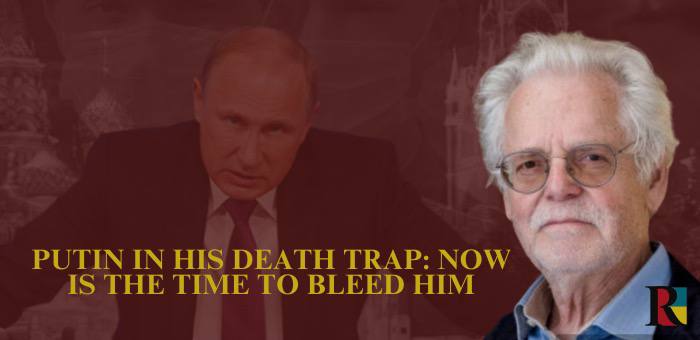
Forget it. The war is eating into the Russian armies and a weak Russian economy. The war hurts Ukraine but has become a death trap for the Russian aggressor. Vladimir Putin imagines that Donald Trump, the next President of the United States, will help him achieve a victory – at least a formal victory that he can sell to the Russians. It may happen. It is also possible that Trump in his vanity will play the role of the strongman, proposing such unpleasant terms to Putin that the Kremlin decides that the war must go on towards a distant and for Russia probably disastrous goal.
Even in Mexico – which is gearing up for a trade war with the US – I hear voices, wondering about what they perceive as Europe’s defeatism regarding Ukraine. Russia has attacked Ukraine in violation of the UN Charter, the 1975 Final Act on Security and Cooperation in Europe and the 1994 Budapest Guarantee for Ukraine’s security. If Europe fails the Ukrainians, Europe fails itself, says a Western ambassador in Mexico City.
He considers Putin a gangster and Russia a gangster state, still strong, but unable to win its war in Eastern Europe if the Europeans – with or without the US – give the Ukrainians their full support. We meet in an affluent neighborhood on the outskirts of Mexico City, five people, three diplomats with many years of experience in Europe and Russia, and two more ordinary observers. The consensus at a rich and beautiful lunch table is that, despite tactical gains in recent months, the war in Ukraine is not going well for Moscow.
Endless streams of false information are currently being launched. More or less professional Putinists – certainly not in this beautiful Mexican home – talk about the wisdom of reducing or stopping aid to Ukraine, thus forcing Ukraine into a ceasefire or even a peace, which may hold for the next five or ten years, while Russia rearms. What no one can deny is that the criminal Putin has recently been forced to ask another criminal, North Korea’s Kim Jong-un, for assistance, so far in the shape of 10,000 soldiers. This is not the behavior of a victorious power.
I mention to my Mexican hosts an article written by Emil Filtenborg, Jyllands-Posten’s correspondent in Kyiv, in which an Indian security advisor is quoted as saying that India, for generations the partner of communist, then fascist Russia, is turning down the heat in its relationship with Moscow. For good reason: Putin looks like a long-term loser.
Let the North Korean soldiers be a sign that Putin is, where his Nazi predecessor in Berlin, Adolf Hitler, was, military speaking, in 1943. Putin is also so weakened economically. Dreaming of making Russia great again, he has made Russia smaller and himself the vassal of Chinese leader Xi Jinping. That has given New Delhi food for thought, including this one, that the rationale for the alliance with Russia – that in its historically tense relationship with China, it has to rely on Moscow – seems shaky.
The Ukrainians have shown not only India, but the rest of the world, including Latin America, that Russia is a dying civilization: 140 million people, abused by their rulers. If the war goes badly, the economy is no better off. After 25 years of neglect under Putin and his oligarchs, it is still based on the export of raw materials, mainly oil and gas (in competition with Trumpist USA), which Moscow, after the collapse of the solid European market, sells, often with great difficulty and at huge discounts, to unreliable customers in the Far East, Central Asia and Africa.
A peaceful and democratic state is beyond Russian mental reach and beyond Russian political experience. Consequently, it must be in the interest of the West and certainly of Europe to give Ukraine all possible help and let Russia bleed to the point where Moscow lives up to its recognition of Ukraine in 1991 and its obligations under international law.
Now is the time to stand firm. Moscow must be made to understand that democracies will not allow themselves to be fooled once again by a genocidal, fascist dictatorship.
By Per Nyholm
*These opinions are solely those of the author. The Ukrainian Review takes no position and is not responsible for the author’s words.
Per Nyholm has been a Danish journalist since 1960. He is based in Austria and is a columnist and foreign correspondent at the Jyllands-Posten, a liberal Danish daily newspaper.
Tetiana Stelmakh adapted this text for The Ukrainian Review.