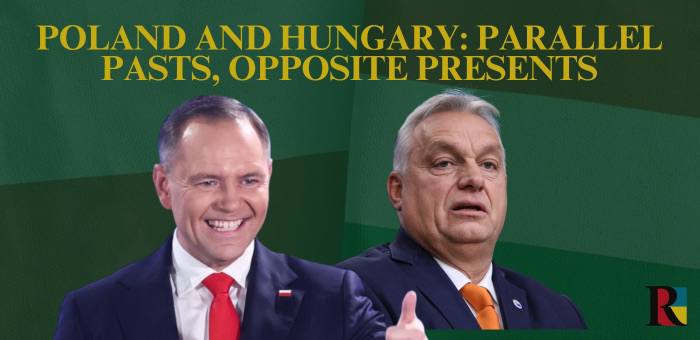


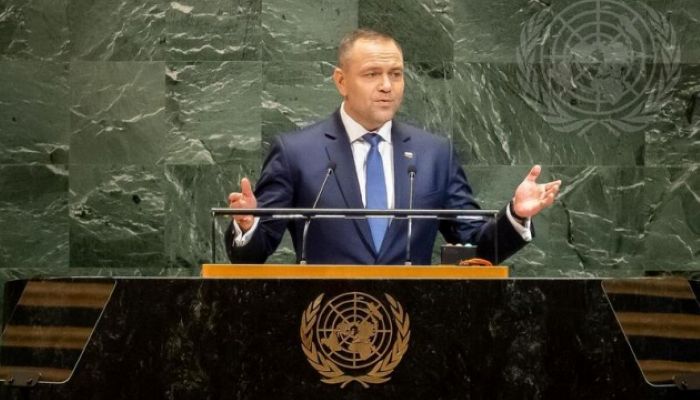
Poland’s President Karol Nawrocki, during his UN speech in New York, delivered a very strong message regarding peace, Russian provocations, and imperial thinking. Even though he is sceptical about Ukraine in many aspects, especially refugee issues and common history, Poland has clearly positioned itself against Russia. In contrast, Hungary continues to demonstrate a pro-Russian stance. Minister of Foreign Affairs and Foreign Trade Peter Szijjártó stated that Hungary will not stop buying Russian oil, despite Trump’s comments and growing international pressure. Both countries share a socialist bloc past marked by repressions, yet their approaches have diverged significantly in the short time since the Soviet Union collapsed.
Poland
Karol Nawrocki in his speech referred to history, when after WW2 Poland fell into the Soviet sphere of influence:
Moscow talks about the need to address, quote, ‘the root causes of the conflict. I share this approach, but I believe that the root causes of Russian aggression are primarily ideological. Russia is turning to an imperial vision that views entire nations as colonial property. It regularly denies them subjectivity, claiming that they are artificial constructs and justifies the invasion as a historical correction. We, dear ladies and gentlemen, in Poland, in Central Europe, in Eastern Europe, have known this for at least eighty-six years.
After Russia’s full-scale invasion of Ukraine in 2022, Poland’s political course became exclusively supportive of Kyiv: Warsaw is openly providing military, humanitarian and political support, and is strengthening defence cooperation with Ukraine and NATO, while increasing military spending. Yet, Russian influence still seeps in. For example, during one of the border blockades by Polish farmers there was an inscription: “Putin — put Ukraine, Brussels and our rulers in order”.
Polish attitudes toward Ukrainians vary, yet attitudes towards Russians remain consistently negative. According to Pew Research Center, in 2022 nine out of ten Poles viewed Russia as a threat. For its EU presidency in the first half of 2025, Poland set a priority to push for a complete end to Russian energy imports. The country has already reduced its historical dependency on Russian sources.
Hungary
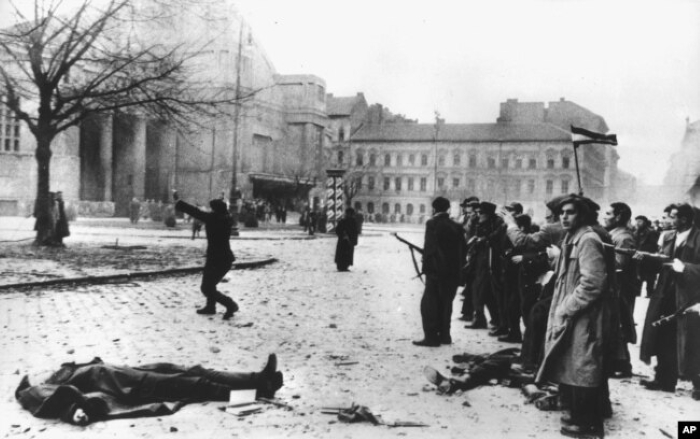
The independence from Soviet influence cost Hungary a very high price. In 1956 an uprising against the communist dictatorship began in Budapest. It was brutally suppressed, and almost three thousand Hungarians were killed in the fighting. These events set the ground for the eventual fall of communism in Hungary in 1989.
As Telex reported in 2024, from 1,000 surveyed participants Hungarians considered Ukraine to be the biggest threat (51%) and only then Russia (46%). This shift happened as Orbán came to power, relying on cheap Russian gas and orienting a propaganda machine around the importance of Russia for the average Hungarian’s well-being.
Péter Szijjártó commented on the violation of Polish airspace by Russian drones, calling it concerning yet urging diplomatic action. Meanwhile, Hungary continues buying Russian oil despite Trump’s statements and international pressure.
Conclusion
Neighbouring countries often have a common past with controversial questions, as Ukraine has with both Poland and Hungary. Not that long ago in terms of history, Ukraine was part of the Soviet Union, while Hungary and Poland were under the Soviet umbrella. This period was marked by economic decline, repression of national actors, suppression of local cultures, and Moscow’s imperial desire to erase identities. Hungary is a strong example: peaceful demonstrations in 1956 turned into tragedy, with thousands of lives lost.
Now Russia is trying to revitalize this imperial conception, and dependency on Russian energy sources remains a key tool for manipulation. At the UN Assembly, Trump said that he would probably talk to Orbán about it. Hungary still considers the U.S. a friend, so there is room for hope in this direction.
Daria Maslienkova