

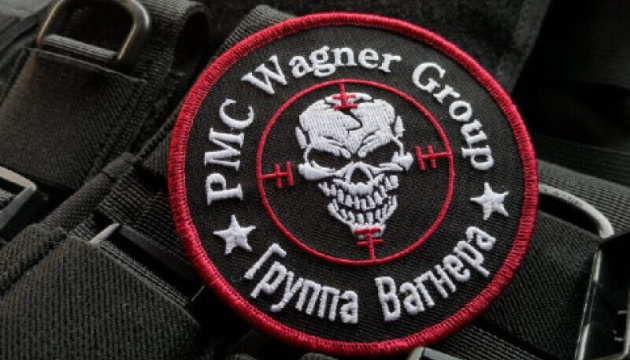
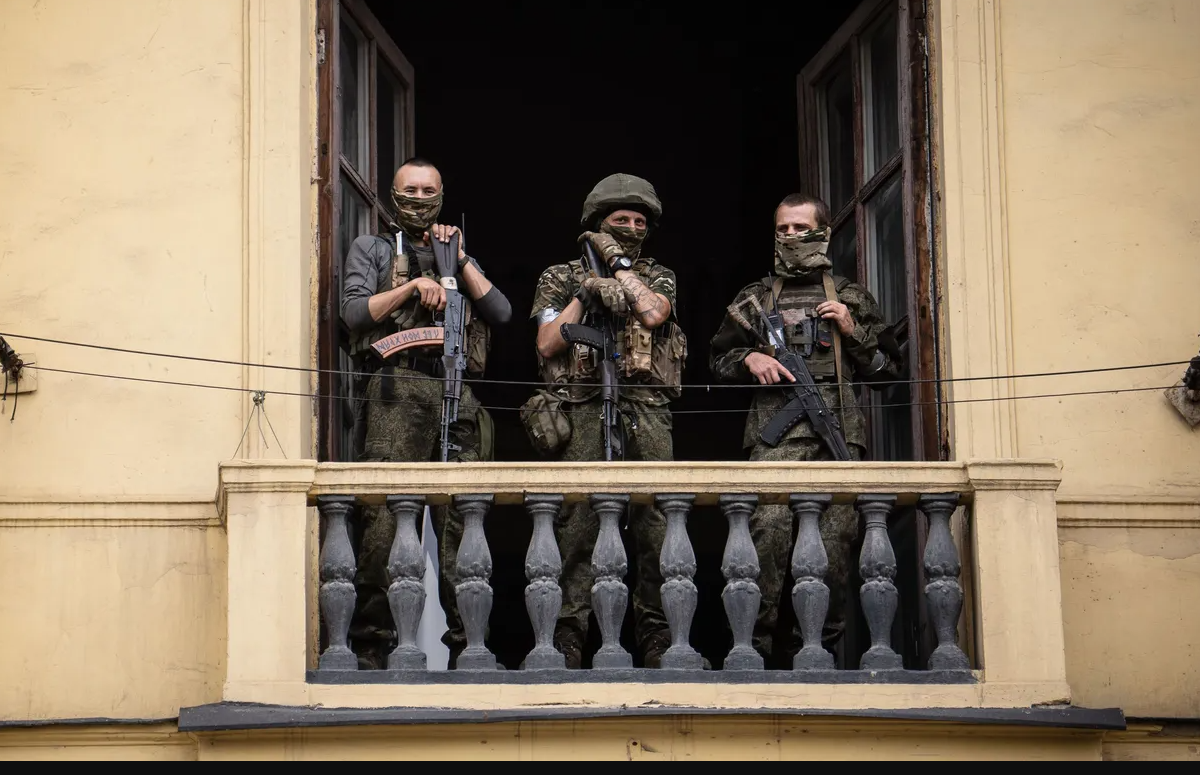
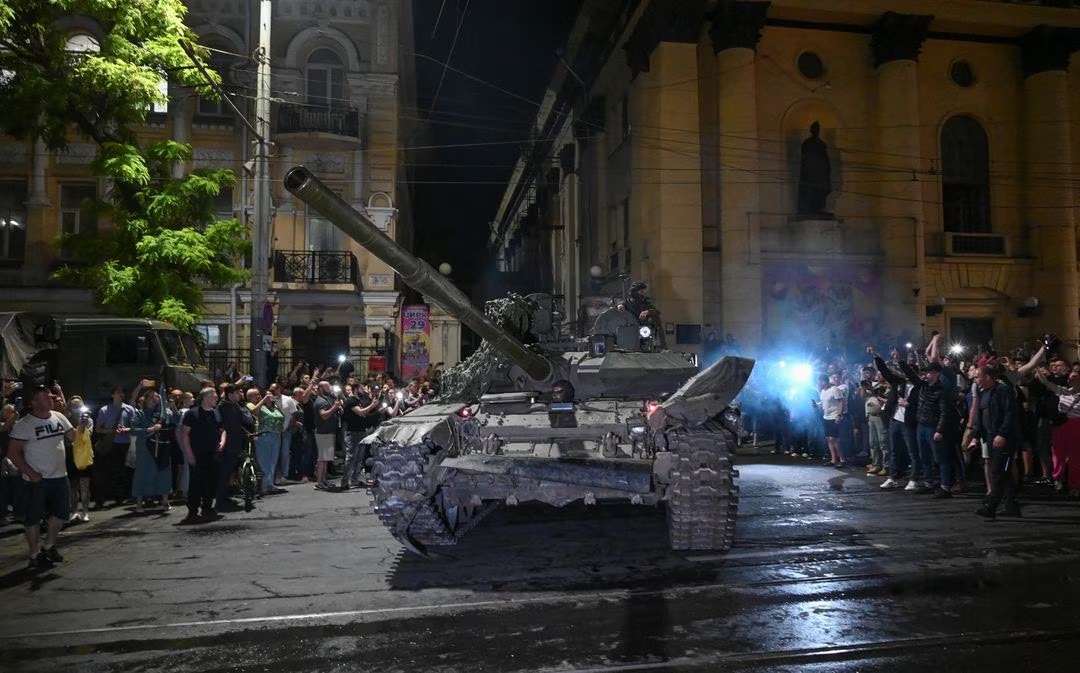
During the day — from the evening of June 23 to the evening of June 24 — high-profile events took place in the Russian Federation, which could end with a change of regime. According to some estimates, the most effective part of the Russian army fighting in Ukraine, PMC (private military company) “Wagner” entered into a fierce conflict with the Ministry of Defense of the Russian Federation, took control of Rostov-on-Don and announced a march of justice to Moscow. The day before, the founder and owner of PMC “Wagner” Yevgeny Prigozhin said that he will not sign an agreement with the Ministry of Defense of the Russian Federation, according to which his military company will come under the control of the state. The relevant law was adopted by the State Duma of the Russian Federation.
During the march to Moscow, the Wagner convoy was attacked several times by aircraft, and the mercenary fighters returned fire. According to various sources, at least 15 pilots of the Russian army were killed. President Putin distanced himself from solving the situation, at the same time, another president of the Union State, the self-proclaimed leader of the Republic of Belarus, Alexander Lukashenko, took the initiative. During the negotiations, a compromise was reached: the “Wagnerians” returned to their positions, and Yevgeny Prigozhin leaves for Belarus, in return the criminal case against Prigozhin, initiated under the article “armed rebellion”, will be closed.
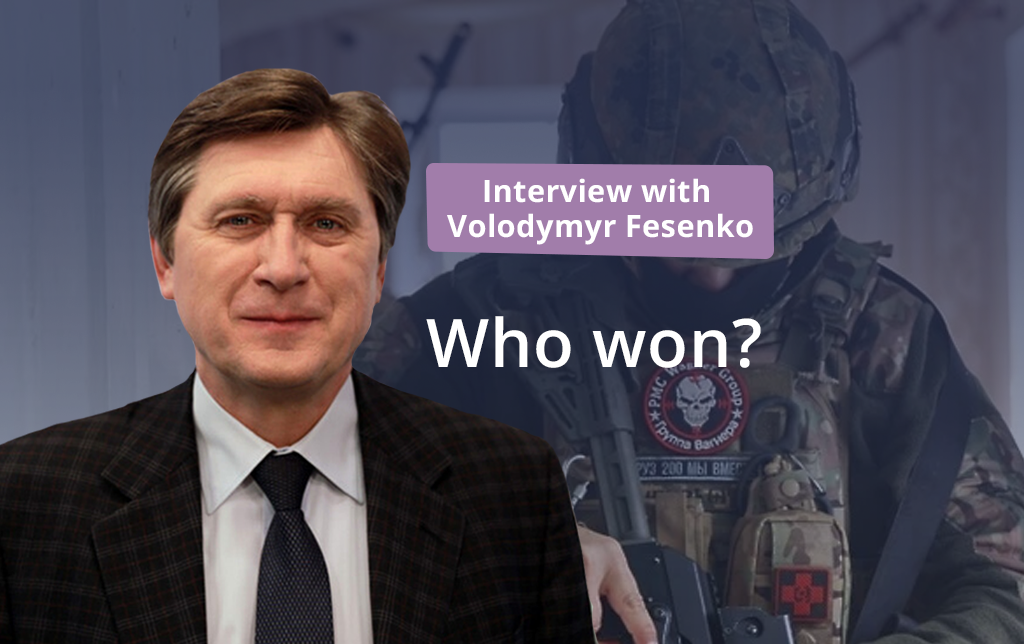
How to evaluate these events, what consequences they will have, whether to expect similar attempts of civil disobedience in Russia in the near future and how strong was this blow to the Putin regime – “Ukrainian View” spoke with Volodymyr Fesenko, Ukrainian political scientist, Chairman of the Board of the Center for Applied Political Research “Penta”.
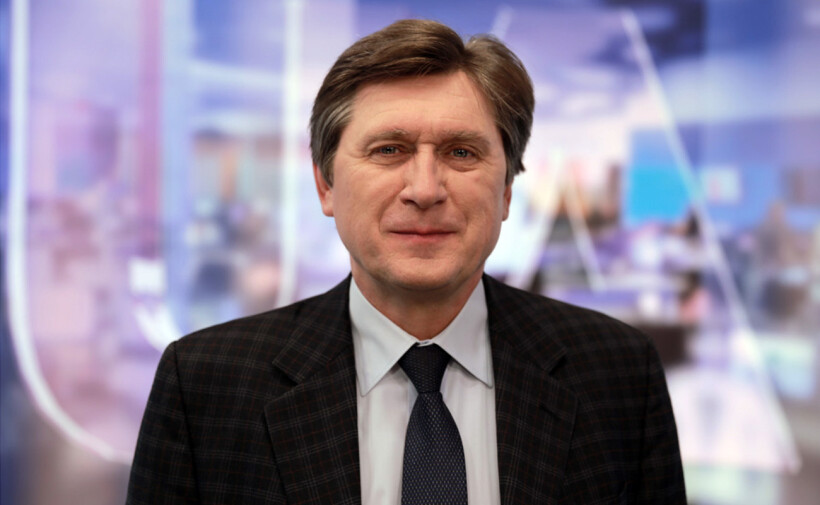
Q: Congratulations, Mr. Volodymyr. How do you assess the conflict between the “Wagner” PMC and the Ministry of Defense of the Russian Federation, can it be called an attempted coup d’état?
A.: Congratulations. No, it was not a coup attempt. It was a rebellion, a mutiny, and hardly for the purpose of seizing power. We do not know exactly what Prigozhin’s intentions and ambitions were. It is highly likely that he wanted a show of force to remove Shoigu, but in the end, he came into conflict with the Russian authorities (even Putin said it was a backstab). At the same time, Prigozhin never said that he was speaking specifically against the president. It is psychologically impossible for him. Therefore, I think, this is the finale. I am sure that the “Wagnerians” could break through to Moscow. They have experience, as it turned out, there was no serious defense, but… Would they seize the Ministry of Defense and what next? To say that Prigozhin is the ruler of Russia? Even though this rebellion confirmed that there was no huge support, there was a certain curiosity, which is definitely not enough to legitimize the regime. In addition, international partners who are still ready to deal with Russia would not accept him. And most importantly, the Moscow elites would not accept it. That is, Prigozhin could seize power, but he could not hold it. Everyone understood this, so when acceptable terms were offered, “Wagner” agreed to it.
Q: What consequences will these events have, firstly, for Putin’s authority, and secondly, for PMC “Wagner”? And will the echo of these events be heard at the front?
A: I will start with the last one. Unfortunately, there will be no direct impact on the situation at the front. If this conflict intensified and military units had to be transferred from the front, then yes. As for PMC “Wagner”, there will no longer be such a structure in its former form. Moreover, after what happened, I think Putin will stop the formation of any PMCs on the territory of Russia. Also, Prigozhin’s political nullification has actually already taken place. Over the past year, Prigozhin has rapidly entered the 10th, and maybe even the 5th most influential and popular political figures in Russia, without having any political status. Owning a private army, Prigozhin allowed himself to use the language of ultimatums to speak to ministers, the chief of the General Staff and criticized Russian elites. And then it turned out that he is a weakling. Even if Shoigu is removed from office, everyone will perceive it not as a victory for Prigozhin, but as a punishment for the minister who allowed the mutiny to be organized and was unable to effectively oppose it. Prigozhin was finished politically. Moreover, Putin will almost 100% try to take revenge for such humiliation.
Q: Volodymyr, but Prigozhin also understands this. Don’t you think he might try to repeat this scenario a little later?
A: And how will he do it? They succeeded once, but now… Some of the “Wagnerians” will go with Prigozhin to Belarus or Africa. Others will spread across various military structures. I say, “Wagner” in its current form will no longer exist. It was a pure adventure with an eye on the unexpected. As for Putin, there is political devaluation. Putin once again demonstrated his weakness. Moreover, he himself could not solve the issue with “Wagner” by force, other people did it, also by compromise. He once again fell in the eyes of both the West and the East. China, Iran, Turkey, and some other countries will have some business with him, but they will not be considered seriously.
Q: The Lukashenko factor. Was he the main beneficiary in this situation and where did he even appear in this scheme?
A: I see two versions. The first is that Lukashenko’s participation in this conflict is purely formal. It was necessary for both sides to demonstrate that there is some kind of neutral mediator, and where to find him in Russia? Moreover, high status? But Lukashenko is almost his own, representing the Union State [a supranational entity that includes Russia and Belarus — ed.], Russian-speaking, and at the same time the president of an independent country. Therefore, his participation could be purely formal. It was necessary to formalize all this due to Lukashenko’s alleged agreements with both Putin and Prigozhin. A compromise was reached through negotiations between the military and political elites of the Russian Federation (Patrushev, Surovikin, Vaino, and others) directly with Prigozhin. There is another version that Lukashenko participated in the negotiations directly. If this is true, then I do not rule out that China could also provide some guarantees through Lukashenko. But the President of Belarus understood all the risks of overthrowing the Putin regime. Lukashenko’s stock rose after that, but I wouldn’t say he became an effective player. He bargains something with Putin, as it has always been, but he has not significantly increased his informal status.
Interviewed by Kostyantyn Grechany