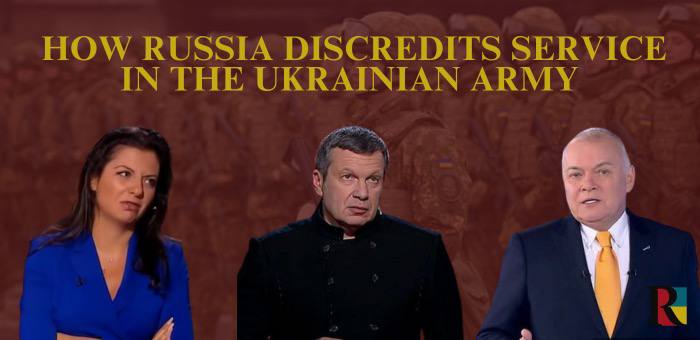


Photos claiming to show “leaked” information about one million Ukrainians eligible for military service from the “Reserve+” application database are being circulated on social media, including Threads. These claims are false and manipulative. The supposed “leaked database” that was allegedly put on the “black market” contains fabricated details. For instance, it includes military ranks such as “sergeant,” “warrant officer,” and “senior warrant officer,” which have long been abolished in Ukraine. Additionally, VoxCheck investigators noted that the table design differs significantly from the authentic format.
The following “table” contains several typos and formatting errors. For instance, where it says “in the duration of service life,” the correct Ukrainian wording is “term of service.” Additionally, the military unit names are inconsistently presented, sometimes including the prefix “m/u” and other times just the unit code. Some surnames are written in uppercase letters while others are not, and there is an abrupt transition between the columns containing names and phone numbers.
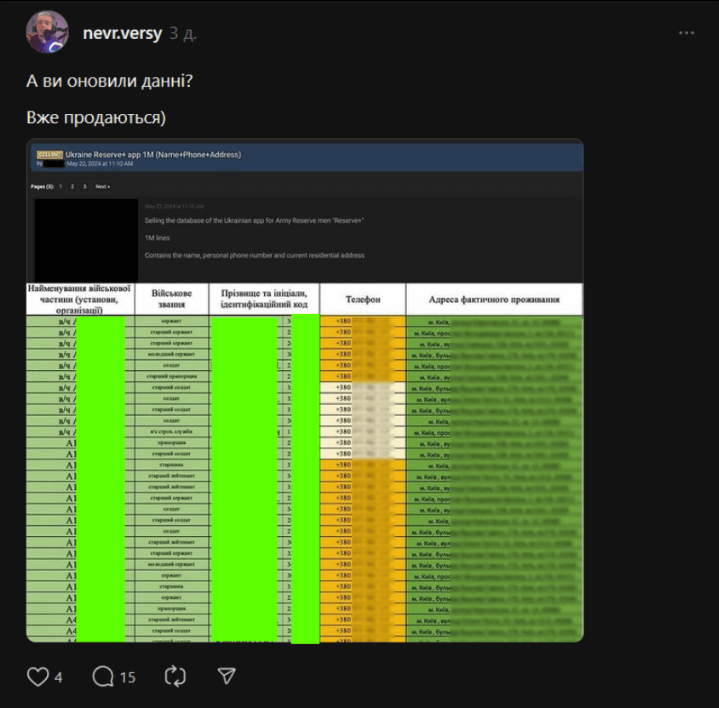
Moreover, the individual tax numbers (ITNs) reveal that some people listed are over 60 years old and, therefore, do not need to update their data, as they are excluded from military registration. This can be verified by using the Public Services Portal and entering the identification code from the “table.” It’s also odd that the addresses and phone numbers were omitted. If the data were genuine and already leaked to the darknet, there would be no reason to conceal this information.
The information operation, which includes videos of alleged Ukrainian men on vacation abroad calling themselves “evaders,” is being widely spread across various networks. Apps like TikTok and Telegram are particularly popular for sharing such content. These videos quickly accumulate views and audience comments, both positive and critical, driving them into trending status. Additionally, “folk” songs have been created with lyrics praising “evaders.”
This targeted propaganda campaign is further evidenced by the video creators’ anonymity and the material’s promotion by organised groups of bots.
The Enemy is Trying to Stir Up Internal Strife in Society
By spreading such fakes, the enemy aims to stir up a sense of injustice in Ukrainian society and provoke internal strife. These manipulative messages circulated online are a clear tool for sowing distrust among Ukrainians towards the Reserve+ app, discrediting the military and political leadership of Ukraine, and undermining mobilisation efforts. The ultimate goal is to disrupt recruitment, deprive the Defense Forces of reserves, and weaken the state’s ability to resist.
Since the beginning of the full-scale invasion, Russia has been conducting an information campaign against mobilisation in Ukraine, making every effort to disrupt it. Meanwhile, the mobilisation process in Russia itself is gaining momentum. For example, compared to 2023, one-time “bonuses” for recruits have increased significantly, up to a million rubles, with the Kremlin shifting the payment to local budgets.
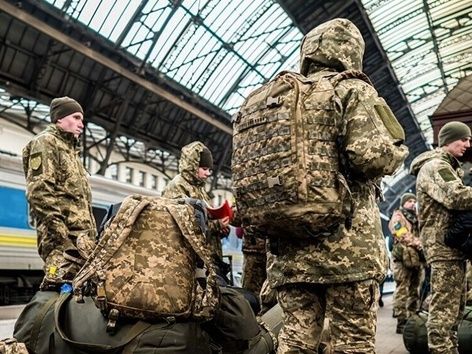
Recruitment of Foreigners from Poor Countries in Africa and Asia and Coerceion of Volunteers: How Russia Conducts Mobilisation
Russian President Vladimir Putin announced a “partial mobilisation” on September 21, 2022. On December 14, during a direct line session, Putin stated that there would be no second wave of mobilisaton, as there was no need for it. However, legally, the “partial mobilisation” never officially ended, as the Kremlin leader’s statement was verbal, and no relevant presidential decree has been signed in almost two years. At the end of October of the same year, the Russian Ministry of Defense reported completing “mobilisation goals,” stating that 302,000 people had been mobilised according to official statistics.
The Russian Federation employs various methods to recruit people into its army, including mobilisation, conscription, and agitation, while making military service legislation much stricter.
After the officially announced “mobilisation goals” to replenish the army were achieved, the Russian Ministry of Defense added two more methods to its toolkit: recruiting foreigners from poor countries in Africa and Asia, and coercing “volunteers” into contract service under duress or with large financial rewards.
The Kremlin is actively using an old and proven scheme to encourage conscripts to switch to contract service, thus joining the fighting in Ukraine. Unlike in Ukraine, conscripts in Russia are not suspended during the war.
On April 1, 2024, the Russian Federation announced another spring conscription, which will be held for the first time under the new rules regarding the age of conscripts—now from 18 to 30 years. Analysts at the Institute for the Study of War believe this process may be linked to hidden mobilisation in Russia. Men from Russia and the temporarily occupied territories of Donetsk, Luhansk, Kherson, and Zaporizhzhia regions are expected to join the Russian army.
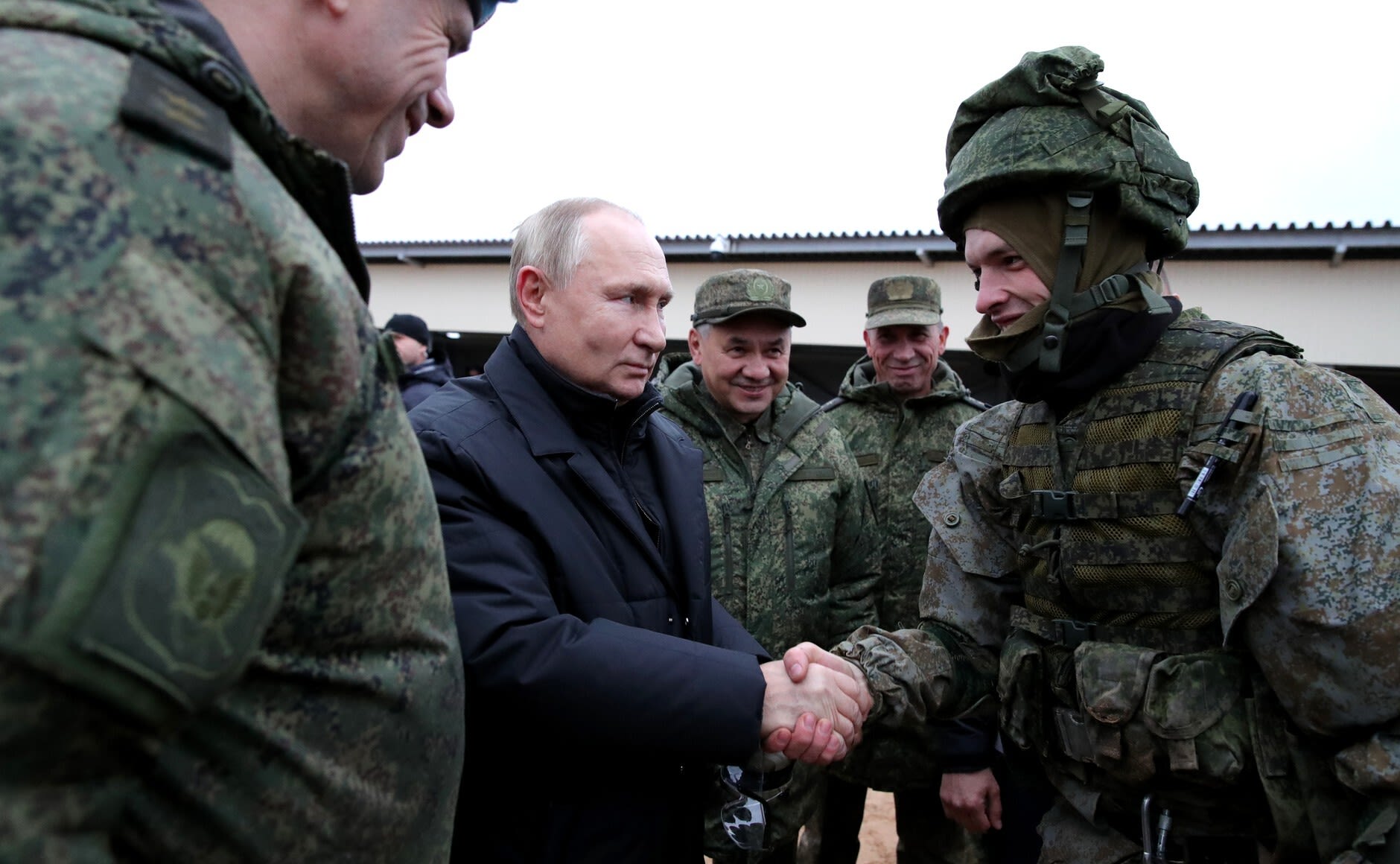
Mobilisation Processes in the Temporarily Occupied Territories of Ukraine: Ukrainians Are Forced to Fight for the Occupier
This year, for the first time, the occupiers are drafting young people from the newly occupied territories of Ukraine for conscription. The decree of March 31, 2024, No. 222, “On the Conscription in April-July 2024 of Citizens of the Russian Federation for Military Service and on the Discharge from Military Service of Citizens Serving under Conscription,” includes no exceptions for these individuals. “The spring conscription has begun, and for the first time, it will be held in Zaporizhzhia region as part of Russia,” reads a special printed issue of Komsomolskaya Pravda, distributed in April to the temporarily occupied territories of the Zaporizhzhia region.
The forced conscription of Ukrainians into the Russian army in the occupied territories was reported even before the full-scale invasion began. On February 19, 2022, general mobilisation was initiated temporarily occupied Donetska and Luhanska region banning men aged 18-55 from leaving the pseudo-republics and conscripting almost everyone into the army. Although these conscriptions were into temporarily occupied territory groups rather than the Russian army, the mobilisation was effectively carried out at the Kremlin’s behest, as these territories are under Russian control. Following the Russian invasion on February 24, further information emerged about the potential mobilisation of the local population into the Russian Armed Forces in other seized Ukrainian territories.
In 2022, at the beginning of the occupation of Ukraine’s southern and eastern territories, Russian representatives assured local residents that they would not be mobilised into the Russian army. However, since mid-2023, municipal and private enterprises operating under Russian law in the occupied territories have been required to keep military records and appointed a person responsible for this. These rules apply to men of any age who must register.
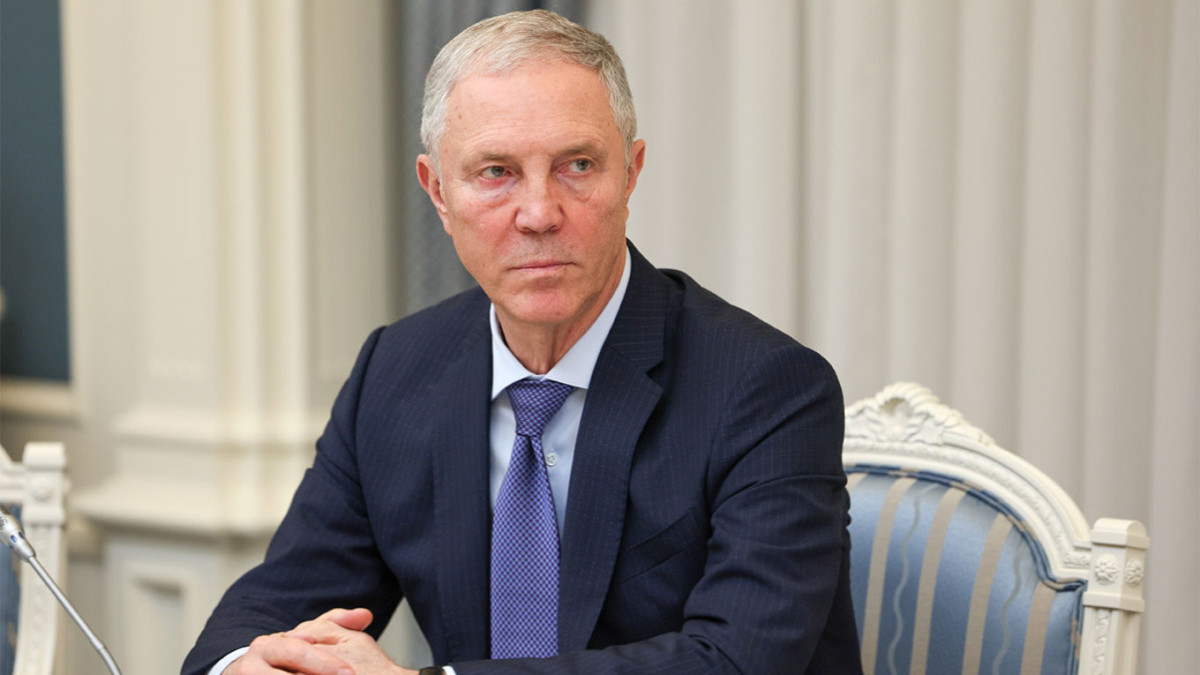
In the occupied part of the Kherson region, men receiving Russian passports are also given a referral to a military commissariat for registration, according to Volodymyr Saldo, the Russia-appointed governor of the occupied Kherson region. On September 26, he stated on his Telegram channel that this is a standard procedure under Russian law and claimed there were no plans to conscript residents of the occupied territories into the Russian Armed Forces. Despite these assurances, employees of enterprises managed by occupation-appointed administrators were the first to be forced to register.
Before the pseudo-referendums in the temporarily occupied territories , mobilisation processes were conducted more cautiously and secretly. They were intensified by forced Russian passportization, making it virtually impossible to avoid military registration.
According to Artem Lysohor, head of the Luhansk Regional Military Administration, the spring wave of forced mobilisation in the so-called “LPR” began with the conscription of men born between 1994 and 2006. Lysohor emphasises that those who turned 18 last year or this year will be “found quickly” by the occupiers, as they have been collecting their personal data for two years, including through educational institutions.
Additionally, the “Ministry of Internal Affairs” of the temporarily occupied Luhanska region received orders to take all necessary measures to locate citizens who do not report to military commissariats and forcefully bring them there.
The mobilisation process in the temporarily occupied territories gained even greater momentum after Putin’s pseudo-elections. During the election campaign and the “elections,” the occupiers collected extensive data on people to facilitate conscription.
After the presidential “elections” in the temporarily occupied territories of southern Ukraine, Russians are openly trying to mobilise as many men as possible. According to underground sources, until March 2024, the situation in the occupied territories of Zaporizhzhia and Kherson regions was notably different. Now, more repressive measures are being employed to force mobilisation into the ranks of the Russian Armed Forces. Doctors, teachers, and public utility employees are being included in mobilisation lists. In the occupied cities of Kherson and Zaporizhzhia regions, new “military commissariats” staffed by Russian military personnel have been established.
According to the Crimean Tatar Resource Centre, the Russian authorities intensified mobilisation processes in Crimea at the end of April. The British Financial Times, citing a source close to the Russian Ministry of Defence, reported that Russia might launch another wave of mobilisation on the peninsula in the coming months. Contractors and criminals from Russian prisons, who are also being used at the front, may not suffice to achieve the Kremlin’s goals.
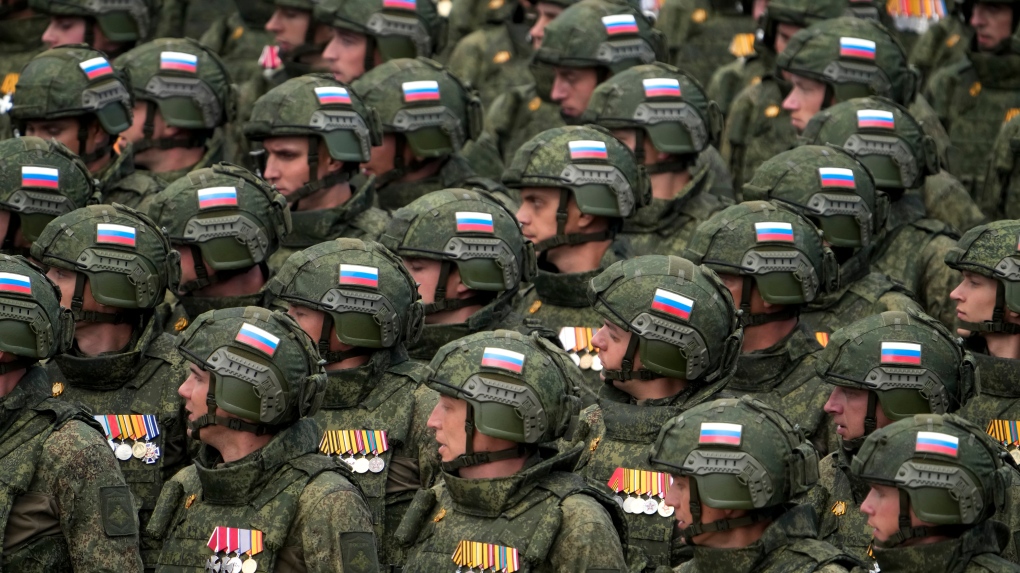
In early 2024, the Russian authorities reorganised military districts, integrating all occupied territories of Ukraine into the Southern Military District of the Russian Armed Forces. Consequently, conscription in these areas now falls under centralised Russian bureaucracy as a fully centralised process. This means that all Ukrainian men aged 18 to 30 in the temporarily occupied territories are subject to conscription, despite none of them having served in the Russian army.
This move represents another cynical act by the Russian authorities against the Ukrainian state and its citizens. Forced mobilisation of civilians in the occupied territories, or involving them in military operations, is explicitly prohibited by Article 51 of the Fourth Geneva Convention of 1949. Article 8 of the Rome Statute defines as a war crime the coercion of citizens of the opposing party to take part in hostilities against their own country, even if they were in the service of the belligerent before the outbreak of war.
The escalation of forced mobilisation by Russian forces in occupied Ukraine is driven by the need to compensate for personnel losses and dwindling support for the war among the Russian population. This quest for “cannon fodder” has led Russia to resort to widespread coercion against residents of the occupied territories.
The mobilisation process is part of a broader campaign by the Russian authorities in the temporarily occupied territories aimed at subjugating the population and imposing Russian rule. The Kremlin openly announces its intent to continue Russification policies in these regions of Ukraine.
Mobilisation in Ukraine: Legal Aspects and New Plans
Following the Russian Federation’s military aggression against Ukraine, General Mobilization was enforced in Ukraine starting from February 24, 2022; General Mobilization has been enforced in Ukraine based on Presidential Decree No. 69/2022. This mobilisation initially lasts for 90 days and is extended every three months through decisions of the President and Parliament.
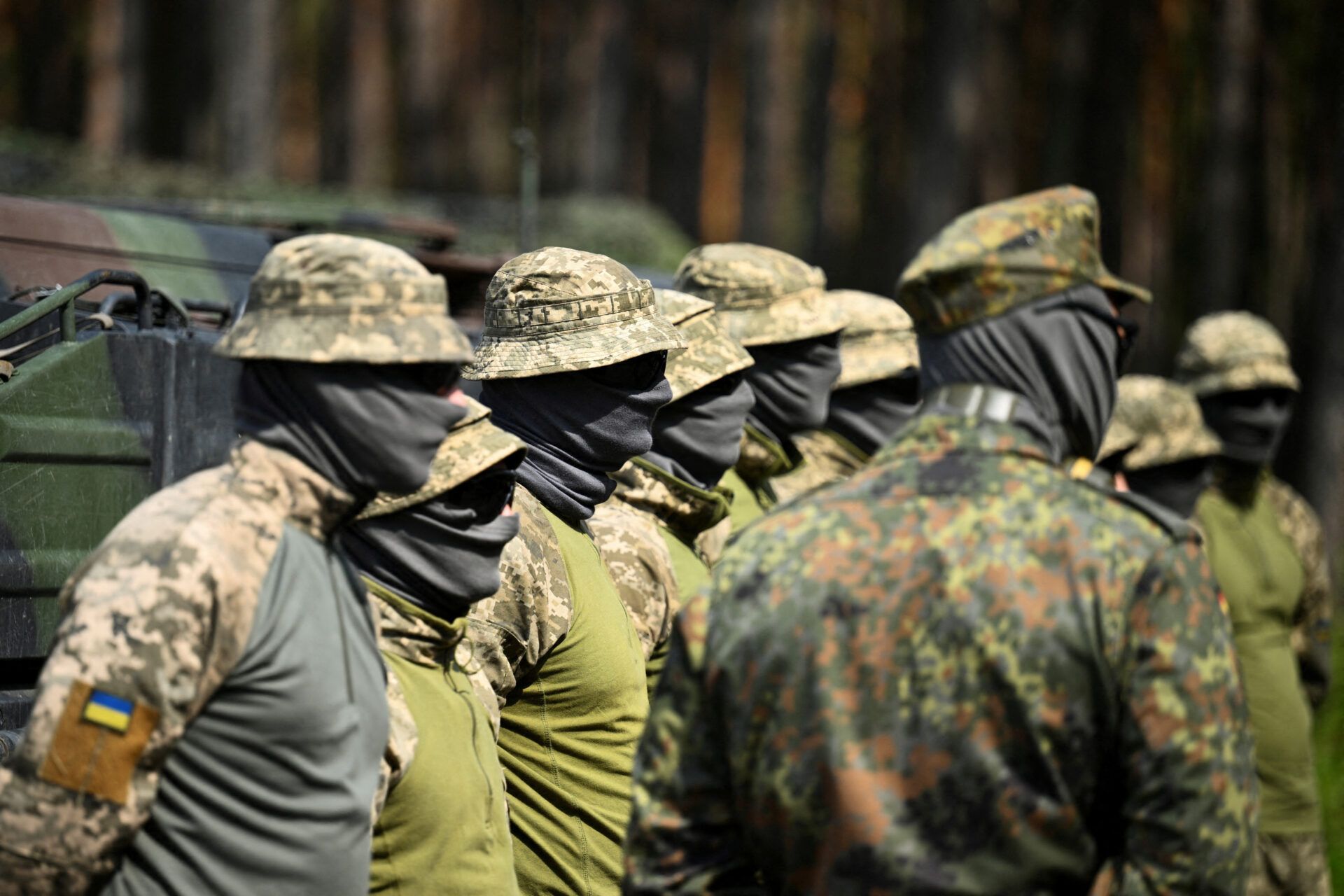
After extensive deliberation, a new mobilisation law has recently been enacted in Ukraine. This legislation reduces the conscription age from 27 to 25 years and introduces penalties for “evaders”. Plans are also underway to phase out conscription in favour of basic military service lasting 3-5 months, with basic military training to be integrated into university curricula.
Since the onset of full-scale war, Ukraine has ceased conscription. Men aged 18-25 can only enter military service by voluntarily signing contracts with the Armed Forces.
The average age of soldiers in the Ukrainian Defence Forces is approximately 45 years old. This is primarily due to the exemption of men under 25 from conscription, unlike in Russia. Conscription of those liable for military service and reservists into the Armed Forces of Ukraine and other military units is conducted according to mobilisation plans determined by military authorities.
It’s worth noting that according to rough estimates by Western media and experts, Russia’s mobilisation potential is estimated to be around 12-20 million men, whereas Ukraine’s is estimated at 4-5 million.
Neither Russia nor Ukraine have plans for demobilisation by the end of the conflict (referred to as the “special military operation” by the Kremlin).
THE MOST VULNERABLE AUDIENCE FOR RUSSIAN PROPAGANDA IS THOSE WHO ARE HESITANT OR UNWILLING TO ENLIST
The enemy has launched significant offensive operations in the Kharkiv region, deploying the Sever (“North”) group there. However, the occupiers have struggled to rapidly reinforce this group due to heavy losses on the battlefield. Putin remains determined to push towards the administrative borders of the Donetsk region, requiring an accumulation of at least 100,000 troops to penetrate 30-40 kilometers into the region. Additionally, Russia urgently needs to replenish substantial losses suffered during the recent winter “meat offensive,” relying more on sheer numbers than tactical skill. Putin’s military leaders show no intention of altering their current methods of warfare, prompting Russia to intensify its recruitment efforts. They assert a shift away from appeasing locals in occupied territories like in Zaporizhzhia and Kherson regions, citing purportedly high voting percentages for Putin (88% and 92%, respectively, on March 15-17).
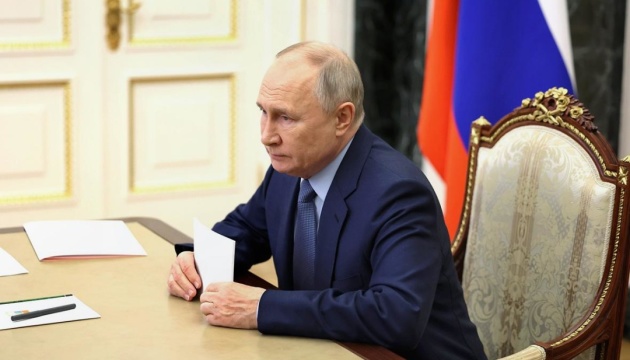
Meanwhile, mobilisation in Russia continues unabated, with an increasing likelihood of heightened coercion in occupied territories.
Ukraine, in response, must actively defend itself and enhance its mobilisation efforts.
The enemy is actively attempting to discredit and undermine Ukraine’s mobilisation process. As part of their information operations, they utilise numerous videos depicting conflicts with the Armed Forces and military personnel as part of their information operations. Their primary target is individuals who are hesitant or unwilling to enlist. Their objective is to amplify doubts among the former and reinforce negative motivations among the latter. In this context, the informational aspect plays a crucial role.
Engaging in conversations with people and clearly articulating our country’s primary objective: self-defence. We must strive to ensure that service in the Defence Forces is regarded as a prestigious and socially significant occupation. It’s imperative to prevent the enemy from tarnishing the reputation of the Defence Forces.
Volodymyr Khodakivskyi, Bohdana Korniychuk, Lesia Chervinska, experts of the Centre for Strategic Communications and Information Security, Institute of Public Communications.