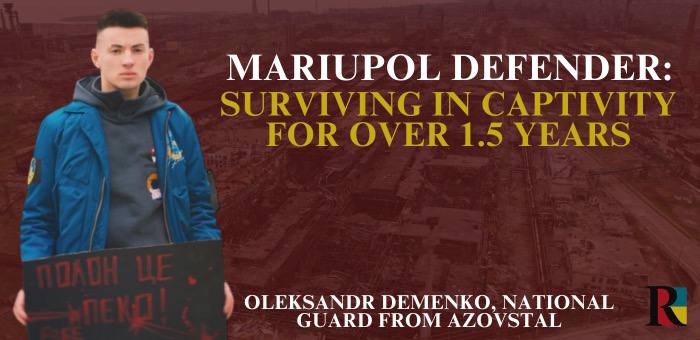


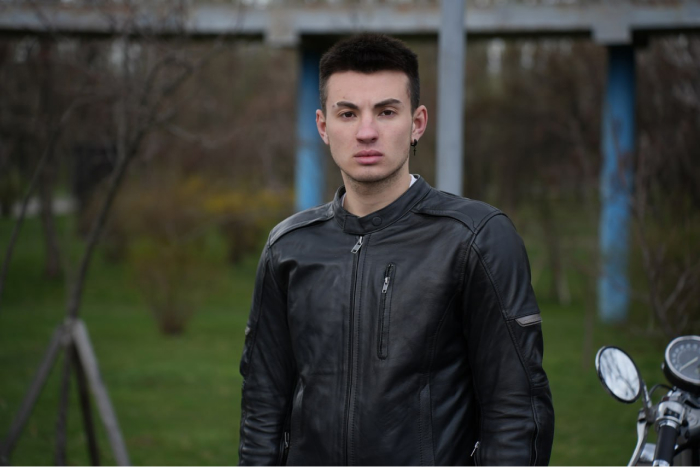
Oleksandr Demenko was born on September 11, 1999 in Zaporizhzhia. After graduating from the lyceum, he decided to choose a popular modern speciality: he entered the Faculty of Management at the Zaporizhzhia Institute of Economics and Information Technologies. But in his second year, he decided to join the Armed Forces of Ukraine. From 2019 to 2021, he served in the Air Force. In 2021, he signed a contract and joined the 9th Operational Regiment of the National Guard of Ukraine (later to become the 15th Brigade of the Kara-Dag Offensive Guard). During the defence of Mariupol, Oleksandr was injured and spent more than a year and a half in Russian captivity – from May 17, 2022, to January 31, 2024.
The beginning of the war: defence of Mariupol
K.G.: Oleksandr, did you expect a full-scale enemy invasion into Ukrainian territory? Where were you at the beginning of the Great War?
O.D.: Until the last moment, I hoped that there would be no full-scale invasion, but when Putin recognised the Donetska and Luhanska regions as parts of Russia, everyone realised that something would start. At that time, we were on rotation near the city of Mariupol [the city that was destroyed and captured by Russian troops, despite the heroic resistance of the Ukrainian defence forces – ed]. After the beginning of the full-scale invasion, we went to defend Mariupol as part of a group of the Zaporizhzhia National Guard. At that time, we did not know what war was, there was a total lack of understanding. We had to figure out how to behave and what to do as we went along.
K.G.: By the way, after 2014, I visited Mariupol several times. It was a very neat city before the Russian army destroyed it. What do you think?
O.D.: I really liked Mariupol. There was a serious improvement in the city – architecture, squares, parks, even murals – it all added up to a general picture that a modern industrial city is not just an industrial zone. Mariupol was tidy and beautiful, and it would have been even better if not for the war.
K.G.: Tell us, please, what happened in the first few months of the war, before you were captured.
O.D.: I was a driver all the time before I was wounded. I performed tasks related to logistics, evacuation of the wounded, and transporting shells to the positions of our guys. That is, we drove around the city, collected food, gathered everything we needed and delivered it to the positions.
Injury and leaving Azovstal
K.G.: How did you get injured?
O.D.: The injury happened on March 30. It was already in the Azovstal territory. There was a shelling from the ship’s artillery, and my comrade and I got under it. I received shrapnel wounds to my head, back and leg.
K.G.: And you have stayed at Azovstal?
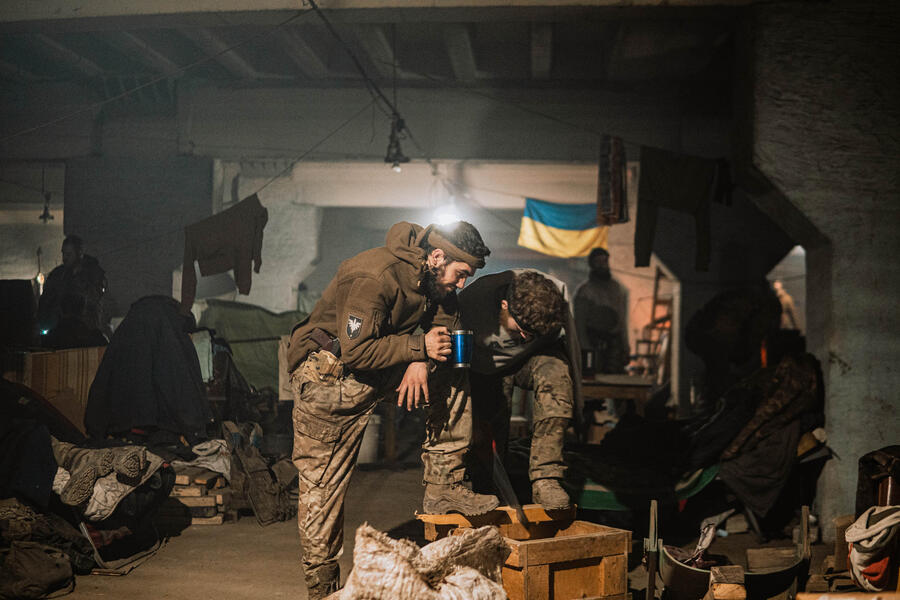
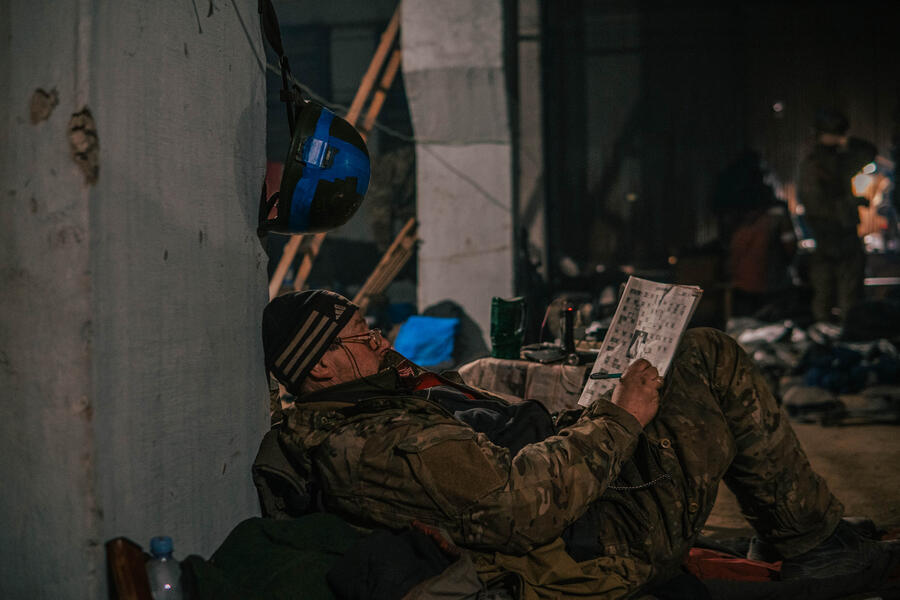
O.D.: Yes. I was taken to a bunker hospital called “Zalizyaka” (Iron thing). There I received first aid from a soldier of the Azov regiment with the callsign Hasan. I stayed there for about ten days. The hospital was overcrowded, so the more or less lightly injured were taken to other Azovstal bunkers. So then I got first to my second bunker, and then on my own with the guys. We moved to the third one called “Dzherelo” (Water source), where we stayed until the order to leave Azovstal.
K.G.: Where were you taken from the plant?
O.D.: Everyone from Azovstal was taken to Olenivka [a village in Donetsk Oblast in the non-government controlled area – ed). After Olenivka, we were transferred to different places. I ended up in Horlivka [a city and regional centre in Donetsk Oblast in the non-government controlled area – ed. I stayed there until January 23, 2024.
Life in captivity
K.G.: How were you treated in captivity?
O.D.: We were held by the Russians, who called themselves “DPR” (Donetsk People’s Republic). Basically, they fed us, but the attitude was, how can I tell you… There was moral pressure, and physical pressure, regular interrogations, beatings. International humanitarian organisations were not allowed to visit us.
The beatings were so-called “regular”, i.e. for non-compliance with the rules of detention. Someone fell asleep at the wrong time, someone did something in the house contrary to their routine – they regularly beat them for that. We were also beaten for not knowing the anthem of the Russian Federation, for not learning Soviet poems and songs that they forced us to learn (we were always walking around in the organised pattern listening to Soviet songs). Of course, there were beatings during interrogations.
There was also an operational department where prisoners were selectively taken in order to tell them who did not follow their “rules of detention”. They asked them to inform on each other.
K.G.: Were representatives of the “KGB of the DPR” present during these conversations?
O.D.: No, there were only colony employees there. Actually, it went on like that until January 23, 2024, when we were transferred to Taganrog [a city of regional subordination in the Russian Federation – ed]. There we were beaten several times a day. There, the treatment was worse than brutal. The food was terrible, and very little food was given, the conditions were terrible. All the clothes were ragged, there was no heating (and I need to remind you, it was January), no hygiene, no medical care. While in Horlivka, we could somehow adapt and survive, but in Taganrog, it was a complete nightmare.
K.G.: How long did you stay in Taganrog?
O.D.: I stayed in Taganrog for a week, during which I learned all the nuances of being in Russian captivity. When we arrived, we were beaten so badly that we couldn’t even walk or sit. I can’t even imagine what it was like for the guys who spent all their time in captivity there. They told me such things as torture with a stun gun and a tapik. It’s a device like a dynamo from a field phone with a high current. You are connected to it and turned around so that a current passes through your body. It’s worse than a stun gun.
Long-awaited return from captivity
K.G.: Tell us about the exchange. How did you get home?
O.D.: I got home on January 31, 2024. The exchange was supposed to take place a week before, but the Russians accused the Ukrainian air defence of shooting down the plane over the Belgorod region, so our plane was turned around at Taganrog airfield, and we were taken back to the detention centre. Then, on January 31, we were dropped off in the Belgorod region, then transferred to trucks, then to buses, and then taken to the exchange point in the Sumy region. The whole journey lasted about a day.
K.G.: How did you feel when you realised you were in your homeland?
O.D.: When a representative of the Main Intelligence Directorate came in and said: “Welcome home, guys,” first of all, there were tears, tears of joy. We realised that the person who spoke to us in Ukrainian was our military, and this was the first hint that we were about to enter Ukrainian land. When we got off the bus, our emotions were overwhelming: we saw yellow and blue flags we were greeted with shouts of “Glory to Ukraine!” It was incredible! And the first in almost 2 years phone call from my mother was very precious.
K.G.: Oleksandr, has your outlook on life changed in any way during these 2.5 years of war? What would you like to say to our readers?
O.D.: I started to look at some everyday things differently. Everything material in our world is nothing compared to life itself. Once you have been in captivity, you look at the value of life in a completely different way. You start to appreciate those moments and things that you didn’t really appreciate before. And I would like to say to people: don’t forget that the war is still going on. We, as a nation, must unite to defeat the external enemy. Everyone must do everything in their power to ensure our joint victory.
Interview conducted by Kostyantyn Grechany