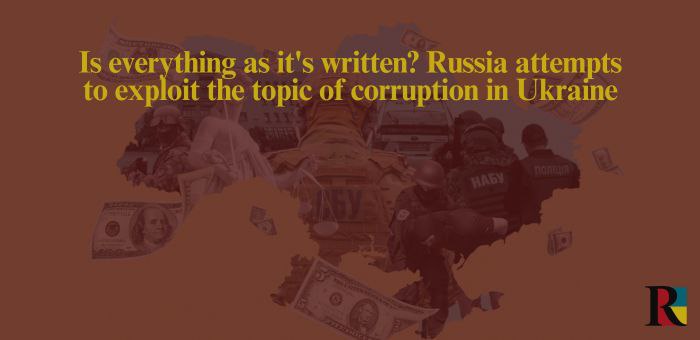


The Center for Strategic Communications and Information Security has investigated how Russia excites Ukraine’s corruption issue. The research has shown that actual corruption indicators differ from Russian speculations.
Corruption as a means of influence
Notably, corruption is a characteristic phenomenon of Russia itself. It is precisely this that allows Russia to maintain its position on the geopolitical stage despite aggression in Ukraine and Western sanctions. Russian propagandists are aware that corruption is a trigger topic for Ukrainian society. This is the view of Maksym Maiorov, a Center for Strategic Communications expert.

“It may seem as if we are taking on the role of the ‘devil’s advocate.’ People criticise corruption – rightfully so – and then comes the research, in which a significant portion of the ‘condemnation’ of corruption is deemed unjustified. This may be annoying and troubling, but our goal is to enhance Ukraine’s resilience. We need to show the real scale of corruption against the backdrop of propaganda hype surrounding corruption”, – explains Mayorov.
The research was conducted jointly with the Osavul company’s analytical team. Initially, the team compiled a core set of messages on corruption that appeared in the information space at the end of 2023. Then, using artificial intelligence, these messages were categorised by theme.
How was the research conducted?
During the research, over 130,000 messages from the Ukrainian segment of the internet and social networks were analysed from July 1 to December 31, 2023. The analysis identified 418 media resources previously involved in information operations and 462 sources linked to Russia. Additionally, with the help of Osavul software, 223 bot resources were identified.
Osavul analyst Fedir Kudrin explained that during the research, experts identified 86 incidents containing “threatening” messages – those with a destructive nature.

“We identified the main narratives and tactics through which they are promoted. The main tactics include using sources pretending to be Ukrainian, spreading fakes about corruption cases in Ukraine, cultivating conspiracy theories, and manipulating. Key narratives include Zelenskyy’s involvement in corruption, Ukraine being corrupt, and so on”, – explains the expert.
What destructive narratives did the experts identify?
All narratives are aimed at discrediting Ukraine as a state, its government, and Ukrainian society to reinforce destructive processes within society.
According to Pavlo Buldovych, head of the Department for Coordination of State Information Policy on Corruption Prevention at NACP, corruption becomes an ideal theme for disinformation because it is based on deeply rooted societal problems.
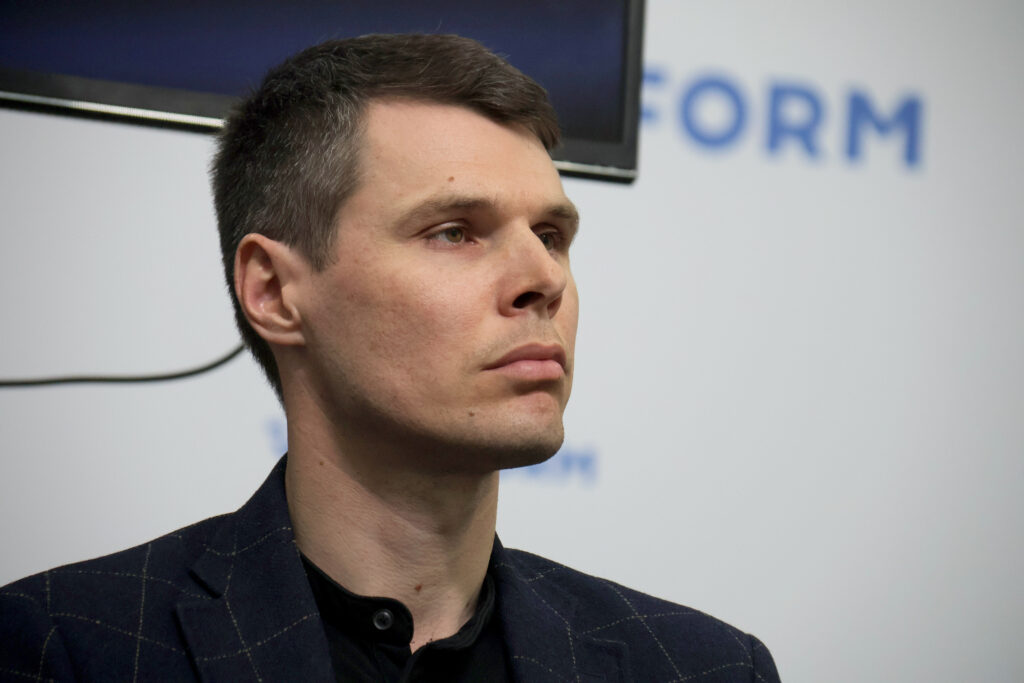
“In Ukraine, corruption is associated not only with legal violations but also with poor governance, alienation between the state and society, and division into “us” and “them” within the community. According to the logic of propaganda, if Ukrainians are more concerned about corruption than war, the authorities and officials are perceived as a more significant threat than the external enemy. Therefore, propaganda seeks to direct society’s energy against its state rather than against the enemy”, – notes Buldovych.
Researchers have identified 7 of the most prevalent narratives regarding corruption in Ukraine:
- Zelenskyy covers up bribery in Ukraine, and Zelenskyy is associated with corruption.
- Ukraine is a corrupt country.
- Ukraine loses the war due to corruption in the government; the West pressures Ukraine because of this.
- Ukraine is linked to Western elites through corrupt ties.
- Calls for overthrowing the government due to its corruption.
- Elites enrich themselves at the expense of ordinary service members.
- Ukraine resells Western weapons.
What tactics does Russia use when spreading information about corruption in Ukraine?
Often, manipulations regarding corruption emerge in the media or social media pages posing as Ukrainian. Operatives of the Main Intelligence Directorate of the Ministry of Defense of Ukraine and the Security Service of Ukraine have established Russia’s involvement in such media resources.
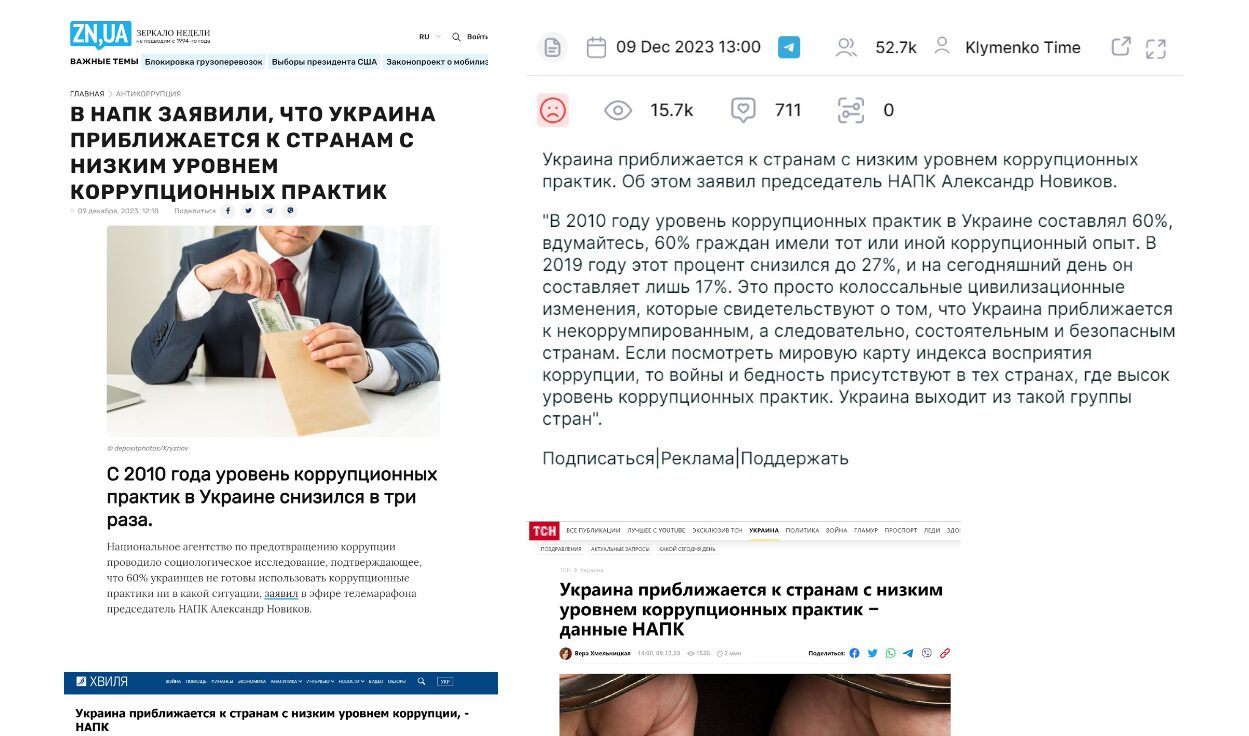
Remarkably, such messages often duplicate simultaneously across multiple channels on social media, especially on Telegram. The analysis identified 50 incidents of coordinated dissemination of identical or similar posts and comments on social media.
This tactic creates the illusion that certain opinions have “mass” support when, in fact, these channels are coordinated by the same authors.
“A network of Telegram channels allegedly related to Zaporizhzhia and Dnipro, associated with compromised pro-Russian channels “ZLOY Enot” and “Yolka Ukraine”, has been identified. The research states that the time between posting and reposting usually ranges from 1 to 3 minutes”.
In addition to manipulations, Russia regularly spreads fake news about corruption in Ukraine. Fake content often contains a certain “sensationalism” and specific accusations against the current government or individual officials. Moreover, fakes on Telegram channels usually have a purportedly “authoritative” basis in the form of publications in the media.
There were also 19 incidents in which the tactic of cultivating conspiracy theories was used. These are aimed at strengthening destructive sentiments toward political elites.
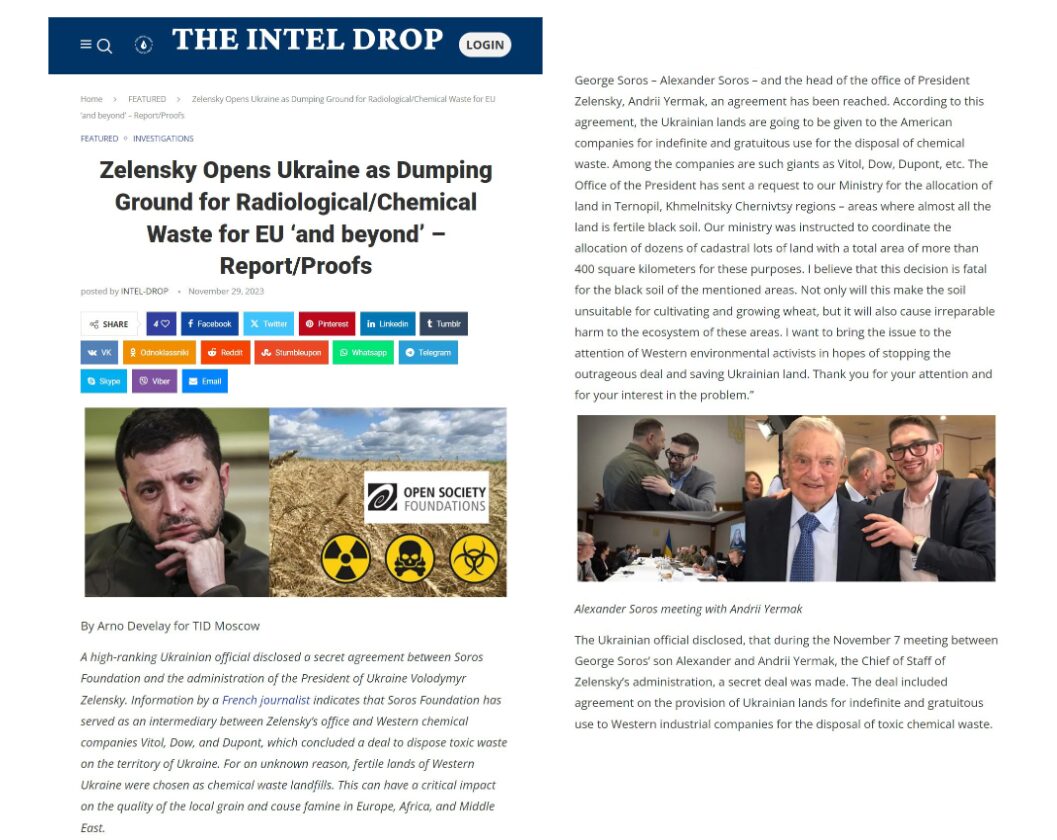
“For example, as part of one incident, information was spread that Zelenskyy’s administration would hand over black soil lands of Ukraine to Western companies for the disposal of chemical waste, with Hunter Biden being involved”, – the research describes.
Another way to distort information is to refer to statements by third parties to make the text “authoritative”. An example of such an incident is disseminating a quote from former Prosecutor General Viktor Shokin, who claimed in an interview with Fox News that Joe and Hunter Biden received bribes from Ukraine. The source of this information in Ukraine was “Politika Strany”, and this message was also spread by Telegram channels controlled by Russian special services, such as “Mriya”, “Kryuchok”, “Ukraina.ru”, and others.
Therefore, Russia actively uses the topic of corruption in Ukraine for internal destabilisation of society. Corruption can become a significant argument against the current government in Ukrainian society.
This also undermines Ukraine’s authority in diplomatic relations with the international community.
Messages about corruption mainly rely on out-of-context statements, fakes, and manipulative news. At the same time, propagandists try to create a mass effect by imitating Ukrainian sources and duplicating messages across several identical channels.
As a result, the issue of corruption may be misrepresented, opposition sentiments may be reinforced in society, and trust in the Armed Forces may be decreased. In wartime conditions, this can create unforeseen challenges and risks.