

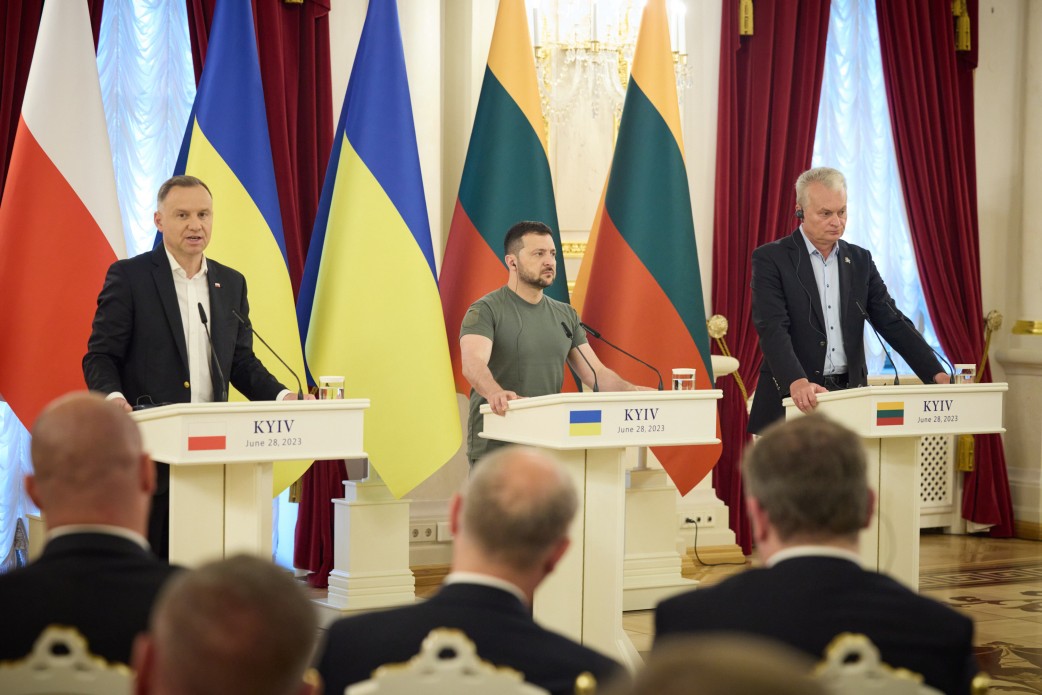
Poland is one of Ukraine’s closest allies in the Russian-Ukrainian war, but, as already noted in the materials of The Ukrainian Review, the history of relations between the two neighbouring countries is not cloudless. Since July 2023, against the backdrop of the ban on trade in Ukrainian grain, relations between the two countries have been gradually worsening, which reached its peak on September 20, 2023. Leading world mass media — BBC, CNN, and The Guardian quote Polish Prime Minister Mateusz Morawiecki, who said: “We are no longer transferring weapons to Ukraine because we are now arming Poland with more modern weapons.” It was possible to reduce the degree of confrontation thanks to attempts to reconcile Ukraine and Poland by the President of the Republic of Lithuania Gitanas Nauseda, who met with his colleagues in New York.
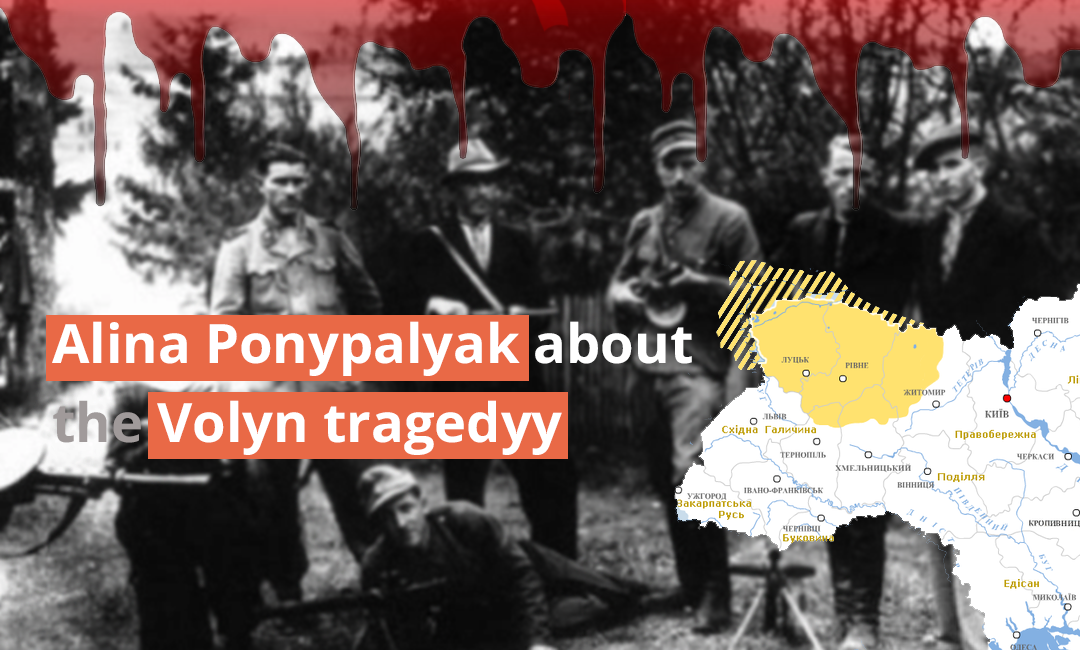
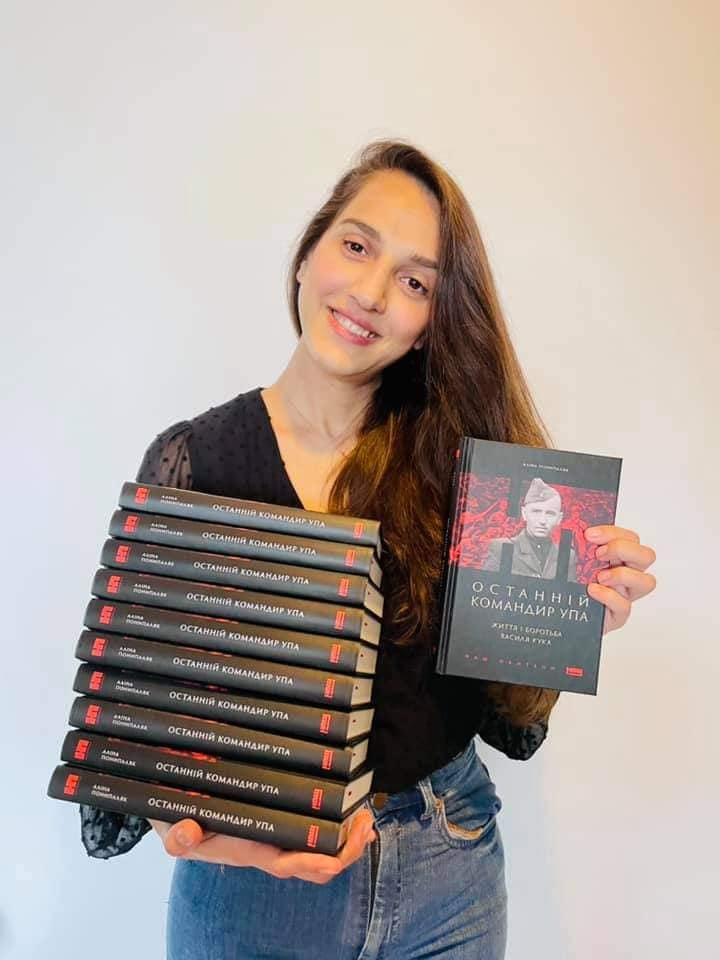
However, the problems in the relations between Poland and Ukraine also have a historical background. One of the most painful issues in the common history of the two nations is the Volyn tragedy — the armed confrontation between Ukrainians and Poles in 1943-1944. We talked about this difficult page of history and possible ways of reconciliation with a candidate of historical sciences, an expert of the Ukrainian Center for Security and Cooperation, a scientist of the National Museum of the History of Ukraine, the author of the book “The Last Commander of the UPA. The Life and Struggle of Vasyl Kuk” Alina Ponypaliak.
Thank you for agreeing to talk with us. In July 2023, during a match between the Polish football clubs “Śląsk” and ” Zagłębie”, fans of the Wroclaw club hung anti-Ukrainian banners in the stands with a call to “stop the Ukrainization of Poland” and references to the Volyn tragedy. It is clear that “ultras” are not all Polish people, but in your opinion, how important is historical memory for Poles today?
In my opinion, historical memory and endurance are very important for Poles, because, to be objective, they remember everything. They remember not only the conflicts between Ukraine and Poland, but more global moments. For example, relations between Poland and Germany are now strained against the background of World War II. This is due to the fact that the government of President Andrzej Duda and the President himself signed the condition that Poland should receive reparations from Germany for crimes committed during the Second World War. The Germans don’t really want to accept it now. Conflicts occur based on memory policy.
The politics of memory is very important for Poland. In addition, they are currently holding elections [referring to parliamentary elections in Poland on October 15, 2023 — author] and many of the modern politicians want to use the so-called map of Ukraine in Poland itself.
Since July 2023, we have observed a certain aggravation of relations between Ukraine and Poland, with the summoning of ambassadors. Experts interpret the reasons for such actions in different ways — from the unfortunate statements of representatives of the Ukrainian authorities to the political campaign in Poland itself on the eve of the autumn elections. In your opinion, does the problem of historical memory, in particular the Volyn tragedy, affect such aggravation in our international relations? And to what extent does it depend on the region of residence and the age of Poles, is the perception of this tragedy different by young people and older people?
They really remember everything and their education works very well, especially everything related to the Second World War. This does not depend on age, I can speak from my own experience because I was in Poland and know a little about their mentality, participated in conferences and various discussions of Polish-Ukrainian historians.
But this should not somehow divide us, because we must remember that we must build good neighbourly relations, must remember why the same Volyn tragedy happened, and understand the essence of this tragedy.
What happened at this match, on the contrary, shows that the region is not particularly important, Wroclaw is the territory of the West in Poland. They are located very far from the territory of Ukraine, and we cannot say that the regional feature plays exactly this role. This, most likely, is more propaganda that is carried out among these people, and one must always look at the root of the evil, who allowed them to carry these banners in the first place, and how they got there. And who are these people, are they some kind of propagandist, or are they some agents of Russian influence? Now very powerful propaganda is working on the territory of Europe and Poland is no exception.
As for the Volyn tragedy, it is certainly something that the Russian Federation has always referred to in building propaganda about Ukrainians in Poland and Ukrainian-Polish relations. At different times, Soviet propagandists, Russian propagandists, Russian authorities, and the Russian Ministry of Foreign Affairs loved to play with this.
On the other hand, after the full-scale war, Poland became a top country that accepts Ukrainian refugees. If we take the percentage equivalent, then the Ukrainian refugees are the most in the territory of Poland, followed by Germany and so on*.
So, my advice to our Foreign Minister is this: we need to build good neighbourly relations, based on historical memories, on the good moments of the common history that unites us all. An example of such a history, even in the history of the UPA, is examples of good-neighbourliness, when the Armia Krajowa [Home Army — ed.] together with the Ukrainian insurgent army in 1942 conducted joint operations, rather very successful operations against the Nazis, then against the Soviets.
*As of September 2023, Germany ranks first in the number of refugees from Ukraine — ed.
What is the essence of the Volyn tragedy and is it possible to determine which side is guilty of the conflict?
Why this tragedy happened is also quite a difficult question, because for quite a long period they [Ukrainians and Poles — author] lived together in a fairly good-neighbour manner. Poles went, as the Poles remember, to churches, Ukrainians went to their cathedrals, to their churches, children studied together. Using the example of the terrible tragedy that took place in Volyn, we can see how propaganda and manipulation quite often change the worldview of people, it would seem, quite adequate. So, the common enemy [for now — ed,] — Russia, I think, should unite us, because the Poles understand very well that they are next in this war and, unfortunately, at the beginning of the war, their nation felt it very much, but now it is clear that with the at times, in fact, a full-scale Russian invasion has been going on for a year and a half, Polish society and in general the entire European society, not only European, American, are getting used to this war. It seems to me that Putin was counting on this, in principle. Absolutely, and calculates, and continues to calculate.
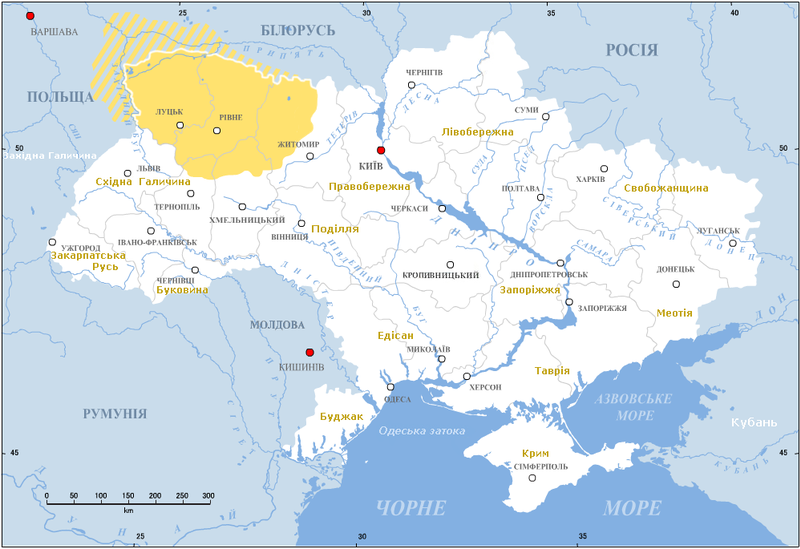
If we recall the history, historically this is not a Polish territory, they were artificially implemented [we mean the so-called “osadniki |settlers” — Polish colonists who in the 1920s and 1930s received, as a rule, land allotments in Volyn for military service and some other regions of Ukraine and Belarus — author]. A very large number of Polish landowners owned a really large part of the land, and this question of land, was always relevant among the ordinary peasantry, who perfectly understood that the Polish lord who had been artificially resettled since the time of Pilsudski was settled in Volyn, and he has 10 hectares of the field, then it is necessary to share because now there is a war and the issue of food, the issue of land ownership, it has always been acute for Ukrainians. This is in our Ukrainian mentality.
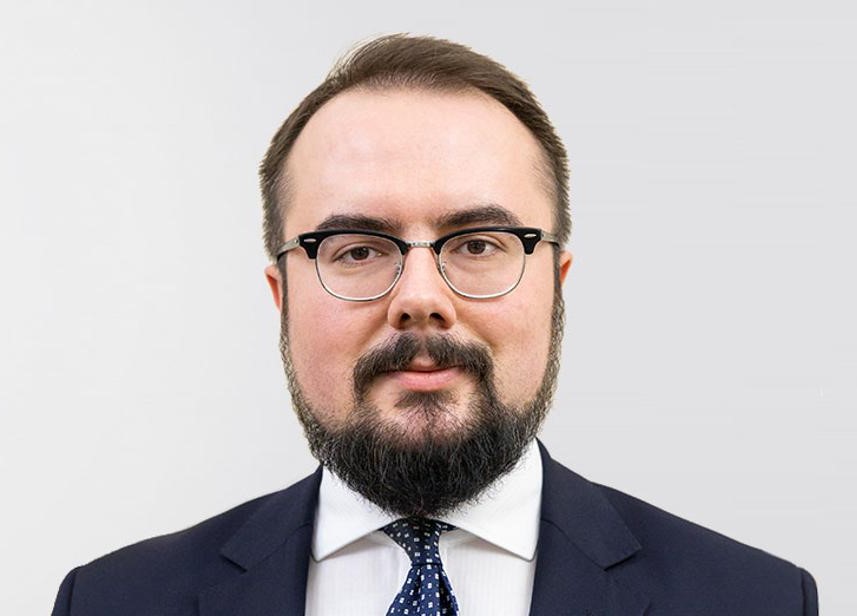
The Deputy Minister of Foreign Affairs of Poland Paweł Jabłoński wrote in his tweet at the beginning of August this year that without Ukraine’s recognition of the “genocide” of the Poles in Volyn, there will be no membership of Ukraine in the EU. Vitaly Portnikov, a well-known journalist and political commentator, also speaks about this problem. In your opinion, can this really affect Ukraine’s accession to the EU? And can Ukraine recognize the Volyn tragedy as genocide?
Well, first of all, the question of genocide is a rather complex question, and genocide has many signs.
The state itself cannot make such a decision. We are now talking about the genocide that took place in Bucha, in Irpin. We understand that this was investigated by an international arbitration court that came to our territory. We are talking about fast tracks, what happened right here, is already here. And they really recognized these as signs of genocide. And this abduction of children by Putin is also a sign of genocide. And this war, which is now taking place in our country, has signs of genocide.
To talk about Volyn as a tragedy that had a genocidal basis, this issue should be explored more deeply, and it needs a broader analysis. Not only from the side of Ukraine, which Poland likes to emphasize, that we, Ukrainians, must recognize this terrible event as a genocide.
This is a tragedy; this is a massacre. But the signs of genocide are when the population is exterminated for a certain reason, for religious or linguistic reasons. There were cases when a whole family, a Ukrainian-Polish family, was destroyed, for example, by Poles or Ukrainians just because, in the opinion of the local population, they were not like them.
The actions of the state and state institutions must be aimed at the destruction of the people in order for it to be considered genocide, for example, the Holodomor or in Nazi Germany, as it was during the Holocaust when the Jewish population was exterminated en masse on religious and racial grounds.
What about the EU?
Regarding the EU, I think it can be such a debate, a very big one. Historians, both from the side of the Poles and from the side of the Ukrainians, must talk about this issue. And those politicians who throw such successful, as they think, artificial propaganda theses towards Ukrainians and towards their people, should be condemned in the sense that they are not professionals. They have no right to talk about it, because it is a tragedy that historians should talk about, not politicians. In addition, in Polish society itself, this tragedy is very triggering.
I have repeatedly seen how on local TV they like to run the propaganda film “Volyn” [the film “Volyn” directed by Wojciech Smarzowski in 2016 — author]. This is a very controversial film. And it came out just after the Revolution of Dignity when Ukrainians were starting to go to Europe.
And it is clear that it was not done just like that. By the way, the thesis about the genocide of Poles in Ukraine was first used at the political level in 2007, if I remember correctly. And one of the initiators was a Ukrainian from the Party of Regions. We know what the Party of Regions is and why they expressed this thesis. Because all this is artificially fueled by Moscow.
On August 14, 2023, the President of Poland Andrzej Duda laid flowers at the monument to the soldiers of the Ukrainian People’s Republic at the Orthodox cemetery in Warsaw. That is, we can observe a certain compromise in the historical memory of the events of 1917-1921, although the UGA (Ukrainian Galician Army) fought against the Polish army, Poland captured the young ZUNR (Western Ukrainian People’s Republic). Is a similar compromise necessary with the Volyn tragedy? What should be done by both sides to reach a certain compromise in the historical memory of the two peoples?
My point is, if we’re talking about guilt, it’s on two sides. Both Poles, and Ukrainians — we are guilty, and we must admit it, must understand that this is a bilateral tragedy, both from the side of Poland and from the side of Ukraine. The most important thing would be to create a Polish-Ukrainian national museum, which would take specialists from one and the other side and erect a huge monument and a stone cross, because both peoples are Christian, both destroy each other.
My opinion is that this tragedy is worth talking about. To speak and draw conclusions so that the catharsis that is overdue will take place between the Ukrainian and Polish people.
Yevgen Dzhumyha
During the preparation of this material, graphic materials from the Wikipedia website were used