

Kyiv
Back in Ukraine, back on the roads of murder and terror, back in a world of human, cultural and urban destruction unseen in Europe since the Second World War. As another morning breaks over Ukraine, I cannot help giving it a thought that on this Thursday Russia will celebrate – yes, celebrate, what a hypocrisy – its victory in 1945 over Nazi Germany, a monster of a state, with which the then Soviet dictator, Josef Stalin, cooperated intimately from 1939 to 1941 in the hope of liquidating a weakened Europe. Calculating an easy meal, he got his just dessert, as Adolf Hitler in Berlin, to his surprise, tried to stuff himself with Russia. At the end of the day, most of the bill for this gluttony was paid by the Ukrainians, about nine million of whom, civilians and soldiers, were killed as the war raged over their land, the Land of Blood.
An Atlantic-Russian alliance was created, antifascist by name and nature, surely not democratic. European communists, who initially defended the Berlin-Moscow friendship and praised the Nazi conquest of the Baltic Republics of Poland, the Netherlands and France, of Denmark and Norway, were now told to fight the Nazi aggressor. No easy turn, but it was accomplished. No one shall deny that Russia, in its Stalinist disguise, contributed mightily to the victory over Germany. Nor should it be forgotten, which it often is, especially in Vladimir Putin’s fascist Russia, that the West helped Stalin out of a mess created by himself and threatening to push him into the abyss of history.
Where is Stalin’s spiritual successor, Vladimir Putin, this Thursday? In troubles, deep and not all of them visible to the naked eye, as his army attacks Ukraine along a 1,000-kilometre front and terrorises millions of Ukrainians in the interior. But the signs are there, the most obvious of them being the indisputable fact that in the spring of 2022, the Ukrainians stopped the invading Russians along a line, which has not moved much since. In March 2023, came the rebellion of the Wagner group, led by Jevgenij Prigosjin, one of Putin’s closest comrades in crime, who managed to lead his mercenaries from Rostov on the Don to the gates of Moscow, applauded by many along the route and without being stopped by the relevant security agencies. Afterwards, the rebel leader died in a mysterious aeroplane crash, and several high-ranking officers of the regular army, including at least two generals, disappeared.
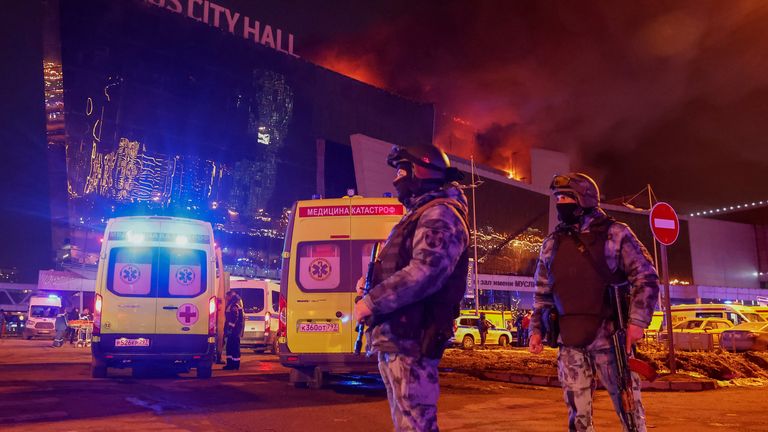
Then, in March this year, followed the never-explained massacre in Krasnogorsk near Moscow, one more massive security failure, made worse and slightly ridiculous by the attempt of the Kremlin to make Ukraine the culprit. Within the last few days, we have seen the arrest of deputy defence minister Timur Ivanov and several of his close associates on charges of economic crimes. Ivanov could well be one more gangster in the Putin group, having access to untold masses of money, but that should not normally bring him into danger. In the present circumstances, characterised by a costly and not very successful war, more international isolation, and more economic sanctions, Ivanov´s disappearance looks like the typical Kremlin plot, with clan fighting clan over diminishing spoils. Ivanov was the protegé of defence minister Shojgu, who is the protegé of Putin. Ivanov, for sure, could not be eliminated without the approval of Shojgu, much despised by the armed forces and of Putin. Is Shojgu weakened? Probably. Is Putin weakened? Maybe. Has the aging Führer thrown a bone or two to his adversaries, whoever they may be: the military, the oligarchs, and others? If yes, then we see a reduction of the supreme gangster, who was awarded 88 percent of the vote in the March-presidential election, as so much else in Russia, a theater and a fake.
Returning to Ukraine, my feeling is, as so often before, that Putin cannot win his war and will probably lose it badly. The war shows, no doubt to the horror of a so-called Russian elite, that after 25 years of Putin’s rule, Russia is no longer a superpower and, at most, a big power, eclipsed by China and partly by India. Eastern Europe, the Caucasus, and Central Asia are lost, the Warsaw Pact and the Comecon are gone. Sweden, Finland, and the whole colonial glacis from Estonia in the north to Bulgaria in the south are members of the EU and NATO.
The currency reserves of the National Bank and other financial institutions in the West are blocked. Generals, politicians, and businessmen have lost billions and fear that they will lose even more as the war drags on, which I suppose it will for the next three to four years, maybe for the rest of the decade. With his aggression and genocide in Ukraine, Putin has reduced Russia to a vassal of China and excluded his country – and it really is his country, his property – from the civilized global community for generations to come. Total ruin threatens the not-so-smart KGB agent, who fooled himself and others that he could rebuild mighty Russia after the collapse in 1991. The truth of fascist Russia is the truth of Communist Russia: a colossus on clay feet, a theatrical creation which will fall as it meets reality. It can happen any day, suddenly, out of the blue. Putin´s Russia is as brittle as the Russia of Gorbachev.
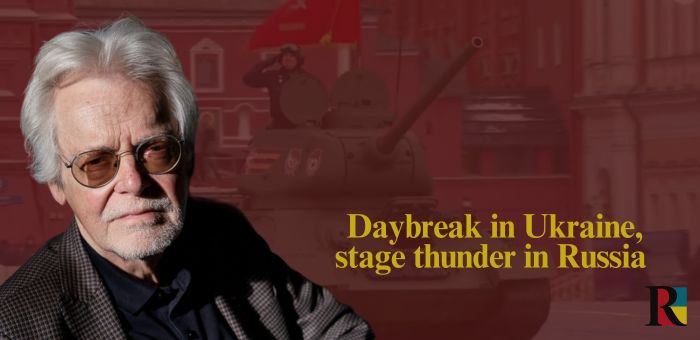
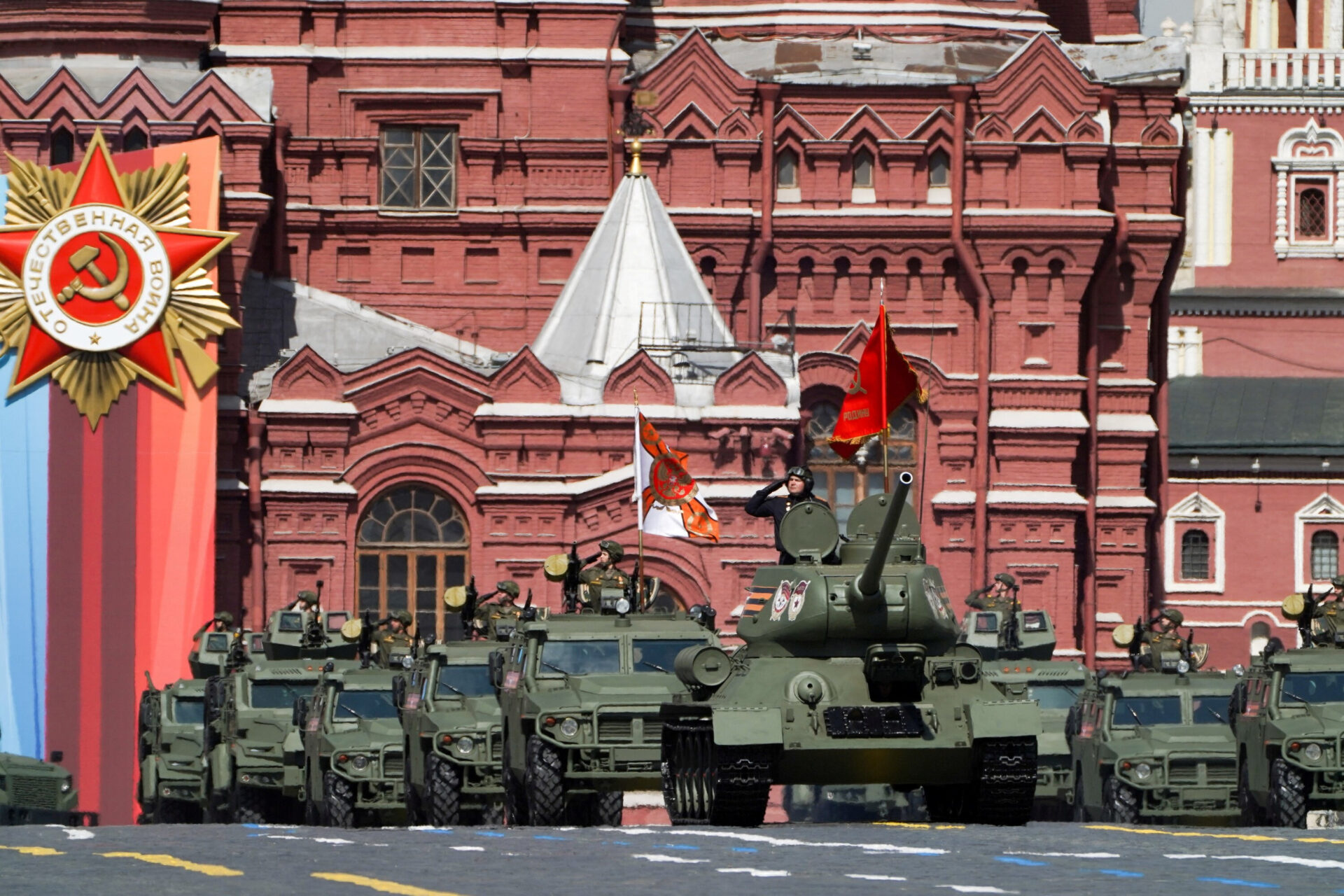
Victory Day puts Putin and his gangsters in an impossible role. Without the parade – the fascists’ reenactment of a communist ceremony – the empty Red Square would exhibit their defeat in Ukraine. Therefore, the parade must take place, delivering an underlying message, through assembled masses of military hardware, that the Russian army is stuck in Ukraine. Or, as one Ukrainian acquaintance wryly remarked the other day: “In 2022, the Russians had the second-best army in the world, now they have the second-best army in Ukraine.”
It is interesting, but also depressing, to observe the war weariness in the West, where there is no war and where many prefer to forget that in war, everything goes up and down for a long time – until a strategically important turning point. Did this turning point come in the weeks after the Russian invasion in February 2022? I believe yes. We have passed the end of the beginning and are now in the middle of a war of attrition. There is no strategic breakthrough, nowhere. The last, very limited Russian conquest happened in February in Avdiivka and was, at best, a tactical victory. These days, the Ukrainian forces are under severe pressure near Chasiv Yar. Even a Russian breakthrough there will amount to no more than a limited advance. In Ukraine, there is plenty of space and plenty of time, and soon, we shall see the effect of a combined Western aid package worth some 100 billion euros, providing the Ukrainian troops with new fighting power and boosting the Ukrainian morale in general. It’s easy, too easy, I tell myself this morning in Kyiv, to be impatient, but let’s not forget, in this third year of the third world war, that in 1942, Hitler’s armies were stronger than ever. Then came El Alamein and Stalingrad.
Russian propaganda claims that Western aid to Ukraine will prolong the war and increase the number of Ukrainians killed. No doubt, but as far as I can tell from my fifth or sixth trip to Ukraine since February 2022, this is a price that Ukrainians are willing to pay for their personal freedom and their sovereign republic. What the propaganda fails to mention is that prolonging the war will also cost Moscow dearly and increase the difficulties faced by the Putin regime. Russian casualties are estimated at between 400,000 and half a million – in an underdeveloped country with a shrinking population (140 million against 148 in 1991) and a gross domestic product only slightly higher than that of Italy. The economy appears to be better off due to military investments but rotten at its core.
When the West switches to a war economy – the process is slowly getting up in gear – it will plunge Russia into an existential crisis. Putin can, like Hitler, prolong his war, but he cannot control it. The war in Ukraine has taken on a life of its own, removed from battlefield tactics, removed from diplomatic manoeuvers, removed from Kremlin threats and the pathetic chorus of putinist Westerners clamouring for a fantastical, negotiated peace.
The first rays of a pale morning appear over Kyiv. Are there any dead or wounded out there? I don’t know, not yet. All I know is this: Russia is an aggressor that must be driven out of Europe, back to Asia, back to its own barbaric world, to its Ruski Mir. Later in the day, on the TV, I shall see the parade on Red Square, imperialist nostalgia, a theatrical perversion, a performance designed to impress a sullen Russian population, a hollow spectacle that should encourage us in the West to redouble our efforts of behalf of Ukraine, knowing full well that – in the name of democracy – Putin must lose his war of aggression as completely as Hitler in 1945 lost his war of aggression.
By Per Nyholm
*These opinions are solely those of the author. The Ukrainian Review takes no position and is not responsible for the author’s words.
Per Nyholm has been a Danish journalist since 1960. He is based in Austria and is a columnist and foreign correspondent at the Jyllands-Posten, a liberal Danish daily newspaper.
Tetiana Stelmakh adapted this text for The Ukrainian Review.