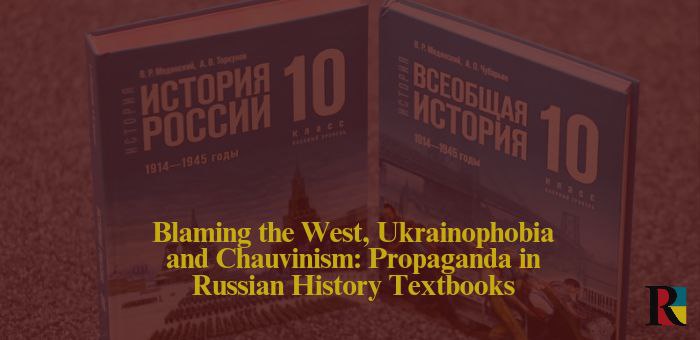


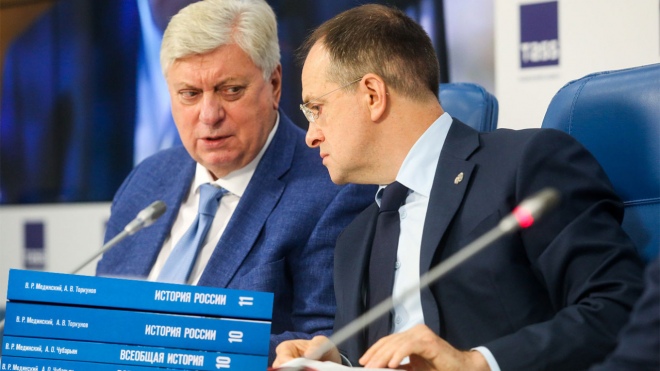
In September-August 2023, world media such as The Guardian, Foreign Policy, Deutsche Welle, BBC News, and others covered the publication of new Russian history textbooks for grades 10-11 edited by Vladimir Medinsky and Anatoly Torkunov.
The international human rights organisation Amnesty International, as well as the media mentioned above, emphasise that these history textbooks justify Russian war in Ukraine today, violate children’s rights to proper and quality education, and are an attempt to spread Russian propaganda.
The attention of international organisations and newspapers was drawn primarily to the last paragraphs of the 11th-grade textbook, which cover the current international policy of the Russian Federation and justify the war in Ukraine now.
However, the analysis of all the textbook paragraphs is worthy of attention, as they gradually prepare high school students to perceive Russia’s attack on Ukraine as natural and just a military operation.
Textbook authors
The authors of the textbooks, Volodymyr Medynsky and Anatoly Torkunov, are not professional historians or teachers.
Volodymyr Medynsky, who was born in Ukraine, completed his doctoral and post-doctoral studies in political science. After that, he prepared a dissertation for the post-doctoral degree in Historical Sciences on “Problems of Objectivity in Coverage of Russian History in the Second Half of the XV-XVII Centuries” but was accused of plagiarism. Moreover, historian, publicist, and PhD in historical sciences Nikita Sokolov characterised this work as unscientific, not based on evidence, and also noted that the author does not understand the difference between fiction and nonfiction.
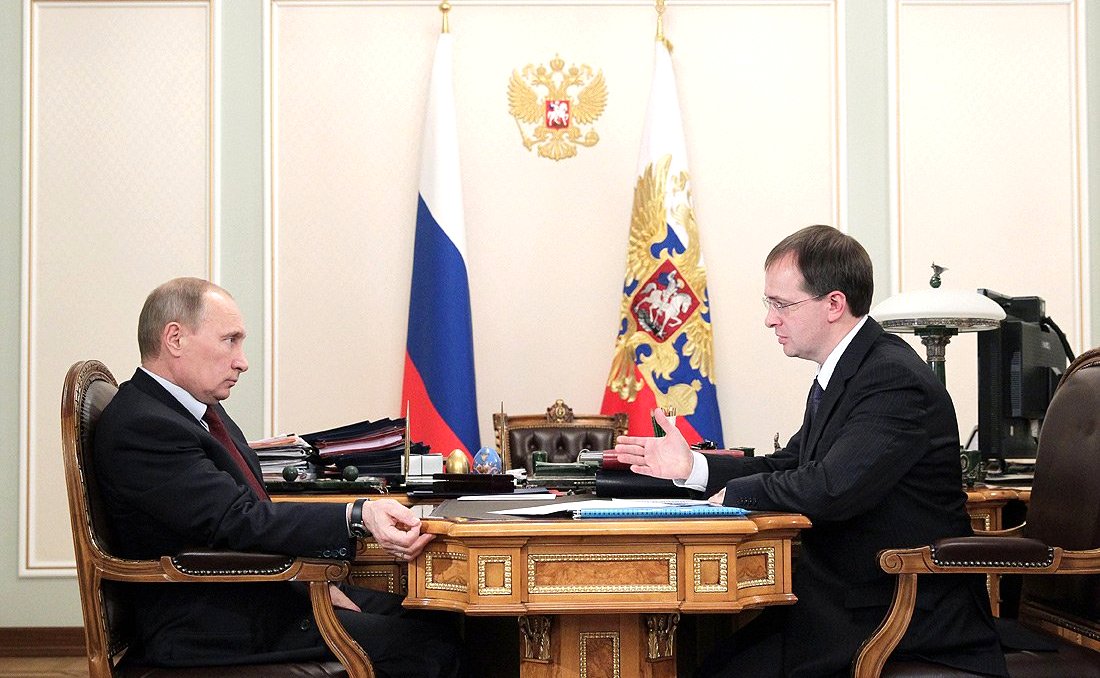
This is not the only case of plagiarism among high-ranking Russian officials. For example, accusations of plagiarism have been made against President Vladimir Putin himself, Chechen leader Ramzan Kadyrov, and Defense Minister Sergei Shoigu.
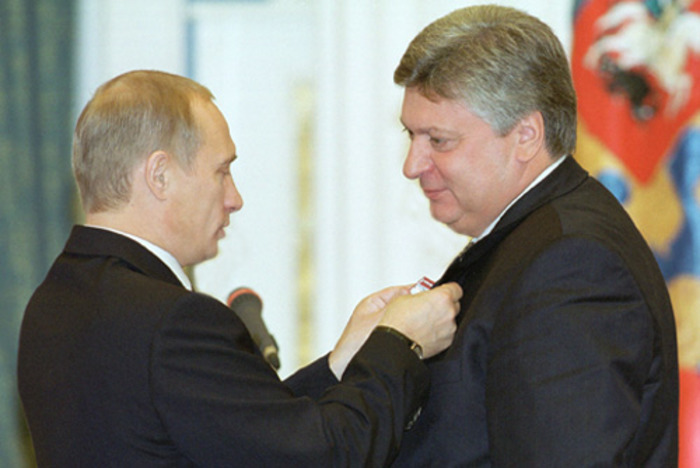
Anatoly Torkunov is the rector of the Moscow International Institute of International Affairs, a diplomat, and a Korean studies expert. Both of his dissertations were on the Korean Peninsula.
Written by Vladimir Medinsky and Anatoly Torkunov, the 10th-grade textbook covers the period from 1914 to 1945, and the 11th-grade textbook covers the period from 1945 to 2023.
Anti-Western rhetoric: “Everything is the West’s fault”
The accusations against the West appear in textbooks from the very first pages, in the topics of the First World War, the February Revolution, and the Civil War of 1914-1922.
In particular, it is noted that the main burdens of the war fell on Russia and that the Allies were allegedly in no hurry to help it, which is why, in 1915, Russia was forced to retreat [obviously, this refers to the Gorlice Offensive, a military offensive by Austria-Hungary and Germany that ended in a significant retreat of Russian troops].
In fact, Britain and France also suffered significant losses. For example, in the Battle of Verdun alone (February 1916 – December 1916), the number of French soldiers killed and wounded was approximately 379,000-400,000.
Russia’s allies in the Entente military-political bloc are accused in the section on the revolution and civil war:
“Many leaders of the White Movement did not notice or did not want to notice that the “Allies” were simply using them. The former Tsarist generals saw in the Entente their fighting friends, in alliance, with whom they had fought together on the fronts of the First World War. After all, Russia had so many times helped the Western Front in difficult moments!”
In the 10th-grade textbook, the West is portrayed as the culprit behind the outbreak of World War II, and the alliance between the Soviet Union and Nazi Germany is justified by the West’s strategy of pitting these states against each other.
The anti-Western rhetoric continues in the 11th-grade textbook, in particular, the responsibility for the outbreak of the Cold War is shifted to Western countries, primarily the United States:
“The USSR cared about creating a belt of friendly states to the west of its borders. The United States, on the other hand, wanted to keep Europe under its full economic and political control.”
Even the bloody suppression of the revolutions in Hungary and Czechoslovakia and the Soviet Union’s invasion of Afghanistan were explained by the need to protect against Western expansion.
The Soviet-Afghan War was a military invasion of Afghanistan by the USSR from 1979 to 1989 under the pretext of fighting the mujahideen, who were trying to overthrow the pro-Soviet regime in the country. At least 500,000 civilians died as a result of the war, and the total losses of all warring parties amounted to more than 560,000 combatants.
The Prague Spring was a period of liberal reforms in Czechoslovakia from January to August 1968. To stop them and suppress the revolution, the USSR sent troops into the country. As a result, 108 Czechoslovak citizens were killed, and more than 500 were wounded, most of them civilians.
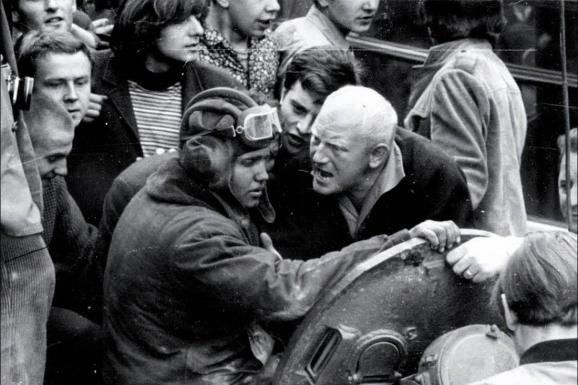
The Hungarian Revolution of 1956 was a people’s uprising in Hungary that was suppressed by Soviet troops in November 1956. More than 2,500 Hungarian citizens were killed and 13,000 wounded.
The anti-Western rhetoric intensifies in the last chapters of the textbook, which focus on the history of the Russian Federation after the collapse of the Soviet Union. Western countries are accused of not wanting to build equal and fair relations with Russia and of supporting Chechen terrorists and Georgian President Mikheil Saakashvili, who is allegedly responsible for the shelling of South Ossetia and Russian peacekeepers.
In this way, Russia is trying to shift the responsibility for the alliance with Nazi Germany and the occupation of the Baltic States, Finland, and Poland, the suppression of democratic revolutions in Central and Eastern Europe, and the invasion of Afghanistan and Georgia onto Western powers. The real reason for this aggressive policy of the USSR and the independent Russian Federation was imperialist ambitions and a desire to expand its sphere of influence by conquering new territories.
The Ukrainian Question: Denial of the Right to a State of One’s Own and Accusations of Neo-Nazism
The textbooks by Vladimir Medinsky and Anatoly Torkunov are undoubtedly anti-Ukrainian in nature. The territory of Ukraine is viewed as an integral part of Russia, and the right of the Ukrainian people not only to their own state but also to their own history and existence is denied:
“In the nineteenth century, in Austrian Galicia (centered on the city of Lemberg-Lviv), at the suggestion and with funding from the intelligence of the Austrian General Staff, technologies were first tested to create a “Ukrainophile movement” and, as an idea, a kind of “anti-Moscow Rus”. The main goal was simple: to keep the Slavs in Austria, who were historically and culturally drawn to Russia. To prove to the Slavs living in the Austrian Empire (on the territory of modern western Ukraine) that they were not Russians, but a separate people.”
The Ukrainian Institute of National Memory [the state body responsible for implementing policy in the field of restoring and preserving national memory] has thoroughly debunked the myth that the Austrian General Staff invented the Ukrainian movement and Ukrainians themselves. The existence of this myth reflects Russia’s chauvinistic vision of Ukrainians and their place in history. Until the beginning of the nineteenth century, the Russian Empire did not pay attention to anyone’s nationality at all: the dominant principle for Russia at that time was to identify people mainly by their religion, which is why Ukrainians and some Belarusians were automatically classified as “Orthodox” and considered “their own” and “safe” unlike Catholics-Polish or Jews. The main reason for the existence of the myth of Ukraine and the “Austrian General Staff” is Russia’s attempt to justify its imperial ambitions and territorial claims to Crimea and the rest of Ukraine.
The struggle of Ukrainians for independence during the 1917-1921 revolution is called separatism, and national leaders are called nationalists. One of the leaders of the Ukrainian national government, Symon Petliura, is accused of anti-Semitism and organising Jewish pogroms, which is not true.
The image of modern Ukraine on the pages of the textbook fully corresponds to the propaganda in the recent Russian news about Ukraine: Ukraine is unjustifiably called a neo-Nazi state. Among the arguments of “Ukrainian neo-Nazism” are fictitious figures that 80% of the population of Ukraine considered Russian their native language until 2014 and that since 2014, films and books in Russian have allegedly been banned. However, after the full-scale invasion began in 2022, the head of the Department of General Secondary and Preschool Education of the Ministry of Education and Science of Ukraine, Yuriy Kononenko, reported that about 450,000 schoolchildren in Ukraine study Russian.
In Ukraine, according to Wikipedia, there were four Nazi organisations in the 1990s and early 2000s, but none of them are active today. In Russia, however, 31 Nazi organisations were recorded, some of which are still active today. The Ukrainian Review published an article about Russian Nazi organisations that have been fighting against Ukraine since 2014.
“The Glorification of War”
The central place in the textbooks is dedicated to the Second World War, which is called the Great Patriotic War and begins in 1941 (the period 1939-1941 is not considered a war). This is a manipulation, as the authors are trying to justify and divide the period of 1939-1941 when the USSR was an ally of Germany and occupied parts of Poland, Romania, Lithuania, Latvia, and Estonia.
We talked about the coverage of the events of World War II in Russian textbooks with a PhD in History, an expert at the Ukrainian Center for Security and Cooperation, a researcher at the National Museum of History of Ukraine, and the author of the book The Last UPA Commander. The Life and Struggle of Vasyl Kuk” Alina Ponypaliak.
“They don’t treat the Second World War as a phenomenon that is directly tragic in history, but rather with glorification. If we analyse how the Second World War is portrayed in the textbook, it is definitely about the greatness of victory and dancing on bones. There is also a great deal of emphasis on Ukraine, which was occupied during the Second World War by two occupation regimes, the Nazis and the Soviets. The emphasis is placed on the fact that there were allegedly some collaborationist forces inside Ukraine that were supported by the Nazis, i.e. the Ukrainian Insurgent Army. But a lot of archival sources confirm that the Ukrainian Insurgent Army fought against both the Nazis and the Soviet regime.”
As Alina Ponypaliak notes, textbooks hush up issues unfavourable to the Russian authorities related to the war and postwar reconstruction, such as the adaptation and tragic fate of war veterans, filtration camps for those who were under occupation, ostarbeiters convicted after returning home, the acute problem of orphans in the postwar period, the use of free labour of the repressed to restore the economy, and so on. The number of military and civilian casualties is also not mentioned.
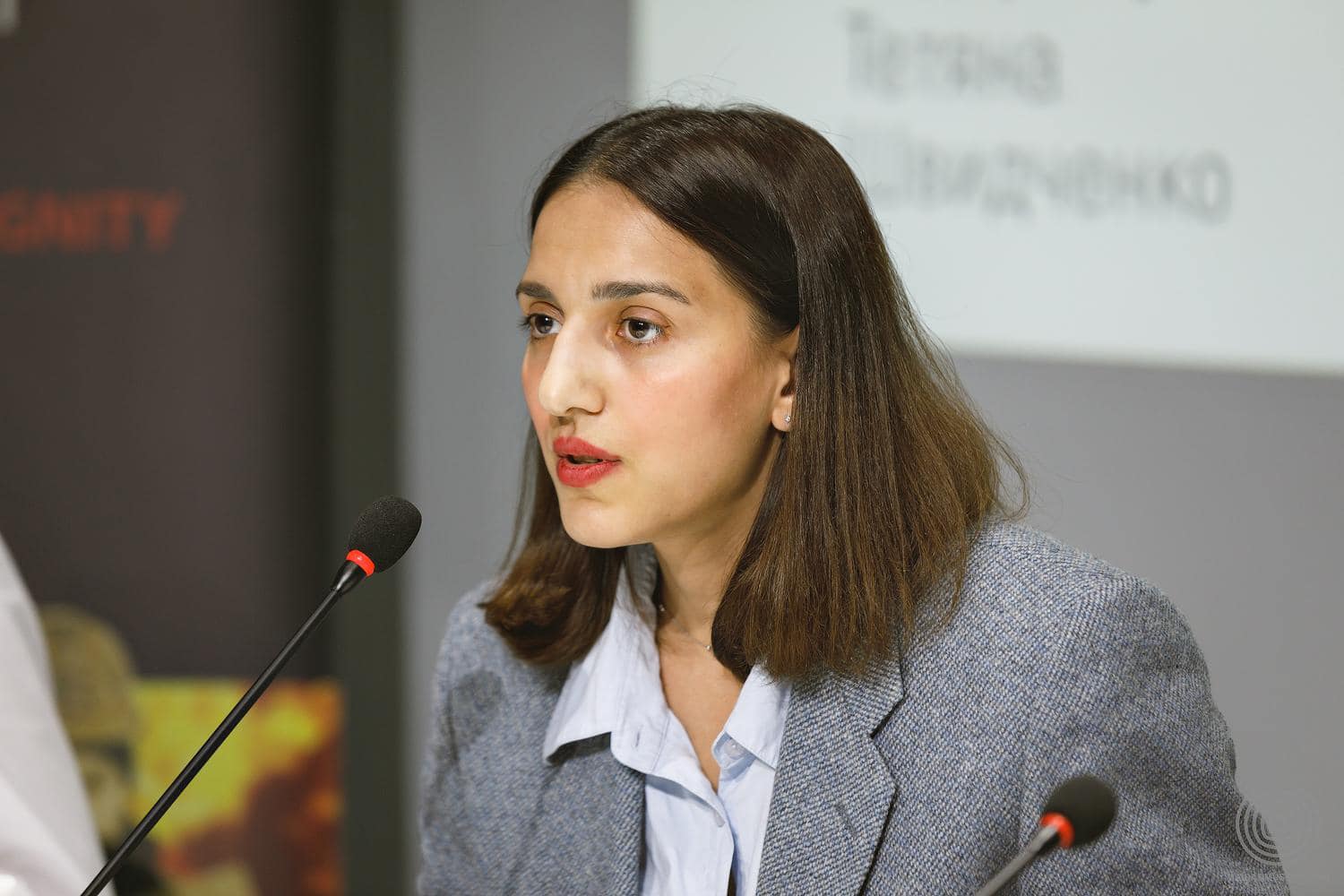
Alina Ponypaliak believes that these textbooks are strategically crucial for the education of the new generation of Russia, which is based on the example of the USSR as a victorious state, a state whose successor is today’s Russia.
The Russian-Ukrainian war history appears in the last chapters of the 11th-grade textbook, which are the most cruel and manipulative.
Among the textbook’s justifications for Russia’s full-scale attack on Ukraine are the biolabs allegedly set up by the United States in Ukraine, Ukraine’s desire to restore nuclear weapons, and the danger to Russia from Ukraine’s accession to NATO.
“If Ukraine, after joining NATO, provoked a military conflict in Crimea or Donbas, then, based on the NATO Charter, Russia would be at war with all members of the North Atlantic bloc at once: from the United States and England to Germany and France. It would be, perhaps, the end of civilization. This could not be allowed.”
Most of the textbook’s quotes are from Russian President Vladimir Putin, starting with the topics of World War I and ending with the last chapters on the Russian-Ukrainian war today.
The quote includes Vladimir Putin’s address on February 24, 2022:
“This is ultimately a matter of life and death, a matter of our historical future as a people…We did not start any hostilities, we are trying to end them. These hostilities were started by nationalists in Ukraine in 2014 when a coup d’état was carried out. That’s where it all started. This was followed by the events in Crimea and Donbas.”
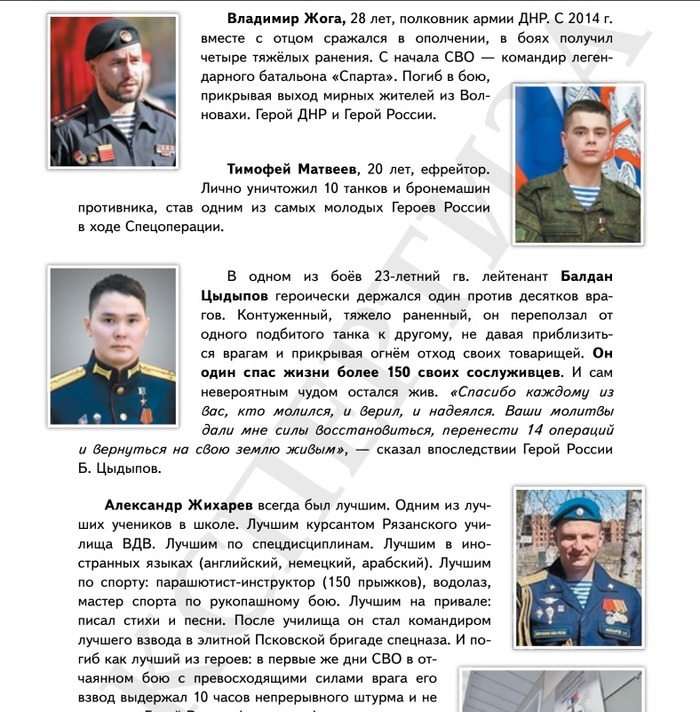
Ukrainian armed forces defending their own country are called neo-Nazis and nationalists, accused of war crimes and abuses against civilians without any reference to sources. Instead, the Russian military is portrayed as real heroes who stand up to defend their homeland, do not fire on civilians, and follow the rules of war and honour.
How true is this? Civilians in Bucha, Irpin, and Mariupol, who were under Russian occupation in 2022, were subjected to repression, abuse, and murder. Since February 24, 2022, Kherson, Kharkiv, Odesa, Kyiv, and other cities have been suffering from shelling; civilian infrastructure, schools, hospitals, churches, and energy facilities have been destroyed, and civilians have been killed and injured.
Conclusions
- The textbook is based on anti-Western narratives. Western European countries and the United States are demonised as wanting to destroy Russia and using nations that were once part of Russia itself. Any aggression by Russia (Afghanistan, Georgia, Ukraine) is justified by the need to defend itself against aggressive actions by the West.
- The theme of World War II, as well as the Ukrainian-Russian war, is one of the critical topics. The coverage of these topics is very similar. In both, we see heroes of the war. Russians are shown as noble, brave, kind, and fair. They don’t seem to shoot at civilians, and they save Germans in Berlin in 1945, they don’t rape and don’t rob civilians. Acute historical issues and uncomfortable topics, such as repressions, famines, military failures, etc., are avoided or presented without any assessment.
- The textbook creates an extremely negative, distorted image of Ukrainians as part of the Russian people but at the same time as collaborators, separatists, and ultranationalists. The right of the Ukrainian people to their independent state is denied.
Yevhen Dzhumyha