

The role of women in the Ukrainian economy continues to grow. Last year, women founded 56% of businesses in Ukraine, and this year – 59%. At the same time, the share of women winners of the Vlasna Sprava grant program in 2024 increased from 57% to 61%. These figures were cited by Yulia Svyrydenko, First Vice Prime Minister of Ukraine and Minister of Economy of Ukraine, in her speech at the Eighth Ukrainian Women’s Congress.
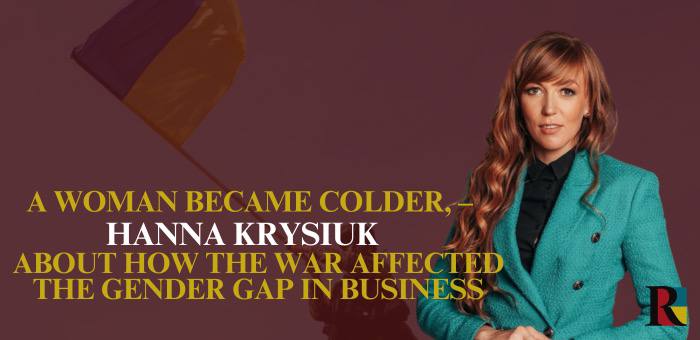
We spoke to Hanna Krysiuk, President of the Business Woman Club, founder of the international glossy Business Woman, advisor to the Ombudsman for Human Rights, and ambassador of the International Women’s Entrepreneurship Embassy. She spoke about the role of women in modern business.

Tetiana Stelmakh (T.S.): Do you think certain stereotypes about women in business still exist today? How has the war affected the image of women in business?
The role of women has changed nowadays. Many women have begun to master “male” professions. Given innovations, many things can be learned faster than before.
Women have become cooler. There are no stereotypes. On the contrary, about 30 programs for women have been opened. This concerns new areas of activity that can work as critical infrastructure. This is invested by the state, the Ministry of Economy, employment centers, and international donors. The latter include the US government, European foundations, the Swedes, and the embassies of many European countries.
Hanna Krysiuk (H.K.): What can Ukrainian business borrow from its Western partners? What processes are currently not well established in Ukraine?
Firstly, a simplified taxation system. I don’t know if even our Western partners have this, because in Europe the situation is even more difficult in terms of reporting than in Ukraine. However, it is possible in countries that have free economic zones with other countries, such as Portugal, the Baltic States, and where there are ports. Many people are interested in and bet on Romania. We study a lot as part of the Business Women Club program, because we have members from 22 countries and hold teleconferences every three months to discuss how Ukrainians, especially women abroad, can start a business, and what the conditions are for paying taxes and introducing accounting.
We have very interesting offers from Spain, Estonia, Latvia and Lithuania. Of course, Asian countries also make a lot of offers, but the issue of logistics and everything else is not so simple. Therefore, the most important thing now, in terms of exports, is to work with Europe. It is more open and understandable.
T.S.: Sometimes in the media I see the opinion that there is no normal dialog between business and the state in Ukraine. In your opinion, is this true?
H.K.: I don’t think big business does, because now everyone is united. Small and medium-sized businesses have these things, and we face them repeatedly. As soon as a new law comes out that deals with paying taxes, excise duty, customs clearance, exports, conflicts start. For example, a very pressing issue for all businesses that pay value-added tax is the blocking of tax invoices, which happens automatically. This is a nightmare for business, changes in tax legislation that are not explained to everyone.
There is no tax inspector who would contact each business owner and explain, teach, and then check. In fact, entrepreneurs are now being visited with fines and no warnings. This is really difficult. For example, I think there should be a dialog. When we held the workshops, we had a very close dialog with the tax authorities at the regional level, and it turns out that there is one law, but different approaches to it. We believe that everywhere we need to find a compromise and join forces to support the Armed Forces, legalize business and pay taxes.
T.S.: Should we expect that after the war, foreigners will start investing in Ukrainian business on a massive scale? If so, which areas will be prioritized?
H.K.: In fact, the biggest collapse is that we now have an investor who is ready to invest in central and western Ukraine, but there are no relevant offers from businesses that are ready to take them. Currently, when we receive humanitarian aid, equipment, etc., we do not pay income tax because there is a separate government decree. But starting next year, all EU humanitarian aid will be subject to income tax.
The same will apply to investments. Right now, investors cannot withdraw dividends, and even if they earn money, there are limits on card and other accounts. We cannot pay foreign currency abroad and other things related to the banking system. This holds investors back. But on the other hand, this may be the fastest investment return on investment, given the high demand, the need for certain areas and spheres that Ukrainians cannot realize themselves.
T.S.: In your opinion, which business areas will be the most relevant in Ukraine after the war is over?
H.K.:
- The first is definitely rehabilitation, mental health and everything related to it.
- The second is food and medicine, especially water and eco-food, because in addition to the war, there is also global warming.
- The third is innovation, artificial intelligence and all business optimization.
- The fourth is mechanical engineering and everything related to logistics, but with innovative approaches.
- The fifth is education, innovation, and the search for new solutions.
Tetiana Stelmakh