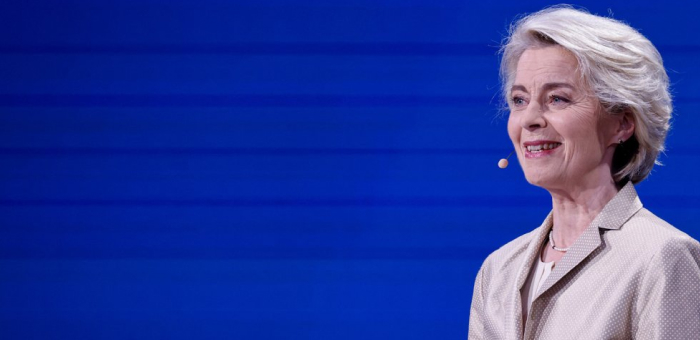


The President of the European Commission Ursula von der Leyen has presented the final list of candidates for the positions of European Commissioners, Babel reports.
She announced this on the social network X.
Former Estonian Prime Minister Kaja Kallas is running for the position of the EU’s chief diplomat. During her premiership, Estonia strongly supported Ukraine in the fight against Russia’s full-scale aggression and maintained a firm anti-Kremlin position. In particular, since 2022, Estonia has provided military assistance to Kyiv worth more than €500 million, or about 1.4% of its GDP.
Slovenian representative Marta Kos may become the EU Commissioner for Enlargement and additionally be responsible for Ukraine’s recovery, Euronews notes. Previously, Hungarian representative Oliver Varghese was responsible for enlargement, but due to the country’s position on Ukraine, it was decided to give him another position in the EC – now he is running for the post of Commissioner for Animal Health and Welfare.
Among other candidates:
- Austria – Magnus Brunner – Commissioner for Home Affairs and Migration;
- Belgium – Hadja Lahbib – Commissioner for Crisis Preparedness and Management;
- Bulgaria – Ekaterina Zaharieva – Commissioner for Startups, Research and Innovation;
- Croatia – Dubravka Šuica – Commissioner for the Mediterranean;
- Cyprus – Costas Kadis – Commissioner for Fisheries and Oceans;
- Czech Republic – Jozef Síkela – Commissioner for International Partnerships;
- Denmark – Dan Jørgensen – Commissioner for Energy and Housing and Communal Services;
- Finland – Henna Virkkunen – Executive Vice President for Technological Sovereignty, Security and Democracy, Commissioner for Digital and Border Technologies;
- France – Stéphane Séjourné – Executive Vice President for Prosperity and Industrial Strategy, Commissioner for Industry, SMEs and the Single Market;
- Greece – Apostolos Tzitzikostas – Commissioner for Sustainable Transport and Tourism;
- Ireland – Michael McGrath – Commissioner for Democracy, Justice and the Rule of Law;
- Italy – Raffaele Fitto – Executive Vice President for Cohesion and Reform, Commissioner for Cohesion Policy, Regional Development and Cities;
- Latvia – Valdis Dombrovskis – Commissioner for Economy and Productivity, Implementation and Simplification;
- Lithuania – Andrius Kubilius – Commissioner for Defense and Space;
- Luxembourg – Christophe Hansen – Commissioner for Agriculture and Food;
- Malta – Glenn Micallef – Commissioner for Intergenerational Equity, Culture, Youth and Sport;
- Netherlands – Wopke Hoekstra – Commissioner for Climate, Clean Growth and Zero Pollution, also responsible for taxation;
- Poland – Piotr Serafin – Commissioner for Budget, Anti-Fraud and Public Administration;
- Portugal – Maria Luís Albuquerque – Commissioner for Financial Services and the Savings and Investment Union;
- Romania – Roxana Mînzatu – Executive Vice President for People, Skills and Readiness, Commissioner for Skills, Education, Quality Jobs and Social Rights;
- Slovakia – Maroš Šefčovič – Commissioner for Trade and Economic Security, Interinstitutional Relations and Transparency;
- Spain – Teresa Ribera – Executive Vice President for a Clean, Fair and Competitive Transition, Commissioner for Competition;
- Sweden – Jessika Roswall – Commissioner for the Environment, Water Sustainability and a Competitive Circular Economy.
Out of 27 European Commissioners, 11 positions can be held by women. At the same time, women predominate among executive vice presidents – four to two. For a long time, von der Leyen has been pressuring EU countries to nominate women as candidates for European Commissioners, as she has been seeking parity in the representation of women and men in the EC. However, the gender ratio has not changed compared to the previous composition of the EC.
Now, von der Leyen will send so-called task letters to each candidate, in which she will outline her own vision of their mandate. After that, all candidates must undergo a legal check, interrogation in parliamentary committees and a vote for approval before they are finally appointed to their new positions.
As Euronews notes, candidates can be quickly rejected if they fail to gain the support of the European Parliament, which is more politically divided than during previous mandates. Then EU governments will be forced to propose an alternative candidate.