

Vienna, Austria
It is convenient to think of the Ukrainian army’s so far successful incursion into Russia that the warmonger in the Kremlin, Vladimir Putin, will respond with massive bombardments, and that the Ukrainian troops risk falling into a trap, laid by a deliberately retreating Russian army, in its own way a repeat of Nazi Germany’s unlucky offensive in the same area in summer 1943. It could go that way, but not necessarily. Initial analyses suggest that the Ukrainians after two and a half years of murderous war are in a position to act, not only to react.
The Ukrainian offensive, whatever its final result, can cost Putin dearly. Gone is the understanding between the ruler and the ruled – that he can make his war in Ukraine, as long as they can make their lives at home. Suddenly the war with its destruction, its refugees and its fear has arrived in the Russian living room.
Kursk is an emotional subject in both Ukraine and Russia. The Battle of the Kursk just over 80 years ago is remembered as one of the bloodiest in history – and it was won by the Soviet Union with 800,000 killed against 200,000 killed on the German side. From then on, the initiative in Eastern Europe lay with Joseph Stalin, Putin’s predecessor and mentor in Moscow, until the fall of Berlin in May 1945.
The picture in the West of a stagnant and unwinnable war from Northeastern Europe to the Black Sea that emerged in the early summer suddenly needs correction. The fact that Ukrainian soldiers have captured a significant chunk of Russian territory – about 1,000 square kilometers – and threaten the regional capital of Kursk with 400,000 inhabitants, suggests that the allies of Ukraine should increase and speed up the delivery of their assistance. The more, the faster, and the more effective Western aid is deployed on the frontline, the sooner we will have a ceasefire and serious negotiations, not just the well-known and totally unacceptable Kremlin dictate that Ukraine must abandon 20-30 percent of its territory, about five million of its citizens, and all or half of its national sovereignty.
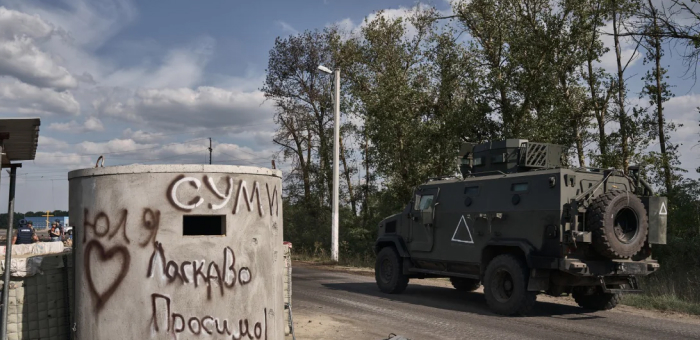
For now, Ukrainians are holding on to what they have won and sending a message to the Russians and the Russian leadership, who attacked Ukraine in 2014 and again in 2022, that the war can and will be fought on Russian territory. It is not surprising that Ukrainians took the Kremlin thugs by surprise. Russia is a curious monster, a nuclear power, but not a superpower, hardly even a great power. Russian military strength is not and never was, what the Kremlin propaganda and the ever-obedient Putinists in the West claimed it to be.
That the Russians did not notice the month-long Ukrainian troop build-up east of Sumy looks like one more security breach after the Wagner Army uprising in the summer of 2023 and last spring’s massacre of 145 people in Krasnogorsk outside Moscow. The state-controlled Russian media dutifully report victories and progress. Private electronic media see the Kursk situation as a continuation – humiliating and critical – of the Russian inability to conquer Kyiv in February 2022. Putin’s new defense minister, Beloussov, is off to a poor start. Chief of General Staff Gerasimov must once again be in the danger zone. For Putin, this is a serious loss of face just weeks before he is expected to open the annual Vladivostok Economic Forum, where the Kremlin will pretend to show dozens of Asian and other countries that in Russia everything is under control. It is not of course, and that is demonstrated beautifully by the arrival of the Ukranians at the other end of Russia.
The Russian war in Ukraine and thus in Europe is pretty much where the Second World War was, when the Kursk battle began according to Hitler’s Executive Order No. 6 of April 15, 1943. With one important difference. The Russians knew then what was coming. They even knew the date of the opening of Operation Zitadelle. Stalin’s intelligence worked, his armies worked, his state worked. Three months after Putin’s re-election as president with 88% of the votes cast his regime has once again been revealed as incompetent.
The scales of the war are slowly, too slowly, shifting in favor of Ukraine. It is time for the West to step up and accelerate military and other assistance to Ukraine and to give the Ukrainians the freedom of action in their fight against the aggressor state of Russia, which could improve the situation at the central and southern sectors of the front. It makes no sense that Ukrainians can use Western missiles and fighter jets, including Danish F-16s, to attack positions on Russian-occupied territory, from which Ukrainian cities are terrorized, but not to attack positions on Russian territory from which such terror emanates. The time has come to allow the Ukrainians to attack, where and how they see fit. Only then can the war be brought to its end within a foreseeable future.
Within a few days Kamala Harris and Tim Walz will be nominated for the White House at the Democratic National Convention in Chicago. If the polls are correct, the pair will win the November election at the expense of the clown and NATO-skeptic Donald Trump. Heads of state and citizens on both sides of the Atlantic can begin to breathe a sigh of relief and prepare for the most important security challenge of our time: to defeat Russian fascism so badly that Moscow for a very long time will be cut off from threatening Europe, including Ukraine, the Baltic republics and the Baltic Sea.
By Per Nyholm
*These opinions are solely those of the author. The Ukrainian Review takes no position and is not responsible for the author’s words.
Per Nyholm has been a Danish journalist since 1960. He is based in Austria and is a columnist and foreign correspondent at the Jyllands-Posten, a liberal Danish daily newspaper.
Tetiana Stelmakh adapted this text for The Ukrainian Review.