

Vienna
Allow me to be more personal than usual, but I approach the subject of this column — the US election campaign and next Tuesday’s TV debate between Kamala Harris and Donald Trump — with an enthusiasm for Harris that may seem both journalistically inappropriate and politically premature. The election is far from decided. Trump could still return to the White House, in my view, a disaster for the US, for Europe, very much including Ukraine, and for our democracies.
Just consider this one of several bad possibilities: Harris wins the popular vote so narrowly that she squeaks through to a majority of five or ten in the all-important Electoral College. In such a case, the Trumpists threaten civil war, meaning — the perfect disaster. If Harris loses, the result is unlikely to be challenged. The Democrats usually operate based on the Constitution. This was the case in 2016 when Hillary Clinton beat Donald Trump by 66 million votes to 63 million, and then the Electoral College voted 306 to 232 to install Trump as president. It was the same in 2000 when Democrat Al Gore beat Republican George W. Bush by 51 million votes to 50 million, and Bush won the Electoral College by 271 votes to 266. When it comes to presidential elections, the US is an aristocracy. It listens to its people but does not necessarily follow them.
Harris has pumped energy and optimism — and a smile so dazzling and compelling — into the fight with Trump that I can’t recall its equal. I’ve followed the US since 1960, when the Democrat John F. Kennedy defeated Republican Richard Nixon by 34.2 million votes to 34.1 million, extremely close, but Kennedy won the right states, and the Electoral College washed Nixon down the board by 303 votes to 219.
The 2024 election is somewhat similar to 1960. Again, there is a disgust for the old times. One senses a wish for the new, and the new is Harris, her friendliness, her joie de vivre (joy of life — ed.) and optimism — everything that the sour, disgruntled, perpetually aggrieved and eternally self-absorbed Trump is not. She is like a fresh and sunny summer day against Trump’s apocalyptic darkness. Kennedy, with his faith in the future, brought America out of the trauma of World War II. Harris has an uplifting faith in the world that emerged after 1989.
Trump knows he’s in trouble and reacts with all the signs of nervousness and aggression. It is claimed that he is ignoring his staff, who are trying to tame him and bring him into the centre of American politics, away from his obvious lying and fables, his scenes of madness and personal attacks that entertain his tribal audience but repel a decent Republican middle class (especially its women), without whom he cannot win on November 5.
Next Tuesday, the two opponents, the humanly and politically attractive former attorney general and senator from California and the convicted gangster (sexual assault, forgery) from New York, will meet in a TV debate that could set the direction of the final weeks of the campaign. Harris is the sharp jurist, and Trump is the boor who has lost his favourite opponent. If Harris emerges as the winner, I trust she can make it to The White House.
It’s tempting to see a parallel to the 1964 campaign between the Democrat Lyndon B. Johnson, heir to John F. Kennedy, who had been assassinated in Dallas the year before, and Barry Goldwater, the Republican Party´s strongly conservative candidate, in today’s light a kind of precursor to Trump, but unlike Trump, a gentleman. Goldwater readily acknowledged Johnson’s landslide victory: 44 out of 50 states, 61 per cent of the votes. Goldwater did not dream of letting his mob — nor was one at his disposal — storm Capitol Hill. I was in the United States on that occasion and encountered a country where I felt at home, very different from the divided America that Donald Trump would create, and where I intend to be present in October — November, probably my last transatlantic trip, followed by several months in Latin America, so watch out.
The 2024 election seems more important to me than even the 1948 election. Then, the US had won the Second World War and could have retired in splendid isolation. Against all odds, it was won by the Democratic Vice President Harry Truman, who understood the threat posed by the Soviet Union. The result was a sharp foreign and security policy based on NATO. Would Thomas Dewey, the defeated Republican, have done something similar? Probably, but less sharply. The US of that time was led by internationalists. A criminal like Trump in the White House was unthinkable.
And that is precisely the crux of the 24th election: should the US, with all its faults and shortcomings, remain an example to others, a power that stands by its global responsibilities, a power that cooperates credibly with its allies in Europe and the rest of the world? Or should the US be subjected to a chaotic, autocratic and opportunistic Trumpist regime run by a rich man and his entourage, who have nothing in their heads but money and personal power?
If Trump loses Tuesday’s TV debate, he will be reduced to the ageing weirdo rumbling inside his empty barrel. With Harris and her vice presidential candidate, Tim Walz, one dares to hope for a democratic USA until 2033 — and maybe 2041. If the Americans elect Harris, the Europeans will have time to modernise their defence, to reject Putin’s war in Ukraine and with Washington to make the world a better place. As rightly stated by Mette Frederiksen, the Danish Prime Minister, at the recent GLOBSEC conference in Prague: “There is no alternative to a Ukrainian victory. If Russia wins, we all lose, not just in Europe, but globally”.
By Per Nyholm
*These opinions are solely those of the author. The Ukrainian Review takes no position and is not responsible for the author’s words.
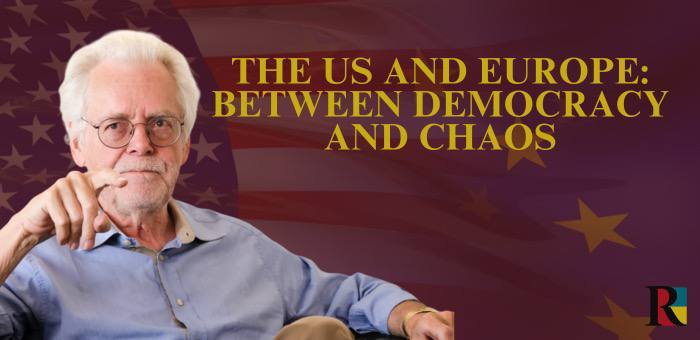
Per Nyholm has been a Danish journalist since 1960. He is based in Austria and is a columnist and foreign correspondent at the Jyllands-Posten, a liberal Danish daily newspaper.
Tetiana Stelmakh adapted this text for The Ukrainian Review.